
Marriage and Divorce: A Practical Guide to Saving Your Relationship

The single best next step to prevent or recover from divorce is to start an evidence-based, skill-first relationship program and pair it with an early checkpointed plan. Begin within 72 hours. Not next month, not “when things calm down.” Marriage and divorce outcomes hinge less on how bad a fight gets and more on whether couples build repair skills before contempt sets in.
Tonight, try this: the next time a conversation gets tense, one partner says, “Can I try that again? I didn’t say that the way I meant to.” That single sentence, a soft startup, interrupts the criticism-defensiveness cycle before it spirals.
- Say the soft-startup line above during your next disagreement, even a small one.
- Set a 15-minute check-in this week to talk about one issue, not everything at once.
- Look at a structured option like Couples Fight School® and its F.I.G.H.T. Plan® framework if you want a guided path rather than winging it.
Key Takeaways
Marriage and divorce outcomes improve most reliably when couples pair early, skill-focused relationship education with a checkpointed plan rather than waiting for a crisis to force action.
| Point | Details |
|---|---|
| Start within 72 hours | Use a soft-startup script tonight rather than waiting for a calmer week that may not come. |
| Expect moderate, real gains | Relationship education reports effect sizes around .30 to .36 for communication and quality, not a guaranteed fix. |
| Match help to severity | Occasional friction fits a self-guided course; contempt, stonewalling, or safety risks need therapy or immediate intervention. |
| Use the 6-week checkpoint | Reassess conflict frequency and emotional safety at week 3 and week 6 before deciding to continue, upgrade, or pause. |
| Consider Couples Fight School | The F.I.G.H.T. Plan® offers courses and coaching built around the same script-first, checkpointed approach described here. |
Table of Contents
- Marriage And Divorce Prevention Tools You Can Use Today
- What Does the Research Say About Marriage Counseling?
- Should You Try a Course or Go to Therapy?
- Your First 6 Weeks: A Step-By-Step Plan to Rebuild Your Marriage
- Why We Built the F.I.G.H.T. Plan®
- How to Talk to Your Kids During a Marriage Crisis
- Where to Find Support Beyond the Therapist’s Office
- Cultural and Legal Factors That Shape Marriage and Divorce
- What Actually Moves the Needle in a Struggling Marriage
- Start Building Better Habits With Couples Fight School
- Sources
Marriage And Divorce Prevention Tools You Can Use Today
Most couples don’t need a theory of relationships. They need scripts they can say out loud when their heart rate spikes and their brain goes blank. Here’s what actually holds up in the moment.
1. The soft startup script. Instead of “You never listen to me,” try: “I feel unheard when I’m talking and you check your phone. Can we try that conversation again?” It names the feeling, names the behavior, and asks for a redo instead of assigning blame.
2. The repair script. When a conversation has already gone sideways: “I got defensive there. That wasn’t fair to you. Can we pause and come back to this in twenty minutes?” Naming your own misstep, out loud, does more to de-escalate than any argument about who’s right.
3. The three-step regulation routine. Pause before responding. Label the feeling silently (“I’m at a 7 out of 10 right now”). Breathe for four counts in, four counts out, or take a 20-minute timeout if the pause isn’t enough. This isn’t stalling. It’s giving your nervous system time to stop treating your partner like a threat.
- Pause: count to ten before you respond to a sharp comment.
- Label: name the emotion in one word (“frustrated,” not “you’re impossible”).
- Breathe or step away: a short walk resets the body faster than pushing through.
Beyond the moment of conflict, two daily habits matter more than any single script. A five-minute check-in each evening, just “how was your day, what’s on your mind,” keeps small resentments from calcifying. And noticing “bids,” those small requests for attention or connection your partner makes throughout the day, matters as much as answering big questions. A partner mentioning a work stress isn’t asking you to fix it. They’re asking you to look up.
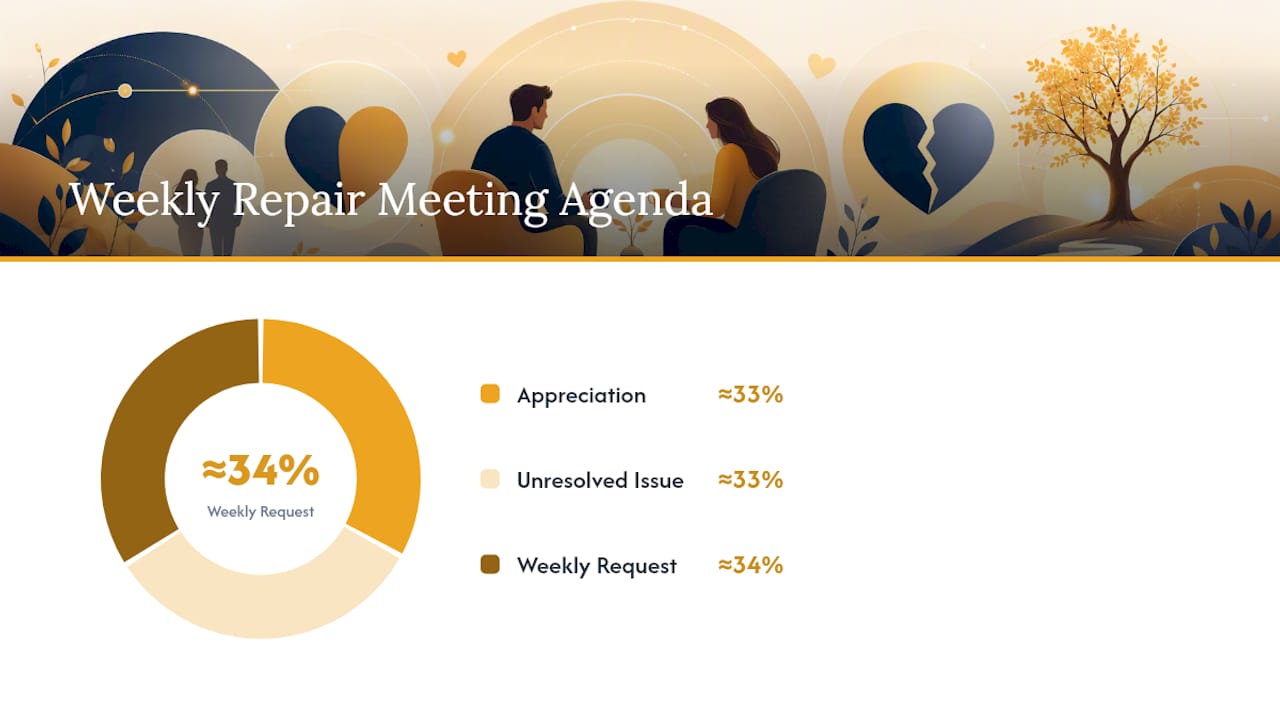
Pro Tip: Set a recurring 20-minute “repair meeting” once a week. Agenda: one appreciation, one unresolved issue, one request for the coming week. Keep it to three items. Couples who let it sprawl into a general complaint session tend to skip the next one.
For more structured scripts and conflict de-escalation steps, Couples Fight School’s guide to diffusing conflict walks through the full sequence.
What Does the Research Say About Marriage Counseling?
Relationship education works, but not the way most marketing implies. Meta-analytic reviews of relationship education programs report effect sizes in the small-to-moderate range, roughly .30 to .36, for improvements in communication and relationship quality. That’s a real, measurable gain. It’s not a guarantee your marriage survives the next decade.
What the numbers actually mean: Most relationship education programs run 8 to 20 sessions or a short structured course, and produce noticeable communication gains within weeks. Whether those gains translate into a lower divorce rate over 10 or 20 years is where the evidence gets thinner.
Some large randomized trials tell a more hopeful story for specific groups. PREP program variants, tested with military couples among others, showed measurably lower divorce rates in intervention groups up to two years out. Premarital education broadly shows gains that hold for six months to three years in controlled comparisons, though long-term divorce-prevention data stays limited.
The clearest pattern across the research: timing beats intensity. Couples who start early, before contempt and stonewalling become the default response, get more out of any given hour of work than couples who wait. Online and brief programs remove real barriers like childcare and scheduling, and they still move the needle. You don’t need a weekend retreat to start seeing change. You need to start.
Should You Try a Course or Go to Therapy?
Not every struggling marriage needs a therapist’s office. Some need a structured course. Some need both, immediately. Here’s how to sort it.
- Ask if the conflict is occasional or entrenched. Occasional friction over chores or schedules responds well to a self-guided course. Recurring contempt, eye-rolling, or one partner going silent for days points toward professional help.
- Check mutual willingness. If both partners want to improve things, a course or coaching often works. If one partner is checked out or actively considering divorce, discernment counseling gives you a structured way to decide together whether to rebuild or separate with clarity.
- Weigh the timeline you can commit to. Standard couples therapy runs roughly 8 to 20 sessions depending on severity. Weekend intensives compress that work into two or three days for couples who can’t do weekly sessions but can clear a weekend.
Red flags that override every other consideration:
- Any threat of physical violence or a pattern of coercive control. Safety planning comes first, not couples work.
- Active affair or ongoing deception that hasn’t been disclosed and stopped.
- One partner refusing any engagement at all, which usually means individual work or discernment counseling before joint sessions make sense.
If you’re engaged and still building your foundation, conflict skills before the wedding matter more than most premarital checklists acknowledge.
Your First 6 Weeks: A Step-By-Step Plan to Rebuild Your Marriage
Pick a lane and commit to it for six weeks. Reassess. Adjust. That’s the whole model.
- Week 1: Set the foundation. Do the soft-startup exercise at least once. Write a one-paragraph commitment (“we agree to try this for six weeks before deciding it doesn’t work”). Schedule your first weekly check-in and, if you’re going the course or coaching route, enroll now rather than “this weekend.”
- Weeks 2 through 5: Build the skill stack. Each week, target one skill: soft startups, the three-step regulation routine, the daily five-minute check-in, then the full 20-minute repair meeting. Assign light homework, like noticing one bid for connection you missed that day.
- Week 3 checkpoint. Ask honestly: is conflict frequency down? Does each partner feel safer raising a hard topic? If homework is being skipped consistently, that’s information, not failure. It usually means the format is wrong, not the couple.
- Week 6 checkpoint. Decide: continue self-guided, upgrade to therapy or coaching, or bring in a discernment counselor if one partner is still ambivalent about staying.
For couples starting therapy instead, a parallel 8-session mini-plan works similarly: reassess at session 4, checking whether specific incidents are decreasing, and again at session 8, when many clinicians expect visible shifts even if deeper work continues.
| Week | Focus | Checkpoint Question |
|---|---|---|
| 1 | Commitment and first exercise | Did we both actually try it? |
| 2 to 3 | Soft startups and regulation | Is conflict de-escalating faster? |
| 4 to 5 | Daily check-ins and repair meetings | Do we feel safer bringing up hard topics? |
| 6 | Full reassessment | Continue, upgrade to therapy, or seek discernment counseling? |
Why We Built the F.I.G.H.T. Plan®
Carlos Todd, licensed mental health professional and co-founder of Couples Fight School, built the F.I.G.H.T. Plan® around one observation from clinical work: couples don’t fail because they lack love. They fail because nobody taught them what to do in the ninety seconds after a comment lands wrong.
Most couples don’t need more insight into why they fight. They need a script for the next fight, and a plan for the one after that.
The framework runs through courses, coaching, and workshops, built for dating, engaged, and married couples, including blended families and Christian couples wanting faith-integrated material. Typical participation looks like a short course plus weekly practice, or ongoing one-on-one coaching for couples wanting more direct guidance.
How to Talk to Your Kids During a Marriage Crisis
Children absorb tension long before parents think they notice. If your marriage is actively in a rough patch, whether you’re working to save it or already separating, how you involve kids shapes their sense of safety more than the conflict itself.

Keep three principles in mind. First, age-appropriate honesty beats silence. A six-year-old needs “Mom and Dad are having a hard time and working on it,” not details. A teenager can handle more context but still doesn’t need to be your confidant or your mediator.
Second, never make a child choose sides or deliver messages between parents. That’s one of the most damaging patterns in high-conflict households, and kids carry it for years. If you notice yourself venting about your partner to your child, stop and find another outlet.
Third, keep routines stable even when the relationship isn’t. Bedtime, meals, and school schedules give kids a sense of control when the adults around them feel unpredictable. If you’re in active recovery from a betrayal or a separation scare, tell kids what’s staying the same before you tell them what’s changing.
If custody or separation is on the table, a family therapist experienced in child-inclusive practice can help you script these conversations. That’s a different skill set than marriage repair, and it’s worth the separate appointment.
Where to Find Support Beyond the Therapist’s Office
Therapy and structured courses aren’t the only paths forward, and they don’t have to be the first one. Peer support groups, often run through community centers or religious organizations, give couples a place to hear that they’re not the only ones struggling. That alone reduces the shame that keeps a lot of couples silent until a crisis hits.
Books and workbooks fill the gap between “we need help” and “we’re ready to book an appointment.” A couples therapy workbook with structured exercises works well for couples who want privacy while they figure out whether they’re ready for a course or coaching.
For couples wanting a faith-based support structure, congregational counseling programs and organizations like Prism Counseling & Coaching integrate religious values directly into the work rather than treating faith as a side note. That distinction matters for couples whose marriage vision is inseparable from their religious framework.
Online communities carry real value too, but treat them the way you’d treat a message board for medical advice: useful for feeling less alone, risky as a substitute for a tailored plan. A stranger’s story about their marriage isn’t a diagnosis of yours.
Cultural and Legal Factors That Shape Marriage and Divorce
Marriage and divorce don’t happen in a vacuum. Cultural background shapes what couples fight about and what they’re willing to say out loud. In some families, raising a complaint about a spouse to an outsider, even a therapist, carries stigma that keeps couples silent until the relationship is already in crisis. Naming that dynamic openly, rather than pretending every couple approaches help-seeking the same way, makes counseling more useful when couples do seek it.
Legal considerations matter too, though they belong to a different professional than a relationship coach or therapist. Divorce settlement terms, including asset division, custody arrangements, and support obligations, vary by state and depend heavily on individual circumstances. A relationship educator or coach can help you fight less and communicate better. They cannot and should not advise you on divorce mediation strategy or settlement law. If your marriage has reached the point where divorce is being seriously discussed, pairing relationship work like discernment counseling with a consultation from a family law attorney gives you both emotional clarity and legal footing, rather than making a life-altering decision on incomplete information.
What Actually Moves the Needle in a Struggling Marriage
Most advice about saving a marriage treats communication as the whole problem. It isn’t. The research on relationship education consistently shows the same pattern: skills improve, satisfaction improves, but the effect sizes are modest, not miraculous. Couples who expect a course or a few sessions to erase years of resentment are set up to feel disappointed even when the program worked exactly as designed.
Here’s what conventional advice underplays: timing outperforms technique. A mediocre script delivered in week one of trouble beats a perfect script delivered after two years of stonewalling. Waiting for “the right moment” to address a marital issue is usually just avoidance wearing a patient costume.
If you take one thing from this article, take this: don’t wait for a crisis to justify getting help. Start with the smallest version of the plan, a soft-startup line tonight, a check-in this week, and let the six-week checkpoint tell you whether to go further. Waiting for certainty before acting is how small marital issues become divorce settlement conversations.
— Carlos
Start Building Better Habits With Couples Fight School
There’s a real gap between reading about communication scripts and actually using them under pressure, and that’s exactly where Couples Fight School® is built to help. Rather than a single counseling session or a generic self-help book, the F.I.G.H.T. Plan® gives you a structured sequence of skills, practiced through courses, coaching, and workshops, so the scripts in this article become second nature instead of something you have to remember mid-argument.
If you want direct, one-on-one guidance rather than a self-paced course, online coaching for couples pairs you with a real practitioner who can adjust the plan to your specific pattern of conflict. Sessions are structured but flexible, usually weekly, and built around the same six-week checkpoint model outlined above. If you’d rather start with a guided course you can move through at your own pace, the Stop the Fighting course covers the same communication and repair framework in a self-directed format.
Either way, the first step is the same one this article opened with: pick a lane, and start this week.
Sources
- Evaluation of Premarital Education (review)
- Best practices in relationship education (Family Relations review)
Recommended