
Is Your Relationship Mutually Abusive? Signs, Misconceptions & What to Do
|
Getting your Trinity Audio player ready...
|

If you find yourself in a relationship where both of you are hurting each other in cycles that feel impossible to escape, you may be asking a painful but crucial question:
“Is my relationship mutually abusive?”
The concept of mutual abuse in a relationship is one of the most complex and misunderstood dynamics in modern relationships, leaving countless individuals confused, blaming themselves, and trapped in a relentless cycle of escalating harm.
This feeling of shared toxicity creates a unique kind of prison: one where you might simultaneously feel like a victim and a perpetrator, unsure where the problem truly began or how to make it stop.
This comprehensive guide aims to provide the clarity you desperately need.
We will define what mutual abuse truly means, help you recognize its subtle and overt signs with a detailed checklist, and, most critically, teach you how to distinguish it from reactive defense.
Our goal is not just to label your experience but to provide a compassionate, actionable path toward safety, understanding, and ultimately, healing.
No matter how tangled the dynamic feels, there is a way to untangle it, and it starts with seeing it clearly.
What Is Mutual Abuse in a Relationship? Defining a Complex Dynamic
To deal with this challenging issue, we must first define it with precision.
Mutual abuse in a relationship occurs when both partners consistently and actively engage in patterns of harmful behavior intended to control, punish, degrade, or emotionally wound the other.
It is a sustained, two-directional power struggle where both partner’s abusive tactics ( such as verbal assaults, psychological manipulation, intimidation, coercive control, or physical violence) are used as instruments in a destructive dance.
This is a critical point: mutual abuse is not simply a “toxic” relationship marked by frequent, heated arguments. Many couples argue poorly.
Mutual abuse is characterized by a reciprocal intent to harm as a method of gaining power, expressing rage, or managing profound insecurity within the relationship.
Signs You Might Be in a Mutually Abusive Relationship: A Detailed Checklist
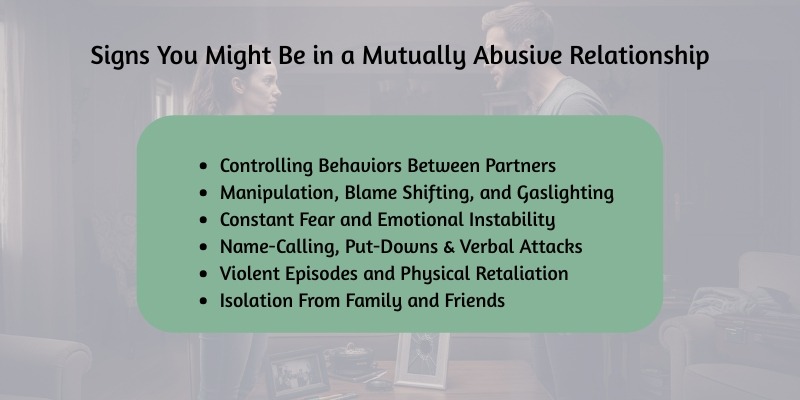
Recognizing mutual abuse requires moving beyond looking at isolated explosive incidents and instead examining the consistent, underlying patterns that define your daily interactions.
It’s about the dynamics of your relationship, the emotional atmosphere that feels normal to you.
Use the following detailed mutual abuse signs as a mirror, not a weapon. Be honest with yourself about which patterns feel persistently familiar.
Controlling Behaviors Between Partners
In a mutually abusive dynamic, controlling behaviors couples exhibit are often reciprocal, creating a locked system.
It may not be a simple case of one dominant controller and one submissive victim. Instead, you might find a volatile trade-off.
One partner may meticulously monitor the other’s phone calls and social media, while the other exerts control by withholding affection, using financial restrictions (“I pay the bills, so I decide”), or employing guilt and emotional blackmail to limit independence (“If you really loved me, you wouldn’t go out with your friends”).
The control is bilateral, creating a cage that both people, in some way, are building and reinforcing. You may both feel controlled and, in turn, seek to control the other as a misguided way to feel safe or powerful.
Manipulation, Blame Shifting, and Gaslighting
This is the psychological basis of the mutual abuse dynamic. The relationship becomes a battlefield where truth and perception are the primary casualties.
You might both engage in gaslighting in relationships, consciously or unconsciously making the other doubt their memory, judgment, and sanity.
Phrases like “You’re too sensitive,” “That never happened,” or “You’re crazy for thinking that” are fired from both sides. Blame shifting abuse becomes the default language of conflict. Accountability vanishes.
Every issue, from a missed appointment to a deep emotional wound, becomes a circular debate about who started it, whose fault it really is, and who is the “worse” person.
Conversations are an exhausting arena where you’re not solving problems but negotiating competing realities in a contest where someone must be declared the “loser.”
Constant Fear and Emotional Instability
The emotional climate is one of pervasive dread and unpredictability. You are both walking on eggshells partner to partner, perpetually braced for the next explosion, which could be triggered by a misplaced tone, a forgotten chore, or simply a bad day.
This environment breeds chronic fear, shame, anxiety, and abuse. You feel afraid of your partner’s anger, of your own reactions, of the next fight.
You feel deep shame; ashamed of the cruel things you’ve said, ashamed of the person you’ve become in this relationship, ashamed that you can’t just “be normal.”
And you feel constant anxiety, a low-grade hum in your nervous system that persists even during brief periods of calm, because you know the peace is temporary. The instability is mutual; both of your moods dictate the weather in your shared home.
Name-Calling, Put-Downs & Verbal Attacks
Respect has been systematically destroyed and replaced by a pattern of using words as targeted weapons.
Name calling put downs are not occasional slips but a regular feature of your conflicts. Insults about intelligence, appearance, character, or worth are hurled back and forth.
You both know exactly which words will cut the deepest, and you use them. The goal in the moment is not to communicate but to wound, to win the argument by destroying the other’s composure.
This mutual contempt is a poison that seeps into every interaction, making it difficult to recall or access any foundation of love or admiration.
Violent Episodes and Physical Retaliation
When conflict escalates beyond words, it can tragically become a two-way street of physical aggression. This defines mutual violence relationships. It might start with one partner shoving, and the other shoving back.
It could involve throwing objects at each other, blocking doorways, or reciprocal hitting.
Research provides a stark, critical picture of how common this escalation is: in a sample of couples reporting intimate partner violence (IPV) in the past year, about 69.5 percent reported that physical aggression was bilateral, with both partners engaging in violent acts.
This statistic is crucial because it dispels the myth that violence in relationships is always one-sided.
It highlights how a dynamic can turn into a horrifying, reciprocal pattern where both people are causing and experiencing physical harm, often in a frantic, reactive spiral that leaves both terrified and deeply traumatized.
Isolation From Family and Friends
The toxic cycle often naturally leads to isolation from friends and family. This isolation is not always the classic model of one partner forbidding contact. In mutual abuse, it can be a co-created process.
You may both feel too much shame, embarrassment, or exhaustion from the constant drama to maintain social appearances.
You might actively discourage each other from going out, framing it as “We don’t need anyone else,” or “They just don’t understand us.”
You may trash-talk each other’s support systems, creating an “us against the world” mentality that actually serves to keep the dysfunctional dynamic private, unchallenged, and therefore more powerful.
The outside world becomes a threat to the volatile equilibrium you’ve established.
Reactive Abuse Explained: The Critical Distinction From Mutual Abuse

This distinction is the most important concept in this entire guide. Misunderstanding it can keep a true victim trapped and provide an abuser with a powerful weapon.
Reactive abuse explained simply is this: it is a survivor’s defensive, often out-of-character, reaction to enduring prolonged, severe abuse.
It is not a pattern of instigation or mutual participation in a power struggle; it is a breaking point.
Imagine a person who has endured months or years of covert manipulation, verbal degradation, gaslighting, and control. They have tried to be calm, to reason, to “be better.” But the abuse continues.
Eventually, their nervous system reaches its absolute limit.
They snap: they might finally scream back with ferocity, throw something (not at the person, but in frustration), slam a door, or hurl back the cruel insult they’ve heard a thousand times. In that moment, the primary abuser seizes on this reaction.
They drop their aggressive stance and adopt a calm, wounded demeanor. They say, “Look at you. You’re insane. You’re abusive. See what you make me deal with? We’re both toxic.”
This is a masterful manipulation tactic to evade accountability and reframe the victim as the problem.
Key differences between mutual abuse and reactive abuse:
- Intent & Pattern: Reactive abuse is a defensive response to an existing pattern of harm, not a consistent pattern of initiating harm. The true abuser sets the tone of control and instigates the majority of conflicts; the reacting partner is trying to regain a sense of power, set a boundary, or simply make the unbearable abuse stop. In mutual abuse, both parties instigate.
- Power Imbalance: In mutual abuse, power struggles are more fluid and can shift. In reactive abuse, there is a clear, consistent primary aggressor who holds control over the relationship’s dynamics, even during calm periods. The reactive partner does not have equal power to control, intimidate, or manipulate the other’s life.
- Use of the Reaction: An abuser will often deliberately provoke a reaction to weaponize it. They will then use the partner’s one-time outburst as “proof” of mutual dysfunction to friends, family, or even the courts, further isolating and discrediting the true victim. This calculated use of the reaction is absent in truly mutual dynamics, where both are primarily focused on hurting the other, not on crafting a public narrative.
How Mutual Abuse Develops Over Time: The Escalating Cycle
Mutual abuse rarely erupts fully formed at the start of a relationship. It typically evolves insidiously through a corrosive, self-reinforcing emotional abuse cycle that both partners, trapped in their own pain and poor coping mechanisms, continue to fuel.
Understanding this cycle is key to breaking it.
- The Tension Building Phase: This is not a calm period. It’s a slow burn where both partners contribute to an atmosphere of simmering resentment, hyper-critical communication, and walking on eggshells. Minor irritants (a dish left out, a delayed text reply) are infused with the weight of past unresolved fights. You both stockpile grievances, sense the other’s disapproval, and communicate through passive-aggressive comments or cold silence. The air becomes thick with unspoken anger and the anticipation of the next blow-up.
- The Explosion or Acute Abuse Phase: The built-up tension inevitably erupts into a full-blown abusive incident. In a mutually abusive dynamic, this explosion is often a chaotic, volatile exchange. It could be a screaming match with mutual threats and horrific insults, a physical altercation where both push/shove/hit, or a simultaneous unleashing of designed-to-wound psychological attacks. Unlike one-sided abuse, the aggression flows in both directions, often in a frantic, escalating feedback loop where each person’s action justifies the other’s reaction in their own mind.
- The Guilt, Justification, and Blame-Shifting Phase: In the aftermath, both may feel intense guilt, shame, fear, and emotional exhaustion. However, instead of this leading to mutual accountability and repair, it often triggers blame shifting abuse. The conversation becomes about “You made me do this because you…” or “If you hadn’t said X, I wouldn’t have done Y.” You each become a defense attorney for your own actions and a prosecutor for the other’s, justifying your own harm by focusing exclusively on the harm you received. True reconciliation is impossible in this space.
- The “Calm” or Honeymoon Phase: Eventually, exhaustion or fear of losing the relationship leads to a period of détente. You may both become overly nice, buy gifts, have passionate make-up sex, or make sweeping promises (“We’ll never fight like that again”). You might avoid all conflict, pretending the explosion never happened. This temporary calm is deeply unstable because the underlying power control dynamics and the mountain of unresolved rage and hurt remain unaddressed. It’s a ceasefire, not a peace treaty.
This cycle repeats, and with each revolution, it often accelerates. The explosions may happen more frequently, the tactics may become more severe, and the “calm” periods may shorten.
Both individuals can become addicted to the intensity: a trauma bond where the intermittent reinforcement of love after hatred creates a powerful, destructive attachment.
Why Mutual Abuse Happens
Several underlying factors, often intergenerational and psychological, can combine to create the petri dish where mutual abuse grows. It’s rarely about simple “meanness.”
- Unhealed Trauma & Poor Emotional Regulation: Both partners often enter the relationship with unprocessed trauma from childhood (e.g., growing up in a violent or emotionally chaotic home), past abusive relationships, or other significant losses. This trauma wires the nervous system for hypervigilance and defensiveness. When triggered, their default survival response is “fight.” They lack the skills to regulate overwhelming emotions like rage, shame, and fear, so they externalize them onto their partner. It becomes a case of two wounded people reflexively attacking the person closest to them, mistaking them for the original source of their pain.
- Modeled Behavior and Lack of Healthy Blueprints: If both individuals grew up in environments where conflict was “resolved” through screaming, manipulation, silent treatment, or violence, they may have no functional blueprint for a healthy disagreement. This dysfunctional pattern feels like “love” or “normal passion” to them. They unconsciously replicate the only relational language they know.
- Mutual Codependency and Trauma Bonding: The relationship may be built on intense, enmeshed dependency; a “you complete me” dynamic gone terribly wrong. Your identities and self-worth are fused with the relationship. Any perceived threat to this fusion (like independence, outside friendships, or criticism) feels existential. This triggers extreme anxiety and mutual lashing out in a desperate, toxic attempt to maintain the dysfunctional bond. The powerful emotional abuse cycle itself creates a trauma bond, an addiction to the intense highs of reconciliation after the horrific lows of abuse.
The Emotional & Psychological Impact of Mutual Abuse
Living in this seemingly perpetual war zone extracts a devastating toll on your mental, emotional, and physical health. The constant state of fear shame anxiety abuse creates a specific constellation of suffering:
- Chronic Hypervigilance and PTSD Symptoms: Your nervous system is permanently on high alert, stuck in a fight-or-flight mode. You may startle easily, have trouble sleeping, and be constantly scanning your partner for signs of the next mood shift. This can meet the criteria for Complex PTSD.
- Profound Identity Erosion and Moral Injury: One of the most painful impacts is the loss of self. You may look in the mirror and not recognize the person who says such cruel things. The shame of your own actions creates a “moral injury”; a deep wound to your conscience and self-concept. You think, “I am a monster,” which reinforces feelings of being undeserving of help or a better life.
- Severe Anxiety and Depression: The unpredictable environment, constant criticism (from both outside and within), and deep shame are fertile ground for clinical anxiety disorders and major depression. Hopelessness becomes a constant companion.
- Complete Isolation and Cognitive Dissonance: The feeling that you are both a perpetrator and a victim creates profound isolation. You believe no one would understand, and you may fear judgment if you disclose your own harmful behaviors. This cognitive dissonance (“I am a good person in a terrible situation” vs. “I do terrible things”) is mentally exhausting and paralyzing.
Steps to Break the Cycle of Mutual Abuse
Breaking free from this dynamic requires immense courage, radical honesty, and almost always, external help. Your physical and emotional safety is the non-negotiable priority. This is not about saving the relationship in its current form; it is about saving yourselves.
- Acknowledge the Pattern with Radical Honesty: This is the foundational, most difficult step. Both partners must be willing to say, aloud, “Our dynamic is mutually destructive and abusive. We are both causing harm, and we need to stop.” This must be done without the immediate slide into blame-shifting. It’s an acknowledgment of the system, not just the other person’s actions.
- Prioritize Individual Therapy Above All Else: This is critical. Couples counseling is often contraindicated and can be dangerous in actively abusive dynamics. A couples therapist may unintentionally empower the more manipulative partner or force vulnerable sharing in an unsafe environment. Each partner needs to work individually with a therapist who specializes in trauma, abuse, and attachment disorders. The goal is to understand your own triggers, trauma history, contributions to the cycle, and to build personal emotional regulation skills; without the partner present.
- Establish Non-Negotiable Safety Boundaries: With therapeutic guidance, establish clear, concrete boundaries to prevent immediate harm. These are rules for de-escalation, not conflict resolution. Examples: “If either of us starts to yell or use insults, we will immediately separate to different rooms for a minimum of one hour.” “No name-calling, threats, or references to past mistakes during arguments.” “Physical space will always be respected; no blocking exits or throwing objects.”
- Create a Detailed Safety Plan: Have a practical plan for when discussions escalate beyond repair. Know which room you will go to. Have a bag with essentials (phone, charger, keys, wallet) ready if you need to leave for a few hours. Agree on a neutral “time-out” word or gesture that means “I am emotionally flooded, and we must stop talking NOW.”
- Consider a Structured, Therapeutic Separation: In many cases, the cycle is too entrenched to break while living together. A planned separation (with clear rules about contact and the explicit goal of working on individual healing) can be necessary. This is not a step toward divorce but a circuit breaker to stop the momentum of abuse and allow space for therapy to take root. Communication during this period should be minimal, logistical, and possibly facilitated by your individual therapists.
When Mutual Abuse Is Not What’s Actually Happening
It is ethically essential to scrutinize the dynamic closely. What is labeled as mutual abuse in a relationship by outsiders (or, destructively, by one partner) is very often one-sided abuse with a reactive partner.
Misdiagnosing this can have fatal consequences. Warning signs that you are not in a mutually abusive relationship, but rather with a primary aggressor, include:
- Instigation: One partner instigates the vast majority of conflicts and controlling behaviors, even during so-called “good times.”
- Power and Control: One partner exerts significant control over the other’s life (through intimidation, financial control, or manipulation) regardless of the other’s behavior. The fear is not symmetrical.
- Strategic Escalation: One partner deliberately provokes reactions to then play the victim (“Look what you made me do” or “See how crazy you are?”).
- Disproportionate Force and Threat: The level of threat or violence is not equal. One partner might use threats of suicide, harming pets, taking children, or destroying cherished possessions to maintain control.
- Asymmetric Fear: The fear levels are not equal. One lives in terror of the other’s moods and retaliations, while the other uses anger and fear as intentional tools of control.
If this describes your situation, the framework for safety changes. Your focus must shift from “how do we fix this together” to “how do I safely plan my exit.”
Resources like the National Domestic Violence Hotline (1-800-799-SAFE) are essential, as they understand these dynamics and can help you create a safety plan that doesn’t rely on your partner’s cooperation.
FAQs
Can two people really be abusive to each other?
Yes, absolutely! In truly mutual abuse, both partners are active participants in a cycle of coercive control, manipulation, or violence.
It is a two-directional pattern where both partners’ abusive behaviors are used to gain power, express rage, or manage insecurity within the relationship. It is a shared, albeit destructive, dance.
How do I know for sure if it’s mutual abuse or just reactive abuse?
Examine the pattern, intent, and power. Ask yourself:
- Who sets the emotional tone of the home?
- Who instigates most conflicts?
- After a blow-up, who seems to gain power or control from it?
- Reactive abuse is a desperate, out-of-character defense against a sustained pattern of mistreatment.
Mutual abuse is a sustained pattern where both parties independently initiate harm as part of their conflict style. A therapist specializing in abuse can help you untangle this.
Can a relationship survive mutual abuse? Is fixing it possible?
It is possible, but it is a long, difficult, and non-linear path that requires a specific process. It cannot be fixed by simply “trying to communicate better” or reading a book together. It requires:
- Full, separate accountability from both partners
- Intensive, long-term individual therapy for each person to address their underlying trauma and patterns
- A period of separation to break the cycle’s momentum
- Only much later, and only if both have done significant individual work, could structured couples therapy with a very specialized therapist be considered.
Without this full commitment, the pattern will almost certainly continue.
Is mutual abuse common?
Research indicates it is more common than traditional narratives suggest.
The statistics cited earlier (40-60% of abuse cases involving mutual dynamics and nearly 70% of violent incidents being bilateral among reporting couples) show that relationships where both partners use abusive tactics are a significant subset of intimate partner violence.
This doesn’t make it less serious; it makes recognizing it more urgent.
What is the very first thing I should do if I think I am in a mutually abusive relationship?
Prioritize safety and seek expert, individual guidance. Your first steps should be:
- Contact a domestic violence hotline. They are trained to help even if you feel you have also been harmful. They offer confidential support and can help you assess risk and make a safety plan.
- Seek an individual therapist who lists trauma, abuse, or “relationship issues” as a specialty. Be honest about the dynamic in the first session.
- Begin practicing the “time-out” boundary immediately. At the first sign of escalation, disengage.
Confide in one safe, non-judgmental person outside the relationship to break the isolation.
Conclusion
Understanding the painful, complex dynamics of mutual abuse in a relationship is the first step toward liberation.
This issue is uniquely challenging because it requires you to hold two difficult truths at once: you have been harmed, and you have caused harm.
Whether your relationship is one of two-directional harm or of reactive defense within a one-sided power structure, the cycle you are in is causing profound damage to your spirit, your health, and your future.
The solution begins with breaking the denial, silencing the internal voice of shame that says you don’t deserve help, and courageously seeking expert guidance for yourself as an individual.
You deserve a relationship rooted in mutual respect, safety, and repair: not one anchored in fear and retaliation.