
Why Does My Partner’s Past Bother Me? A Therapist Explains the Real Reasons
|
Getting your Trinity Audio player ready...
|

Struggling with an uneasy feeling every time you think about your partner’s history is a deeply common experience.
If you’re asking yourself, “why does my partner’s past bother me,” it’s important to know you are not alone, and your feelings are not a sign of immaturity or weakness.
That pang of jealousy, the mental image of them with someone else, or the fear that their past relationships hold a power your current one doesn’t; these are signals, not flaws.
This discomfort is less about the specific details of their history and more about what those details trigger within you. It often points to our deepest needs for security, uniqueness, and trust.
Understanding the real reasons is the first step toward healing, as this emotional reaction is rooted in psychological, emotional, and attachment-based origins.
By exploring these roots, you can move from a place of fear and comparison to one of security and connection, transforming the partner’s past relationship impact from a source of pain into an opportunity for personal and relational growth.
Why Does My Partner’s Past Bother Me? Understanding the Root Cause
The simple answer is that our partner’s past feels like a threat to our present security. It represents a part of their life where you didn’t exist, filled with experiences, intimacies, and emotions that can feel like competition for their affection.
But the deeper, more therapeutic answer is that this bothers you because it taps into fundamental human fears: the fear of not being enough, the fear of being replaced, and the fear of future abandonment.
Your brain, wired for connection and safety, can interpret your partner’s past as potential danger to your bond.
This isn’t logical, but it is emotionally real. The stories, photos, or even vague knowledge of their ex can activate a primal anxiety about your value and place in their heart.
This discomfort is a messenger, asking you to look inward at your own needs for reassurance, your own history with trust, and the strength of the security you feel in your relationship right now.
Recognizing this is the crucial first step in addressing the pain, rather than just trying to suppress the thoughts.
How Your Own Past Influences Your Reactions
Often, the intensity of your reaction has less to do with your partner’s actual history and more to do with your own. This is about emotional baggage past relationships leave behind.
If you’ve experienced betrayal, rejection, or abandonment in the past (whether in childhood or adult relationships) your nervous system becomes primed to scan for similar threats.
Your partner’s past can become a screen onto which you project your old, unhealed hurts.
Think of it like an emotional allergy. A past betrayal has sensitized you.
Now, even a harmless mention of an ex can trigger a full-blown reaction of fear, jealousy, and insecurity: your system is overreacting to a perceived threat based on old data.
These emotional triggers from past experiences are powerful because they bypass rational thought and speak directly to your survival brain, which is screaming, “Danger! You’ve been hurt this way before!”
According to a Thriveworks survey, 77% of people report that negative experiences with past partners have influenced how they behave in current relationships, often causing heightened vigilance toward red flags and trust issues.
This statistic powerfully illustrates that our past isn’t just history; it’s an active filter through which we view our present.
Your increased sensitivity is a protective mechanism, but one that needs understanding and gentle management to avoid harming a healthy current relationship.
Attachment Style and Why It Intensifies Reactions

The blueprint for how you love and expect to be loved (your attachment style) plays a starring role in this dynamic.
If you have insecure attachment patterns, particularly an anxious attachment style, your partner’s past can feel like a constant, looming threat.
Anxiously attached individuals crave constant closeness and reassurance and are hypersensitive to any sign of potential rejection or abandonment.
For someone with this style, knowledge of a partner’s past can fuel endless “comparison loops”:
- Were they more fun with their ex? Was the sex better?
- Do they still think about them?
This isn’t about curiosity; it’s a desperate attempt to gauge your security and worth.
The fear anxiety current relationship generates is rooted in a deep-seated worry that you are inherently less lovable than a past partner.
Research published in the Journal of Relationships Research found that individuals with higher attachment anxiety are more likely to make frequent comparisons between their current partner and their partner’s ex, which can lead to self-doubt and ongoing relationship uncertainty. This research confirms the direct link.
Your attachment system, designed to keep you connected to a loved one, is misfiring, interpreting your partner’s past as evidence that the connection is unstable. Understanding your attachment style is key to calming this internal alarm.
The Role of Comparison: Why You Keep Thinking About Their Ex
The mental act of comparison with ex-partners is perhaps the most common and painful symptom.
It feels involuntary, a spiral where you measure your looks, your personality, your achievements, and your relationship against an imagined (and often unfairly idealized or demonized) version of their past partner.
This comparison is, at its core, a misguided form of self-protection. Your mind believes that if it can just “figure out” what the ex had that you don’t, you can fix it and secure your partner’s love.
It’s a strategy to control the uncontrollable; your partner’s free will and feelings. This behavior is often driven by jealousy rooted in history, both yours and the perceived romantic history you’re competing with.
The jealousy isn’t really about the ex; it’s about the fear of losing your partner to any threat, real or imagined. The ex simply becomes the easiest target for that fear.
Past Trauma and Its Impact on Your Reactions
For some, the reaction to a partner’s past is more than anxiety; it’s a trauma response. If you have experienced unresolved trauma past love, such as infidelity, emotional abuse, or a sudden, painful breakup, your reactions can be intense and overwhelming.
Past trust issues from past betrayals create a hair-trigger alert system.
A simple, innocent comment about a past relationship can feel like a shock, triggering feelings of panic, rage, or numbness that seem disproportionate to the present moment.
This is because your brain and body are reacting as if the old betrayal is happening again. The past is not past; it’s a live wire in your nervous system.
Furthermore, this dynamic can connect to a psychological pattern known as repetition compulsion relationships, where individuals unconsciously seek out or create dynamics that mirror past wounds, hoping to finally “solve” them or gain mastery.
You might find yourself drawn to partners whose pasts are ambiguous or intense, not by chance, but because it resonates with an old, familiar pain you are trying to heal.
How Communication Patterns Reflect Old Wounds
Your fear doesn’t stay locked inside; it leaks out into how you communicate, creating communication barriers past wounds. You might find yourself:
- Withdrawing: Shutting down emotionally because expressing your fear feels too vulnerable.
- Interrogating: Asking endless, detailed questions about the past in a quest for certainty you can never truly find.
- Accusing: Projecting your insecurity onto your partner, implying they must still have feelings because you’re so bothered.
- Testing: Making subtle comments to see if your partner gets jealous too, trying to validate your own feelings.
These patterns are defensive strategies. They push your partner away just when you most need reassurance, creating a vicious cycle where your fear of abandonment actually creates distance.
Learning to communicate from the vulnerable feeling (“I feel scared and insecure when I think about your past”) instead of from accusation (“Why did you do that with them?”) is a monumental shift that breaks this cycle.
Are You Reacting to the Past or to Your Partner?
A critical step is learning to differentiate: are your intense feelings a reaction to a genuine concern in your present relationship, or are they emotional triggers from past hurts being activated?
This is where difficulty trusting a partner needs careful examination.
Ask yourself:
- Is my partner behaving in an untrustworthy way now? (e.g., secretive with their phone, in contact with an ex against agreements).
- Or, am I feeling insecure because of my own history, even though my partner’s present actions are consistent and loving?
If it’s the latter (which it often is) the work is internal.
The goal becomes emotional regulation: soothing your own nervous system rather than trying to control your partner’s history or demand reassurance that can never fully quiet the internal fear.
Grounding techniques, mindfulness, and self-validation are essential tools here.
Healing From the Fear of Your Partner’s Past
The path of healing from relationship trauma is one of turning inward with compassion. It involves building a stronger, more secure relationship with yourself so that your sense of worth is not so easily shaken by thoughts of your partner’s history. This healing work includes:
- Developing Self-Awareness: Noticing your triggers without judgment. “Ah, there’s that jealous story my mind is telling me again.”
- Practicing Self-Validation: Acknowledging your feelings are real and understandable, even if they are based on old data. “Of course I feel scared, given what I’ve been through.”
- Cultivating Self-Worth: Investing in activities, friendships, and goals that affirm your value outside of the relationship.
As you become more secure within yourself, your partner’s past naturally holds less emotional power. It becomes a part of their story that led them to you, not a rival to your current love.
How to Manage Past-Based Fears in a Healthy Way
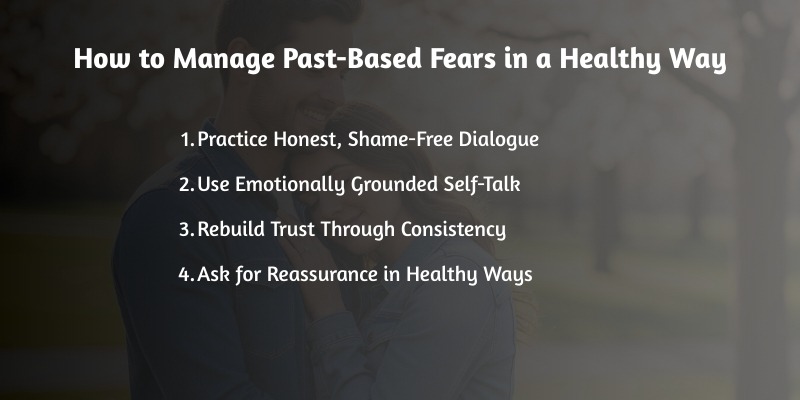
In addition to internal work, practical relationship strategies are crucial for managing past relationship fears.
Practice Honest, Shame-Free Dialogue
Create a safe space to share feelings without blame. Use “I feel” statements: “I sometimes feel insecure when your past comes up. I don’t need details, but I do need to feel like we can talk about this without it becoming a fight.”
Use Emotionally Grounded Self-Talk
Challenge the catastrophic thoughts. Instead of “They loved their ex more,” try, “Their past relationship helped shape them, but it ended for a reason. Our relationship is unique and different.”
Rebuild Trust Through Consistency
Trust is built in the present moment, through small, reliable actions. Focus on the ways your partner shows up for you now. Their consistent, loving behavior in the present is the strongest antidote to fear of their past.
Ask for Reassurance in Healthy Ways
It’s okay to need reassurance. Ask for it directly and positively: “Can you tell me what you love about what we have that feels different?” rather than “Do you still think about your ex?”
When to Consider Therapy for These Feelings
There is immense strength in seeking support. Consider couple therapy for relationship baggage if:
- The thoughts about your partner’s past feel intrusive, constant, and are disrupting your daily life or sleep.
- Your anxiety leads to behaviors you’re not proud of, like snooping, constant accusations, or controlling actions.
- The fear is causing significant conflict or eroding intimacy in your current relationship.
- You recognize the roots are in past trauma that feels too big to handle alone.
Therapy provides a neutral space to unpack your history, understand your attachment patterns, and develop new tools for emotional regulation and communication. It is a proactive step toward creating the secure, loving relationship you deserve.
FAQs
Is it normal to feel bothered by my partner’s past?
Yes, it’s very common. It becomes a problem only if the feelings are constant, overwhelming, and start to damage the trust and connection in your current relationship.
Why do I compare myself to my partner’s ex?
Comparison is a protective, if flawed, strategy. It’s your mind’s attempt to assess threats and secure your bond. It’s often fueled by insecurity and attachment anxiety, not by facts about your worth.
How do I stop intrusive thoughts about my partner’s past?
You can’t always stop the first thought, but you can manage your reaction. Acknowledge the thought without judgment, then gently redirect your focus to the present moment or to evidence of your current relationship’s strength.
Does insecure attachment cause jealousy?
Yes, significantly. Anxious attachment, in particular, creates a heightened sensitivity to any perceived threat to the relationship, making jealousy and comparison much more frequent and intense.
Can therapy help me trust again?
Absolutely. Couple therapy can help you heal from past betrayals, understand your triggers, build self-worth, and develop the skills to build trust slowly and safely in a new relationship.
Conclusion
Asking “why does my partners past bother me” is the beginning of a deeply important journey; not just about your relationship, but about yourself.
These feelings, as painful as they are, are not a life sentence. They are a signal from your inner world, pointing to old wounds that need care, attachment needs that crave security, and a self-concept that deserves strengthening.
Remember, your reaction is rooted in a human desire to protect a connection you cherish.
By approaching these feelings with curiosity and compassion instead of shame, you can begin to separate the ghosts of the past from the reality of your present partnership. Healing is possible.
It starts with understanding, is nurtured by self-kindness, and flourishes through open, vulnerable communication. Your past and your partner’s past do not have to define your future together.