
Manage Conflict Before Marriage Habits That Actually Work

Managing conflict before marriage habits means building the daily communication practices, emotional regulation skills, and shared conflict rules that determine whether your relationship grows stronger or quietly erodes before you ever say “I do.” Couples who develop these habits proactively report significantly higher satisfaction levels than those who wait until conflict becomes chronic. The good news: pre-marriage conflict resolution is a learnable skill set, not a personality trait. This guide walks you through the core habits, the communication strategies behind them, the tools that accelerate progress, and the mistakes that quietly sabotage even well-intentioned couples.
What are the core habits to manage conflict before marriage?
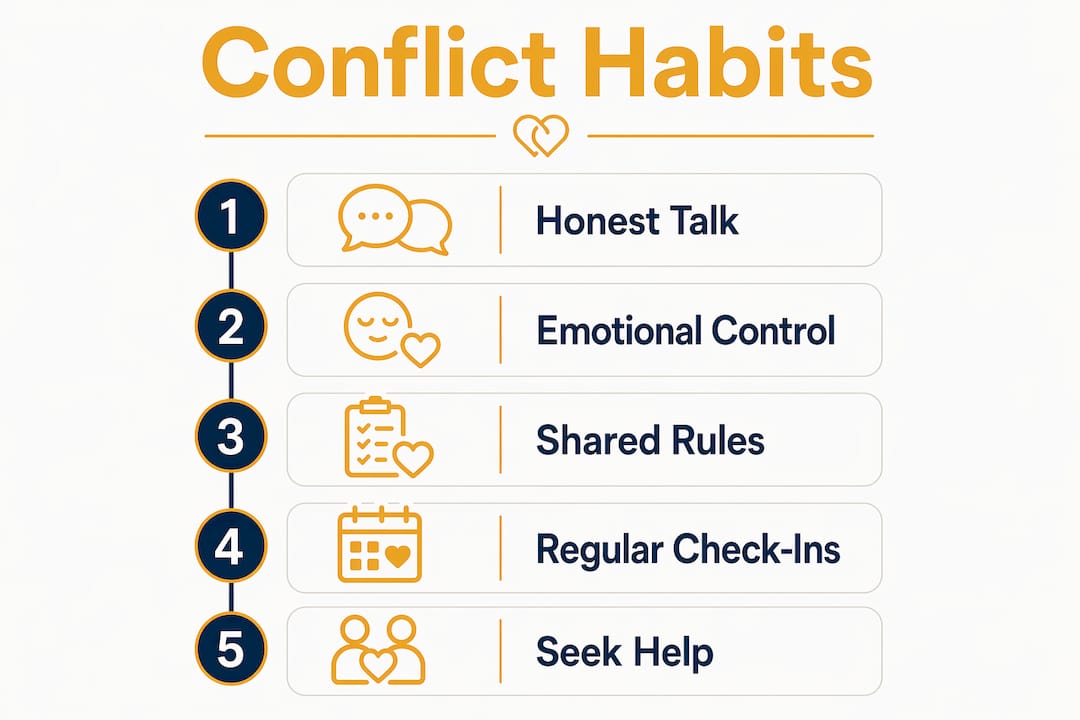
Conflict management skills for couples start with five foundational habits. Each one addresses a specific failure point that licensed therapists see repeatedly in couples who struggle after the wedding.
-
Practice honest, frequent communication. Structured conversations daily or several times per week build the emotional safety that makes hard conversations feel less threatening. Frequency matters because trust is built in small moments, not grand gestures.
-
Learn to recognize emotional flooding. When your heart rate spikes and your thinking narrows, constructive communication becomes neurologically impossible. Agreeing in advance on a pause signal, such as a hand gesture or a specific word, lets both partners step back without the break feeling like abandonment.
-
Establish shared conflict rules together. Write them down. No interrupting, no name-calling, no bringing up unrelated past grievances. These rules are not restrictions. They are the architecture of a safe conversation.
-
Schedule regular relationship check-ins. A weekly 20-minute check-in where each partner shares one appreciation and one concern prevents small resentments from calcifying into recurring arguments. Think of it as relationship maintenance, not crisis management.
-
Build repair routines. Repair is what happens after a fight. An apology, a hug, a specific acknowledgment of what went wrong. Therapist Moshe Ratson describes this as building a relational culture, a set of agreed norms that provide stability even when feelings fluctuate.
Pro Tip: Write your conflict rules on a shared note in your phone so both of you can reference them when emotions run high. The act of writing them together is itself a bonding exercise.
How does effective communication before marriage prevent conflict?
Effective communication before marriage is not about talking more. It is about talking differently. Most couples fall into parallel monologues: each person waits for their turn to speak rather than genuinely absorbing what their partner said. That pattern, left uncorrected, becomes the default mode during arguments.

Active listening means repeating back what you heard before responding. “What I’m hearing is that you felt dismissed when I changed our plans. Is that right?” This one habit alone interrupts the escalation cycle before it starts. It signals that your partner’s experience matters more to you than winning the point.
Expressing needs without defensiveness requires a specific structure. Lead with your feeling, name the situation, and make a clear request. “I felt anxious when we didn’t talk about finances. Can we set aside time this week to go through our budgets together?” That approach is far less likely to trigger a defensive response than “You never want to talk about money.”
“Healthy couples do not avoid conflict; they develop skills to manage it. The absence of conflict can indicate suppressed needs, while repair attempts show resilience.” — Licensed marriage therapists, via Growing Self Counseling
Handling disagreements with curiosity rather than judgment changes the entire emotional register of a conversation. Ask “Help me understand why this matters so much to you” instead of “Why are you making such a big deal out of this?” The first opens a door. The second slams one shut. Conflict management skills for couples are built one conversation at a time, and communication is where every habit either holds or breaks down.
Key communication habits that prevent destructive conflict:
- Replace “you always” and “you never” with specific, observable descriptions of behavior
- Validate your partner’s feelings before offering your own perspective
- Pause and breathe before responding to anything that triggers a strong reaction
- Agree on a word or signal that means “I need five minutes, not forever”
- End difficult conversations with a repair statement, even something as simple as “I love you and I want us to figure this out”
What tools and strategies can engaged couples use to build these habits?
Engaged couples have more structured resources available to them now than at any previous point. The challenge is choosing the right combination rather than overwhelming yourselves with options.
| Tool | Best For | Commitment Level |
|---|---|---|
| Premarital counseling | Deep communication patterns, values alignment | 6-12 sessions with a licensed therapist |
| Couples workbooks (e.g., Prepare/Enrich) | Self-guided reflection and structured exercises | 1-2 hours per week |
| Conflict resolution courses | Skill-building with frameworks and practice | Online, self-paced |
| Weekly check-in ritual | Ongoing habit maintenance | 20-30 minutes per week |
| Pause protocol agreement | Emotional regulation during active conflict | One-time setup, ongoing use |
Premarital counseling stands out as the highest-leverage investment. Couples who access structured premarital education report significantly higher long-term satisfaction than those who seek help only after conflict has become entrenched. Starting early means you are building skills on a foundation of goodwill, not trying to repair damage under stress.
Apps and workbooks serve a different function. They are practice tools, not replacements for real conversation. Use them to generate topics you might not naturally raise. The Prepare/Enrich program, for example, surfaces differences in financial values, family expectations, and conflict styles before they become live arguments.
Creating a daily or weekly structured conversation is the simplest habit with the highest return. It does not need to be formal. A 10-minute walk where you each share one thing that felt good and one thing that felt hard that day builds the emotional vocabulary couples need when harder conversations arise. You can also use conflict resolution questions as conversation starters to go deeper on topics that matter.
Pro Tip: Set a recurring calendar reminder for your weekly check-in. Treat it with the same priority as a work meeting. Relationships that get scheduled time get maintained.
What common mistakes should couples avoid when managing conflict?
The most damaging mistake is not fighting too much. It is avoiding conflict entirely. Suppressed needs do not disappear. They accumulate until they surface as contempt, withdrawal, or an explosion over something trivial. Avoiding conflict or mishandling it with blame, insults, or shutting down leads directly to harmful interaction patterns that deteriorate the relationship over time.
The Gottman Institute’s research across 40+ years and 3,000+ couples identifies four specific behaviors as the primary predictors of relationship breakdown: criticism, contempt, defensiveness, and stonewalling. These patterns are observable early in a relationship, which means engaged couples have a real opportunity to interrupt them before they become entrenched.
Other common pitfalls to watch for:
- Pushing through emotional flooding. When one or both partners are flooded, no productive conversation is possible. Continuing to argue in that state causes harm and teaches your nervous system that conflict is dangerous.
- Skipping repair. Ending a fight without any acknowledgment or reconnection leaves both partners feeling unresolved. Even a brief “I’m sorry we got heated. I care about us” matters.
- Using the relationship as a scoreboard. Tracking who apologized last or who “won” the last argument is a sign that the goal has shifted from connection to competition.
- Waiting for the right moment. There is no perfect time to address a concern. Waiting too long allows resentment to build context around an issue that could have been resolved simply.
The 5:1 positive-to-negative interaction ratio confirmed by the Gottman Institute is a useful benchmark. The goal is not zero conflict. It is maintaining enough positive connection that conflict does not define the relationship.
How to maintain and strengthen these habits over time before marriage
Building habits is the first step. Sustaining them as life gets busier, as wedding planning stress peaks, and as you learn more about each other’s triggers is the real work.
-
Hold a monthly relationship council. This is a slightly longer, more structured version of your weekly check-in. Review your conflict rules, discuss what has been working, and adjust anything that feels off. Relationships evolve, and your agreements should evolve with them.
-
Revisit your conflict rules every few months. What worked six months ago may need updating as you learn more about each other’s communication styles. Treat the rules as a living document, not a contract set in stone.
-
Prioritize emotional safety above being right. Every time you choose connection over winning a point, you are making a deposit into the relational account that funds your ability to weather harder conversations later.
-
Seek help early if patterns worsen. If the same argument keeps cycling without resolution, that is a signal to bring in a third perspective. Premarital coaching or counseling is not a sign of failure. It is a sign of seriousness about the relationship.
-
Celebrate progress explicitly. When you handle a difficult conversation well, name it. “We just navigated that really well. I’m proud of us.” Positive reinforcement strengthens the habit loop and builds shared identity as a couple who handles conflict well.
Healthy conflict strengthens marriage, teaching resilience and communication skills that benefit both partners and any family they build together. The couples who thrive are not the ones who never fight. They are the ones who fight better every time.
Key takeaways
Pre-marriage conflict resolution requires building five core habits: honest communication, emotional regulation, shared conflict rules, regular check-ins, and repair routines.
| Point | Details |
|---|---|
| Start habits before the wedding | Couples who build conflict skills early report significantly higher long-term satisfaction. |
| Emotional flooding breaks communication | Agree on a pause protocol before conflict starts, not during it. |
| Avoid the four destructive patterns | Criticism, contempt, defensiveness, and stonewalling predict relationship breakdown across decades of research. |
| Aim for a 5:1 positive ratio | Maintaining five positive interactions for every negative one keeps emotional balance during conflict. |
| Repair is non-negotiable | Every difficult conversation needs a closing repair gesture to prevent unresolved tension from accumulating. |
What I’ve learned from working with couples before they marry
After years of working with engaged couples at Couplesfightschool, the pattern I see most often is this: couples come in believing conflict is the problem. They want to fight less. What they actually need is to fight better.
The couples who build the strongest foundations before marriage are not the ones who agree on everything. They are the ones who treat their relationship as a system worth designing intentionally. They write down their conflict rules. They practice pausing before they have to. They check in weekly even when things feel fine, especially when things feel fine.
The hardest shift I ask couples to make is accepting that love alone is not a system. Feelings fluctuate. Stress arrives. Life gets complicated. What holds a relationship together during those seasons is not the intensity of your feelings. It is the structure you built when things were calm. That structure is exactly what these habits create.
If you are engaged and reading this, you are already ahead. The couples who struggle most are the ones who assumed love would handle everything. You are asking better questions. Keep asking them, together.
— Carlos
Build your conflict skills with Couplesfightschool
Knowing the habits is the starting point. Practicing them consistently, with guidance from professionals who have helped hundreds of couples do exactly this, is what makes the difference.
Couplesfightschool offers online coaching for couples designed specifically for engaged and dating couples who want to build real conflict resolution skills before marriage. The F.I.G.H.T. Plan® framework gives you a structured system for communication, emotional regulation, and repair that you can apply immediately. If you prefer a self-paced option, the Fight Less, Love More course walks you through the same core skills at your own pace. Both options are built by licensed mental health professionals Carlos Todd and Natasha Pemberton-Todd, and both are designed to meet you exactly where you are.
FAQ
What does it mean to manage conflict before marriage?
Managing conflict before marriage means building communication habits, emotional regulation skills, and shared conflict rules before the wedding so disputes are handled constructively rather than destructively. It is about designing a relational system, not eliminating disagreement.
How often should engaged couples practice conflict resolution skills?
Experts recommend structured conversations daily or several times per week to build emotional safety and communication fluency before marriage. A weekly formal check-in combined with daily small moments of connection is the most sustainable approach.
Is premarital counseling worth it for conflict management?
Yes. Couples who access premarital education report significantly higher long-term satisfaction than those who seek help only after conflict becomes chronic. Starting before problems entrench means you are building skills on a foundation of goodwill.
What are the biggest warning signs in pre-marriage conflict?
The four behaviors most predictive of long-term relationship breakdown are criticism, contempt, defensiveness, and stonewalling. If any of these patterns appear regularly in your arguments, addressing them before marriage is the highest-priority step you can take.
Can conflict actually strengthen a relationship before marriage?
Yes. Healthy conflict builds resilience and teaches couples communication skills that benefit them for decades. The goal is not a conflict-free relationship but one where both partners feel safe, heard, and capable of repairing after difficult moments.
Recommended