
Why Couples Struggle to Repair After Fights

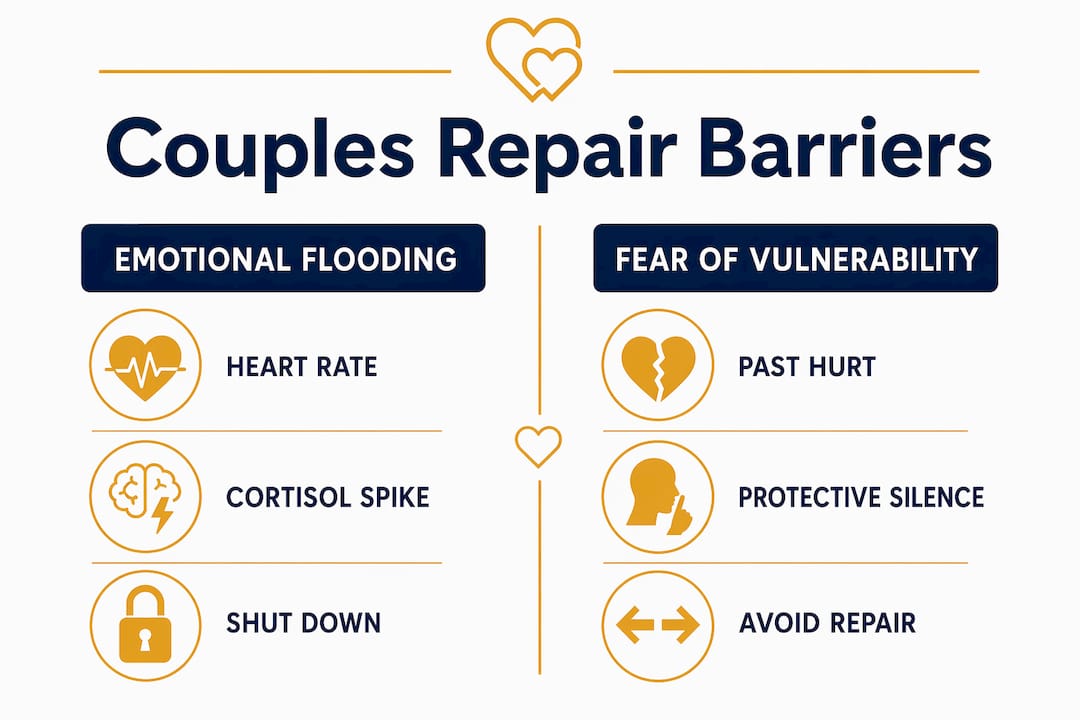
Relationship repair is defined as the deliberate process of rebuilding emotional safety and connection after a conflict. Most couples know they need to reconnect after a fight, yet why couples struggle to repair after fights comes down to two core forces: emotional flooding that shuts down clear thinking, and fear of vulnerability that keeps both partners waiting for the other to move first. These are not character flaws. They are predictable physiological and psychological responses. Understanding them is the first step toward changing them.
Why couples struggle to repair after fights: the real reason
The central barrier to repair is emotional flooding. Flooding is a state where your heart rate spikes, cortisol and adrenaline surge through your body, and your brain’s prefrontal cortex, the part responsible for empathy and problem-solving, goes offline. Your amygdala takes over, and you shift into self-protection mode. At that point, productive conversation is physiologically impossible.
Research confirms that flooded partners need 20–30 minutes before a repair conversation can succeed. That window is not optional. Trying to resolve things while still flooded almost always makes the conflict worse. The brain simply cannot access the empathy and nuance that repair requires.

The second reason repair fails is timing. Many couples attempt to reconnect too soon, while both partners are still activated. Others wait too long, allowing resentment to harden into silence. Neither approach works. Repair requires a deliberate pause followed by a deliberate return.
Pro Tip: Set a specific time to return to the conversation before you take a break. Saying “Let’s talk again in 30 minutes” prevents the break from becoming avoidance.
- Flooding impairs listening, empathy, and the ability to take another person’s perspective.
- A racing heart is a signal to pause, not push through.
- Breaks only work when both partners agree to return.
What psychological barriers lead couples to avoid repair after fights?
Fear is the most common reason couples avoid repair. Specifically, reaching out first feels too vulnerable and risky. Each partner waits for the other to make the first move, and the silence stretches. This is not indifference. It is self-protection.
Several psychological barriers compound this pattern:
- Fear of further hurt. Reaching out opens you to rejection. If your partner dismisses your attempt, the wound deepens.
- Waiting for the other person to apologize first. Both partners often feel they were wronged. Neither wants to validate the other’s position by moving first.
- Resentment loading. Silence after a fight is rarely neutral. Without repair, resentment accumulates and makes the next conversation harder.
- Misreading repair attempts. A partner who makes a joke or offers a hug after a fight is often attempting repair. If the other partner reads this as dismissiveness, the attempt fails and the initiator stops trying.
- Confusing repair with resolution. Many couples believe repair means fully resolving the argument. It does not. Repair means re-establishing enough safety to continue the conversation.
The fear of vulnerability is not a weakness. It is a rational response to past hurt. But when both partners protect themselves simultaneously, the relationship stalls. Someone has to move first. That act of courage is what repair actually looks like in practice.
Understanding emotional triggers in relationships helps couples recognize when fear is driving their silence rather than genuine indifference.
What are effective communication strategies to successfully repair after conflict?
Repair does not require a perfect apology or full resolution. Repair requires three things: acknowledgment of the rupture, active listening, and ownership of your contribution. These three steps rebuild connection even when the underlying disagreement remains unresolved.
Here is a practical sequence for repair conversations:
- Use a softened startup. Research shows that how a conversation begins predicts its outcome. Starting with “I felt hurt when…” lands differently than “You always…” The first invites dialogue. The second triggers defense.
- Acknowledge the rupture without blame. Say what happened from your perspective without assigning fault. “Things got heated and I want to reconnect” is a repair bid. It signals intent without escalating.
- Listen to understand, not to rebut. Active listening means reflecting back what your partner said before responding. “What I’m hearing is that you felt dismissed. Is that right?” slows the conversation and builds safety.
- Take ownership of your part. You do not need to accept full blame. You do need to name what you contributed. “I raised my voice and I know that made it harder for you to hear me” is specific and honest.
- Use repair language that validates. The statement “I see how my reaction impacted you” is far more effective than “I’m sorry you feel that way.” The first takes ownership. The second deflects it.
- Accept small repair attempts. Humor, affection, or a request to slow down during conflict are all repair attempts. Accepting them prevents escalation. Rejecting them signals to your partner that their bids are not welcome.
Pro Tip: Practice repair language before you need it. Rehearsing phrases like “I see how my reaction impacted you” makes them easier to access when emotions are high.
For couples who want to go deeper on how to diffuse conflict before it reaches the flooding stage, building these skills outside of conflict is the most effective approach.
How do underlying unmet needs affect the repair process?
Most surface arguments are not really about the surface issue. Conflict often triggers deeper feelings of being dismissed, unappreciated, or unsafe. The fight about dishes is rarely about dishes. It is about feeling unseen or undervalued.
This is why surface-level apologies fail. Saying “I’m sorry I forgot the dishes” does not address the underlying message your partner received, which may be “I don’t matter to you.” Repair requires going one level deeper.
Common unmet needs beneath relationship conflicts include:
- The need to feel valued and appreciated
- The need to feel heard and understood
- The need for emotional safety and predictability
- The need for respect and fairness
- The need for connection and closeness
True repair is about addressing unmet emotional needs and rebuilding safety, not solely fixing the argument’s surface issues.
When you identify the need beneath the argument, your repair conversation changes. Instead of defending your behavior, you address your partner’s experience. “I hear that you felt like I wasn’t prioritizing you. That matters to me” speaks directly to the wound. That is what rebuilds trust.
Emotional safety in relationships is the foundation that makes this kind of honest conversation possible. Without it, partners stay guarded and repair remains shallow.
How can couples build a relationship environment that supports repair?
Repair does not only happen after fights. It is built daily through the quality of ordinary interactions. Partners with secure foundations maintain approximately a 5:1 ratio of positive to negative interactions. That ratio creates an emotional reserve that makes repair easier when conflict does occur.
The table below shows the difference between relationships that repair well and those that get stuck:
| Habit | Relationships that repair well | Relationships that stay stuck |
|---|---|---|
| Positive interactions | Consistent appreciation and affection daily | Positive moments are rare or conditional |
| Repair attempts | Recognized and accepted quickly | Missed or rejected |
| Vulnerability | Partners take turns being open | Both partners stay guarded |
| Conflict language | Softened startups, ownership statements | Criticism, contempt, defensiveness |
| Professional support | Sought proactively or early | Avoided until crisis |
Building this kind of environment requires consistent practice outside of conflict. Express appreciation specifically and often. Recognize when your partner is reaching toward you, even imperfectly. Practice patience when repair feels slow. These habits do not eliminate conflict. They make recovery from conflict faster and less damaging.
When patterns feel too entrenched to shift alone, couples therapy provides a structured space to rebuild these habits with professional guidance.
Key Takeaways
Couples struggle to repair after fights primarily because emotional flooding and fear of vulnerability block the reconnection process, not because they lack love or commitment.
| Point | Details |
|---|---|
| Flooding blocks repair | Take a 20–30 minute break before attempting repair conversations to restore cognitive function. |
| Fear drives silence | Both partners often wait for the other to move first; someone must take the first step despite the risk. |
| Repair is not resolution | Re-establishing emotional safety matters more than fully resolving the argument in the moment. |
| Language shapes outcomes | “I see how my reaction impacted you” rebuilds trust far better than deflecting apologies. |
| Daily habits matter | A 5:1 positive-to-negative interaction ratio builds the emotional reserve that makes repair possible. |
What I’ve learned after years of working with couples in conflict
After working with hundreds of couples, the pattern I see most often is this: both partners want to reconnect, and neither one moves. They sit in separate rooms, each convinced the other doesn’t care enough to reach out. Both are wrong. Both are scared.
The couples who repair well are not the ones who never get flooded or never feel afraid. They are the ones who move anyway. They reach out with a text, a touch, or a simple “I don’t want us to stay like this.” That act of courage, small as it looks, is the entire game.
What I’ve also learned is that most couples are fighting about the wrong thing. The argument on the surface is almost never the real issue. When I help couples slow down and ask “What did you need in that moment that you didn’t get?” the conversation shifts completely. Suddenly they’re not defending positions. They’re talking about fear, longing, and connection.
The physiological piece matters too. I’ve seen couples try to repair while still flooded and make everything worse. Understanding that your brain is temporarily offline during flooding is not an excuse. It is information. Use it. Take the break. Come back when you can actually hear each other.
Repair is a skill. It gets easier with practice. The couples who struggle most are often the ones who never learned that repair was even possible, let alone how to do it. That’s exactly why Couplesfightschool exists.
— Carlos
Couplesfightschool can help you repair faster and fight smarter
If you recognize these patterns in your relationship, you are not alone and you are not stuck.

Couplesfightschool offers online coaching for couples built around the F.I.G.H.T. Plan® framework, a structured system for communication, emotional regulation, and repair. Whether you are dealing with recurring arguments, emotional distance, or communication breakdowns, the programs give you practical tools you can use immediately. You can also explore conflict resolution techniques designed specifically for couples who want to stop repeating the same fights. Real change starts with the right skills, not just the right intentions.
FAQ
Why is repairing after a fight so hard for couples?
Repair is hard because emotional flooding shuts down empathy and clear thinking, while fear of vulnerability keeps both partners from reaching out first. These are physiological and psychological responses, not signs of a broken relationship.
How long should couples wait before talking after a fight?
Partners need 20–30 minutes after a heated argument before their nervous systems calm enough for productive conversation. Attempting repair while still flooded typically escalates the conflict.
What does a good repair attempt actually look like?
A repair attempt can be as simple as a touch, a joke, or saying “I don’t want us to stay like this.” Small gestures that signal a desire to reconnect count as repair, even before a full conversation happens.
Why do apologies sometimes fail to repair a relationship?
Apologies fail when they address behavior without acknowledging the emotional impact. Saying “I see how my reaction impacted you” rebuilds connection because it takes ownership of the experience your partner had, not just the action you took.
When should couples seek professional help with conflict repair?
Couples should consider professional support when repair attempts consistently fail, when the same conflicts repeat without resolution, or when emotional distance is growing. Early support is more effective than waiting for a crisis.
Recommended