
Why Couples Fight About the Same Things

Recurring fights in relationships are defined by unmet emotional needs, not the surface topics couples argue about. Whether you keep clashing over tone of voice, money, or household chores, the real issue is almost always something deeper: feeling unseen, unvalued, or emotionally unsafe. Psychology research identifies this as a conflict cycle, a pattern where the same emotional triggers produce the same defensive reactions, regardless of the specific topic. Understanding why couples fight about the same things is the first step toward actually changing it.
Why do couples keep fighting about the same things?
The short answer is that recurring fights signal unmet emotional needs, not unresolved logistics. When you argue about dishes in the sink, you are rarely arguing about dishes. You are arguing about feeling unsupported, taken for granted, or alone in the relationship. The surface topic is just the trigger. The emotional need underneath is the real fight.
This is why the same arguments in relationships repeat even after couples think they have resolved them. Nothing changes because the emotional need was never addressed. Conflict cycles, a term used in relationship psychology to describe these repetitive patterns, persist because both partners keep responding to the symptom rather than the source.
Emotional triggers activate a protection mode in the brain, where tone and past experiences influence conflict more than the actual words spoken. Both partners feel completely justified in their reactions. That mutual justification is exactly what keeps the cycle spinning.
What do couples most commonly argue about?
The most common argument topics in 2026, according to a YouGov survey, are tone of voice (36%), communication styles (29%), money (26%), emotional needs (23%), life decisions (21%), and household chores (21%). These numbers reveal something important: the top two triggers are not about money or logistics at all. They are about how partners speak to each other and whether they feel heard.
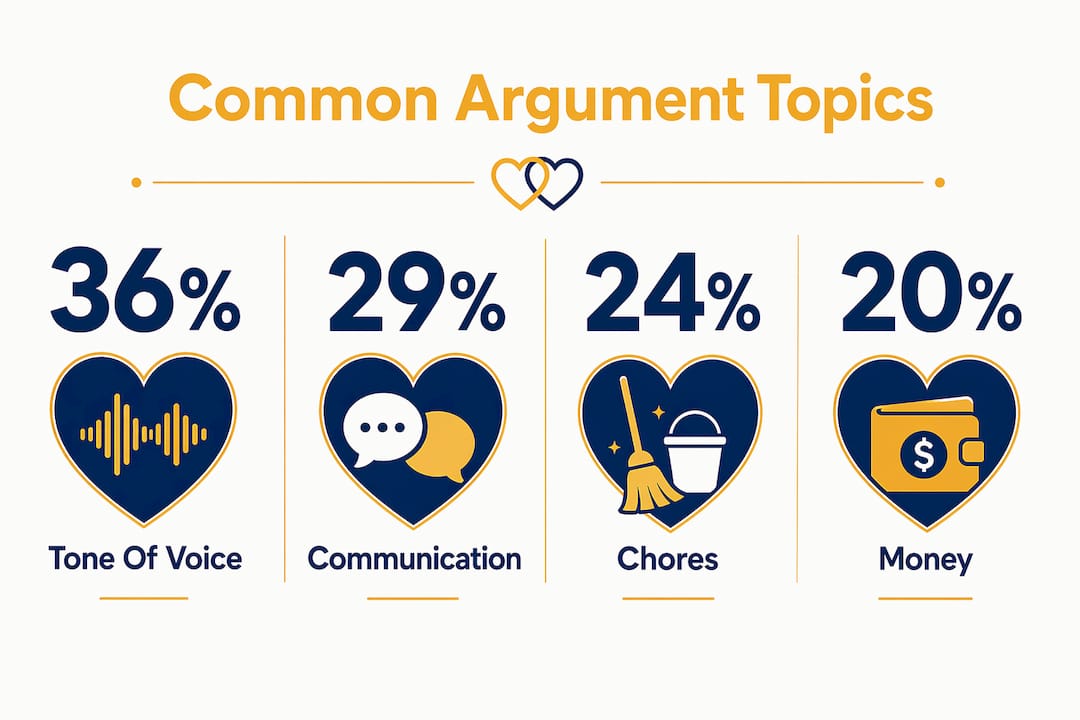
Living arrangements shift these patterns significantly. Unmarried cohabiting couples argue more frequently about emotional needs (43% vs. 18%), money (40% vs. 28%), and chores (37% vs. 21%) compared to married couples. Shared space amplifies friction because daily life creates more opportunities for unmet needs to surface.
Gender also shapes what partners fight about. Women report higher rates of arguing about tone of voice (41% vs. 29%), chores (27% vs. 15%), and quality time (23% vs. 11%) than men. These differences reflect different emotional priorities, not different levels of commitment.
Each surface topic maps to a deeper emotional need:
- Tone of voice signals a need to feel respected and safe
- Money often reflects anxiety about security or fairness
- Chores represent a need to feel like an equal partner
- Emotional needs point directly to feeling seen and valued
- Quality time signals a fear of disconnection or being deprioritized
Pro Tip: When you notice a recurring argument topic, ask yourself what you would feel if the issue were never resolved. That feeling is the real need driving the fight.
How do attachment styles drive repetitive conflict cycles?
Attachment styles, developed in early childhood and carried into adult relationships, are the single biggest driver of couples recurring conflicts. An anxious attachment style produces a partner who pursues connection during conflict. An avoidant attachment style produces a partner who withdraws. When these two styles meet, the result is the pursuer-withdrawer dynamic, one of the most common and damaging patterns in couple disagreements.
The pursuer-withdrawer dynamic is not a character flaw. It is a physiological response where both partners’ nervous systems simultaneously seek safety in incompatible ways. The pursuer pushes for connection because distance feels threatening. The withdrawer pulls back because pressure feels overwhelming. Each partner’s reaction intensifies the other’s fear, which is why fight intensity so often exceeds the complexity of the actual issue.
Conflict escalation stems partly from evolutionary protection mechanisms in the nervous system. The brain’s fight-or-flight response overrides rational communication the moment a partner feels emotionally threatened. This is why logical conversations can collapse into shouting matches within minutes.
Recognizing your attachment style and your partner’s is not just a therapeutic exercise. It is a practical tool. When you understand that your partner’s withdrawal is fear-based, not dismissive, you can respond with curiosity instead of escalation. Couplesfightschool’s conflict escalation patterns resource breaks down eight specific cycles that attachment-driven behavior creates, which helps couples identify exactly where their pattern lives.
Pro Tip: Before your next difficult conversation, name your own attachment tendency out loud. Saying “I tend to push when I feel disconnected” gives your partner context and lowers their defensive response.
What is negative sentiment override and why does it matter?
Negative sentiment override is a psychological state where a partner interprets neutral or even positive communication as hostile, based on accumulated emotional residue from past fights. Couples often begin conflicts with preset negative conclusions, which means the argument escalates before either person has said anything genuinely harmful.
The practical effect is that your partner’s tone of voice, facial expression, or word choice gets filtered through every unresolved hurt from previous arguments. A simple question like “Did you pay the bill?” lands as an accusation. A neutral observation becomes a criticism. Partners interpret behavior through a lens of past hurt, which distorts communication and escalates arguments before either person realizes what happened.
The table below shows how the same statement lands differently depending on whether negative sentiment override is active:
| What was said | Neutral interpretation | Negative sentiment override interpretation |
|---|---|---|
| “You forgot again.” | A reminder about a missed task | “You never care about what matters to me.” |
| “I’m tired tonight.” | A statement of physical fatigue | “You are avoiding me again.” |
| “Can we talk later?” | A request for better timing | “You are shutting me out.” |
| “That’s not what I meant.” | A clarification | “You are gaslighting me.” |
Slowing the moment down is the most direct way to interrupt this pattern. When you feel the heat rising, pause and ask yourself: “What am I actually feeling right now? Is it anger, or is it fear? Is it frustration, or is it hurt?” That one question shifts the brain out of protection mode and into reflection.
Pro Tip: Name the emotion underneath your reaction before you speak. “I feel scared that you don’t care” lands very differently than “You never listen to me.”
How can couples break recurring fight cycles?
Breaking cyclical relationship issues requires shifting the goal of conflict from winning to understanding. Most couples enter arguments trying to prove a point. The fights that actually resolve something are the ones where both partners get curious about what the other person is protecting.
Slowing conflict moments to identify emotions like fear or hurt helps couples move from blame to curiosity. This approach reduces escalation and promotes genuine understanding. It sounds simple. In practice, it requires real discipline, especially when your nervous system is already in fight-or-flight mode.
Naming positive partner qualities regularly counters negative sentiment override by building a fuller, more balanced perception of your partner. Think of it as a relational bank account: every genuine acknowledgment of your partner’s strengths deposits credit that gets drawn on during conflict. Couples who do this consistently find that arguments de-escalate faster because neither partner feels fundamentally disrespected.
Practical steps couples can take right now:
- Identify the emotional need underneath the surface complaint before speaking
- Use “I feel” statements instead of “you always” or “you never” accusations
- Call a time-out when physiological arousal is too high for productive conversation, then return within 30 minutes
- Ask one curious question during conflict: “What are you most afraid of right now?”
- Repair quickly after fights with a specific acknowledgment, not just “I’m sorry”
- Seek professional conflict coaching when the same cycle has repeated for more than six months without improvement
Emotional safety and accountability together create the conditions where long-standing conflict patterns can actually change. Awareness alone is not enough. Both partners must take responsibility for their role in the cycle, not just their partner’s behavior.
Key Takeaways
Recurring couple fights are driven by unmet emotional needs, attachment-based conflict cycles, and negative sentiment override, and breaking these patterns requires curiosity, emotional awareness, and mutual accountability.
| Point | Details |
|---|---|
| Surface issues mask deeper needs | Arguments about chores or money almost always reflect unmet emotional needs like feeling unseen or unsupported. |
| Attachment styles fuel repetition | The pursuer-withdrawer dynamic keeps couples locked in the same fight because both partners seek safety in incompatible ways. |
| Negative sentiment override distorts communication | Past emotional hurt causes partners to interpret neutral comments as attacks, escalating conflict before it starts. |
| Curiosity breaks the cycle | Shifting from blame to curiosity, by asking what your partner fears, interrupts the fight-or-flight response. |
| Repair and accountability matter most | Awareness of conflict patterns only produces change when both partners take responsibility and repair consistently. |
What I have learned from watching couples fight the same fight
After years of working with couples in conflict, the pattern I see most often surprises people: the couples who fight the most are usually the ones who care the most. The fights are not evidence of a broken relationship. They are evidence of two people who have not yet learned how to speak the language of their own emotional needs, let alone each other’s.
What I have found is that most couples are not fighting about the topic. They are fighting for the relationship. The argument about dishes is a bid for partnership. The argument about money is a bid for security. The argument about tone is a bid to feel respected. When I help couples see that, something shifts. The defensiveness drops a little. The curiosity goes up.
The hardest part is not identifying the pattern. Most couples can do that after one honest conversation. The hard part is staying curious when your nervous system is screaming at you to defend yourself. Vulnerability in conflict feels like weakness. It is actually the fastest path to resolution. When one partner says “I’m scared, not angry,” the other partner almost always softens.
Breaking these patterns takes patience and it takes both people showing up. One partner doing the work alone will not change a two-person cycle. But when both partners commit to understanding rather than winning, the same arguments that once lasted hours can resolve in minutes. That is not an exaggeration. That is what I have watched happen, repeatedly, when couples finally address the emotional need underneath the fight.
— Carlos
Couplesfightschool can help you break the cycle
Recurring fights do not have to define your relationship. Couplesfightschool was built by licensed mental health professionals specifically to help couples understand the emotional patterns driving their conflicts and replace them with skills that actually work.
Through online coaching for couples, structured courses, and the F.I.G.H.T. Plan® framework, Couplesfightschool gives you practical tools to identify your conflict cycle, manage emotional triggers, and build the kind of communication that creates real connection. The Stop the Fighting course is a direct resource for couples ready to move from repeated arguments to lasting understanding. Whether you are dating, married, or somewhere in between, the support is there when you are ready.
FAQ
Why do couples argue about the same things repeatedly?
Recurring arguments reflect unmet emotional needs rather than unresolved surface issues. Until the underlying need, such as feeling respected, secure, or valued, is addressed directly, the same fight will keep returning in different forms.
What is the pursuer-withdrawer dynamic?
The pursuer-withdrawer dynamic is a conflict pattern where one partner seeks connection by pushing for resolution while the other seeks safety by pulling away. It is driven by attachment styles and becomes self-reinforcing because each partner’s reaction intensifies the other’s fear.
What is negative sentiment override in relationships?
Negative sentiment override is a state where accumulated emotional hurt causes a partner to interpret neutral or positive communication as hostile. It is one of the primary reasons couples escalate quickly even over minor issues.
How can couples stop repeating the same arguments?
Slowing the conflict moment to identify the emotion underneath the reaction, using “I feel” statements, and repairing quickly after fights are the most effective starting points. Professional coaching accelerates this process significantly.
How often do couples argue?
A YouGov survey found that 21% of Americans in relationships argue weekly, and 22% argue a few times per month. Only 5% of couples report never arguing, which means conflict is a normal part of most relationships.
Recommended