
Why Couples Repeat the Same Arguments: Real Reasons

Recurring arguments are defined by relationship psychology as conflict patterns where the same emotional triggers resurface repeatedly, regardless of how many times a couple discusses the surface issue. 21% of American couples report arguing at least once a week, and most of those fights circle back to the same handful of topics. That number tells you something important: the problem is rarely the dishes, the budget, or the tone of voice. The real reason why couples repeat the same arguments is that the surface dispute is almost never what the fight is actually about. Unmet emotional needs, defensive communication habits, and unresolved wounds from the past keep pulling couples back into the same loop.
Why couples repeat the same arguments
The core reason fights repeat is that couples try to solve the wrong problem. They debate the content of the argument, who said what, who forgot what, who is right, while the actual issue sits underneath untouched. Couples often fight repeatedly because the goal mistakenly becomes winning rather than understanding a partner’s emotional needs. Winning a point does nothing to address the emotional need driving the fight. So the fight comes back, sometimes the next day, sometimes the next week, wearing a slightly different costume.
Relationship researchers use the term “negative interaction cycles” to describe these loops. One partner pursues connection or resolution. The other withdraws to avoid escalation. The pursuer pushes harder. The withdrawer shuts down further. Neither person gets what they actually need, and the cycle repeats. Recognizing this pattern is the first real step toward breaking the cycle of recurring conflict.

What topics trigger repeated arguments most often?
YouGov’s Q1 2026 survey identified the most common argument triggers among American couples. The top three are tone of voice, communication style, and money. Unmarried cohabiting couples report higher conflict frequencies around emotional needs, money, and household chores compared to married couples. Gender also plays a role: women report arguing more frequently about emotional needs, while men report more conflict around communication style differences.
Here is how the top triggers break down:
| Argument Topic | Who Reports It Most |
|---|---|
| Tone of voice | Both partners, across relationship types |
| Communication style | Men report slightly higher frequency |
| Money and finances | Unmarried cohabiting couples most affected |
| Emotional needs | Women and cohabiting couples most affected |
| Household chores | Cohabiting couples report highest frequency |
These surface topics matter, but they are symptoms. A fight about chores is rarely about chores. It is about feeling unsupported, unappreciated, or invisible. A fight about money is often about control, security, or trust. When couples understand that the stated topic is a proxy for a deeper emotional complaint, they stop trying to win the argument and start trying to address what is actually wrong.
Pro Tip: When you notice the same fight starting again, pause and ask yourself: “What am I actually feeling right now?” Naming the emotion, whether it is fear, loneliness, or disrespect, gives your partner something real to respond to.
How do emotional needs and childhood wounds fuel conflict cycles?
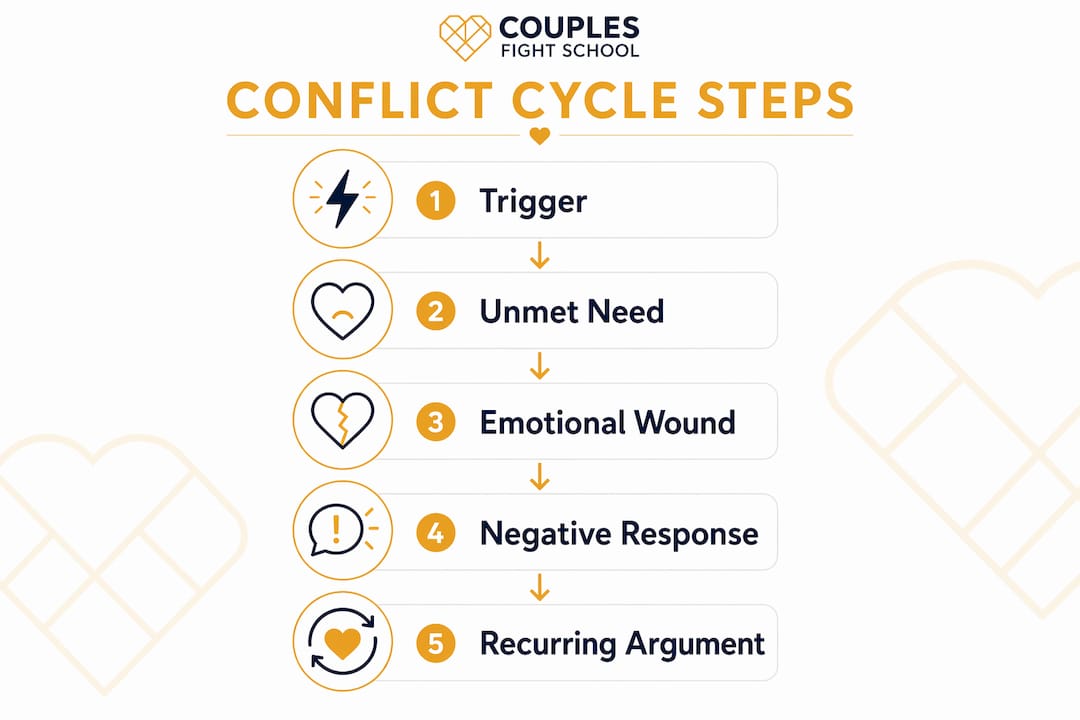
Persistent conflict is often propelled by childhood emotional wounds and past resentments, which transform minor disputes into intense emotional battles. A partner who grew up with critical parents may hear neutral feedback as an attack. A partner who felt powerless as a child may dig in hard during disagreements about household decisions. These reactions are not irrational. They are the nervous system doing exactly what it learned to do to survive.
Unmet emotional needs show up as recurring surface complaints. A partner who constantly argues about not getting enough help around the house may actually be expressing a need to feel like an equal partner. A partner who keeps fighting about screen time may be expressing a need for connection and presence. The complaint is real, but it is pointing at something deeper. Addressing the “how” of interactions is more effective than trying to fix the surface “what.”
The pursuit-withdrawal pattern is one of the most destructive cycles in relationships. One partner chases resolution or emotional closeness. The other retreats because the intensity feels overwhelming. Both partners are trying to protect themselves, but the result is that neither feels heard or safe. This cycle does not resolve on its own. It requires deliberate interruption.
- Unmet need for security shows up as fights about money, plans, or commitment.
- Unmet need for respect shows up as fights about tone, dismissiveness, or being talked over.
- Unmet need for connection shows up as fights about time, attention, or emotional availability.
- Unmet need for autonomy shows up as fights about control, decisions, or personal space.
Pro Tip: After a fight cools down, try asking your partner: “What were you really needing from me in that moment?” The answer will almost always surprise you and give you a more useful target than the argument itself.
What communication patterns keep fights going?
Criticism, contempt, defensiveness, and stonewalling are four destructive behaviors shown to predict the breakdown of relationships if left unaddressed. Researcher John Gottman labeled these the “Four Horsemen.” Each one shuts down the possibility of genuine understanding. Contempt is the most damaging of the four because it signals disgust rather than disagreement.
The first three minutes of a conflict conversation set the entire trajectory of the fight. Harsh start-ups trigger fight-or-flight responses in the nervous system, which shuts down empathy and clear thinking for the rest of the conversation. A softened start-up, meaning a calm, specific, and non-blaming opening, keeps both partners’ nervous systems regulated enough to actually listen. This is not about being polite. It is a biological regulation tool.
Predictive brain coding causes partners to interpret ambiguous behaviors as negative based on past fights. If your partner has been dismissive before, your brain will read a neutral expression as dismissive again. This happens automatically, below conscious awareness. It reinforces argument repetition even when neither partner intends to escalate.
Here is how to shift the communication patterns that keep fights alive:
- Replace criticism with a complaint. “You never listen” is a criticism. “I felt unheard when you looked at your phone during our conversation” is a complaint. One attacks character; the other describes a specific experience.
- Use repair attempts early. A repair attempt is any gesture, word, or action that signals you want to de-escalate. Humor, a touch on the arm, or simply saying “I don’t want to fight” can reset the conversation.
- Listen to understand, not to respond. Most partners spend the other person’s speaking time preparing their rebuttal. Listening for the emotional need behind the words changes the entire dynamic.
- Name your own emotional state. Saying “I feel scared when we argue about money” gives your partner something to connect with instead of defend against.
- Identify your communication patterns early. Catching a destructive habit before it becomes automatic is far easier than dismantling it after years of repetition.
What practical strategies can couples use to stop repeating fights?
Happy relationships maintain a 5:1 ratio of positive to negative interactions. That ratio is not just a feel-good metric. It builds the emotional bank account that couples draw from when conflict hits. When the account is full, repair attempts land. When it is empty, even a gentle comment can spark a fight.
Pausing during escalation is one of the most underused tools in conflict resolution. When either partner’s heart rate climbs significantly, the brain’s capacity for empathy and rational thought drops sharply. Taking a 20-minute break, not to avoid the conversation but to regulate the nervous system, allows both partners to return to the discussion with actual access to their better judgment.
Shifting focus from the problem’s content to the interaction process is a key insight from relationship research. Fights seldom revolve around the stated topic. The core is a negative cycle driven by survival-mode nervous system reactions. Solving the surface issue during peak conflict is ineffective because neither partner is neurologically capable of collaborative problem-solving at that moment.
- Build communication agreements. Decide together, during a calm moment, how you will handle conflict. Agree on a signal to pause, a time to return, and a rule against contemptuous language. Communication agreements reduce the chaos of in-the-moment reactivity.
- Practice vulnerability over defensiveness. Defensiveness protects the ego but blocks connection. Sharing what you are afraid of or what you need creates an opening your partner can actually walk through.
- Increase positive interactions daily. Affection, humor, genuine interest, and appreciation outside of conflict build the relational buffer that makes repair possible inside conflict.
- Focus on understanding, not resolution. Not every argument needs a solution. Sometimes a partner needs to feel heard more than they need the problem fixed.
Resolving recurring arguments requires consistent practice, not a single breakthrough conversation. The couples who change their conflict patterns are the ones who commit to small, daily shifts in how they speak, listen, and repair.
Key Takeaways
Recurring arguments persist because couples address surface topics while the underlying emotional needs remain unmet and unspoken.
| Point | Details |
|---|---|
| Surface fights hide deeper needs | Arguments about chores, money, or tone are almost always about unmet emotional needs. |
| Childhood wounds fuel reactivity | Past emotional injuries cause partners to overreact to neutral or minor triggers. |
| The Four Horsemen predict breakdown | Criticism, contempt, defensiveness, and stonewalling destroy emotional safety if unchecked. |
| Softened start-ups change outcomes | How a conflict begins shapes both partners’ nervous systems for the entire conversation. |
| The 5:1 ratio builds repair capacity | Maintaining five positive interactions for every negative one creates the trust needed to resolve conflict. |
What I’ve learned after years of watching couples fight the same fight
After working with couples across a wide range of backgrounds and conflict styles, one pattern stands out above all others. Couples who keep repeating the same fights are not incompatible. They are disconnected. The argument is a symptom of that disconnection, not the cause of it.
Most couples I work with come in convinced that if they could just resolve the argument about money, or the argument about in-laws, or the argument about intimacy, everything would be fine. What they discover is that the argument was never really the problem. The problem was that both partners stopped feeling emotionally safe with each other. Once safety goes, every conversation becomes a potential threat, and the nervous system responds accordingly.
The couples who make real progress are the ones who stop trying to win and start trying to understand. That shift sounds simple. It is not. It requires you to stay curious about your partner’s experience even when you are hurt, frustrated, or convinced you are right. Couplesfightschool’s F.I.G.H.T. Plan® was built around exactly this challenge: giving couples a structured way to move through conflict without destroying the connection they are trying to protect.
Conflict is not the enemy of a good relationship. Contempt is. Avoidance is. Automatic reactivity is. Conflict, handled with skill and intention, is actually one of the most powerful ways couples build trust and deepen intimacy. The couples who learn to fight well end up closer than the ones who never fight at all.
— Carlos
How Couplesfightschool can help you break the cycle
Knowing why fights repeat is only half the work. The other half is building the skills to respond differently when the next argument starts.
Couplesfightschool offers practical conflict resolution tools designed specifically for couples stuck in repeating patterns. The Stop the Fighting course walks couples through the communication skills that replace defensiveness with understanding and criticism with connection. For couples who want personalized support, online coaching for couples provides direct guidance from licensed professionals who specialize in conflict and communication. Whether you are newly together or decades in, the tools exist to change how you fight and what you build from it.
FAQ
Why do couples keep arguing about the same things?
Couples repeat the same arguments because the surface topic is a stand-in for an unmet emotional need. Until that underlying need is named and addressed, the fight has no real resolution.
What are the most common topics couples fight about?
Tone of voice, communication style, and money are the top three argument triggers among American couples, according to YouGov’s 2026 survey data.
What is the 5:1 ratio in relationships?
The 5:1 ratio refers to John Gottman’s research finding that happy couples maintain five positive interactions for every one negative interaction, which builds the emotional trust needed to repair conflict effectively.
How does a softened start-up reduce conflict?
A softened start-up, meaning a calm and specific opening to a difficult conversation, keeps both partners’ nervous systems regulated. Harsh start-ups trigger fight-or-flight responses that shut down empathy and make resolution nearly impossible.
Can recurring arguments be a sign of deeper relationship problems?
Recurring arguments are a sign of unmet emotional needs and communication gaps, not necessarily incompatibility. Addressing the underlying emotional cycle, rather than the surface topic, is what creates lasting change.
Recommended