
How to Break the Emotional Withdrawal Cycle in Couples

Emotional withdrawal in relationships is defined as a pattern where one partner pulls back emotionally while the other pursues connection, creating a self-reinforcing cycle that erodes intimacy over time. Psychologists call this the pursuer-withdrawer dynamic, and it is the recognized clinical term for what couples often describe as feeling “shut out” or “smothered.” To break the emotional withdrawal cycle, couples must first understand that neither partner is the villain. The cycle itself is the problem. Research shows this pattern appears in 60–70% of distressed couples, and Dr. John Gottman and Dr. Sue Johnson, the founder of Emotionally Focused Therapy (EFT), both identify it as one of the most damaging forces in long-term relationships.
What triggers the emotional withdrawal cycle in couples?
The pursuer-withdrawer cycle runs on fear, not malice. The pursuing partner fears abandonment and reaches out more intensely when they feel disconnected. The withdrawing partner fears overwhelm or emotional engulfment and pulls back to self-regulate. Both responses make perfect sense individually. Together, they create a feedback loop that escalates conflict.
Emotional withdrawal is a protective response to nervous system overwhelm, not a sign of indifference. Understanding this single fact removes a huge amount of blame from the equation. When your partner goes silent or leaves the room, their nervous system is flooded. They are not choosing to hurt you.
“The cycle is better understood as a predictable response to fear. Seeing it as an external trap helps couples stop blaming each other and start collaborating against the real problem.”
Common triggers that activate the cycle include:
- Criticism or contempt in the opening moments of a conversation
- Unresolved past arguments that make the current topic feel loaded
- Stress from outside the relationship (work, finances, family) that lowers each partner’s emotional threshold
- Feeling unheard repeatedly, which intensifies the pursuer’s urgency
- Feeling cornered, which intensifies the withdrawer’s shutdown response
One more detail most couples miss: roles in the cycle are not fixed. A partner who typically withdraws may pursue intensely when the topic is finances or parenting. Roles shift with context and stress level. Recognizing this fluidity stops the trap of labeling one partner as “the cold one” and the other as “the needy one.”
What mindset shifts do couples need before breaking the cycle?
Practical strategies fail without the right foundation. The most critical shift is reframing the cycle as a shared problem rather than a character flaw in either partner. Couples who approach this work with curiosity instead of blame move faster and sustain progress longer.

Agreeing on a shared signal to name the cycle when it starts is one of the most effective early steps. This could be a word, a phrase, or even a hand gesture. The signal shifts both partners from reactive mode into observer mode. It says, “We are in the cycle again,” not “You are doing it again.”
Key mindset shifts that create the conditions for change:
- Commit to the “we” frame. The cycle is happening to both of you, not because of one of you.
- Accept that vulnerability is required. Healing emotional disconnection means sharing fears, not just frustrations.
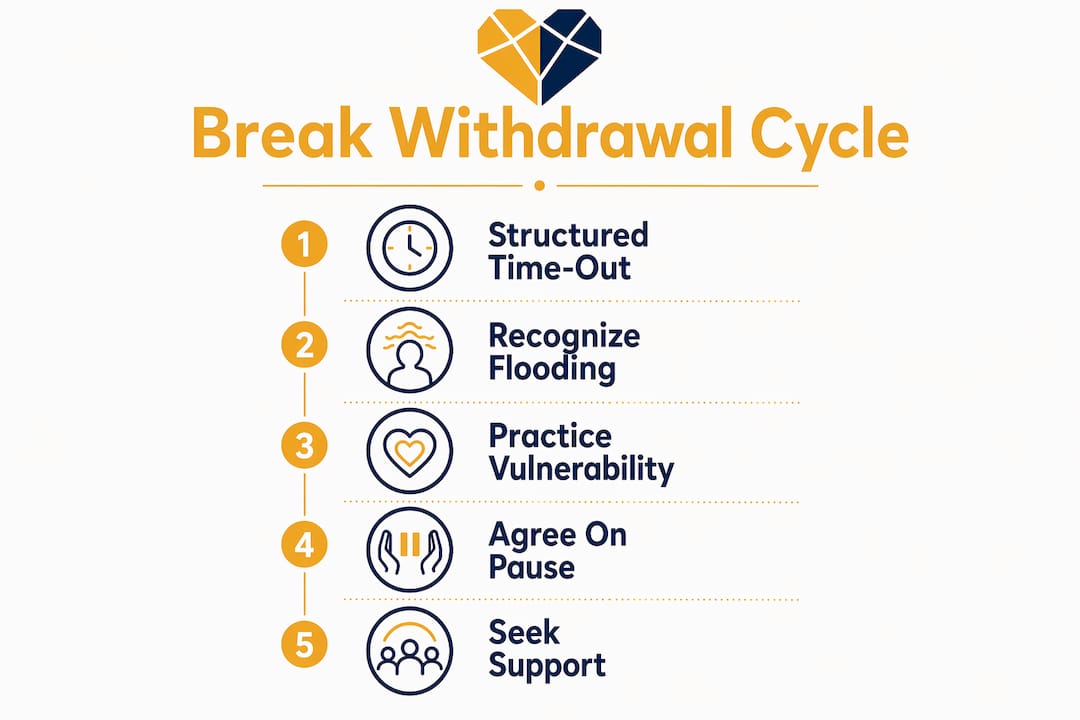
- Recognize flooding in your own body. Racing heart, tight chest, and shallow breathing are signals to pause, not push through.
- Agree that pausing is not abandonment. A structured break is a tool, not a rejection.
Practicing vulnerability by sharing fears and needs gradually builds the emotional safety both partners need. Small disclosures build trust faster than large, dramatic confessions.
Pro Tip: Before your next difficult conversation, agree on one word or phrase that either partner can say to pause the discussion without it feeling like a shutdown. Practice using it during a calm moment so it feels natural when tension rises.
Step-by-step strategies to stop emotional distance in your relationship
Breaking the cycle requires specific, practiced behaviors. These are not one-time fixes. They are skills that improve with repetition.
-
Use a structured time-out. When either partner feels flooded, call the agreed signal and take a 20-minute break to let the nervous system calm down. Set a timer. Commit to returning. The return is what separates a healthy pause from emotional abandonment.
-
Name the cycle, not the crime. Instead of “You always shut me out,” try “I think we are in our cycle right now.” This language invites collaboration instead of defense.
-
Pursuers: soften the start-up. Naming fears instead of criticisms changes the entire tone. “I get scared when I feel us drifting apart” lands very differently than “You never talk to me.” The first opens a door. The second slams one.
-
Withdrawers: stay present and name the overwhelm. Silence feels like rejection to a pursuing partner. Saying “I am feeling overwhelmed and I need ten minutes, but I am not leaving this conversation” keeps the connection alive even during a pause.
-
Respond to small bids for connection. A bid is any small gesture toward closeness: a touch, a question, a shared laugh. Couples who respond to bids 86% of the time build significantly stronger emotional intimacy. That statistic reflects thousands of small moments, not grand gestures.
-
Return and reconnect. After every time-out, come back to the conversation. Even a brief “I am glad we talked” closes the loop and signals safety.
| Strategy | Who it helps most | What it changes |
|---|---|---|
| Structured time-out | Both partners | Nervous system regulation |
| Softened start-up | Pursuers | Reduces defensiveness in partner |
| Naming overwhelm | Withdrawers | Prevents perceived abandonment |
| Responding to bids | Both partners | Builds daily emotional intimacy |
Pro Tip: Keep a short list of your personal flooding signals (jaw tension, raised voice, urge to leave) on your phone. Reviewing it before a hard conversation helps you catch the moment before it escalates.
Common challenges when trying to overcome emotional withdrawal
Progress is rarely linear. Most couples hit the same walls, and knowing what to expect makes those walls easier to climb.
The biggest obstacle is emotional flooding in the moment. Even couples who understand the cycle intellectually find it nearly impossible to apply skills when their nervous system is in overdrive. The solution is practice during calm moments, not just crisis moments. Role-playing the softened start-up when you are both relaxed builds the neural pathway you need when things get heated.
“Deeper intimacy is built not through grand gestures but through repeated small bids and responsive moments of vulnerability.”
Other common challenges include:
- Reverting to blame when progress stalls. Blame feels satisfying in the short term and destroys connection in the long term. Redirect to the cycle language every time.
- Role confusion when partners switch positions. If the usual withdrawer suddenly pursues, the usual pursuer may not know how to respond. Name it: “I notice our roles feel different today.”
- Fear of vulnerability. Sharing a fear feels risky. Build safety gradually with lower-stakes disclosures before tackling the deepest wounds.
- Slow progress. Couples often expect rapid change and interpret slow progress as failure. Small wins, like one conversation that did not escalate, count as real progress.
When the cycle is deeply entrenched, Emotionally Focused Therapy offers a structured clinical path. EFT helps couples identify the cycle, de-escalate conflict, and build secure attachment bonds. It is one of the most well-researched approaches for exactly this dynamic. Seeking professional help is not a sign of failure. It is a sign that you take the relationship seriously.
How do you rebuild emotional connection after breaking the cycle?
Breaking the cycle creates space. Filling that space with consistent connection habits is what makes the change permanent.
-
Build love maps. Stay genuinely curious about your partner’s inner world: their current worries, evolving goals, and daily joys. Love maps, a concept developed by Dr. Gottman, are the foundation of lasting intimacy.
-
Create rituals of connection. A morning coffee together without phones, a ten-minute check-in before bed, or a weekly walk counts. Couples who establish rituals and regular check-ins report higher relationship satisfaction and intimacy over time.
-
Practice direct emotional expression. Replace “I’m fine” with “I am feeling anxious about work and I could use some reassurance.” Directness removes the guesswork that fuels withdrawal.
-
Express gratitude specifically. “Thank you for staying in the conversation even when it was hard” reinforces the exact behavior you want more of. Generic praise fades. Specific appreciation sticks.
-
Check in on relationship health regularly. A monthly conversation about what is working and what feels off catches small drifts before they become large distances. Couples who maintain daily connection habits and consistent check-ins sustain emotional intimacy far more effectively than those who only address problems when they become crises.
The goal is not a conflict-free relationship. The goal is a relationship where both partners feel safe enough to repair quickly when the cycle reappears, because it will. The difference between couples who thrive and couples who struggle is not the absence of the cycle. It is the speed and skill of the repair.
Key Takeaways
Breaking the emotional withdrawal cycle requires both partners to recognize the pursuer-withdrawer pattern as a shared trap, apply specific regulation and communication skills, and build consistent daily habits that sustain emotional safety.
| Point | Details |
|---|---|
| The cycle is a shared problem | Neither partner is the cause; the pursuer-withdrawer pattern is a mutual fear response. |
| Roles are not fixed | Either partner can pursue or withdraw depending on the topic and stress level. |
| Regulation before resolution | A structured 20-minute break calms the nervous system and makes productive conversation possible. |
| Small bids build big intimacy | Responding to connection bids consistently is more powerful than occasional grand gestures. |
| Professional help accelerates progress | EFT therapy is a proven clinical approach for couples with deeply entrenched withdrawal patterns. |
What I have learned from working with couples stuck in this cycle
After years of working with couples at Couplesfightschool, the pattern I see most often is not cruelty or indifference. It is two people who love each other deeply and have no idea they are both terrified. The pursuer is terrified of being alone. The withdrawer is terrified of being consumed. Neither one is wrong. Both are in pain.
The couples who break through fastest are not the ones with the least conflict. They are the ones who stop trying to win the argument and start trying to understand the fear underneath it. That shift, from “you are the problem” to “this cycle is our problem,” is the turning point I watch for in every session.
What I tell every couple: do not wait for a perfect moment to practice these skills. The imperfect, messy attempts are where the real learning happens. A conversation that starts badly and ends with both partners feeling heard is a victory. Celebrate it.
Seek structured support when you feel stuck. The F.I.G.H.T. Plan® framework at Couplesfightschool was built specifically to give couples a repeatable system for exactly these moments. You do not have to figure this out alone.
— Carlos
Couplesfightschool resources for breaking the withdrawal cycle
Knowing what the cycle is and knowing how to interrupt it in real time are two very different things. Couplesfightschool offers evidence-based online courses and coaching programs designed to give couples the specific skills that address the pursuer-withdrawer dynamic directly.
The relationship skills every couple needs are taught through practical, psychology-backed tools built around the F.I.G.H.T. Plan® framework. These resources cover emotional regulation, softened start-ups, bid responsiveness, and communication agreements that hold up under pressure. If you and your partner are ready to move from distance to connection, online coaching for couples at Couplesfightschool gives you a structured path with professional guidance at every step.
FAQ
What is the emotional withdrawal cycle in couples?
The emotional withdrawal cycle, clinically called the pursuer-withdrawer pattern, is a dynamic where one partner seeks closeness while the other pulls back. It appears in 60–70% of distressed couples and creates repetitive conflict without resolution.
How long does it take to break the pursuer-withdrawer pattern?
There is no fixed timeline, but couples who practice regulation skills and communication strategies consistently see meaningful improvement within weeks. Deeply entrenched patterns often benefit from structured support through EFT therapy or a program like Couplesfightschool.
Can one partner break the cycle alone?
One partner changing their behavior can shift the dynamic, but lasting change requires both partners to recognize the cycle and commit to new responses. Unilateral change reduces escalation but does not fully rebuild emotional connection.
Why does emotional withdrawal feel like rejection?
Withdrawal triggers the pursuing partner’s fear of abandonment, which the brain interprets as rejection even when the withdrawer is simply overwhelmed. Withdrawal is a protective response to flooding, not a statement about the relationship’s value.
When should couples seek professional help for emotional withdrawal?
Seek professional help when the cycle repeats despite genuine effort, when conversations regularly escalate to contempt or stonewalling, or when one or both partners feel hopeless about change. EFT therapy is a clinically validated approach for this exact pattern.
Recommended