
What Is a Secure Relationship? Your Complete Guide

A secure relationship is defined by psychological safety where both partners can be fully themselves without fearing punishment, ridicule, or abandonment. This is the clinical foundation behind what attachment researchers call “secure attachment” in adult partnerships. You can be honest, vulnerable, and imperfect in a secure relationship, and your partner stays. That consistency is not a small thing. It is the entire structure on which lasting intimacy is built.
Most couples assume security means no conflict, no jealousy, and no hard days. That assumption is wrong, and it causes real damage. Secure relationships have all of those things. What they have differently is the ability to repair, to stay curious about each other, and to return to connection after rupture. Couplesfightschool, founded by licensed mental health professionals Carlos Todd and Natasha Pemberton-Todd, teaches exactly this: security is a practice, not a personality trait you either have or you don’t.
What is a secure relationship, and what does it actually look like?
A secure relationship is one where consistent emotional responsiveness forms the daily foundation of trust. That means when you reach for your partner emotionally, they reach back. Not perfectly, not every single time, but reliably enough that your nervous system learns it is safe to keep reaching.

The signs of a secure relationship show up in ordinary moments, not just during crises. Secure couples make eye contact during hard conversations. They say “I was wrong” without it feeling like a defeat. They give each other space without interpreting it as rejection. These behaviors are not accidental. They are the result of two people who have, consciously or not, built habits of attunement.
Here are the core features of secure relationships:
- Emotional honesty. Partners share feelings without editing them into something more acceptable.
- Conflict repair within 24–48 hours. Addressing conflict promptly prevents emotional distance from becoming permanent.
- Mutual autonomy. Each person supports the other’s friendships, goals, and independent life without reading independence as a threat.
- Authentic communication. Conversations are direct, not coded or passive-aggressive.
- Physical and emotional attunement. Partners notice each other’s moods and respond with care, not defensiveness.
Pro Tip: Start a daily 5–10 minute check-in with your partner. Ask one open question about their inner world, not their schedule. This single habit builds the consistent responsiveness that attachment security runs on.
The contrast with insecure patterns is sharp. An insecure dynamic often involves monitoring, testing, or withdrawing to see if the partner will chase. A secure dynamic involves asking directly and trusting the answer.
How does attachment theory explain secure relationships?
Attachment theory, developed by John Bowlby and later expanded by Mary Ainsworth, identifies four primary attachment styles that shape how adults relate in romantic partnerships. Understanding these styles explains why some people find security natural and others find it genuinely difficult.
- Secure attachment. These individuals feel comfortable with closeness and independence. They trust partners and communicate needs directly.
- Anxious attachment. These individuals crave closeness but fear abandonment. They often seek constant reassurance and read neutral behavior as rejection.
- Avoidant attachment. These individuals value independence to the point of emotional distance. Closeness feels threatening, so they pull away when partners get too near.
- Disorganized attachment. These individuals both want and fear closeness, often due to early trauma. Their behavior in relationships can feel unpredictable to both themselves and their partners.
The critical insight is that insecure attachment is a survival adaptation, not a character flaw. If you grew up in an environment where emotional needs were met inconsistently or critically, your nervous system learned to stay on alert. That vigilance kept you safe as a child. In adult relationships, it creates cycles of anxiety and avoidance.
“Earned security is achievable through therapy and consistent, responsive interaction. Secure-secure relationships view love as safe and conflict as repairable. That is not a rare gift. It is a learned skill.”
— Just Stop Dating
“Earned security” is the term researchers use for people who did not start with secure attachment but built it through intentional work. Therapy, responsive partners, and repeated safety experiences literally re-train the nervous system over time. This means your attachment history is not your destiny.
What practical steps can couples take to build a secure relationship?
Building security is not about grand gestures. It is about repeatable, small behaviors that accumulate into trust. Two frameworks make this concrete.
The Secure Attachment Loop
The Secure Attachment Loop is a five-step process for creating safety through vulnerability and empathy:
- Lead with soft emotions. Instead of “You never listen,” say “I feel invisible when I’m talking and you’re on your phone.”
- Validate your partner’s experience. Reflect back what you heard before defending yourself.
- Create mutual resonance. Both partners acknowledge the shared emotional experience beneath the conflict.
- Problem-solve together. Only after emotional safety is established do you move to solutions.
- Repair and reconnect. Close the loop with a physical or verbal gesture that signals “we’re okay.”
This sequence matters because most couples skip straight to problem-solving. That skips the emotional work entirely, which is why the same argument keeps returning.
The SECURE™ Attachment Model
The SECURE™ Attachment Model identifies six pillars that define a secure partnership:
| Pillar | What it looks like in practice |
|---|---|
| Stable | Consistent behavior that partners can predict and rely on |
| Emotionally Soothing | Ability to calm each other during stress, not escalate it |
| Connected | Regular, meaningful contact that goes beyond logistics |
| United | Shared values and a sense of being on the same team |
| Resilient | Bouncing back from conflict without lasting resentment |
| Easy | A baseline comfort and lightness in the relationship |
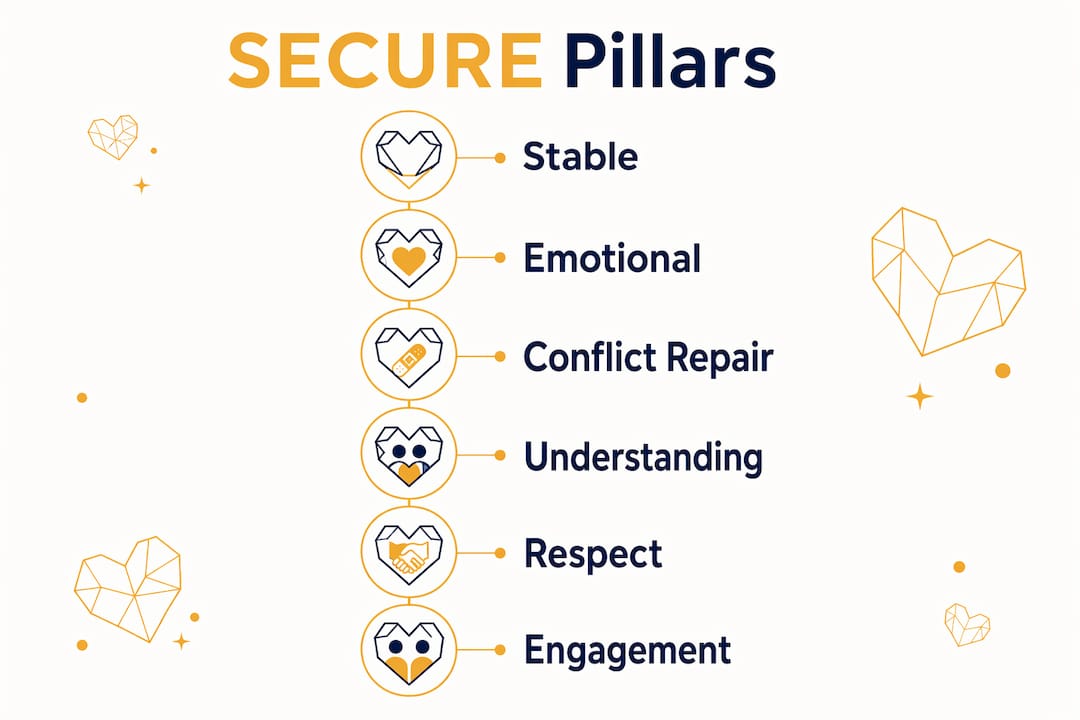
These six pillars work together. A couple can be deeply connected but not resilient, and that gap will show up every time conflict hits.
Pro Tip: Review the SECURE™ pillars together and each rate your relationship on a scale of 1–5 for each one. The lowest-rated pillar is your starting point, not a verdict on your relationship.
Daily habits that support security include expressing appreciation once per day, naming your own emotional state before asking your partner to respond to it, and building a conflict resolution framework you both agree to use before arguments start.
How do secure partners handle jealousy, emotions, and independence?
Secure individuals experience jealousy and doubt. The difference is what they do with those feelings. Secure partners self-manage difficult emotions calmly rather than demanding constant reassurance from their partners. They reflect internally first, then communicate from a grounded place.
This is the opposite of outsourcing emotional regulation. Insecure partners often need their partner to repeatedly confirm that everything is fine. That pattern creates exhaustion on one side and anxiety on the other. Secure partners build internal trust from consistent partner behavior over time, which means they do not need to test or monitor.
Here is how secure partners handle specific emotional challenges:
- Jealousy. They notice it, name it to themselves, and decide whether it reflects a real concern worth discussing or a fear worth examining alone first.
- Silence. Comfort with silence is a sign of nervous system regulation, not emotional withdrawal. Insecure couples often panic when conversation stops.
- Independence. Secure individuals allow autonomy and do not interpret a partner’s independent life as a sign of reduced love.
- Projection. Secure partners ask about their partner’s feelings rather than assuming they know. “Are you upset with me?” replaces “You’re clearly angry.”
Pro Tip: When you feel a strong emotional reaction toward your partner, wait 10 minutes before responding. Ask yourself: “Is this about what just happened, or is this an older fear?” That pause is where security gets built.
The goal is not emotional flatness. Secure people feel deeply. They have simply learned to process emotion without making their partner responsible for fixing it every time.
Key Takeaways
A secure relationship is built on consistent emotional responsiveness, effective conflict repair, and mutual respect for each other’s autonomy.
| Point | Details |
|---|---|
| Security requires psychological safety | Partners must feel safe to be vulnerable without fear of punishment or abandonment. |
| Conflict repair is the real measure | Repairing within 24–48 hours prevents resentment and keeps emotional closeness intact. |
| Attachment styles can change | Earned security through therapy and responsive relationships re-trains the nervous system over time. |
| Autonomy strengthens trust | Secure partners support independence rather than reading it as a threat to the relationship. |
| Security is a daily practice | Small habits like check-ins, soft startups, and named emotions build security more than grand gestures. |
What I’ve learned after years of working with couples on security
Most couples who come to me believe their relationship is broken because they fight. That belief is the first thing I address. Conflict is not the problem. The absence of repair is the problem.
I have worked with couples who argue loudly and love deeply. I have also worked with couples who never raise their voices and are completely disconnected from each other. The quiet ones often have the harder road, because they have confused the absence of conflict with the presence of security. Those are not the same thing.
What I find consistently is that the couples who build the most durable security are not the ones who started with it. They are the ones who chose to keep showing up after rupture. Every time you repair a conflict instead of burying it, you are sending your nervous system a message: “This relationship is safe.” Over time, that message becomes the foundation.
The concept of earned security changed how I practice. Knowing that attachment is not fixed means no one is beyond building a more secure relationship. It requires honesty, patience, and the willingness to be uncomfortable. But the couples who do this work describe their relationships as fundamentally different. Not easier, necessarily. Safer. That distinction matters more than most people realize.
If you are reading this and thinking “this sounds like a lot of work,” you are right. It is. So is the alternative.
— Carlos
Building secure relationships with Couplesfightschool
Security does not build itself. It takes the right tools, applied consistently, with someone who knows what they are doing.
Couplesfightschool offers courses, coaching, and frameworks designed specifically for couples who want to move from recurring conflict and emotional distance toward genuine safety and connection. The Stop the Fighting course teaches the communication skills that secure couples use every day, including softened startup, emotional validation, and conflict repair. For couples who want personalized support, online coaching with Carlos and Natasha provides direct guidance tailored to your specific dynamic. If you are ready to build the kind of relationship where both of you feel safe, start with the relationship skills program built for couples who are serious about lasting change.
FAQ
What is the simplest definition of a secure relationship?
A secure relationship is one where both partners feel emotionally safe to be vulnerable, knowing they will not be punished, mocked, or abandoned for it. Consistent responsiveness to each other’s emotional needs is the core mechanism that creates this safety.
What are the signs of a secure relationship?
Signs include calm conflict resolution, repair within 24–48 hours, mutual support for independence, direct communication, and comfort with silence together. Secure partners also express needs without fear and trust each other without constant monitoring.
Can someone with anxious or avoidant attachment build a secure relationship?
Yes. Earned security is achievable through therapy, self-awareness, and consistent responsive interaction with a partner. Attachment styles are not fixed; repeated safety experiences re-train the nervous system over time.
How is a secure relationship different from a conflict-free one?
A secure relationship is not defined by the absence of conflict. It is defined by the ability to repair after conflict quickly and without lasting resentment. Couples who never fight are not automatically secure; couples who fight and repair consistently are.
What does emotional safety feel like in a secure relationship?
Emotional safety feels like the freedom to say “I’m struggling” or “I was wrong” without bracing for a negative reaction. It is the physical sense of relaxation in your partner’s presence, and the confidence that honesty will be met with care rather than criticism.
Recommended