
Your Therapist-Led Coparenting Communication Plan

A therapist-led coparenting communication plan is a short, shared agreement that makes parenting conversations procedural instead of personal. Built from therapist-taught scripts, clear decision rules, and an IBSI-aligned six-session roadmap, it reduces reactivity and protects children by removing the guesswork from who says what, when, and how. Your one-sentence checklist: agree on who speaks first, which communication mode you use, how everyday versus big decisions get made, how you check in on child impact, and what happens when things escalate. To start, print the template in Section 5, agree on a 7-day pilot, and bring it to your next session. Couplesfightschool’s courses and coaching are built around exactly this kind of structured plan, using I-statements, active listening, and Marriage Hack style writing reappraisal as the core tools.
Key Takeaways
A therapist-led coparenting communication plan works because it combines specific scripts, clear decision rules, and a six-session practice roadmap that couples can implement immediately or bring to therapy.
| Point | Details |
|---|---|
| Start with the template | Fill in contact mode, decision roles, and escalation steps before your first pilot week. |
| Use four-part I-statements | Name emotion, situation, impact, and suggestion to keep conversations about behavior, not blame. |
| Six sessions is the benchmark | IBSI-aligned brief systemic work produces measurable behavior change within approximately six sessions. |
| Track three weekly ratings | Rate reactivity, decision follow-through, and child impact on a 1–5 scale each week. |
| Couplesfightschool next step | The Stop the Fighting course and online coaching both map directly to this plan’s scripts and homework structure. |
Table of Contents
- What a coparenting communication plan actually is
- Why therapist principles make the plan work
- What communication tools therapists actually teach
- A fillable coparenting communication plan template
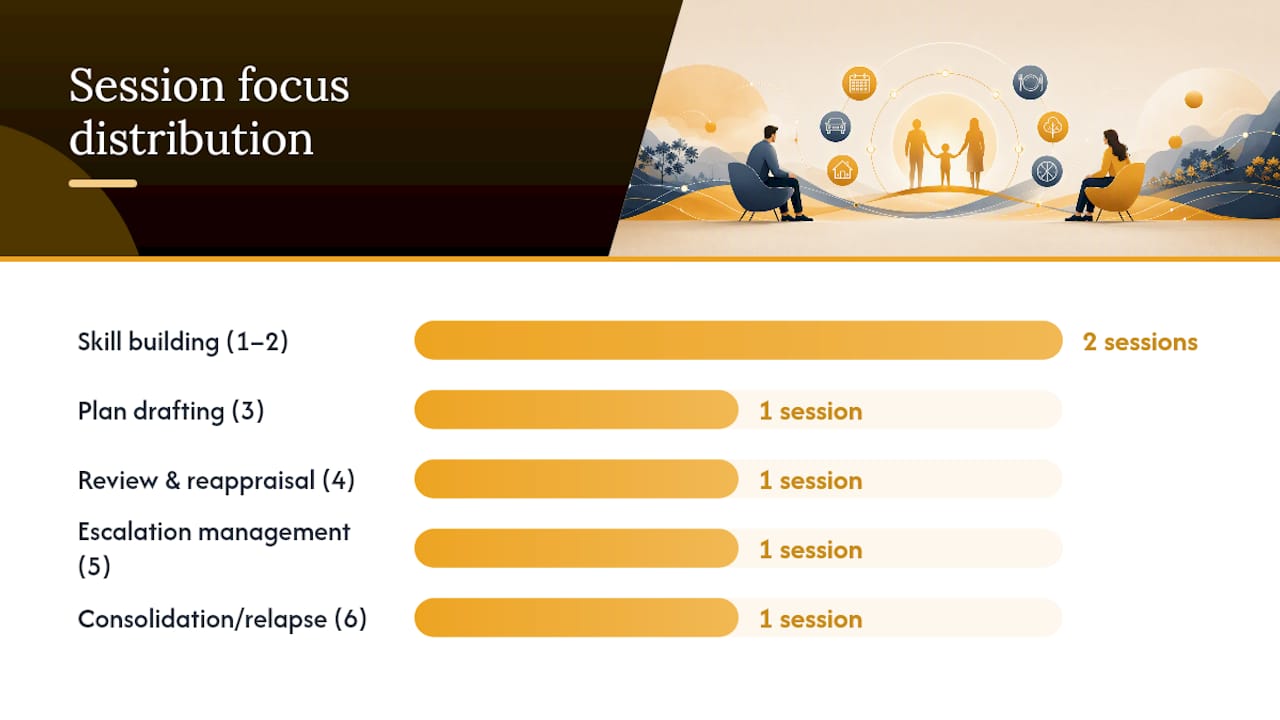
- A six-session therapist roadmap for rolling out the plan
- Short exercises couples can do between sessions
- What to do when coparenting conversations escalate
- How to measure progress and what to expect
- How to choose your starting point
- Why therapist alignment changes everything
- Couplesfightschool can help you put this plan into practice
- Sources
What a coparenting communication plan actually is
A coparenting communication plan is a written agreement between two partners who are raising children together. It spells out how they will talk about parenting, not just what they will decide. A therapist-led version goes further: it includes specific scripts, timing rules, and an escalation path that a clinician helps the couple build and practice.
This article is for couples parenting together inside a romantic relationship, whether married, engaged, or in a blended family. It is not a legal custody document or a post-divorce parenting schedule. Those serve a different purpose for a different audience.
Couplesfightschool is one ready-to-use option for couples who want therapist-created scripts and structured exercises without waiting months for a therapy opening.
Why therapist principles make the plan work
The clinical framework behind an effective plan comes largely from IBSI (Integrative Brief Systemic Intervention), a manualized six-session protocol that frames couples as both romantic partners and coparents from the very first session. Three principles drive the structure.
Joining. A therapist joins with both partners simultaneously, validating each person’s experience before asking either one to change. Without that foundation, one partner typically feels blamed and shuts down.
Child-focused psychoeducation. Research published in PMC shows that connecting parental conflict directly to children’s experience is one of the most reliable motivators for change. When couples see the spillover, they want to fix it. Therapists use circular questioning and miracle questions to make that connection concrete.
Spillover and crossover dynamics. Marital tension bleeds into coparenting, and coparenting friction bleeds back into the marriage. The plan addresses both directions deliberately, not just the parenting side.
Small, testable expectations matter too. Early wins, like completing one scheduled check-in without escalating, rebuild the validation that chronic conflict erodes.
What communication tools therapists actually teach
The most transferable skill is the four-part I-statement. According to UNL Extension’s communication guide, an effective I-message names the emotion, names the specific situation, states the impact, and offers a suggestion. In practice it sounds like this:

“I feel frustrated [emotion] when bedtime routines change without notice [situation] because our daughter gets overtired and I can’t settle her [impact]. Could we agree on a 30-minute heads-up? [suggestion]”
That structure keeps the conversation about behavior, not character. It is harder to get defensive about a specific situation than about a global accusation.
Active listening pairs with I-statements. After your partner speaks, paraphrase before responding: “So what I’m hearing is that you feel cut out of the school decisions. Is that right?” That one check prevents most misunderstandings before they compound.
The C.A.R.E. mindset (Communication, Acceptance, Respect, Empathy) gives couples a pre-conversation reset. Psychology Today’s guidance on C.A.R.E. is direct: text is a notification tool, not a communication mode for complex parenting topics. Reserve face-to-face or voice calls for anything that requires nuance.
Do/don’t quick guide:
- Do schedule parenting conversations at a neutral time, not mid-argument.
- Do pause for 30 seconds before responding to a charged statement.
- Don’t use text to raise a new parenting concern for the first time.
- Don’t bring up a grievance from last week inside a conversation about this week’s logistics.
Pro Tip: Set a recurring 20-minute weekly check-in, same day and time each week. Predictability alone reduces the anxiety that triggers defensive communication.
A fillable coparenting communication plan template
Use this template as a starting point. Fill in each field together, then agree on a 7-day pilot before your next therapy session.
Template fields:
- Contact mode: Face-to-face for decisions; text only for logistics and brief updates.
- Response window: Replies to parenting questions within 4 hours during waking hours.
- Scheduled check-in: Every Sunday at 7:00 PM, 20 minutes maximum.
- Everyday decisions: The parent present at the time decides (meals, homework, bedtime).
- Big decisions: Both partners discuss at the scheduled check-in; 48-hour reflection before finalizing.
- Parental territories: Partner A leads school communication; Partner B leads medical appointments. Revisit in 6 weeks.
- Escalation: If the conversation escalates, pause, write for 30 seconds, then table the topic to the next check-in or request a therapist call-in.
- Review schedule: 6-week review in therapy to adjust what isn’t working.
Decision type overview:
| Decision type | Who decides | Timeframe |
|---|---|---|
| Daily routine (meals, bedtime) | Present parent | Immediate |
| School and activity scheduling | Designated lead partner | Within 4 hours during waking hours |
| Medical and health decisions | Both partners | 48-hour discussion window |
| Financial commitments for children | Both partners | Weekly check-in agenda |
Filled example: “When a school issue comes up mid-week, Partner A sends a brief text: ‘School topic for Sunday check-in.’ At the check-in, Partner A opens with an I-statement. Partner B paraphrases before responding. If either partner feels flooded, they say ‘pause’ and the topic moves to a written note for the therapist.”
Agree on a 6-week review in therapy. What works in week one often needs adjustment by week four.
A six-session therapist roadmap for rolling out the plan
IBSI’s manualized structure gives therapists a reproducible sequence. Brief systemic approaches typically produce measurable changes across 5–6 sessions.
| Session | Objective | Tools used | Homework |
|---|---|---|---|
| 1 | Join with couple; set minimum shared objectives | Joining, psychoeducation on child impact | Observe one parenting exchange without intervening |
| 2 | Introduce I-statements and active listening | Script practice, role-play | Use one I-statement per day for 7 days |
| 3 | Draft the communication plan together | Template, decision-type mapping | Pilot the plan for 7 days; rate reactivity 1–5 |
| 4 | Review pilot; introduce C.A.R.E. and writing reappraisal | Marriage Hack writing task, C.A.R.E. reset | Complete 3×7-minute writing sessions |
| 5 | Address escalation; set parental territories | Escalation flow, pause-and-write | Practice the pause protocol in one real exchange |
| 6 | Reflect on gains; build relapse plan | Circular questioning, consolidation | Schedule 6-week self-review; identify early warning signs |
Fidelity markers are straightforward: homework completion rate and observable behavior change (fewer escalations, more paraphrasing) are the two clearest signals that the plan is taking hold.
Short exercises couples can do between sessions
Three brief interventions build muscle memory between appointments.
-
Marriage Hack-style writing reappraisal (3×7 minutes). Based on the Love Together Parent Together (L2P2) writing intervention, each partner writes for 7 minutes from a neutral third-party perspective on a recent parenting disagreement. Prompt: “How might a wise, caring outsider who wants the best for both of you and your children see this situation?” Do this three times across the week, not three times in one sitting.
-
I-statement role-play (10 minutes). Pick a low-stakes parenting topic. One partner states a concern using the four-part structure; the other paraphrases before responding. Switch roles. Record what felt awkward. Bring those notes to session.
-
Daily 5-minute check-in. Not a problem-solving session. One question each: “What’s one thing that went well with the kids today?” This builds positive coparenting momentum without requiring conflict resolution skills.
Therapists should review homework at the start of each session, not the end. Reviewing it first signals that the between-session work matters as much as the in-session conversation.
What to do when coparenting conversations escalate
High-conflict moments need a pre-agreed protocol, not improvised decisions. The escalation flow has three steps: pause, write, then either table the topic to the next check-in or request a therapist call-in.
Escalation checklist:
- Say “pause” out loud. Both partners stop speaking.
- Each partner writes for 30 seconds: what am I feeling right now, and what do I actually need?
- If the conversation can resume calmly, use an I-statement to re-enter. If not, table it.
- Activate parental territories: temporarily delegate the contested responsibility to one partner with a clear time limit (e.g., “You handle school communication for the next two weeks”).
- If escalation is frequent or safety is a concern, contact a licensed therapist or mediator before the next parenting conversation.
Safety note: If any exchange involves threats, intimidation, or fear, prioritize safety above the plan. Contact a professional or, if necessary, child protective services. No communication plan replaces a safety plan.
Pro Tip: Agree on your pause word before you need it. Couples who pre-negotiate a neutral signal (“pause,” “yellow light”) de-escalate faster than those who try to negotiate the signal mid-conflict.
For practical de-escalation techniques that pair with this protocol, Couplesfightschool has a dedicated resource.
How to measure progress and what to expect
Track three things weekly on a simple 1–5 scale: reactivity during parenting conversations (1 = very reactive, 5 = calm), shared decision follow-through (1 = ignored, 5 = both honored), and child impact observations (1 = children visibly stressed, 5 = no noticeable distress).
Timeline:
- Sessions 2–3: Small wins. Fewer interruptions, at least one successful paraphrase per check-in.
- Session 6: Measurable behavior change. Research on brief systemic approaches confirms that couple-targeted interventions generally improve parental communication and coparenting within this window.
- 3 months post-therapy: Consolidation. The plan runs mostly on autopilot; couples self-correct without needing to invoke every rule.
Revise the plan when homework stalls for two consecutive weeks, escalation returns to baseline, or a new stressor (job change, new child, blended family shift) changes the context. Those are signals to return to therapy, not signs the plan failed.
How to choose your starting point
Seek a therapist first if:
- Conversations regularly feel unsafe or one partner shuts down completely.
- You’ve tried communication tools before and they escalate rather than help.
- There are safety concerns of any kind.
Self-guided work fits if:
- Conflict is mild to moderate and both partners are motivated.
- You want to pilot the plan before committing to a full therapy course.
- You’re looking for structured scripts and exercises you can practice at home.
For self-guided work, a 7-day pilot using the template above is a low-risk starting point. Prepare for a first therapy session by filling in the template fields in advance and bringing your weekly ratings. That gives a therapist immediate, concrete data to work with instead of spending the first session on intake logistics.
Adding practitioner contact to self-directed work tends to improve outcomes, as L2P2 program research suggests. Even occasional check-ins with a coach or therapist sharpen accountability.
Why therapist alignment changes everything
Most couples who struggle with parenting conversations aren’t short on love. They’re short on structure. A plan without therapist alignment tends to collapse the first time emotions run high, because neither partner has practiced the skills under pressure. Therapist involvement creates accountability, catches misuse of techniques early, and gives couples a place to process what the plan surfaces.
Couplesfightschool’s approach is built on exactly this premise: scripts and frameworks are only as good as the practice behind them. The F.I.G.H.T. Plan® framework gives couples a repeatable system, and the communication skills resources on the site translate clinical principles into exercises couples can actually use between sessions. Bringing a filled-out template to a coaching session shortens the runway considerably.
Couplesfightschool can help you put this plan into practice

Couplesfightschool offers the structured support this plan needs to stick. The Stop the Fighting course walks couples through the exact scripts covered here, including I-statements, active listening, and the C.A.R.E. mindset, with built-in homework and practice exercises that mirror the six-session roadmap. For couples who want a practitioner in the room, online coaching pairs you with a trained coach who can review your filled template, assign the writing reappraisal exercises, and hold you accountable between sessions. Both options are available now. Start with the course if you’re ready to practice on your own, or book a coaching session if you want therapist-level guidance from session one.
Sources
- Using “I” messages: A communication skill for reducing defensiveness (UNL Extension)
- Parents in couple therapy: An intervention targeting marital and coparenting relationships (PMC)
- The effectiveness of interventions targeting interparental conflict: systematic review (Journal of Child and Family Studies)
This article is general information, not a substitute for advice from a qualified doctor. Consult a qualified healthcare professional about your own circumstances before acting on anything here.
Recommended