
How to Deal With Issues in a Relationship Right Now

The single most effective move when relationship issues surface is a safe, time-boxed repair conversation that opens with a softened start-up and one clear “I” statement. Not a marathon talk. Not a text essay at midnight. A short, structured conversation where both people know it will end, and it starts gently instead of with an accusation.
This works because how a conversation begins predicts how it ends. Researchers who study couples call this the first three minutes rule, and it holds up: a harsh opening almost always produces a defensive, unproductive fight, while a softened start-up sets up real repair. Small repair attempts, like a well timed apology or a moment of humor, are what keep small conflicts from turning into chronic ones.
Before you dive into the deeper strategies below, here’s what to do in the next hour:
- Set a time limit (20 to 30 minutes) before you start talking.
- Take 10 to 20 minutes apart first if either of you is flooded or shaking with anger.
- Open with “I feel…” instead of “You always…”
- Say one specific thing you need, not a list of grievances.
- Accept any small peace offering your partner makes, even an awkward one.
- Schedule a specific follow-up time to revisit anything unresolved.
Key Takeaways
Relationship issues resolve fastest when couples pair a softened, time-boxed repair conversation with consistent daily habits that keep positive interactions outpacing negative ones.
| Point | Details |
|---|---|
| Start with a softened opening | How you begin a hard conversation predicts how it ends more than what you actually say next. |
| Identify the hidden need | Most surface complaints, money, time, trust, mask a deeper need for safety, respect, or connection. |
| Protect your 5:1 ratio | Stable couples keep roughly five positive interactions for every negative one, even during conflict. |
| Know your red flags | Threats, coercion, or persistent contempt call for safety planning, not communication scripts. |
| Get structured support when stuck | Couples Fight School’s coaching, intensives, and workbooks give couples a repeatable framework alongside or instead of ongoing therapy. |
Trusted Resources and Helplines
- Simply Psychology’s conflict resolution guide: research summary on repair attempts and the 5:1 ratio.
- 988 Lifeline: 24/7 crisis support line.
- SAMHSA National Helpline: treatment referrals for mental health or substance use.
- The Hotline: domestic violence safety planning and chat support.
- RAINN: support for survivors of sexual assault.
- loveisrespect.org: resources for dating and relationship abuse.
Table of Contents
- Common Relationship Problems and the Needs They Hide
- What Is the Step-by-Step Process to Repair a Relationship Conflict?
- What Communication Habits Prevent Conflicts From Escalating?
- When Should You Get Professional Help for Relationship Issues?
- Should You Stay or Leave? Red Flags and Safety Planning
- How Long Does It Take to Rebuild Trust After a Betrayal?
- Quick Exercises and Scripts to Try in the Next 24 to 72 Hours
- How Do You Stay Calm and Self-Soothe During a Fight?
- How Do Attachment Styles Shape the Way You Fight?
- How Do You Set Boundaries Without Escalating a Disagreement?
- What Does Couples Fight School Offer If You Want Guided Support?
- Frequently Asked Questions
- Sources
Common Relationship Problems and the Needs They Hide
Most fights are not about what they appear to be about. The dish left in the sink or the tone of a text message is the surface. Underneath, someone usually feels disconnected, unsafe, unseen, or powerless. Knowing which category you’re in changes what actually fixes it.
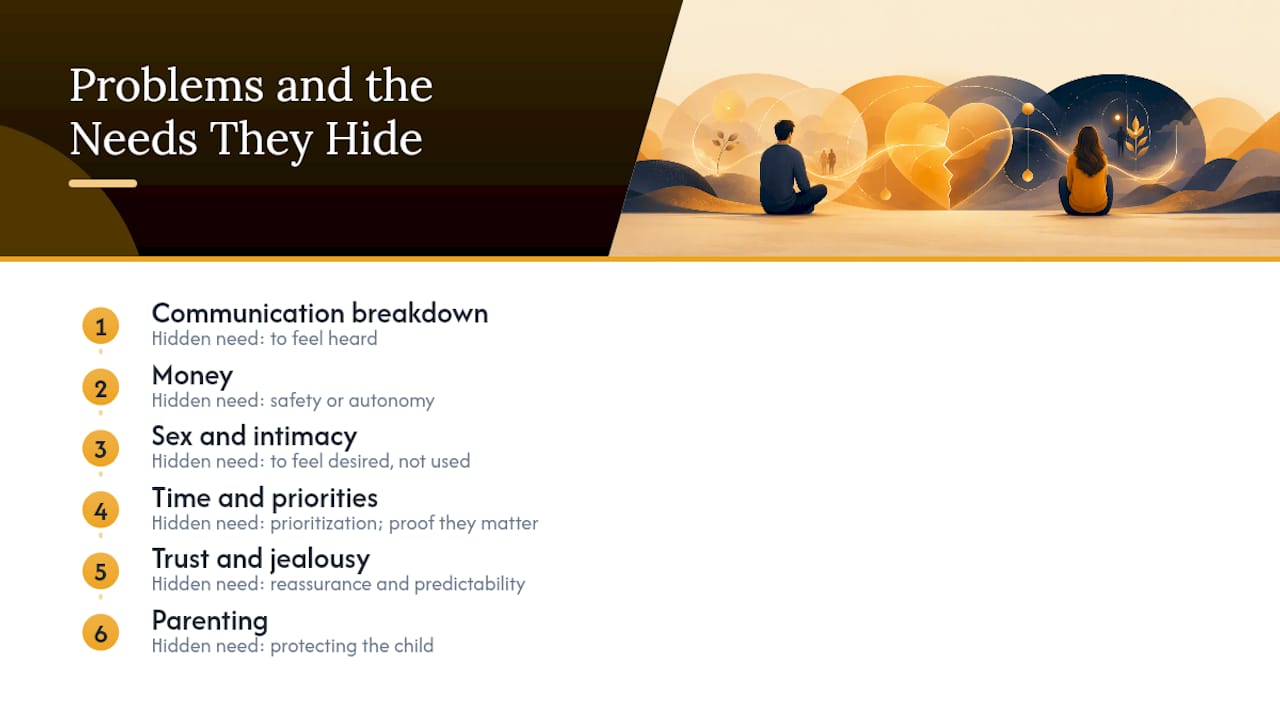
Communication breakdown. One partner talks in specifics, the other in generalities. One needs to process out loud, the other needs silence first. Neither is wrong, but the mismatch reads as disrespect. The hidden need is usually to feel heard, not to win the exchange. Communication styles clash more often from timing and pace than from actual disagreement about the issue itself.
Money. Financial conflict rarely stays financial. It becomes a proxy for control, fairness, or fear about the future. A partner who grew up with scarcity may see a $200 impulse purchase as reckless; a partner who grew up with abundance may see budgeting as controlling. The underlying need is almost always safety or autonomy, not the dollar amount.
Sex and intimacy. Mismatched desire, unspoken expectations, or drift after a major life change (a baby, a move, a health scare) all show up here. The conflict is rarely about frequency alone. It’s usually about feeling desired versus feeling used, or about one partner interpreting rejection as a verdict on the relationship.
Time and priorities. Work, kids, friends, hobbies. Someone feels like they’re low on the list. This one hides a need for prioritization and proof that they matter, which is why “I’m just busy” almost never lands as an acceptable answer.
Trust and jealousy. Sometimes this stems from a real breach. Sometimes it’s an old wound from a past relationship being projected onto a partner who hasn’t done anything wrong. Either way, the need is reassurance and predictability.
Parenting. Differing discipline styles or division of labor around kids trigger some of the most persistent arguments in long-term relationships, largely because both partners believe they’re protecting the child.
Quick signal to gauge severity: a one-off incident usually has an identifiable trigger and resolves once you name it. A recurring pattern shows up in the same words, the same time of day, or the same trigger event across weeks or months. If you can predict the fight before it starts, you’re dealing with a pattern, not an incident, and that calls for the structured repair process below rather than a quick fix.
What Is the Step-by-Step Process to Repair a Relationship Conflict?
Constructive conflict frameworks generally follow the same skeleton: create safety, listen, name the need, generate solutions, agree, and follow through. Here is a version you can run tonight.
- Create a safe space. Pick a time when neither of you is exhausted, hungry, or already irritated. Turn off the TV. Say out loud: “I want to understand this, not win it.”
- Open with a softened start-up. Skip “You never listen to me.” Try: “I felt dismissed earlier when I brought up the schedule. Can we talk about it?” The first sentence you say sets the entire tone for what follows.
- Listen and reflect back before responding. Paraphrase what you heard before adding your own point: “So you felt like I made a decision without checking with you first. Is that right?” This single step prevents more escalation than almost anything else couples try.
- Identify the need underneath the complaint. Ask directly: “What do you need from me right now, connection, space, or a decision?” Most complaints translate into one of four needs: to feel respected, to feel prioritized, to feel safe, or to feel free.
- Generate two or three real options together. Not one person’s solution presented as the only option. Brainstorm out loud, even bad ideas, before picking one.
- Agree on one specific next step and a follow-up date. “Let’s try splitting the bedtime routine and check back in Sunday” beats “Let’s communicate better.”
A few copy-ready lines worth keeping on hand:
- I-statement starter: “I feel [emotion] when [specific situation] because I need [specific need].”
- Reflection prompt: “What I hear you saying is ___. Did I get that right?”
- Repair attempt: “Can we hit pause for a second? I don’t want this to turn into something bigger.”
Pro Tip: Repair attempts often look clumsy in the moment, a bad joke, a hand reaching for yours, an “I’m sorry, that came out wrong.” Struggling couples tend to miss or reject these bids because they’re still in defense mode. Train yourself to notice the attempt and accept it, even if the delivery was awkward. Accepting a clumsy repair attempt matters more than waiting for a perfect one.
Here’s the number that explains why any of this matters: couples in stable, satisfying relationships maintain roughly a 5:1 ratio of positive to negative interactions, even during active conflict. That ratio isn’t about avoiding disagreement. It’s about making sure the small repair moments, the joke, the hand on the shoulder, the “I hear you”, keep outpacing the criticism. Couples who lose that ratio are the ones who report feeling like roommates instead of partners within a year or two.
What Communication Habits Prevent Conflicts From Escalating?
The repair sequence above works during a fight. What you do between fights determines how often you need it.
- Softened start-ups as default, not just for big conversations. Practice with small stuff first.
- Active listening, meaning you’re not formulating your rebuttal while your partner is still talking.
- Reflection and paraphrase, used casually, not just in crisis mode.
- Validation, which is different from agreement: “That makes sense given what happened” doesn’t require you to concede the argument.
- Tactical pause or time-out, agreed on in advance, with a real return time attached (“give me 20 minutes, I’m coming back”).
- Naming the emotion out loud, “I’m anxious, not angry,” clarifies more than most people expect.
- Accepting influence, actually letting your partner’s opinion change your decision sometimes, not just hearing it.
Daily micro-actions raise your baseline ratio without much effort: one specific gratitude (“thanks for handling the pickup today”), one curiosity question (“how did that meeting actually go?”), one physical check-in. None of these take more than 30 seconds.
Weekly, a 15-minute debrief works better than letting five small irritations pile up into one large one. Ask two questions: “What went well between us this week?” and “What’s one thing I could do differently?” Pair that with something that has nothing to do with conflict at all. Even something as simple as a shared meal out resets the emotional tone and gives you something other than logistics to talk about.
When Should You Get Professional Help for Relationship Issues?
Some problems don’t resolve with better scripts. If you’re having the exact same fight for the fifth or sixth time with no new ground gained, that’s a sign. So is the shift from frustration into contempt, eye-rolling, name-calling, or one partner going silent and refusing to engage (stonewalling). Infidelity, active addiction, or untreated mental health conditions also generally sit outside what self-guided repair work can fix alone.
Your options break down roughly like this:
- Couples therapy with a licensed clinician, typically weekly, addressing deeper patterns and history.
- Online therapy or coaching, often more flexible on scheduling and sometimes lower cost than in-person.
- Workshops or structured courses, useful for learning a framework without ongoing sessions.
- Intensives, a concentrated block of hours (often a half day or full day) aimed at breaking a specific stuck pattern fast.
Ballpark U.S. costs: a single therapy session commonly runs somewhere between $100 and $250 out of pocket depending on region and provider, though insurance and sliding scales can lower that. Online coaching programs and structured courses often price out lower per session than traditional weekly therapy. Intensives usually cost more upfront but replace weeks of sessions.
Before booking anyone, ask: What’s your approach to conflict work specifically? How many sessions before we’d expect to see change? What happens if one of us isn’t ready to engage? A peer-reviewed review of couple interventions found that programs teaching structured communication and emotional regulation skills consistently improved outcomes, which is worth asking a prospective therapist about directly. For substance-related concerns, Findtreatment is a searchable government directory of licensed programs.
Should You Stay or Leave? Red Flags and Safety Planning
Not every relationship problem is fixable with better communication, and pretending otherwise can be dangerous. Certain behaviors are warning signs of an unhealthy or unsafe relationship, not just a rough patch:
- Threats, intimidation, or any physical violence, even “minor” or “one-time.”
- Controlling behavior around money, friendships, or your whereabouts.
- Coercion around sex or refusal to accept “no.”
- Persistent contempt, humiliation, or mocking, especially in front of others.
- Isolation from friends or family as a pattern, not an accident.
If any of these describe your relationship, this article’s repair scripts are not the right tool. Safety comes first. A basic safety plan includes: a trusted friend or family member who knows your situation, a specific place you could go on short notice, copies of important documents kept somewhere accessible, and a plan for your phone and accounts if you need privacy from a partner who monitors you.
If you are in immediate danger, call 911. For crisis support, 988 Lifeline is the national number for behavioral health crises. For domestic violence specifically, The Hotline offers chat and phone support. Survivors of sexual violence can reach RAINN, and anyone in a dating relationship dealing with abuse can use loveisrespect.org.
How Long Does It Take to Rebuild Trust After a Betrayal?
Rebuilding trust after infidelity, lying, or another significant breach doesn’t run on a fixed calendar, but a rough shape helps set expectations.
- Immediately (first 1 to 2 weeks): full transparency on the specific breach, no minimizing, and a decision about whether both people want to try.
- 2 to 6 weeks: consistent, checkable behavior changes, agreed on explicitly rather than assumed. Weekly check-ins on how trust is rebuilding, not just whether the fighting has stopped.
- 3 months: a maintenance rhythm, less daily vigilance, more normal connection returning, though occasional resurfacing of hurt is normal.
Accountability looks like specific, observable commitments, not vague promises. “I’ll tell you where I am if I’m running late” beats “I’ll be more considerate.” Track whether the behavior actually happened, not just whether the apology sounded sincere.
When progress stalls, restart with a smaller, single-issue repair conversation rather than reopening everything at once. If two or three restarts don’t move the needle, that’s the moment to bring in a therapist rather than keep repeating the same conversation.
Quick Exercises and Scripts to Try in the Next 24 to 72 Hours
Pick one and use it before your next disagreement, not during the heat of one.
- The 5-5-5 rule: each partner speaks uninterrupted for 5 minutes, then 5 minutes of silent reflection, then 5 minutes of discussion. Total time: 15 minutes.
- Tactical pause script: “I need 20 minutes to calm down. I’m not leaving the relationship, I’m coming back at [specific time].”
- Day-in-the-life check-in: ask “What was the hardest part of your day?” every evening for a week. Two minutes, no advice-giving allowed.
- Gratitude exchange: each person names one specific thing the other did that day. Not “thanks for everything,” something concrete.
Expected outcome: not resolution of every issue, but a measurable drop in how fast conversations escalate within about a week of consistent practice.
How Do You Stay Calm and Self-Soothe During a Fight?
Your body reacts to conflict before your brain catches up. Heart rate spikes, breathing shortens, and once you’re flooded, physiologically, you cannot listen well or think clearly no matter how much you want to. This is biology, not a character flaw.

The fix isn’t to suppress the reaction. It’s to notice it early and interrupt it. Physical signs worth tracking: clenched jaw, tight chest, the urge to raise your voice or go silent. When you notice two or more, that’s your cue to call a tactical pause rather than push through.
Self-soothing during the pause matters more than the pause itself. Slow, extended exhales (longer out-breath than in-breath) calm your nervous system faster than deep breathing alone. A short walk, cold water on your wrists, or simply sitting somewhere quiet for the agreed time all work. What doesn’t work: rehearsing your counterargument during the break. That keeps your body in fight mode even while you’re physically apart.
Come back at the time you promised, even if you don’t feel fully ready. Returning late, or not at all, teaches your partner that time-outs are a way to avoid the conversation rather than a way to have it better.
How Do Attachment Styles Shape the Way You Fight?
The way you learned to handle closeness and separation early in life shows up loudly during conflict. Someone with an anxious attachment style tends to pursue during a fight, texting repeatedly, needing immediate reassurance, reading silence as rejection. Someone with an avoidant style tends to withdraw, needing space to process and experiencing pursuit as pressure.
Put those two together, which happens often, and you get the classic pursue-withdraw cycle: one partner chases for connection, the other retreats for space, and the retreat makes the chasing more urgent, which makes the retreat deeper. Neither person is doing this on purpose, and neither is wrong. They’re running different survival strategies learned long before they met each other.
Knowing your own pattern changes how you interpret your partner’s behavior. Withdrawal isn’t automatically indifference. Pursuit isn’t automatically neediness. If you tend to withdraw, naming it out loud (“I need 20 minutes, I’m not shutting you out”) does more to calm an anxious partner than silence ever will. If you tend to pursue, agreeing in advance to a specific return time reduces the panic that drives the chasing.
How Do You Set Boundaries Without Escalating a Disagreement?
A boundary is a statement about your own limits, not a demand about your partner’s behavior. “I won’t continue this conversation if you raise your voice” is a boundary. “You need to stop yelling” is a demand, and demands tend to invite resistance.

State boundaries before you need them, not in the middle of a fight when they sound like an ultimatum. A calm moment beforehand, “if either of us starts yelling, I want us to agree to pause,” sets the rule when nobody’s defensive.
Boundaries need a consequence you actually follow through on, or they’re just words. If you said you’d leave the room when things get heated, leave the room. Inconsistent follow-through teaches your partner the boundary is negotiable under pressure, which guarantees it gets tested again.
Boundaries also aren’t punishment. “I need space right now” delivered calmly protects the relationship. The same words shouted as a way to win the argument do the opposite. The difference is tone and timing, not the words themselves.
A Publisher’s Perspective on the F.I.G.H.T. Plan®
We built the F.I.G.H.T. Plan® because most couples know they should communicate better but don’t have a repeatable structure for the moment things get heated. It maps closely to the repair sequence above: safety first, then the hard conversation. It’s a practical complement to therapy, built for the 80 percent of conflicts that don’t require clinical intervention, not a substitute for professional care when safety or serious mental health issues are involved.
What Does Couples Fight School Offer If You Want Guided Support?
If the steps above feel right but hard to execute alone at 11 p.m. during an actual argument, that’s normal, most couples need practice with feedback, not just information. Couples Fight School builds that practice into every offering, from a self-paced course to live coaching sessions.

A few ways couples typically start:
- Online coaching for couples who want a therapist-adjacent guide walking them through real disagreements in real time, usually weekly.
- The 4-hour intensive for couples stuck in one specific recurring fight who want to break the pattern in a single concentrated session rather than months of weekly work.
- The couples therapy workbook for couples already in therapy who want structured exercises to use between sessions.
Most couples see the biggest shift within the first two or three sessions, once they have language for what’s actually happening underneath the argument. If you’re ready to stop having the same fight on repeat, explore relationship counseling options and book a starting session this week.
Frequently Asked Questions
What is the fastest way to deal with issues in a relationship?
Start a short, time-boxed conversation with a softened opening line and one specific “I” statement rather than a list of complaints. Keep it under 30 minutes and schedule a follow-up if it’s not fully resolved.
How do you know if a relationship problem is normal or a red flag?
Normal conflict involves disagreement without threats, coercion, or physical intimidation, and both partners can eventually reflect calmly. If you see threats, control, or violence, that’s a safety issue, not a communication issue.
What is a repair attempt in a relationship?
It’s a small bid to de-escalate a fight, humor, an apology, a touch, or an explicit “let’s pause.” Couples who notice and accept these bids tend to stay more stable over time than couples who miss or reject them.
How often should couples check in about unresolved issues?
A short weekly debrief, 15 minutes, works better for most couples than letting frustrations build for a month and then having one large blowup.
When should a couple consider therapy instead of self-guided repair work?
When the same fight repeats without progress, when contempt or stonewalling has become common, or when infidelity, addiction, or a mental health condition is involved.
Sources
- PMC Article: interventions that improve couple functioning
- Mass
- SAMHSA national helpline
- 988 Lifeline