
How to Apologize to Your Spouse and Actually Mean It
A sincere apology in marriage names the specific wrong, takes full ownership without excuses, and states what you’ll do differently, because vague or defensive apologies leave your partner feeling unseen instead of repaired. Couples Fight School, the psychologist Dr. Gary Chapman, and clinicians writing for Psychology Today all point to the same structure. Here’s a script you can use tonight:
“I’m sorry I [specific action]. That must have made you feel [impact]. I was wrong, and I want to do better.”
Use this immediately when:
- The hurt is fresh (within the same day, if possible)
- You’re both calm enough to talk without raised voices
- You have privacy, not mid errand or in front of the kids
Pro Tip: Say the words facing your partner, not while doing dishes or scrolling your phone. Eye contact signals the apology is the priority, not an afterthought.
Key Takeaways
A sincere apology in marriage names the specific offense, takes full ownership, validates the partner’s experience, and pairs remorse with a concrete, followed through commitment to change.
| Point | Details |
|---|---|
| Name the action | Say exactly what you did rather than a vague “I’m sorry about that.” |
| Drop the qualifiers | Cut “but” and “if” entirely; they cancel the apology’s sincerity. |
| Match their apology language | Identify whether your partner needs words, restitution, or a plan for change. |
| Separate forgiveness from healing | Expect acceptance to come quickly and full trust to rebuild over weeks or months. |
| Practice with guided coaching | Couples Fight School’s coaching and courses help couples rehearse apology scripts and accountability. |
Table of Contents
- Why a Real Apology in Marriage Changes Everything
- The Step-By-Step Apology Framework Couples Therapists Recommend
- Non-Apologies That Make Things Worse
- What Happens After the Apology Is Said
- When to Get Outside Help With Apologies and Repair
- Practice Apologies That Actually Rebuild Trust
- Frequently Asked Questions
- Sources
Why a Real Apology in Marriage Changes Everything
A well-delivered apology does three things at once: it restores emotional safety, interrupts the escalation cycle, and models the kind of accountability that keeps small conflicts from turning into resentment.
- Restores safety: your partner stops bracing for the next fight
- Reduces escalation: naming the wrong early prevents defensive spirals
- Models accountability: shows your partner you’ll own mistakes without prompting
- Enables healing: consistent follow through, not just words, rebuilds trust over time
Consider a couple where one partner forgot an anniversary dinner reservation. A flat “sorry about that” left resentment simmering for weeks. A specific apology, naming the missed effort and offering to plan the next date night himself, resolved the tension within days.
Forgiveness and healing aren’t the same event. A partner can forgive quickly, as an act of will, while the emotional healing that restores full trust takes considerably longer and depends on consistent, changed behavior.
The Step-By-Step Apology Framework Couples Therapists Recommend
Every effective apology, according to couples therapists writing for Psychology Today, follows the same sequence: acknowledge specifically, own it fully, validate the impact, express genuine remorse, offer repair, and commit to change. Skip a step, and the apology tends to feel incomplete even when the words sound right.
- Acknowledge the specific action. Say exactly what you did. “I raised my voice during dinner” beats “I know I messed up.”
- Own it without qualifiers. Cut “but,” “if,” and “you also.” Full ownership means the sentence ends after the apology.
- Validate their experience. “That probably made you feel dismissed” tells your partner you understand the impact, not just the action.
- Express genuine remorse. A brief, honest “I hate that I did that to you” carries more weight than a long explanation.
- Offer concrete repair. Ask what would help right now, whether that’s space, a hug, or a specific fix.
- Commit to change and follow through. State one thing you’ll do differently, then actually do it.
Here are four scripts for common ruptures:
Missed event or broken promise: “I’m sorry I skipped your work event without warning you. That was disrespectful of your time, and I know it embarrassed you. I’ll put these dates on our shared calendar going forward.”
Harsh words during an argument: “I’m sorry I called you lazy. That was cruel and untrue, and I said it to hurt you. I want to work on catching myself before I go there again.”
Boundary violation: “I’m sorry I read your messages without asking. That broke your trust, and I understand if you need space before you feel okay with me again.”
Repeated habits: “I know I’ve said this before and haven’t followed through. This time I’m asking for your help holding me accountable, because I want this to actually change.”
Timing and tone matter as much as the words themselves. A rushed apology delivered while walking out the door is often perceived as damage control rather than true remorse. Sit down, lower your voice, and let a pause sit in the conversation instead of filling it with justification.

Pro Tip: Ask your partner, outside of conflict, what makes an apology feel real to them. Dr. Gary Chapman’s research on apology languages found that people vary in whether they need words of regret, a clear acceptance of responsibility, an offer of restitution, or a stated plan for change. Apologizing in the wrong language, no matter how sincere, can leave your partner doubting you.
Here’s how a real exchange might sound:
Him: “I’m sorry I dismissed your idea in front of my parents. That was disrespectful, and I should have backed you up.”
Her: “I’m still upset. It felt like you cared more about impressing them than supporting me.”
Him: “That makes sense. I didn’t think about how that looked to you, and I own that.”
Notice he doesn’t argue with her lingering hurt. Validating the feeling, even when the apology has already been given, is what keeps the conversation from turning into round two of the fight.
Non-Apologies That Make Things Worse
Certain phrases sound like apologies but function as accusations in disguise. Watch for these:
- “I’m sorry you feel that way” (blames their reaction, not your action)
- “I’m sorry, but you were also…” (the “but” cancels the apology)
- “If I offended you, I’m sorry” (denies the offense happened)
- “Okay, I’m sorry, can we move on” (treats the apology as a formality)
Each one shifts responsibility back onto the hurt partner. Focus on the Family’s guidance is blunt about this: naming the actual offense is non negotiable, and conditional language (“if,” “but”) signals you’re protecting your ego rather than repairing the relationship. Crossed arms, a flat tone, or checking your phone mid apology send the same defensive message your words are trying to avoid.
What Happens After the Apology Is Said
Accepting an apology and feeling better are two different things, and conflating them causes real friction. A hurt partner can say “I accept that” and still need days to feel emotionally settled.
If you’re the one who was hurt and you’re not ready to fully forgive yet, try this:
- Acknowledge the apology out loud: “I hear that you’re sorry.”
- Name what’s still lingering: “I’m still feeling guarded, and that’s going to take some time.”
- Ask for something concrete: “Can we check in about this again this weekend?”
Short term (days): expect continued tenderness around the topic; avoid bringing it up as ammunition in unrelated fights.
Medium term (weeks): trust starts rebuilding through repeated, consistent behavior that matches the commitment made.
Long term (months): the old pattern stops triggering the same defensiveness, a sign real healing has taken hold.
Q: My spouse apologized but I’m still angry. Am I wrong?
A: No. Anger and acceptance can coexist while healing catches up to forgiveness.
Q: How do I respond if I need more time before forgiving?
A: Say so plainly, and give a timeframe for revisiting it, rather than going silent.
When to Get Outside Help With Apologies and Repair
Self-guided work handles most day to day ruptures. Reach for a book, workbook, or short course when you and your partner both want to improve but the pattern isn’t a crisis.
- Self-guided: short articles, a shared workbook, or practical exercises on resolving resentment work for occasional friction.
- Courses or workshops: better when apologies keep following the same script and neither partner knows how to break it.
- Couples therapy: necessary for major breaches of trust, betrayal, or patterns where apologies happen but repair still stalls out.
Accountability, according to Prepare/Enrich’s research, works best as an ongoing practice rather than a one-time correction. That means treating change as help you’re requesting from your partner, not responsibility you’re handing off entirely. Couples Fight School builds this into its therapist-created workbook, which walks couples through apology scripts and accountability check-ins developed by licensed clinicians Carlos Todd and Natasha Pemberton-Todd.
A therapist-informed take on why most apologies fail
Most couples don’t lack the desire to apologize. They lack the structure. I’ve seen the same defensive habits show up across wildly different marriages: the “but,” the rushed timing, the apology that never names the actual offense. The F.I.G.H.T. Plan exists because good intentions without a framework rarely produce lasting repair.
Practice Apologies That Actually Rebuild Trust
Reading a framework is one thing. Saying the words out loud, under real emotional pressure, without slipping into defensiveness, is another skill entirely. That’s the gap between couples who apologize well on paper and couples who actually repair.
Couples Fight School’s online coaching for couples gives you guided practice with a real coach, not just a script to memorize. You’ll role play the hard conversations, get direct feedback on where your apologies turn defensive, and build accountability check-ins that stick past the first week. For couples who want a structured starting point first, the communication and conflict resolution course walks through the same F.I.G.H.T. Plan framework with exercises you can practice together at home. Book a coaching session this week if repeated apologies haven’t stuck, or start the course if you’re ready to build the skill from scratch.
Frequently Asked Questions
How do I apologize to my spouse if I don’t think I did anything wrong?
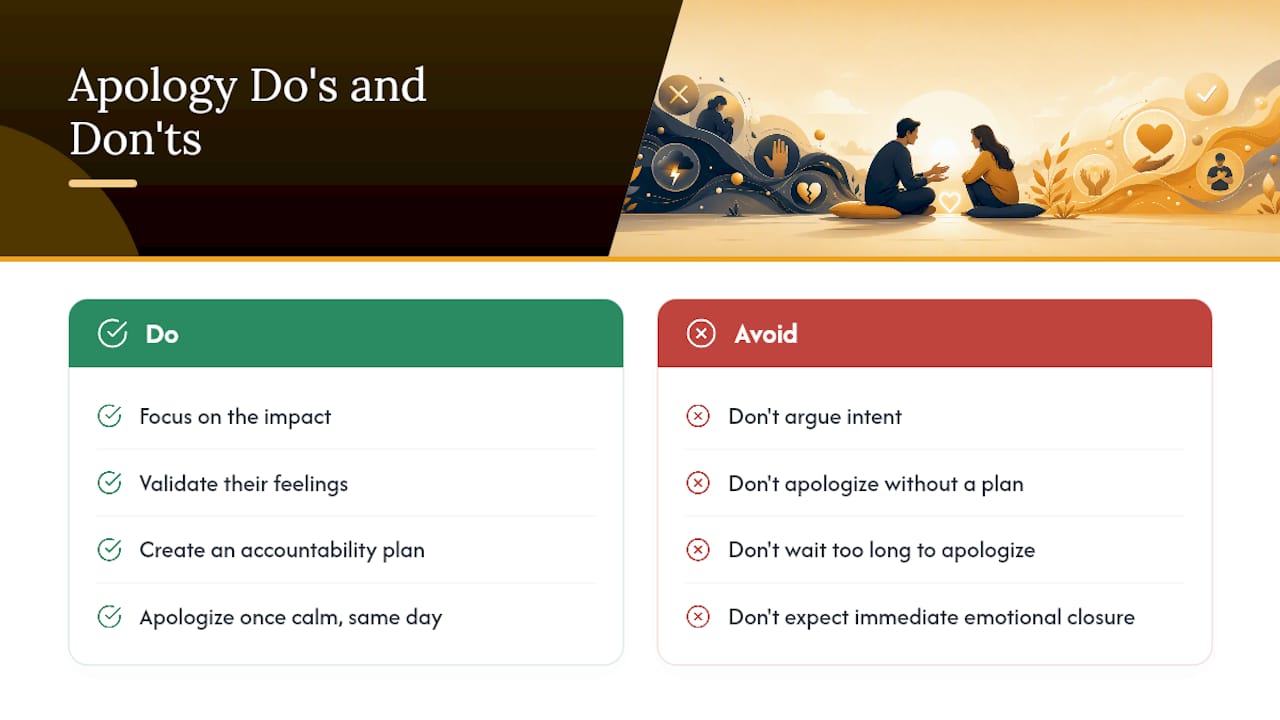
Focus on the impact, not intent. You can validate that your partner was hurt without agreeing your action was objectively wrong.
What if my partner keeps repeating the same offense after apologizing?
Repeated patterns need a concrete accountability plan, not another apology alone. Ask what specific support would help them follow through, and consider conflict resolution techniques built for recurring issues.
How soon after a conflict should I apologize?
As soon as you’re both calm enough to talk without raised voices, ideally the same day. Waiting too long lets resentment settle in.
Can you accept an apology and still feel upset?
Yes. Accepting an apology means you heard it and believe it’s genuine. Feeling fully settled again is a separate, often slower process.
Sources
- How to Apologize, According to a Couples Therapist – Psychology Today
- Forgiveness and marital distress – Focus on the Family
- 4 Areas of Accountability in Marriage – Prepare/Enrich
Recommended
- How to Convince Spouse to Take Marriage Course with You
- How to Agree to Disagree Respectfully as a Couple