
Bids for Connection: What They Are and How to Answer Them

A bid for connection is any small attempt to get your partner’s attention, affection or support: a comment about the weather, a hand on the back, a sigh from the other room. Couples who notice those moments and respond to them build closeness one ordinary minute at a time. Couples who miss them often wake up years later feeling like roommates, and wonder when the distance started.
This guide explains what bids look like in real life, why your response matters more than the bid itself, and how to build the habit of answering them, including what to do after you have already missed a few.
TL;DR
- A bid is any verbal or nonverbal reach for attention, affection, humor or support. Most are tiny and easy to miss.
- You can turn toward a bid, turn away from it, or turn against it. Only the first builds trust.
- Sharing good news counts too. How your partner responds to your wins is tied to daily feelings of intimacy.
- A missed bid is repairable. Name it, return to it, and answer it a few minutes or a day later.
- Practice with one skill at a time, starting with noticing, not fixing.
Table of Contents
- What a bid for connection actually is
- Examples of bids in everyday life
- Three ways to respond: toward, away, against
- Why your response matters so much
- Good news is a bid too
- Why bids get missed
- How to notice and answer bids: a five-step practice
- Making better bids yourself
- How to repair a missed bid
- Our perspective: bids are where conflict is won or lost
- Build the habit with the right tools
- FAQ
- Sources
What a bid for connection actually is
The idea comes from the research of psychologist John Gottman. A university clinic summary describes a bid as anything a couple does to call for attention, ask for affection or otherwise connect, and credits Navarra and Gottman (2018). A CNN report on the concept puts it plainly: bids are simple gestures that seek attention, and the response can say a lot about how strong a relationship is.
Three things make the idea useful:
- Bids are rarely labeled. Nobody says, “I am making a bid for connection.” They say, “Look at that bird,” or they just sigh loudly.
- Bids are not always about the surface topic. “Did you see this article?” often means “Can we share something for a minute?”
- Bids are low risk by design. A small bid lets a person test whether it is safe to reach out before risking a bigger, more vulnerable ask.
That third point is why a dismissed bid stings more than it seems it should. The person is not only losing a chat about a bird. They are learning whether reaching toward you is worth the effort.
Examples of bids in everyday life
Bids come in several flavors. Here are examples you will probably recognize.
| Type of bid | What it sounds or looks like | What it may really be asking |
|---|---|---|
| Attention | “Come look at this.” Holding up a phone with a funny video. | Be here with me for a moment. |
| Affection | Reaching for your hand on the couch. Leaning in for a hug. | Do you still want closeness with me? |
| Humor | An inside joke, a silly voice, a playful jab. | Can we be light together? |
| Support | “My boss was awful today.” A tired sigh at the door. | Will you be on my side? |
| Conversation | “What should we do this weekend?” | Do you want to plan a life with me? |
| Good news | “I got the project I wanted!” | Will you be glad for me? |
| Physical or sexual | A lingering kiss, a hand on your thigh, an invitation to bed. | Do you desire me? |
Notice how many are not about words at all. A partner who hovers in the kitchen while you cook may be bidding for company. A partner who suddenly gets quiet may be bidding for you to ask what is wrong. Some bids are indirect because directness feels risky, especially in a relationship where past requests were met with irritation.
Three ways to respond: toward, away, against
Gottman’s framework describes three kinds of responses. You can turn toward a bid, which means acknowledging it and engaging, even briefly. You can turn away, which means missing it or ignoring it, often because you are distracted. Or you can turn against it, which means answering with criticism, sarcasm or irritation.
Take a simple example. Your partner says, “Wow, look at that sunset.”
- Turning toward: “Beautiful. Come stand here for a second.”
- Turning away: You keep scrolling and say nothing.
- Turning against: “I’m busy. Can you not interrupt me every five minutes?”
Turning toward does not need to be enthusiastic or long. A look up, a “mm, nice,” and a smile tell your partner the line is open. The goal is not to drop everything every time. It is to make sure your partner is rarely left wondering whether you heard them.
Why turning away is the quiet danger
Most couples do not fight about being turned against. They drift because of turning away. Nobody shouts, nothing dramatic happens, and yet one person feels more invisible every week. Over time, people who feel unseen either stop bidding, or they bid louder, and the louder bids tend to sound like complaints. If you have ever heard “you never listen to me” in your house, there is probably a long trail of small, unanswered bids behind it. Our article on why couples stop communicating effectively traces how that drift usually unfolds.
Why your response matters so much
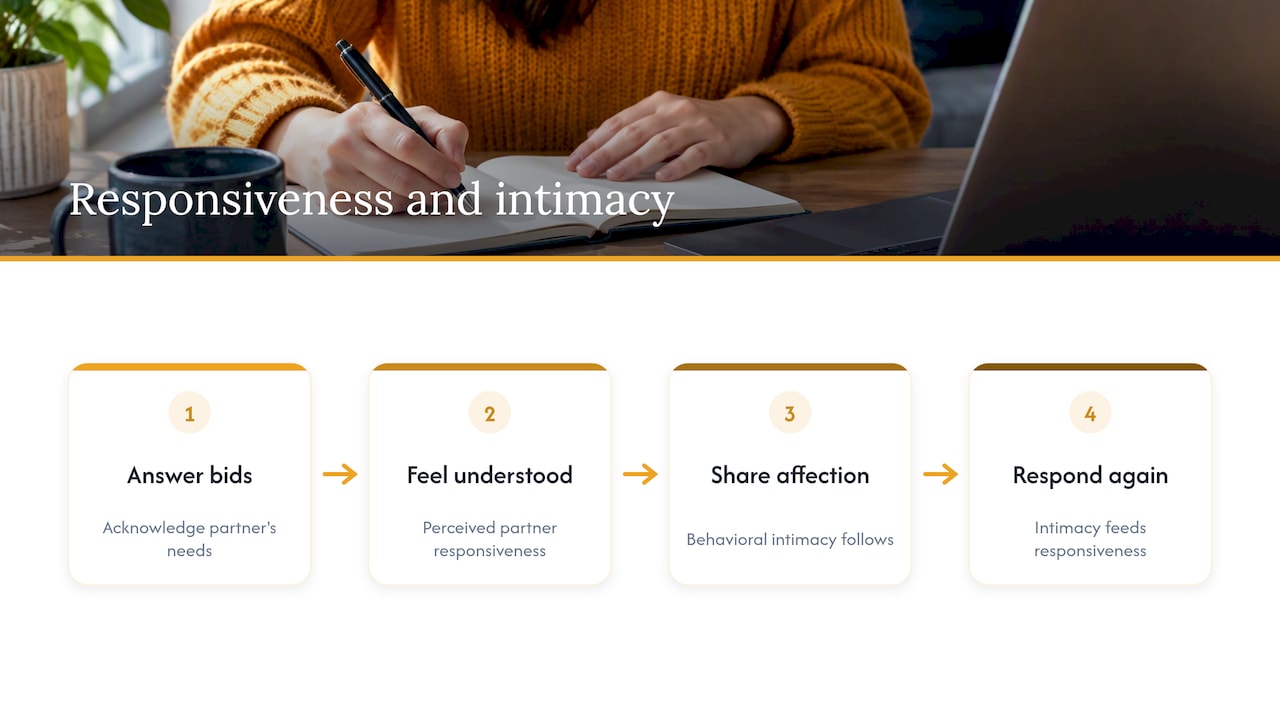
The research behind responsiveness helps explain the power of small moments. Psychologists use the term “perceived partner responsiveness” for the feeling that your partner understands, validates and cares for you. One study found that it forecasts behavioral intimacy as measured by affectionate touch. In plain terms, when people feel their partner is responsive, they are more likely to share physical affection afterward. Responsiveness feeds intimacy, and intimacy feeds more responsiveness.
There is also a twist worth sitting with. Earlier research on how people project their own care onto their partner suggests that how responsive we see our partner as depends partly on how caring and supportive we are being ourselves. If you feel your partner never answers your bids, it is worth asking, gently and without blame, how often you are answering theirs. This is not a verdict on whose fault the distance is. It is a reminder that both people hold part of the thermostat.
The same logic appears in Emotionally Focused Therapy, which describes safety in a relationship through A.R.E.: being Accessible, Responsive and Engaged. Accessible means being emotionally open and present. Responsive means acknowledging and validating your partner’s needs. Engaged means showing active interest in their inner world. Answering a bid is a small daily dose of all three.
Good news is a bid too
Most advice about bids focuses on stress and sadness. But a lot of connection happens when things go well. Researchers call it capitalization: sharing a positive event with a partner so that you both get to savor it. A study of cohabiting couples found that perceived responses to positive events were linked with higher daily feelings of intimacy and lower negative affect, and in some cases with greater sexual satisfaction.
So when your partner says, “They moved my promotion up!” the connected response is not “Cool, what’s for dinner?” It is a real question: “Wait, tell me everything. How did they tell you?” Curiosity is the active ingredient. A flat “good for you” can land as a turn away even though you meant well.
Why bids get missed
Missing bids rarely means you do not care. It usually comes down to a few ordinary causes.
- Distraction. Phones, work stress and a full mental load narrow attention. The bid goes by like a car you did not hear.
- Indirectness. Your partner may hint instead of asking, and the hint is easy to read as noise.
- Different styles. One person bids with words, the other with touch or acts of help. You may be answering a bid you did not make while missing the one you did.
- Built-up hurt. After weeks of conflict, a bid can feel like a trap or a demand, and people turn away to protect themselves. If that sounds familiar, the patterns in eight types of communication breakdowns couples face may help you name what is going on.
- Past experience. Someone who grew up where reaching out was punished or ignored may bid very quietly, or not at all. If you suspect old wounds are in the mix, working through them with a licensed therapist can be a strong next step.
None of these are character flaws. They are habits, and habits can change.
How to notice and answer bids: a five-step practice
You do not need to overhaul your relationship. Try this for two weeks.
- Pick one window of the day. Choose the first thirty minutes after you both get home, or breakfast. Decide that during this window you will watch for bids.
- Put the screen down when you hear a bid. You do not need to stop everything. You do need to look up. Eye contact alone is a turn toward.
- Say one sentence back. “Tell me more.” “That sounds exhausting.” “Oh wow, show me.” Keep it short and warm.
- Ask one follow-up question. A follow-up turns a polite answer into real attention. “What was the worst part?” works better than “Why?”
- Tell each other what lands. Once a week, share one bid that felt well received and one you wish you had caught. No defending, just listening.
If you want ready-made language for step three, our couples conversation scripts give you phrases to use tonight, and our six communication exercises include short drills you can do together in a few minutes.
What if the bid is inconvenient?
Sometimes you truly cannot engage. You are on a work call, or you are mid-crisis with a child. You can still turn toward the bid by acknowledging it and setting a time: “I want to hear this. Give me ten minutes and I am all yours.” Then keep the promise. A deferred bid that is honored is a turn toward. A deferred bid that is forgotten is a turn away with extra steps.
Making better bids yourself
Answering is half of it. The other half is making bids that are easier to catch. If you tend to hint, try being a little more direct.
- Instead of sighing loudly, say, “I had a rough day. Can I vent for five minutes?”
- Instead of “Whatever, I’m fine,” try, “I could use a hug.”
- Instead of silently hoping for a date night, say, “I miss you. Can we plan Saturday?”
It can feel vulnerable to ask outright, and that is the point. A clear bid gives your partner a fair chance to succeed. Also pay attention to tone. A bid that arrives as an accusation (“You never talk to me”) is harder to turn toward than the same need stated softly (“I’d love to talk with you tonight”).
How to repair a missed bid
Every couple misses bids. What separates strong relationships is whether the miss gets repaired. A repair can be very simple:
- Name it: “I think I brushed you off earlier. I’m sorry.”
- Go back to it: “You were telling me about your meeting. I want to hear it now.”
- Offer what you can: “I was distracted, but I’m here. Start from the beginning?”
If the missed bid was big, like a partner who told you something painful and you changed the subject, the repair may need more care. Sit down, ask what they needed in that moment, and listen without defending yourself. If your relationship has been through a breach of trust, bids may feel especially risky for both of you, and structured support can help. Our article on online marriage counseling after infidelity explains what that support can look like.
One caution: if a relationship involves fear, control or any form of abuse, bid-training is not the right tool. Contact the National Domestic Violence Hotline or a licensed therapist who works with safety concerns before trying communication exercises with your partner.
Our perspective: bids are where conflict is won or lost
We have worked with many couples, and the pattern repeats. People arrive describing a big fight about money, in-laws, sex or chores. When we slow the story down, the fight rarely started with the topic. It started days earlier with a string of small moments where one person reached and the other did not notice.
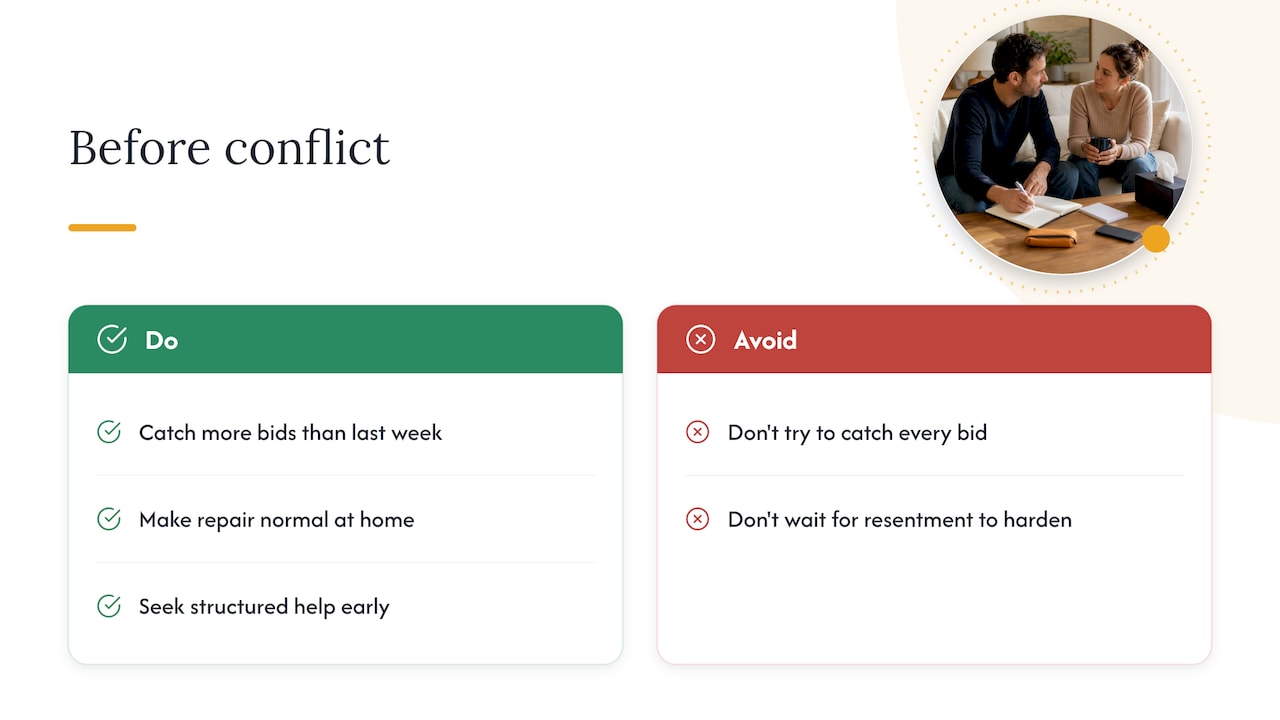
That is why the F.I.G.H.T. Plan® puts so much weight on skills you can use before an argument starts. You cannot out-negotiate a feeling of being invisible. When couples learn to catch bids, arguments get shorter and less personal, because each person has more evidence that the other is on their side. Fewer fights are not the only gain. The couple also becomes safer to be vulnerable with, and that is where deeper intimacy comes from.
Our advice is modest. Do not try to catch every bid. Aim to catch more than you did last week. Make repair a normal part of your home, not a sign of failure. And when the pattern feels too stuck to shift on your own, get structured help early rather than waiting until resentment hardens.
— Carlos
Build the habit with the right tools
If you want a guided path, our couples therapy workbook and the F.I.G.H.T. Plan workbook walk you through reflection exercises and conversation skills one step at a time. The workbook is priced from $14.99 to $25.00, and the F.I.G.H.T. Plan Couples Conflict Toolkit is $27.00. For a full, structured program, Stop the Fighting: The Couples Communication & Conflict Resolution Course is $149.00. If you want someone alongside you, online couples coaching is available, including a four-session VIP private coaching package at $997.00. You can see everything in our shop.
For couples who want to go deeper at home, our guide to intimacy building activities pairs well with a bid-awareness practice.
FAQ
What are examples of bids for connection?
A bid can be as small as “Look at this dog,” a hand squeeze, a shared joke or a sigh that invites you to ask what is wrong. It can also be bigger, such as asking for advice, sharing good news or inviting your partner to bed. Any attempt to get attention, affection or support counts.
What is the difference between turning toward and turning away?
Turning toward means you acknowledge and engage with the bid, even briefly, by looking up, answering or asking a question. Turning away means you miss or ignore it. Turning against means you respond with criticism or irritation.
How often should I make bids?
There is no magic number, and we would not trust anyone who gave you one. Healthy relationships include many small bids across a day, and most are casual. Focus on being a little more responsive and a little more direct, rather than counting.
Can a relationship recover after years of missed bids?
Often, yes, though it takes consistent effort from both people. Start by noticing and answering bids in one daily window, and repair misses quickly. If resentment or betrayal sits underneath the distance, a licensed couples therapist or structured program can help you work through it.
Sources
- Bids for Connection, Utah Valley University Community Clinic
- How bids for connection can make or break a relationship, CNN
- Perceived Partner Responsiveness Forecasts Behavioral Intimacy as Measured by Affectionate Touch, PMC
- Projection of responsiveness to needs and the construction of satisfying communal relationships, PubMed
- Emotionally Focused Therapy: Building Safety in Relationships Through A.R.E., Haven Psychology
- Will you be happy for me? Responses to positive events and sexual well-being in cohabiting couples, PMC
Recommended