
Intimacy After Infidelity: How to Rebuild It, Step by Step

Intimacy after infidelity can come back, but not by rushing it and not by starting with sex. The order that works is safety first, then emotional reconnection, then physical closeness at the pace of the partner who was betrayed. This guide explains each stage, what to say, what to avoid, and when outside help makes the difference.
TL;DR
- Trust has to come before touch. Physical intimacy used as a shortcut to repair usually backfires.
- The sequence is safety (the affair is over, full transparency), then emotional reconnection, then sex, on the betrayed partner’s timeline.
- There is no universal waiting period. Anyone offering a number of days is describing a preference, not a rule.
- Flashbacks during closeness are common. Naming them out loud beats suppressing them.
- Couples who do dedicated therapy often recover well: one study found infidelity couples were not statistically different from other couples on satisfaction at follow-up.
Table of Contents
- Why intimacy disappears after an affair
- The order that works: safety, connection, then touch
- How long should you wait to be intimate after infidelity?
- What about the “72 hour rule” and the “80/20 rule”?
- Restarting sex: practical steps
- What each partner can do
- Our perspective
- Can couples really recover?
- When to get help
- Tools to help you rebuild
- FAQ
- Sources
Why intimacy disappears after an affair
Most couples expect the pain. Fewer expect the silence in the bedroom, or the way even a hug can feel like a risk. Both partners often still want each other, and that makes the distance more confusing.
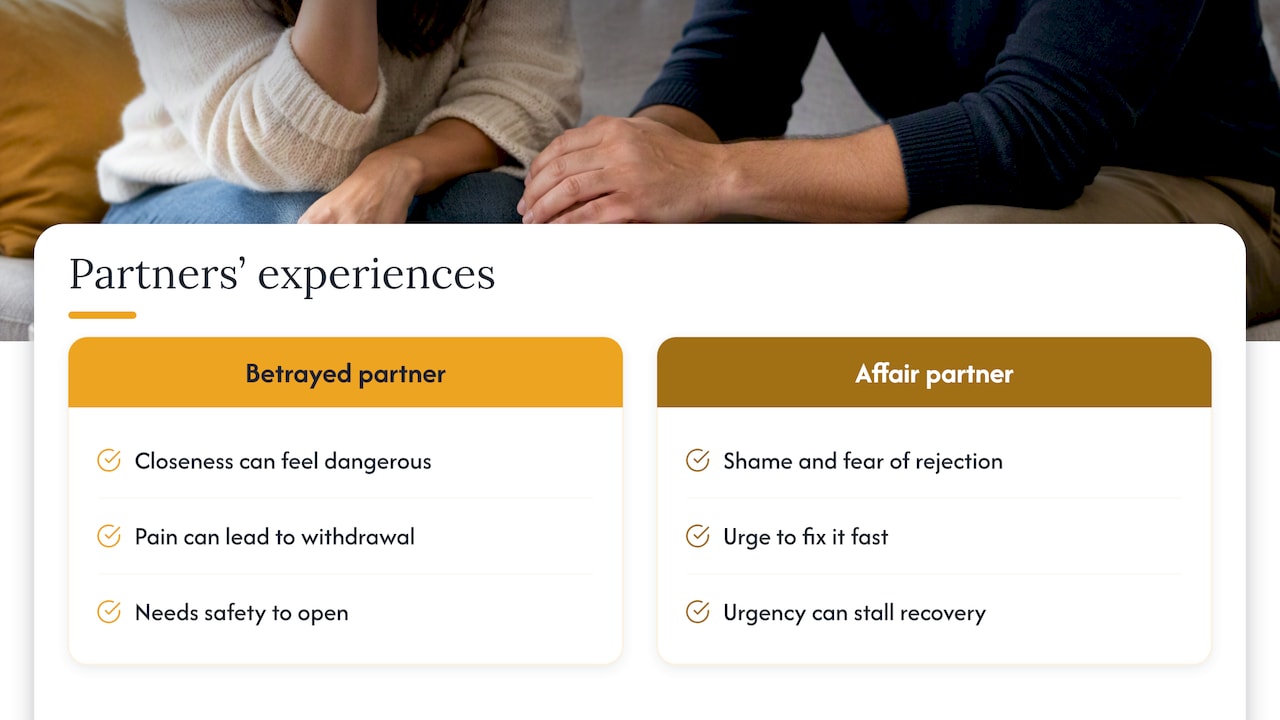
For the betrayed partner, the body reads closeness as danger. The person who hurt them is now the person asking them to be vulnerable. As one marriage and family therapist puts it, the body will not open where it does not feel safe. Intimacy can swing between intense reconnection and sudden, painful withdrawal, and that is a normal part of the process, not a sign of failure.
For the partner who had the affair, there is often shame, fear of rejection, and a pull to “fix it” fast. That urgency is understandable. It is also one of the most common ways recovery stalls, because it asks the hurt partner to perform healing before it has happened.
It also helps to drop the goal of getting back to how things were. A Baltimore therapy practice notes that a relationship usually does not return to its earlier form, but it can become something new and potentially stronger. Therapist Esther Perel frames this as the end of a couple’s first marriage, which opens a choice about whether to build a second one together.
The order that works: safety, connection, then touch
Professionals who work with affair recovery describe the same sequence. Skipping a stage is where most couples get hurt again.
Stage 1: Safety
Intimacy cannot start while the injury is still open. Safety means:
- The affair is genuinely over, with no ongoing contact.
- The partner who cheated is transparent: phone, schedule, and answers to questions, without defensiveness.
- Questions get honest answers, even when the answers are uncomfortable.
Trust is earned back through daily transparency, consistency, and accountability. It is not restored by one apology, however sincere. If you need a concrete structure for this stage, our 30 to 90 day transparency plan after an affair lays out what to share, when, and how to keep it from turning into surveillance. Clear boundaries after betrayal belong here too.
Stage 2: Emotional reconnection
Once the ground is safer, closeness starts in conversation. That means truth, visible remorse, and real listening. The partner who cheated listens to the pain without correcting it, explaining it away, or asking for a deadline on it. The betrayed partner is allowed to ask the same question many times. Repetition is how the mind processes a shock.
Small daily rituals do more here than big gestures: a check-in at the end of the day, ten uninterrupted minutes, a walk without phones. Intimacy is rebuilt in small, reliable moments. If jealousy keeps spiking during this stage, our guide to stopping jealousy after infidelity walks through practical steps. If the affair was emotional rather than sexual, the emotional affair recovery guide covers what is different.
Stage 3: Physical intimacy
Sex comes last, and it comes on the betrayed partner’s terms. That does not mean physical affection has to be frozen until then. Many couples start with non-sexual touch: holding hands, sitting close, a long hug, a back rub with clothes on. The point is to let the nervous system learn that closeness with this person can be safe again.
How long should you wait to be intimate after infidelity?
There is no correct number. Dr. Prerna Kohli’s guidance is that rebuilding intimacy is about creating the right conditions, not meeting a timeline. Some clinicians do suggest a deliberate pause. One affair recovery practice, for example, often encourages couples to take a 90-day break from sex to rebuild emotional connection first. That is one approach, and it will not fit every couple.
A better test than the calendar is a set of questions both partners can answer honestly:
- Has the affair truly ended, and do I believe that?
- Am I getting honest answers to my questions?
- Can we talk about what happened without it turning into a fight?
- When we are affectionate, do I feel present, or do I feel numb or afraid?
- Am I considering sex because I want it, or because I think I owe it?
If the last answer is “owe,” wait. Sex that comes from obligation or fear of losing the relationship tends to deepen the wound.
One caution for the partner who cheated: do not use sex as a way to find out whether you are forgiven. Asking “are we okay now?” in bed puts the hurt partner in a position where honesty feels like rejection.
What about the “72 hour rule” and the “80/20 rule”?
Both phrases come up when people search this topic, and neither is an official recovery protocol.
The 72-hour rule is a social media idea that suggests couples aim to be physically intimate about every three days. Coverage of the trend notes that experts see planned intimacy as helpful for some long-term couples, but it will not fix exhaustion, resentment, or disconnection. After an affair, a schedule like that can feel like pressure. Use it only if the betrayed partner chooses it.
The 80/20 rule is a concept some therapists use: a person may cheat because of a missing piece, often emotional connection or validation, even when most needs are met. Used well, it points to unmet needs that went unspoken. Used badly, it becomes an excuse that shifts blame onto the betrayed partner. Understanding why an affair happened matters, but it never makes the betrayed partner responsible for it.
Restarting sex: practical steps
When both of you are ready, a few practices lower the odds of a painful first try.
Agree on the rules before you are in the moment
The betrayed partner can stop at any time, for any reason, with no argument and no sulking afterward. The partner who cheated agrees to that in advance. This one agreement removes most of the dread.
Start small and build
Begin with kissing and clothed touch. Stay at a level that feels good, and stop there if needed. A successful short, calm session builds more trust than an ambitious one that ends in tears.
Expect intrusive thoughts
Images and flashbacks are common for the betrayed partner during early physical closeness. The guidance is to say them out loud rather than force them down, which reduces their power and lets you keep connecting at a pace that feels safe. A simple phrase agreed ahead of time works: “I’m having a flashback. Can we slow down?” The partner who cheated responds with calm presence, not defensiveness.
Some couples find it helps to stay connected by keeping their eyes open and looking at each other. If that feels too intense, hold hands or keep a hand on the other’s chest. What matters is that each of you can feel the other is present.
Plan for the setback
A good week can be followed by a terrible one, often triggered by a date, a song, or a place. Treat a setback as information about what still needs attention, not proof the effort failed. Talk about it the same day if possible, and go back a step in physical closeness without shame.
Be honest about desire
Not everyone loses interest after an affair. Some betrayed partners feel a surge of desire, driven by anxiety, a wish to compete, or a need to feel chosen. Some partners who cheated want sex to feel forgiven. None of this is wrong, but it is worth naming. Ask yourself what the desire is for, and say it to your partner.
What each partner can do
| If you were betrayed | If you had the affair |
|---|---|
| Say what you need: slower, more information, more reassurance | Answer questions honestly and without irritation |
| Set the pace of touch and be clear when it changes | Never pressure, hint, or keep score about sex |
| Name triggers and flashbacks instead of hiding them | Stay present when your partner is in pain, without defending yourself |
| Notice progress as well as pain, when you can | Keep your commitments every day, including the small ones |
| Ask for support from a therapist or trusted person | Take responsibility for your part without turning it into self-punishment |
Forgiveness is part of the long road, but it is not a switch you flip on a schedule. Our guide to forgiveness after infidelity explains why it should follow accountability, not replace it.
Our perspective
We work with couples every week who are stuck in the same place: they both want closeness, and every attempt at it ends in a fight or a silence. What we see again and again is that the problem is rarely desire. It is the missing structure.
Without a plan, couples fall into the same pattern. The partner who cheated pushes toward repair because the guilt is unbearable. The betrayed partner pulls back because the pain is not yet heard. Each one reads the other’s behavior as proof of the worst. Criticism, defensiveness, and distance take over, and intimacy has nowhere to grow.
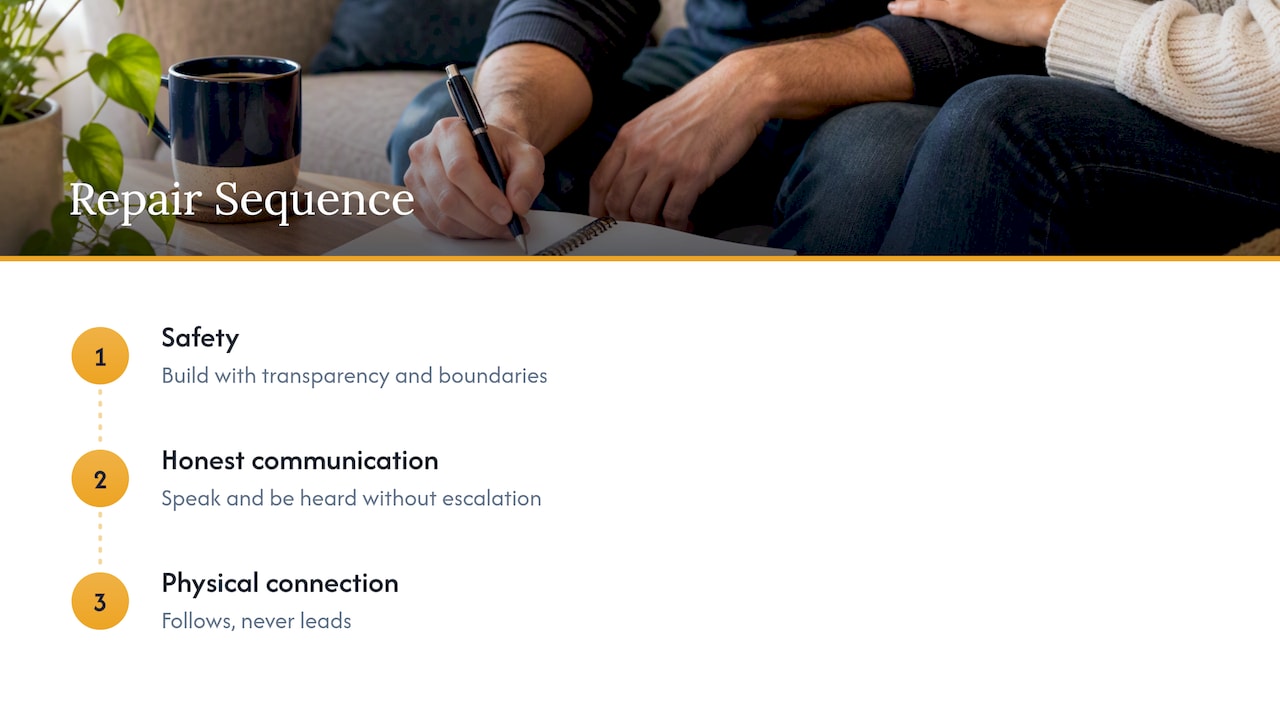
That is why we built the F.I.G.H.T. Plan® as a step-by-step, skills-based system, and why our infidelity materials follow the same order described above. Safety is built first, with transparency and boundaries. Then comes honest communication, where each person can speak and be heard without escalation. Physical connection follows, never leads.
We also want to be straight about something. Reading a workbook together will not make the pain disappear. What it can do is give you a script when you have no words, a way to pause a conversation before it becomes a blowup, and a shared language for what is happening. For many couples, that is the difference between circling and moving forward.
— Carlos
Can couples really recover?
Yes, and the evidence is encouraging. A 2010 study in the Journal of Family Psychology compared 145 couples dealing with infidelity to 385 comparison couples in community-based couple therapy. At follow-up, up to six months after therapy, the infidelity couples were not statistically distinguishable from the others on relationship satisfaction or distress. Many started out more distressed, which makes that result more notable.
The Mayo Clinic says something similar: when both spouses are committed to healing, many marriages survive, and some become stronger. A study of couples who stayed together after an affair also found that some are able to overcome the damage and rebuild.
Two honest limits apply. These are averages, and your relationship may differ. And recovery depends on both people being committed to it. Where there is ongoing deception, or where one partner is only going through the motions, intimacy will not hold.
When to get help
Some situations call for a professional rather than a workbook alone:
- Flashbacks, panic, or sleeplessness that interfere with daily life. Talk to a licensed therapist or your doctor.
- Every conversation about the affair ends in shouting, threats, or shutdown.
- You keep finding new lies. Recovery needs a stable truth first.
- Thoughts of harming yourself. In the US, call or text 988, the Suicide & Crisis Lifeline, right away.
- Any fear of your partner’s behavior. Safety comes before relationship repair.
A structured process helps most couples, and our overview of the benefits of couples therapy after betrayal explains what to expect from it. If distance or schedules are the obstacle, online marriage counseling after infidelity is another route.
Tools to help you rebuild
If you want a structured path rather than guesswork, we offer several options built for this exact stage, created by licensed mental health professionals.
- R.E.S.T.O.R.E Workbook: Healing After an Affair, $9.99 to $20.00, a guided workbook for rebuilding trust and love.
- The F.I.G.H.T. Plan Couples Conflict Toolkit, $27.00, for conversations that keep turning into fights.
- Stop the Fighting course, $149.00, a full communication and conflict resolution course.
- Private coaching: the VIP package of four sessions is $997.00. For couples who want concentrated time, there is a 6-hour couples intensive at $1995. Our RESTORE® infidelity recovery counseling page describes how we approach affair recovery directly.
Start with the workbook if you are early in the process and want to work privately. Choose coaching if you keep hitting the same wall or want someone guiding the pace.
FAQ
How long should you wait to be intimate after infidelity?
There is no set time. Wait until the affair has ended, you are getting honest answers, and the betrayed partner wants closeness rather than feeling they owe it. Some therapists suggest a deliberate pause of around three months, but readiness matters more than a date.
Is it normal to have no desire, or too much desire, after an affair?
Both are common. Pain can shut desire down, and anxiety or a need to feel chosen can push it up. Neither means something is wrong with you, but it helps to name which one is happening and why.
Can sex fix the relationship after cheating?
Usually not. Using sex to jumpstart trust often backfires, because the hurt has not been heard yet. Safety and honest conversation come first, and physical intimacy follows on the betrayed partner’s terms.
What should I do when flashbacks hit during sex?
Stop or slow down, and say what is happening out loud. Naming intrusive thoughts tends to lessen their hold. The partner who cheated stays calm and present, and you return to a level of closeness that feels safe.
Can a relationship survive cheating?
Many do. Research on couple therapy found infidelity couples reached satisfaction levels similar to other couples at follow-up. It takes full honesty and real commitment from both partners.
Sources
- Rebuilding Intimacy After an Affair, Dr. Prerna Kohli
- Restoring Intimacy After Infidelity, Psychology Today
- The Path to Affair Recovery, Psychology Today
- Recovering from Infidelity in a Relationship: A Complete Guide, Baltimore Therapy Group
- Couples Are Trying the 72-Hour Rule to Fix Their Sex Lives, VICE
- Outcomes of couples with infidelity in a community-based sample of couple therapy, PubMed
- Infidelity: Mending your marriage after an affair, Mayo Clinic
- Affair recovery: Exploring similarities and differences of injured and involved partners, PubMed
Recommended
- 6 Neuroscience Backed Steps to Stop Jealousy After Infidelity
- Boundaries After Betrayal: Therapist Tools and a 30–90 Day Plan
- Therapy Backed Behavior First Steps to Repair an Emotional Affair
- 30–90 Day Behavior First Transparency Plan After an Affair