
Libido Mismatch in Marriage: What to Do When Desire Differs

A libido mismatch in marriage means one spouse wants sex more often, or differently, than the other. It is one of the most common problems long-term couples face, and it rarely means anyone has stopped loving anyone. The fix is almost never to make the lower-desire partner “catch up.” It is to understand what is driving the gap, talk about it without pressure, and widen what intimacy means for the two of you.
TL;DR
- Different sex drives are normal in marriage. Researchers treat the gap as something that lives in the relationship, not as one person’s defect.
- Stress, children, health conditions, medications, body image and unresolved conflict all lower desire. Find the driver before you pick a fix.
- Pressure, guilt and keeping score make desire shrink. Clear “I” statements, listening and no-pressure touch work better.
- See a doctor if low desire is hurting your well-being or your marriage, and a couples professional if the conversation keeps turning into a fight.
Table of Contents
- What a libido mismatch actually is
- Why spouses end up with different levels of desire
- What it does to a marriage
- How to talk about it without blame or pressure
- What to do when one of you wants sex and the other doesn’t
- What we see in couples who get stuck
- When to get medical or professional help
- Practical help from Couples Fight School
- A simple 30-day plan to start
- FAQ
- Sources
What a libido mismatch actually is
Clinicians call it sexual desire discrepancy: partners want sex at different levels or frequencies. The European Society for Sexual Medicine describes it as a common and often expected feature of long-term relationships, because everyone’s sex drive moves up and down over time.
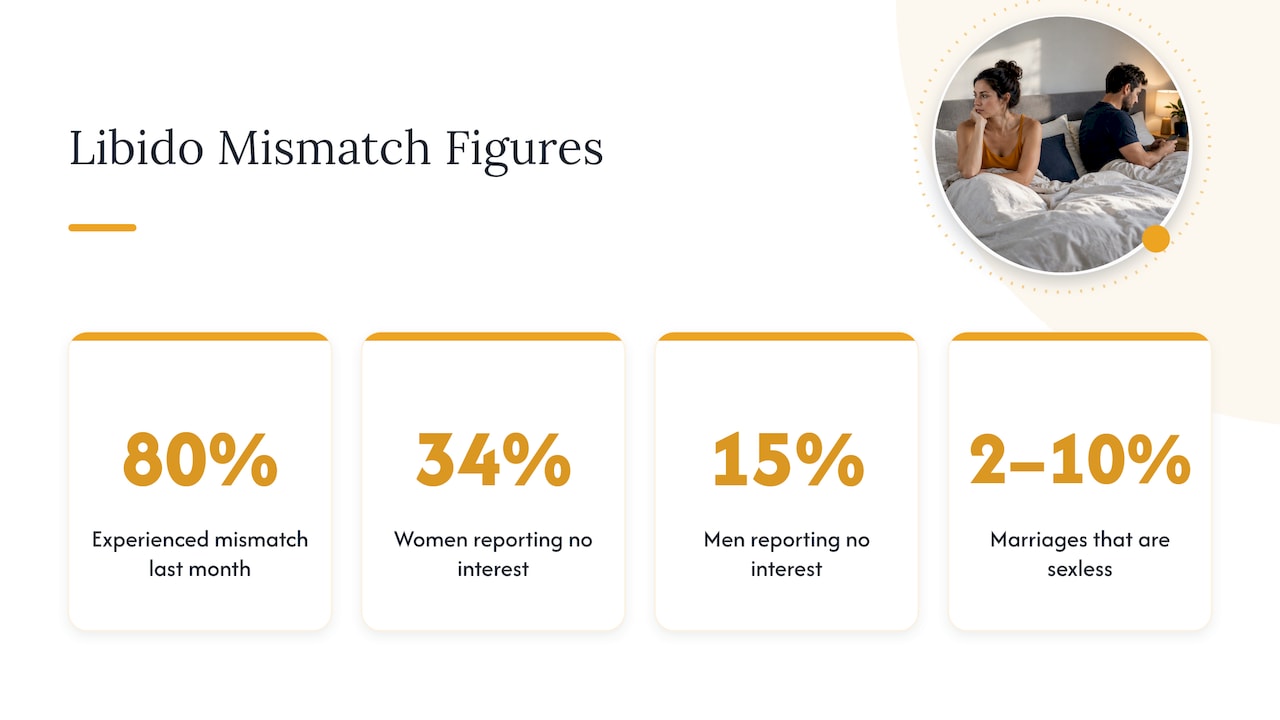
The numbers help put it in perspective. One 2015 study found that 80% of people had experienced a desire discrepancy with their partner in the previous month. Another, from 2017, found that roughly 34% of women and 15% of men report no interest in sex at all. And sex and relationship researchers estimate that 2% to 10% of marriages are sexless, meaning few or no sexual encounters.
The most useful idea in the research is this one: the same position statement says desire problems are best viewed as a relative concept that comes from the relationship context, not an individual deficit to be cured. You are not a high-drive spouse married to a broken one. You are two people whose desire does not currently line up, and that is something you can work on together.
Why spouses end up with different levels of desire
Desire is not a fixed trait. The same position statement notes that it is shaped by individual characteristics, partner behavior, interpersonal dynamics and cultural standards, and that it changes across contexts and over time. In practice, that usually looks like a mix of the following.
Stress, parenting and health
A PLOS One paper lists chronic stress, childbirth and children, medical illness, and certain medications among the factors that can reduce libido. The medications it names include psychotropic drugs and blood pressure medications. If your spouse’s desire dropped after starting a new prescription, that is worth raising with their prescriber rather than assuming it is about you.
Work, money and body image
Northwell Health’s wellness team points out that work obligations, economic anxiety, and worries about one’s body or sexual function can dampen desire. These are quiet pressures. A spouse who is exhausted by a layoff scare or ashamed of their body often says nothing, and the silence reads as rejection.
The relationship itself
This is the driver couples most often miss. Researchers note that sex can express power dynamics or stand in for non-sexual dissatisfaction in the relationship, which means a mismatch can be a symptom rather than the root problem. Resentment about chores, unrepaired fights, feeling criticized or unheard: all of these travel straight to the bedroom.
If your honest answer is “I feel unsafe, controlled or afraid,” that is a different conversation. Learning to recognize signs of unhealthy relationship patterns matters, and so does speaking to a licensed therapist, because coercion around sex is never a communication-skills problem.
What it does to a marriage
The gap itself is rarely what hurts. What hurts is the story each spouse builds around it.
In a US study of how couples handle desire discrepancy, participants described emotional distress, feeling undesired, pressure to satisfy a partner, and a partner turning grumpy after failed attempts to spark desire. Put those side by side and you see the cycle:
- The higher-desire spouse initiates and is turned down. They feel rejected and unwanted.
- The lower-desire spouse feels pressured and guilty. They start avoiding touch altogether so a hug does not become a request.
- The higher-desire spouse reads the avoidance as proof of lost love. The lower-desire spouse reads the sulking as proof that they are only valued for sex.
- Both pull back. Everyday affection disappears, and the next argument has nothing to do with sex.
This is the same pursue-and-withdraw pattern we see in many recurring fights. The topic changes, the dance does not. If you recognize it, our piece on why couples stop communicating effectively walks through how it takes hold.
There is good news in that same study: participants who used partnered strategies reported higher sexual and relationship satisfaction than those who coped alone. Handling this together beats handling it privately.
How to talk about it without blame or pressure
Most couples try this conversation at the worst moment: in bed, right after a rejection, or in the middle of a fight. Choose a neutral time instead, with no expectation of sex afterward. Then follow a few ground rules.
Lead with your own experience
Northwell’s guidance recommends “I” statements to share feelings without making your partner feel attacked, then listening to the response. Compare two openings:
- Blame: “You never want me anymore. You’ve checked out of this marriage.”
- Experience: “I’ve been feeling distant from you lately, and I miss feeling close. Can we talk about what intimacy has been like for you?”
The second one invites an answer. The first demands a defense.
Be clear, listen, and don’t pressure
The National Coalition for Sexual Health’s guide says good communication means being clear about desires and boundaries, listening to each other, and not pressuring your partner. It also stresses that this is not a one-time talk: long-term healthy relationships need ongoing communication that evolves as partners age and needs change. Plan on a recurring check-in, not a single breakthrough.
Scripts you can adapt
For the higher-desire spouse:
“I love you and I’m attracted to you. I want us to figure this out together, not to make you feel guilty. What would help you feel more relaxed and interested?”
For the lower-desire spouse:
“I don’t want you to feel rejected. When I say no, it’s about my energy or my head, not about you. Can we find ways to be close that don’t feel like a test?”
For a stuck moment:
“I can tell we’re both getting defensive. Can we pause and come back to this tomorrow?”
We have more word-for-word language in our sexless marriage communication scripts and in five therapist-backed conversation scripts. If you need to practice the listening part first, try these communication exercises you can do tonight.
What to do when one of you wants sex and the other doesn’t
There is no single right answer, but the research shows what couples actually do. The US study found that common strategies include masturbation, varied non-penetrative activities, talking about needs, and sometimes choosing to have sex despite lower desire. Here is how to use those without turning them into obligations.
Widen the menu
Intimacy does not have to mean intercourse. Couples can explore manual stimulation, oral sex, or non-sexual closeness like massage and cuddling. The National Coalition for Sexual Health adds that touch beyond intercourse can help partners feel closer. A useful rule: agree that some touch is “just touch,” with no expectation it leads anywhere. That takes away the fear that a hug is a request.
Say yes for connection, on your own terms
Some couples find that the lower-desire spouse sometimes chooses sex while desire is low, when the motive is connecting with their partner. That can work when it is a real choice, freely made, and the “no” remains safe at other times. It stops working the moment it becomes a debt. If one of you is gritting your teeth, stop and return to the conversation.
Let solo sex be okay
Self-soothing, including masturbation, is a common way higher-desire spouses manage the gap. It works best when it is discussed openly rather than hidden, and when it is not used as a replacement for closeness.
Rebuild the non-sexual connection
Many desire gaps shrink when daily connection returns: real conversations, shared tasks, laughter, repair after fights. Our list of intimacy building activities for couples is a good place to start, and so is the set of relationship skills every married couple needs.
What we see in couples who get stuck
We are licensed mental health professionals, and we have worked with thousands of couples. Here is our honest take.
First, almost nobody comes to us saying “our libidos are mismatched.” They come saying “we fight all the time,” “he never initiates,” or “she shuts down.” The sex problem and the conflict problem are usually the same problem. When a couple learns to stop criticizing and defending, the bedroom often softens without any sex advice at all.
Second, the biggest mistake we see is treating desire as a performance review. When the higher-desire spouse keeps score and the lower-desire spouse braces for it, nobody feels chosen. Emotional safety has to come first, because desire rarely grows where it is demanded.

Third, the pattern that works is structured and specific: calm the nervous system, say what you feel, listen without fixing, then agree on one small step. That is the logic behind our F.I.G.H.T. Plan® framework, and it applies to this topic as much as to money or in-laws.
Finally, be kind about timing. Betrayal, grief, postpartum months and illness all change desire. If trust has been broken, the sexual relationship will not heal before the trust does.
— Carlos
When to get medical or professional help
There are two kinds of help, and many couples need both.
See a doctor if low desire is affecting your well-being or your marriage. Cleveland Clinic advises that a healthcare provider can check for health issues and refer you to a specialist. Mention any new medications, and tell the doctor if pain, mood changes or fatigue came with the drop in desire. Anxiety, depression or past trauma can also be involved, and a sexual health therapist may be part of the answer.
Bring in a couples professional if every attempt to talk ends in a fight, if resentment has built up, or if the gap has become a stand-in for deeper conflict. Clinicians are advised to look at the overall context of the relationship, including relationship and medical factors, rather than labeling one spouse as having a disorder. A good professional will not make you the problem.
If trust was broken by an affair, the sexual side usually cannot be addressed first. Our guide to online marriage counseling after infidelity explains where to begin.
Practical help from Couples Fight School
If your libido gap is tangled up with arguments, distance or resentment, you do not have to untangle it alone. Our course Stop the Fighting: The Couples Communication & Conflict Resolution Course ($149) teaches the skills for calm conversations about sensitive topics, with therapist-created tools you can use together.

Prefer something lighter? The F.I.G.H.T. Plan toolkit is $27, and our workbooks start at $9.99. If you want personal guidance, VIP private coaching is four sessions for $997. Coaching is education and skills practice, not a replacement for medical care or therapy when you need it.
A simple 30-day plan to start
- Week 1: Pick the time. Schedule one 30-minute talk in a neutral place. Agree that sex is off the table that night.
- Week 2: Name the drivers. Each of you lists the factors that affect your desire: stress, sleep, health, medication, body image, unresolved hurt. Share lists and listen.
- Week 3: Add no-pressure touch. Try a daily six-second kiss, a shoulder massage, or cuddling with clothes on. The rule is that nothing has to follow.
- Week 4: Agree on one experiment. It might be a weekly date, a new way to initiate, or a gentle way to say not tonight. Review how it felt.
If week two turns into a fight, that is information, not failure. It tells you the conflict skills need attention first.
FAQ
Is a libido mismatch a sign my marriage is failing?
No. Desire differences are common and often expected in long-term relationships, and researchers describe them as relative to the relationship rather than a flaw in one person. The risk is not the gap itself but how a couple responds to it. Blame and pressure harm marriages far more than different drives do.
Should the lower-desire spouse just have sex more often?
Not as a rule. Some couples do choose sex despite low desire when the motive is genuine connection, but it needs to be a free choice. Sex out of guilt or fear tends to deepen the problem. Start by finding out why desire is low.
How do I bring it up without hurting my spouse?
Choose a calm time outside the bedroom, begin with an “I” statement about your own feelings, and then listen. Avoid words like never and always. Our conversation scripts give you exact wording.
Could medication or a health issue be the cause?
Yes. Stress, illness, childbirth and some medications, including certain psychotropic and blood pressure drugs, can lower libido. Talk to a doctor before changing or stopping any prescription.
When should we see a counselor?
See one when conversations about sex keep ending in blame or silence, when resentment is growing, or when low desire is hurting your well-being or your marriage. A doctor can rule out medical causes, and a couples professional can help with the relationship side.
Sources
- Sexual Desire Discrepancy: A Position Statement of the European Society for Sexual Medicine
- Strategies for Mitigating Sexual Desire Discrepancy in Relationships
- Sexless Marriage: Causes and Tips for Recovery, Psych Central
- Mismatched sex drives: Relationships and coping, Medical News Today
- Managing Mismatched Sex Drives, The Well by Northwell
- A Guide to Sexual Concerns and Pleasure, National Coalition for Sexual Health
- Low Libido (Low Sex Drive) Causes and Treatment, Cleveland Clinic
- Using spectral and cross-spectral analysis to identify patterns, PLOS One
- Karmic relationship signs and unhealthy love patterns
Recommended
- Sexless Marriage Communication: Scripts to Use Tonight for Couples
- Lonely in Marriage: Why It Happens and How to Reconnect