
Trickle Truth After Infidelity: What It Is and How to Stop It

Trickle truth is when an unfaithful partner reveals the facts of an affair in small installments, usually only after being caught in a new lie or asked a direct question. Full disclosure is the opposite: one planned, honest account of what happened, ideally with a therapist present. If you are the betrayed partner, trickle truth reopens the wound each time. If you are the partner who strayed, the fastest way to stop the cycle is to tell everything the other person needs to know, once, with support.
TL;DR
- Trickle truth means releasing the facts of an affair in pieces, often only when confronted, while minimizing or holding back the rest.
- Each new revelation tends to feel like a fresh betrayal, which keeps trust from ever having a stable place to start.
- People usually do it out of fear and shame, not a plan to hurt, but the effect on the betrayed partner is the same.
- A structured disclosure, ideally guided by a therapist, replaces the leaking story with one coherent account.
- If you are the betrayed partner, you can set limits on how and when you receive information and ask for outside support.
Table of Contents
- What trickle truth actually means
- Trickle truth vs. full disclosure
- Why people trickle the truth
- How trickle truth affects the betrayed partner
- Why a single, honest account helps
- What full disclosure after infidelity involves
- If you are the one who strayed: how to stop trickling
- If you are the betrayed partner: when new information keeps coming
- Can couples recover after trickle truth?
- Perspective: why we push for one honest conversation
- What comes after disclosure
- Get structured help with disclosure and recovery
- FAQ
- Sources
What trickle truth actually means
The term describes a pattern, not a single lie. Business Insider defines trickle truthing as gradually revealing the truth after being caught, usually through a lot of questioning. In an affair, that looks like this:
- “It was just a few texts” becomes “we met for coffee,” which becomes “it went further than that.”
- The affair partner is described as a coworker, then as someone the person talked to for months, then as someone they saw regularly.
- Money, hotel stays or gifts surface only when a statement or receipt turns up.
- Details that were “left out” come up weeks later in the middle of an unrelated argument.
The key feature is who controls the timing. In trickle truth, the information comes out because the betrayed partner found something, pushed, or caught an inconsistency. It does not come because the unfaithful partner decided to be transparent.
What trickle truth is not
Not every incomplete answer is trickle truth. A betrayed partner in shock may ask for details in the first hours and then ask different questions a week later. The unfaithful partner may genuinely not remember a date or may not have known what mattered to you until you asked. The difference is intent and effort. Someone who is honestly trying to be forthcoming says, “I forgot that, here it is, I should have told you sooner.” Someone who is trickling truth waits until the fact cannot be hidden.
Trickle truth vs. full disclosure
The two approaches differ in almost every way that matters to the person who was betrayed.
| Trickle truth | Full disclosure | |
|---|---|---|
| Who sets the timing | The betrayed partner, by finding or asking | The unfaithful partner, by choosing to tell |
| Shape of the story | Revised again and again | One account, with follow-up questions answered honestly |
| Setting | Arguments, late-night confrontations | Planned, often with a therapist |
| Effect on trust | Every revision resets the clock | Gives trust a fixed starting point |
| Emotional tone | Defensive, reactive | Accountable, prepared |
As the research summarized for this article describes it, full disclosure is a planned, comprehensive account of the affair and the relevant secrets. It aims to give the betrayed partner a coherent picture rather than a story that keeps changing.
Why people trickle the truth
It is tempting to read trickle truth as cruelty. Usually it is closer to panic. According to Business Insider’s reporting on trickle truthing, the unfaithful partner is often driven by fear of abandonment, shame, or a wish to limit the pain they are causing. Dr. Theresa DiDonato, quoted there, links the behavior to insecure attachment, where fear of abandonment or conflict drives the choices more than any intent to hurt.
Common reasons look like this:
- Fear of losing the relationship. Each detail feels like it could be the one that ends things, so it gets held back.
- Shame. Saying the full story out loud means seeing yourself clearly.
- Misguided protection. “She does not need to know that.” The belief that less information means less pain.
- Testing the waters. Offering a little and watching the reaction before deciding what else to say.
- Avoiding another fight. The conversation is already unbearable, so the hardest parts get postponed.
These explanations help you understand the behavior. They do not make it harmless. The same source notes that the resulting dynamic stays destructive even when the motive is fear instead of malice.
How trickle truth affects the betrayed partner
Most betrayed partners describe the same thing: they thought they had survived the worst day, and then it happened again. Reporting on the research describes periodic revelations as repeated, fresh trauma that keeps a couple stuck in suspicion, blocks a stable foundation for trust, and can leave the betrayed partner emotionally exhausted (Business Insider, 2023).
In practice this shows up as:
- Checking behavior: phones, receipts, calendars, social media.
- Doubting everything the partner says, including true things.
- Trouble sleeping, concentrating or eating after each new revelation.
- A sense that you are the only one doing the work of finding out what happened.
- Anger at yourself for believing the last version.
There is a second cost. When a betrayed partner has to discover the truth instead of being told it, the relationship picks up a new injury: you were not only lied to before, you are being managed now. That is hard to recover from, and it is why therapists so often push for one honest account early on.
Why a single, honest account helps
Understanding what happened is a basic part of recovery. An article in Psychotherapy Networker on how much to share after an affair makes the point that restored trust depends on honest communication about the infidelity. You cannot rebuild on a story you suspect is incomplete.
How the truth arrives also matters. Reporting on research in the Toronto Sun finds that an affair revealed by a third party or outside event is often more damaging than one the partner discloses themselves. The lesson holds for the details of an affair too: information you hear from your partner, on their initiative, lands differently than information you drag out or stumble on.
What full disclosure after infidelity involves
Full disclosure does not mean replaying every explicit detail. It means sharing the specific information the betrayed partner needs to understand what happened and make decisions about the relationship. The Psychotherapy Networker article describes how a therapist can hold questions until the couple has built a base of caring, compassionate communication, and can delay complex or explicit questions until both partners feel safe.
A typical structure looks like this:
- Preparation. The unfaithful partner writes out the facts: who, how long, where, how it started, how it ended or whether it has, and anything else relevant such as money spent or health risks.
- Questions from the betrayed partner. You decide what you need to know. Some people want a timeline, others want only the essentials.
- A planned conversation. Ideally in a therapist’s office or a set time at home, with a clear start and end, and a plan for what happens afterward.
- Accountability, not defense. The unfaithful partner answers without minimizing, blaming or rushing to be forgiven.
- Follow-up. Questions will come up later. Honest answers to them are part of the process, and they are different from trickle truth as long as nothing was held back on purpose.
A few rules make this safer for both of you:
- Agree beforehand that questions can pause the session if either person is overwhelmed.
- Skip graphic sexual detail unless the betrayed partner clearly wants it and a therapist thinks it will help rather than create intrusive images.
- Agree on how to handle new information that comes up later, so it is shared promptly and calmly rather than hidden.
- Give the betrayed partner time to respond. Do not demand forgiveness in the same conversation.
Our 30 to 90 day transparency plan after an affair lays out what ongoing openness can look like once the disclosure is done, so honesty becomes a habit and not a single event.
If you are the one who strayed: how to stop trickling
If you recognize yourself here, the way out is uncomfortable but simple.
- Stop deciding what your partner can handle. That decision is theirs.
- Write down everything relevant before any conversation, including the parts you hope never come up.
- Ask a therapist to help you structure the disclosure. You are not meant to do this alone.
- Tell it once, completely. Do not edit to look better.
- Volunteer new facts the moment you remember them. Do not wait to be asked.
- Expect anger and do not argue with it. Their reaction is part of the cost of what happened.
It will hurt more in the short run than trickling does. It stops the cycle that makes recovery impossible.
If you are the betrayed partner: when new information keeps coming
This is the hardest part, and no study gives a script for it. These are practical steps drawn from how therapists commonly structure recovery and from what we see in working with couples.
Name the pattern out loud
Say it plainly and without insults: “Each time I learn something new, I lose my footing. I need to know you are telling me everything.” Naming the pattern is not an attack. It is information your partner needs.
Decide what you actually need to know
You do not have to ask about everything. Make a short list of questions that affect your safety, your health, your finances and your decisions about staying. Everything else can wait until you have support.
Put limits on when and how you receive information
Late-night interrogations tend to produce defensive answers and more distress. Agree on a time and a place, a way to pause, and a way to continue the next day. Our guide to boundaries after betrayal walks through how to set these.
Protect your health
If there is any chance of sexual exposure, get medical testing. If you are not sleeping, not eating, or having thoughts of harming yourself, contact your doctor or a mental health professional now. In the U.S., you can call or text 988 for the Suicide & Crisis Lifeline at any hour.
Get support that is not your partner
A therapist who treats betrayal can help you hold your own reactions while the disclosure work happens. Therapy models for affair recovery differ, but professionals in different countries describe a similar arc of stages from shock to rebuilding, as in this overview of the stages of rebuilding a relationship after an affair.
Decide what you will do if the pattern continues
You are allowed to say, “If I find out you held something back after today, I will need a separation while I decide.” That is a boundary, not a threat, and it is fair to say it before the formal disclosure so both of you know what is at stake.
Can couples recover after trickle truth?
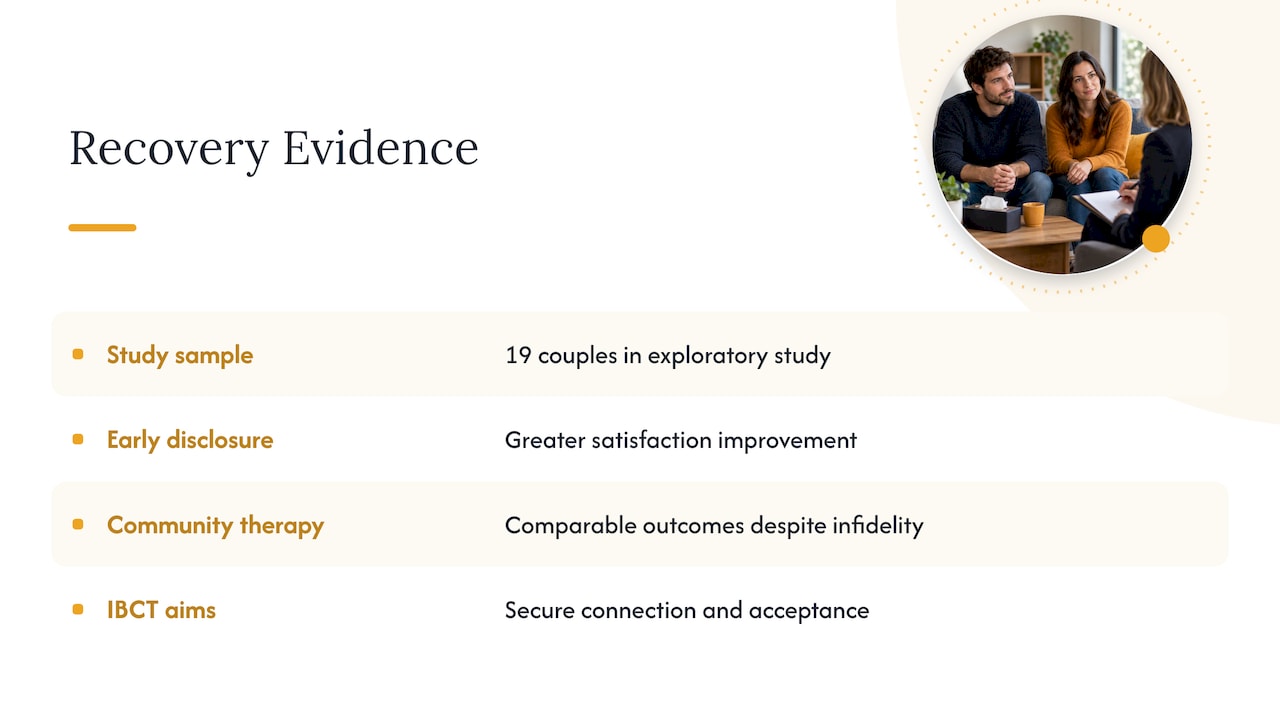
Yes, and the evidence is encouraging when couples get help. An exploratory study of 19 couples dealing with infidelity, indexed by ERIC, found that those who revealed the affair before or during therapy showed greater improvement in satisfaction than couples without infidelity. A larger study of couple therapy in a community setting, published in a psychology journal, found that couples affected by infidelity were often more distressed at the start but could reach outcomes comparable to non-infidelity couples with therapeutic support.
The U.S. Department of Veterans Affairs describes couples therapy as a way to build communication skills and mutual understanding, and notes that integrative behavioral couple therapy aims to build a secure emotional connection and promote emotional acceptance. Those are exactly the things trickle truth erodes, and they are the things worth rebuilding.
These findings do not promise your relationship will survive, and some should not. They do show that an affair, even one that began with half-truths, is not an automatic end point.
Perspective: why we push for one honest conversation
In our work with couples, the pattern is rarely a villain and a victim. It is two frightened people. One is afraid that the whole truth will end the marriage, and the other is afraid that nothing they hear is the whole truth.
The F.I.G.H.T. Plan® was built around a simple idea: structure protects people when emotions run high. Disclosure is the clearest example. When it happens in a heated moment, it becomes another fight. When it happens with preparation, clear ground rules and a plan for what comes next, it can become the first honest conversation the couple has had in a long time.
We ask the partner who strayed to carry the weight of telling the truth, and we ask the betrayed partner to decide what they need rather than absorbing everything. Neither is easy. Both are far easier with a framework and with someone who has walked other couples through it.
That is why our R.E.S.T.O.R.E. approach starts with honesty and safety before any talk of forgiveness. Forgiveness cannot be rushed, and it cannot be built on a story that is still changing.
Carlos
What comes after disclosure
Disclosure is the start, not the end. After the facts are on the table, couples usually face three tasks:
- Rebuilding safety. Transparency habits, agreed boundaries and time. The boundaries after betrayal plan and the transparency plan are built for this stage.
- Managing triggers and jealousy. Intrusive thoughts do not stop on a schedule. Our guide to stopping jealousy after infidelity offers practical steps.
- Rebuilding closeness. Emotional and physical intimacy come back slowly and unevenly. See how to rebuild intimacy after infidelity for a step-by-step approach.
Forgiveness comes later and cannot be forced. When you are ready to think about it, forgiveness after infidelity is a good place to start. If the affair was emotional rather than physical, the process is similar but has its own challenges, which we cover in repairing an emotional affair.
Get structured help with disclosure and recovery
If you are in the middle of this, you do not have to work out the order of events on your own. The R.E.S.T.O.R.E Workbook: Healing After an Affair is a therapist-created guide for rebuilding trust and love, priced from $9.99 to $20.00 depending on format. For one-on-one support, online couples coaching includes a four-session VIP private coaching option at $997.

You can browse the workbook and our courses in the Couples Fight School shop, or read about RESTORE® infidelity recovery counseling to see how we guide couples through disclosure and what follows. For a closer look at what therapy can add after betrayal, see the benefits of couples therapy after betrayal.
FAQ
Is trickle truth the same as lying?
It is a form of lying by omission, though the motive is often fear rather than a plan to deceive. Business Insider’s reporting describes it as gradual revelation after being caught. Whatever the reason, the effect on the betrayed partner is similar: the story keeps changing and trust cannot settle.
How much should be shared in a full disclosure after infidelity?
Share what the betrayed partner needs to understand what happened and make decisions: the nature and length of the affair, the people involved, and anything affecting health, money or safety. Explicit details can wait. A therapist can hold harder questions until both partners are ready, as described in Psychotherapy Networker.
What if my partner keeps revealing new details months later?
Say what you are noticing and ask for one complete, therapist-supported disclosure. Set a boundary on what you will do if more information is withheld. Get your own support too, because repeated revelations can feel like new betrayals and wear you down.
Can a relationship recover if trickle truth already happened?
It can. Studies of couples therapy after infidelity show that couples who start out more distressed can reach outcomes similar to other couples with help. The key step is switching from trickling to one honest account and then following through with consistent transparency.
Should we use a therapist for disclosure?
In most cases it helps. A therapist can pace the conversation, slow down heated moments and help each partner be heard. If you are not ready for in-person therapy, online coaching or a structured workbook can be a starting point, and a licensed therapist can cover anything involving safety or crisis.
Sources
- What Is Trickle Truthing: Why It’s Not Always a Red Flag (Business Insider)
- After an Affair, How Much Should Be Shared? (Psychotherapy Networker)
- Should an affair be disclosed? Risks of hiding or revealing infidelity (Toronto Sun)
- Infidelity and Behavioral Couple Therapy (ERIC)
- Outcomes of couples with infidelity in a community-based sample (PsycNet)
- Relationship Health and Safety (VA Sheridan Health Care)
Recommended
- Intimacy After Infidelity: How to Rebuild It, Step by Step
- 30–90 Day Behavior First Transparency Plan After an Affair
- 6 Neuroscience Backed Steps to Stop Jealousy After Infidelity
- Boundaries After Betrayal: Therapist Tools and a 30–90 Day Plan