
Spiritual Intimacy in Marriage: How to Build It Together

Spiritual intimacy in marriage is the closeness that grows when you can share your faith, doubts and hopes with your spouse, and your spouse responds with care instead of judgment. It does not require identical beliefs or an hour of devotions a day. It grows through small, repeated practices like praying together, talking about what gives your life meaning, and repairing things quickly when you hurt each other. Below is what researchers have found, and a practical way to start.
TL;DR
- Researchers define spiritual intimacy as disclosing your spirituality and being met with support, not judgment. Spouses do not have to share every belief to have it.
- A 2025 study found that praying together and discussing spiritual topics tracked with relationship satisfaction more closely than simply belonging to the same denomination.
- Start small: one short shared practice, at a time that feels easy, repeated weekly before you try to add more.
- If your spouse is not interested, lead with curiosity and private prayer, not pressure.
- Unresolved conflict blocks spiritual closeness, so pair your spiritual habits with solid communication skills.
Table of Contents
- What spiritual intimacy actually means
- What the research says about why it matters
- Praying together as a couple
- Everyday habits that build spiritual connection
- Making it safe to share doubts and struggles
- When your spouse is not interested
- Keeping spiritual connection through conflict
- Our perspective
- Take the next step with us
- FAQ
- Sources
What spiritual intimacy actually means
Most people hear “spiritual intimacy” and picture a couple on their knees every night. The research definition is quieter and more useful. Bowling Green State University’s psychology program describes spiritual intimacy as two things working together: you disclose your spirituality, and you respond to your partner’s disclosures supportively and without judgment.
That definition has two halves, and both matter. Sharing is the half people think of. The responding half is where many marriages stall, because a spouse who shares a doubt and gets a lecture learns to stop sharing.
The same BGSU summary notes that partners do not have to be religiously identical to experience spiritual intimacy, though couples with more shared religious involvement tend to report more of it.
Examples of spiritual intimacy
A family-science paper from Brigham Young University researchers, Increasing Intimacy in Marriage, describes it as sharing religious beliefs and observing religious practices together, such as praying and attending church. In everyday life that can look like:
- Praying a two-sentence prayer together before dinner.
- Telling your spouse about a verse, a sermon or a moment of quiet that stayed with you.
- Admitting you are struggling to believe something, and having your spouse listen instead of fix.
- Serving together at church or in your community.
- Forgiving each other, out loud, and meaning it.
- Reading Scripture or a devotional together and asking each other open questions.
Notice that most of these are conversations. Spiritual intimacy is emotional intimacy with faith as the subject.
What the research says about why it matters
The findings are consistent across several decades of studies, and they come with some useful nuance.
Warmth and satisfaction. BGSU reports that greater spiritual intimacy among husbands and wives has been associated with more warmth, humor, love and marital satisfaction, and with less negativity and hostility.
What you do together counts. A 2025 study in the Journal of Family Communication by Klausli, Gross and Leedom found that shared practices like praying together, discussing spiritual topics, reading Scripture together and encouraging each other were more closely tied to relationship functioning than distal factors such as both spouses belonging to the same denomination. Spiritual intimacy and viewing the marriage as sacred helped explain the link between those practices and satisfaction. In other words, the habit matters more than the label on your church.
Meaning, not just activity. An earlier peer-reviewed study on spiritual intimacy, marital intimacy and well-being found that spiritual meaning, as part of a person’s relationship with God, predicted greater marital intimacy. It also cautioned that spirituality without spiritual meaning could work against intimacy. Going through religious motions together is not the same as connecting.
Communication is the bridge. A study of 342 married couples found that a person’s relationship with God was linked to marital quality indirectly, through how couples communicated about religion. Forgiveness, both of yourself and by your spouse, was also positively associated with marital quality.
These are associations, and they describe groups of couples, not guarantees for yours. But the pattern is clear: talking, praying and forgiving together is where the benefit shows up.
Praying together as a couple
Praying together is the most searched-for form of spiritual connection, and it is also the one couples find most awkward. Many spouses pray privately without difficulty and freeze when asked to do it out loud with the person who knows them best.
The research is encouraging. Psychologist Frank Fincham’s 2012 paper, Praying Together and Staying Together, reported across three studies that praying with and for a partner predicted higher trust and a greater sense of relational unity. In the experiment, participants who prayed with and for their partner twice a week for four weeks reported significantly more unity and trust than a control group who did positive activities together. The samples were small, so treat it as a promising signal, not a prescription.
A review in the Springer handbook series on positive psychology and religiousness summarizes further findings: prayer for a partner has been associated with relationship quality and satisfaction, and in experimental work with more selfless concern, gratitude and forgiveness. A 2015 study in Family Relations found that prayer for a spouse’s well-being buffered against the negative effects of a high-stress marriage.
One caution from a 2026 study by Fincham, reported by PsyPost: the link between praying for a partner and satisfaction was stronger for more religious people and weak for the least religious participants. Prayer works best when it fits who you both are.
How to start praying together
- Pick the easiest moment. A meal, the drive to school, or the minute before the lights go out. Attach it to something you already do.
- Keep it very short. One or two sentences is a complete prayer. Length is not the goal.
- Pray for, not at. Pray for your spouse’s day, health or worries. Avoid using prayer to make a point about an argument.
- Hold hands or sit close. Physical closeness makes the moment feel like connection, not performance.
- Repeat twice a week for a month. That mirrors the schedule used in the Fincham experiment, and it is realistic for busy people.
If you want words to start with, our guide to prayers for marriage conflict gives you language for the harder seasons.
Everyday habits that build spiritual connection
Spiritual intimacy is built the way physical fitness is: with repeatable routines, not occasional heroic efforts. Biblical Counseling Coalition writer Garrett Higbee advises assessing your current season, starting with realistic practices, even once a week, and keeping them repeatable instead of overcomplicated. That is good advice for new parents, shift workers and anyone whose calendar is already full.
Utah State University Extension suggests five ways to create spiritual intimacy: open dialogue, shared spiritual practices, mindfulness and gratitude, serving a higher purpose together, and a safe space for vulnerability and growth.
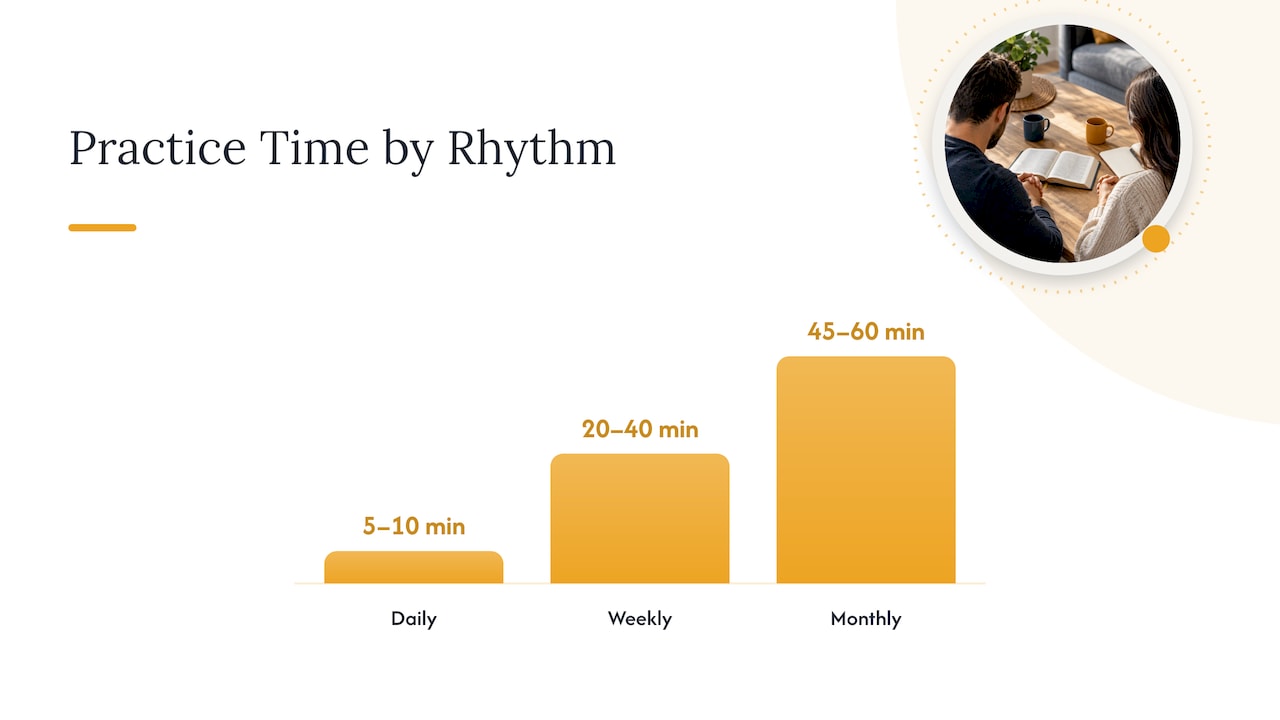
Here is how that can fit into a normal week:
| Rhythm | Practice | Time needed |
|---|---|---|
| Daily | A brief prayer, one genuine appreciation, five minutes of listening | 5 to 10 minutes |
| Weekly | A prayer walk, a date, or a devotional read aloud and discussed | 20 to 40 minutes |
| Monthly | An evening to review how you are doing spiritually and as a family | 45 to 60 minutes |
| Seasonal | A retreat, a service project, or a church event you attend together | A few hours |
The daily, weekly and monthly layers echo the rhythms the Biblical Counseling Coalition describes. Choose one cell from the table, do it for a month, then add another.
Two habits make the biggest difference in practice:
- Talk about “us,” not “you.” When you read or reflect together, ask questions like “What stood out to you?” instead of explaining what your spouse should take from it.
- Protect the time. If the practice only happens when things are calm, it will not happen. Put it on the calendar like any other commitment.
If your marriage needs a stronger base of everyday closeness first, strengthening the friendship foundation in marriage and our list of intimacy building activities for couples are good places to begin. Church can help as well: see how a church community can support your marriage.
Making it safe to share doubts and struggles
The responding half of spiritual intimacy is a skill. When your spouse says “I am not sure I feel close to God right now,” the connecting response is curiosity: “Tell me more about that.” The disconnecting responses are correction, alarm and silence.
Crosswalk’s advice for couples who feel spiritually disconnected includes rebuilding gradually: short shared prayers or brief devotionals, private prayer for your spouse, non-blaming conversations, validating doubts and struggles, and celebrating small steps.
Some struggles go beyond what a couple’s conversation can hold, such as addiction, trauma or depression. In those cases, it helps to understand when therapy and biblical counseling each fit, and to bring in a licensed professional alongside your pastor.
When your spouse is not interested
This is one of the most common situations, and pressure is the one approach that reliably backfires. Here is what the sources recommend.
Do not expect immediate change. CBN’s marriage guidance suggests praying for your spouse, keeping shared prayer very short if your spouse is not spiritually motivated, trying it at a meal or another low-pressure moment, and avoiding nagging or condemnation about church. Its example describes a reluctant husband who gradually joined his wife’s brief meal prayers and grew more comfortable over time.
Treat difference as a relationship issue, not a debate. A Utah State University relationship expert advises couples with religious differences to acknowledge the differences, use curiosity rather than persuasion, share personal stories, participate respectfully in each other’s religious events, repair after mistakes, and consider professional therapy when needed.
A simple script helps: “I would love to share this part of my life with you. What would feel comfortable, even if it is small?” Then accept the answer. The aim is closeness, not conversion.
Keeping spiritual connection through conflict
Faith does not exempt couples from fighting. Our own article on why Christian couples still struggle with conflict explains why, and the answer is usually skills, not sincerity. A couple can pray together on Sunday and still criticize and stonewall each other on Tuesday.
Guidance in Christian Standard on moving from conflict to connection recommends prayer, vulnerable first-person statements, treating disagreements as team problems rather than battles, and seeking counseling or educational help when necessary.
A Desiring God article on pursuing spiritual intimacy adds a perspective many spouses need: pursue Christ instead of making your spouse responsible for your spiritual life. It also encourages sharing weaknesses, choosing one shared practice you are both comfortable with, and being patient after setbacks.
When the hurt is deep, forgiveness is part of the path. Our guide to forgiveness in Christian marriage walks through the steps, and our piece on faith and marriage conflict resolution shows how to bring your beliefs into the way you argue and repair.
Our perspective
We have worked with thousands of couples, and the pattern is the same: spiritual closeness and emotional safety rise and fall together. A couple cannot pray warmly together while one of them is bracing for criticism.
That is why we built the F.I.G.H.T. Plan® as a structured system for communication, emotional regulation, healing and transformation. When spouses learn to speak without attacking and listen without defending, the spiritual conversations come more naturally. Disclosure feels safe, so couples do it.
Our approach is therapist-created and skills-based. We are licensed mental health professionals, and we also design materials for faith-centered couples, because we know that for many of you, faith is the lens through which you see your marriage. We do not ask you to choose between your faith and good psychology. We teach both to work together.
If you are only going to do one thing this week, practice the responding half. When your spouse shares something tender, say “thank you for telling me” before you say anything else.
Carlos
Take the next step with us
If you want structure instead of guesswork, we offer tools for different stages. The Christian F.I.G.H.T. Plan Workbook: A Faith-Centered Guide to Conflict Resolution for Couples is priced from $9.99 to $20.00 and gives you guided exercises to work through together. For a full program, Stop the Fighting: The Couples Communication & Conflict Resolution Course is $149.00 one-off. If you want a professional beside you, our online couples coaching includes a VIP package of 4 private sessions at $997.00.

Browse everything on our shop page and pick the one that matches where your marriage is today. You can also read about the benefits of faith-based marriage counseling before you decide.
FAQ
What are some examples of spiritual intimacy in marriage?
Examples include praying together, discussing what you each believe, reading Scripture or a devotional aloud, attending worship, serving together and forgiving each other. The research definition centers on disclosing your spirituality and receiving your spouse’s disclosures without judgment, so an honest conversation about a doubt counts as much as a prayer.
Can we have spiritual intimacy if we do not share the same beliefs?
Yes. Bowling Green State University’s research summary notes that spouses do not need to be religiously identical to experience it, though more shared religious involvement tends to go with more spiritual intimacy. Curiosity, respect and attending each other’s meaningful events go a long way.
How often should couples pray together?
There is no official number. In Fincham’s 2012 experiment, couples who prayed with and for each other twice a week for four weeks reported more trust and unity. Start with something you can sustain, even once a week, and keep it short.
What if my spouse refuses to pray with me?
Pray for your spouse privately, avoid nagging, and offer a very short prayer at a low-pressure time like a meal. Share your own experience instead of arguing. If the topic keeps causing fights, a licensed couples therapist or coach can help you talk about it safely.
Sources
- Spiritual Intimacy, Bowling Green State University
- Increasing Intimacy in Marriage, BYU Scholars Archive
- Processes Linking Shared Spiritual Practices, Spiritual Intimacy and Satisfaction
- Spiritual Intimacy, Marital Intimacy, and Physical Health
- A Relational Approach to Religion and Spirituality in Marriage
- Praying Together and Staying Together
- Positive Psychology and Religiousness/Spirituality in the Family
- Shared Religious Beliefs, Prayer, and Forgiveness
- PsyPost: Religious individuals who pray for their partners
- Healthy Rhythms in a Godly Marriage, Biblical Counseling Coalition
- 5 Ways You Can Create Spiritual Intimacy, Utah State University Extension
- Navigating Religious Differences in Marriage, Utah State University
- Refresh Spiritual Intimacy in Your Marriage, CBN
- What to Do When You Feel Spiritually Disconnected, Crosswalk
- From Conflict to Connection, Christian Standard
- Six Ways to Pursue Spiritual Intimacy in Marriage, Desiring God
Recommended
- Intimacy Building Activities for Couples That Actually Work
- How to Strengthen the Friendship Foundation in Marriage
- Benefits of Faith-Based Marriage Counseling Explained
- Emotional Intimacy vs. Physical Intimacy: Why You Need Both