
Love Languages and Conflict: Why Fights Happen and What Helps
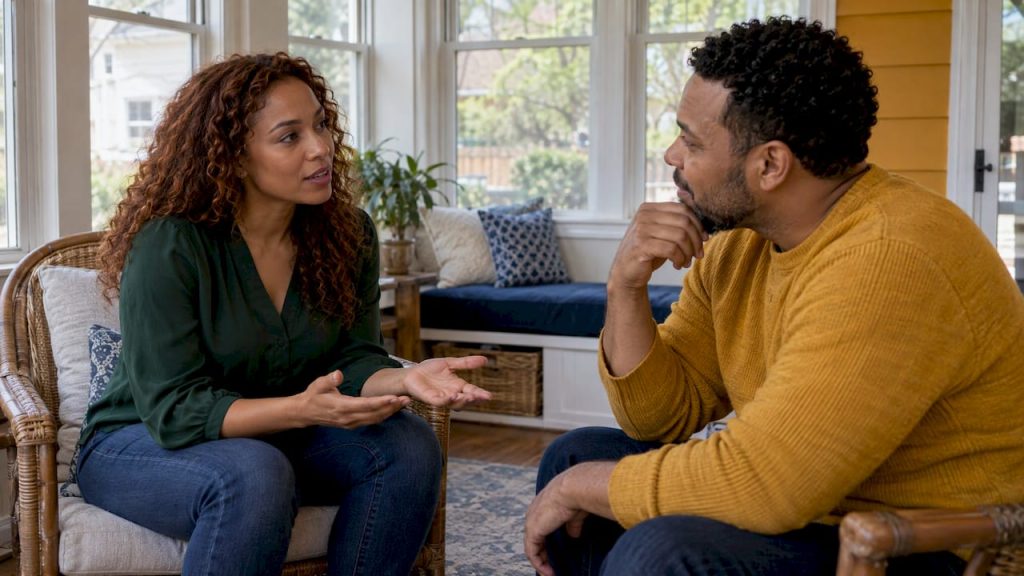
Love languages can start fights when partners show affection in ways the other doesn’t recognize as love, and when the labels become a scorecard. The research suggests the label itself matters less than two skills: learning what your partner actually wants, and staying regulated enough to respond when you’re upset. Those are conflict skills, and they can be practiced.
TL;DR
- Mismatched ways of showing love cause friction mainly when each partner reads the other’s effort as a lack of love.
- Studies are mixed on whether matching love languages predicts satisfaction. Knowing a partner’s real preferences, and self-regulation, show up as stronger threads.
- A love language turns into criticism when it becomes a rule or a debt: “I did my part, where’s yours?”
- In an argument, ask what your partner needs right now instead of assuming it from a category.
- A structured set of conflict tools gives you something to do once the quiz result is on the table.
Table of Contents
- How different love languages create conflict
- Love languages and criticism
- What the research says, in plain terms
- Why the labels fail in the middle of an argument
- How to talk about affection needs without it becoming a fight
- Using a mismatch well
- When love languages are not the real problem
- What we recommend
- Take the next step with Couples Fight School
- FAQ
- Sources
How different love languages create conflict
The framework comes from Gary Chapman and names five categories: words of affirmation, quality time, receiving gifts, acts of service, and physical touch. Researchers summarizing it in 2024 list those same five. The idea is simple: people feel loved through different channels, so love sent in the wrong channel can go unnoticed.
That is where conflict enters. Here is how it tends to look in real homes:
- She wants words, he offers fixes. She is upset about her day. He cleans the kitchen and books the car repair, which is his way of loving. She hears silence where she wanted reassurance. He hears ingratitude.
- He wants touch, she wants time. After a hard week he reaches for her. She wants an hour of undistracted conversation first. Both feel rejected.
- One partner gives gifts, the other counts hours. A thoughtful present arrives on a night the other partner was hoping to be home together.
None of these couples lacks love. Each is sending a message the other cannot decode, and an unread message under stress looks like neglect. Neglect then becomes the argument: “You never notice me.” “You never appreciate what I do.” Once those sentences start, the original difference is buried under blame.
We see the same shape in recurring fights generally. If your arguments loop, our piece on why couples repeat the same arguments explains why the surface topic is rarely the real one.
Love languages and criticism
People searching this topic often ask about criticism, and there are two kinds.
Criticism inside the couple. Learning your partner’s language can quietly turn into a complaint list. “You never touch me.” “You don’t speak my language.” The words sound like information, but they land as a verdict on character. Emily Impett’s 2026 scholarly article warns that rigid use of the framework can foster transactional scorekeeping, the logic of “I expressed love in your language, so you should express love in mine.” The same gesture can feel like care or like a debt, depending on how the partners treat it.
Criticism of the framework. The same 2024 review questions whether everyone has one primary preference, whether there are exactly five categories, and whether matching predicts greater satisfaction. It notes some studies found support for matching and others did not. That is a reason to hold the labels loosely, not a reason to drop the central insight that partners differ in how they want to be loved.
What the research says, in plain terms
If you have time for only one idea, take this: knowing your partner beats labeling your partner.
| Study | What it found |
|---|---|
| Coy and Rodriguez, 2023, 84 couples | People tended to hold biased views of their partner’s affection preferences. Understanding those preferences accurately was associated with greater relationship satisfaction. |
| Mostova, Stolarski and Matthews, 2022, 100 couples | Mismatch between partners’ preferences was associated with lower relationship and sexual satisfaction. Results for empathy differed by gender. |
| Flicker and Sancier-Barbosa, 2024, 696 participants | Satisfaction with a partner’s behavior in your top-ranked category did not predict satisfaction or perceived love better than satisfaction with lower-ranked categories. |
| Bunt and Hazelwood, 2017, 67 couples | Limited evidence that matching promoted satisfaction. Self-regulation explained more of the variation in satisfaction. |
Read together, these studies point in a practical direction. Flicker and Sancier-Barbosa’s results suggest that a broad range of affectionate behavior, especially words of affirmation and quality time in their sample, can matter more than a single top category. Bunt and Hazelwood’s suggest that self-regulation may help explain why some couples do well despite different preferences.
Translated for a living room: don’t wait for a perfect match, and don’t build your marriage on one quiz result. Make your affection wide, and get better at staying steady when a conversation heats up.
Why the labels fail in the middle of an argument
Three things tend to go wrong when couples bring love languages into a fight.
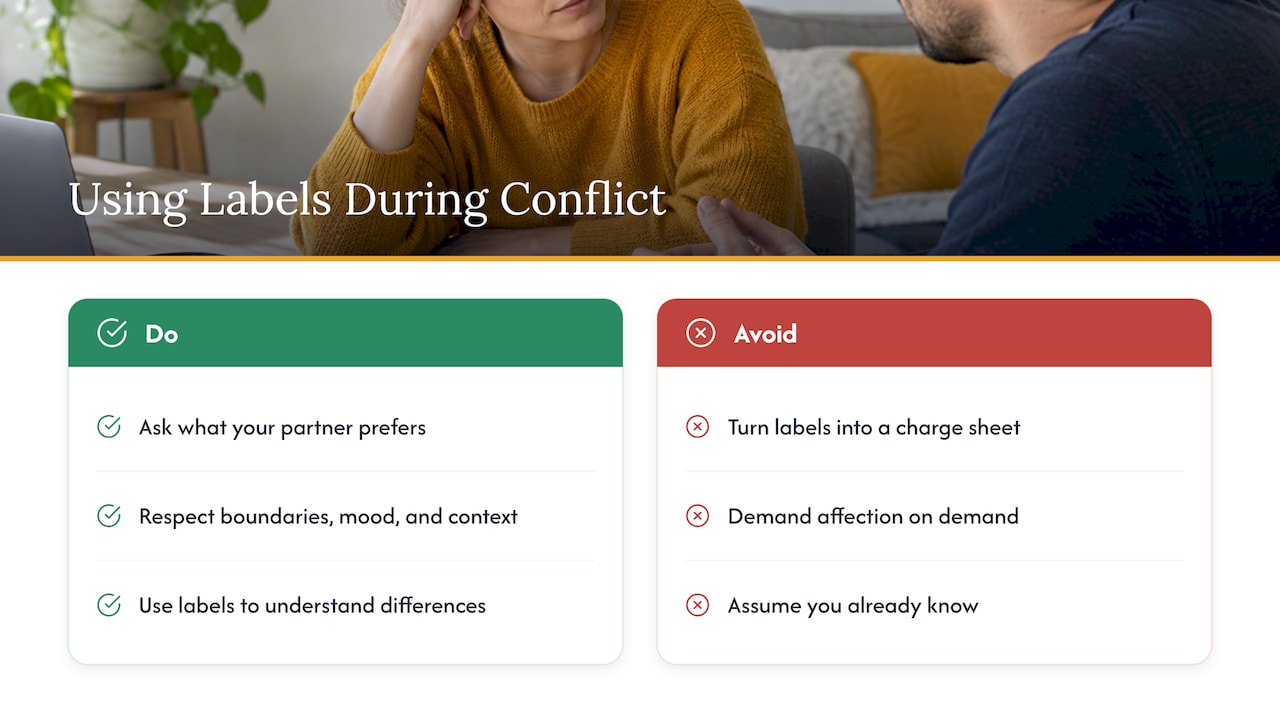
The label becomes a weapon. “Your love language is acts of service, so why didn’t you do the dishes?” turns a tool for understanding into a charge sheet. The partner who feels cornered defends, and the conversation is now about defensiveness.
The label is treated as a rule. Someone says touch is their language, and the other feels obligated to give it on demand. Affection delivered under pressure rarely feels like affection. A person’s no to touch after a sharp exchange is not a love-language violation. Preferences matter, and so do boundaries, mood and context.
The label replaces asking. The Coy and Rodriguez finding is the quiet warning here. If people hold biased views of what their partner prefers, then a label can lock in a guess. The couple stops asking because they “already know.”
How to talk about affection needs without it becoming a fight
These steps work for dating, engaged and married couples alike. They are plain on purpose, because under stress you need something short to hold onto.
1. Pick a calm time, not the middle of the argument
Affection needs discussed at the height of a fight sound like accusations. Wait until you’ve both settled. If you need ideas for pacing, our guide on how to diffuse conflict with your partner covers the pause itself.
2. Describe moments, not categories
Say “When you ask about my day and put your phone down, I feel close to you,” rather than “My language is quality time.” Moments are specific and checkable. Categories invite debate about whether the framework is real.
3. Ask, then reflect back
Ask: “What makes you feel most cared for this week?” Then repeat what you heard before answering. Given that people tend to misjudge their partner’s preferences, this one step corrects a lot of wrong guesses. Preferences also change with stress, health and seasons of life, so the answer from last year may not be this week’s.
4. Make one small request each
Choose one behavior you can each try for two weeks. Keep it small and positive: “A ten-minute walk after dinner” rather than “Be more attentive.” If you want wording, our therapist-backed conversation scripts give you phrases to borrow for exactly this kind of ask.
5. Give without keeping score
This is the Impett point in practice. Offer the gesture because your partner would value it, not to bank credit. If you notice yourself thinking “I’ve done three of those and they’ve done none,” take it as a signal to name the feeling and ask for what you need, not to tally.
6. Respect a no
If your partner declines a form of affection in the moment, believe them. Say what you’d like instead and ask when would work. A relationship where “not now” is safe to say is one where “yes” means something.
Using a mismatch well
Mismatch is useful information. It tells you where each of you feels unseen before it turns into resentment.
A few practical examples:
- Quality time and acts of service. One partner does the chores while the other wants company. Try doing the chore together, or agree on a short block of undistracted time right after the chore is done.
- Words and touch. Pair them. A hand on the shoulder with a specific appreciation covers both channels in one gesture.
- Gifts and everything else. A gift is often less about the object than about being thought of. Pair it with a short note saying what made you think of them. Shared experiences count here too, and a trip planned around the two of you, like the ideas in this piece on creating romantic travel moments that last, can serve quality time and gift-giving at once.
When love languages are not the real problem
If the same fight returns no matter how well you speak each other’s language, the cause is probably underneath: a pattern of criticism and defensiveness, emotional withdrawal, an old injury, or broken trust. Affection tools cannot fix a cycle. You need a way to interrupt the cycle itself. Our breakdown of eight conflict escalation patterns couples repeat can help you name yours.
If you are recovering from betrayal, the gestures that once felt loving may not land for a while, and that is normal. That situation calls for a structured path for rebuilding trust, not a better quiz result. If there is any fear of your partner, or controlling or abusive behavior, a love-language conversation is not the answer: contact a licensed therapist or the National Domestic Violence Hotline at 1-800-799-7233.
What we recommend
We are licensed mental health professionals, and we have watched couples treat a love-language quiz as the finish line. We think of it as a starting question: what does my partner need from me, and can I give it while I’m upset?
That second half is where most couples get stuck, and it is the reason we built the F.I.G.H.T. Plan®. It is a structured system for communication, emotional regulation, healing and relationship transformation. Knowing that your partner values quality time does little if the conversation turns into criticism and defensiveness within three minutes.
Our approach is to give you tools you can use that same night: scripts for hard conversations, guided reflection exercises, and skills for calming down so you can respond instead of react. Use the love languages to start the conversation about affection. Use a conflict framework to keep the conversation safe.
Start with what is specific. Ask your partner one question about how they want to be loved this week, listen to the answer, and do one thing about it.
Carlos
Take the next step with Couples Fight School
If you recognize your relationship in this article, a workbook or course gives you a shared plan to work through together. The F.I.G.H.T. Plan workbook is a therapist-created guide to couples communication and conflict resolution, published at $14.99 to $25.00. The F.I.G.H.T. Plan Couples Conflict Toolkit is $27.00. Our Fight Less Love Again Video Course is $47.00, and the full Stop the Fighting course is $149.00.
Faith is part of how many couples handle conflict, and there is a Christian F.I.G.H.T. Plan workbook for that. If you are engaged, the F.O.R.E.V.E.R. premarital workbook is $9.99 to $20.00. For healing after an affair, the R.E.S.T.O.R.E workbook is $9.99 to $20.00. If you want personal guidance, see online couples coaching: the VIP Private Coaching package of four sessions is $997.00, and the 6 Hours Couples Intensive is $1995. You can browse everything in the shop.
FAQ
Can different love languages really cause arguments?
They can, mostly through misreading. When one partner shows care in a way the other does not register, the effort goes unnoticed and both feel unappreciated. The research is more cautious about whether matching categories predicts satisfaction, so treat mismatch as a prompt to ask questions, not as a diagnosis.
Is it criticism to tell my partner their love language isn’t being met?
It depends on how you say it. “You never speak my language” is a verdict and will likely trigger defensiveness. “I feel closest to you when we have a phone-free half hour, could we try that?” is a request. Describe the moment you want, not your partner’s failure.
Do I need to take the quiz to use any of this?
No. The most useful step is asking your partner what makes them feel cared for, and checking your guesses. A 2023 study of 84 couples found that people often hold biased views of a partner’s preferences, so asking is more reliable than assuming.
What if we both speak the same love language and still fight?
Then the fights are about something other than how you show affection. Look at your pattern: how quickly each of you escalates, whether one of you withdraws, and whether old hurts are involved. Conflict skills such as pausing, scripts for repair and clear communication agreements address that directly.
Sources
- Impett, Park and Muise (2024), Popular Psychology Through a Scientific Lens
- Impett (2026), Speaking the Public’s Love Language
- Coy and Rodriguez (2023), Affection preference, enactment, and relationship satisfaction
- Mostova, Stolarski and Matthews (2022), I love the way you love me
- Flicker and Sancier-Barbosa (2024), Testing the predictions of Chapman’s five love languages
- Bunt and Hazelwood (2017), Walking the walk, talking the talk: Love languages
Recommended