
ADHD and Marriage Conflict: Why You Fight and How to Stop
ADHD does not cause fights by itself. The trouble starts when its symptoms, such as forgetting, interrupting, reacting fast and drifting off mid-conversation, get read as proof that one spouse does not care. Once that story takes hold, both people end up defending themselves. The way out is to separate the condition from the person, slow the argument down, and use a few repeatable skills. This guide shows how.
TL;DR
- ADHD-related behaviors like forgetfulness and emotional overreaction are often misread as lack of love, and that misreading drives most of the conflict.
- A common cycle: one spouse carries more of the load and raises concerns, the other feels criticized, gets defensive and withdraws.
- Pause about three seconds, repeat back what you heard, and tackle one issue at a time.
- Make requests specific and realistic, and use shared systems (planners, reminders, smaller steps) instead of nagging.
- If the same fights keep returning, look at ADHD evaluation or treatment and couples therapy that understands ADHD.
Table of Contents
- Why ADHD and marriage conflict go together
- The patterns that make arguments worse
- How to argue differently, starting tonight
- Talking about follow-through without blame
- Repairing the distance after the fight
- Our perspective
- When to get professional help
- Autism and couples communication: how it differs
- Tools to practice together
- FAQ
- Sources
Why ADHD and marriage conflict go together
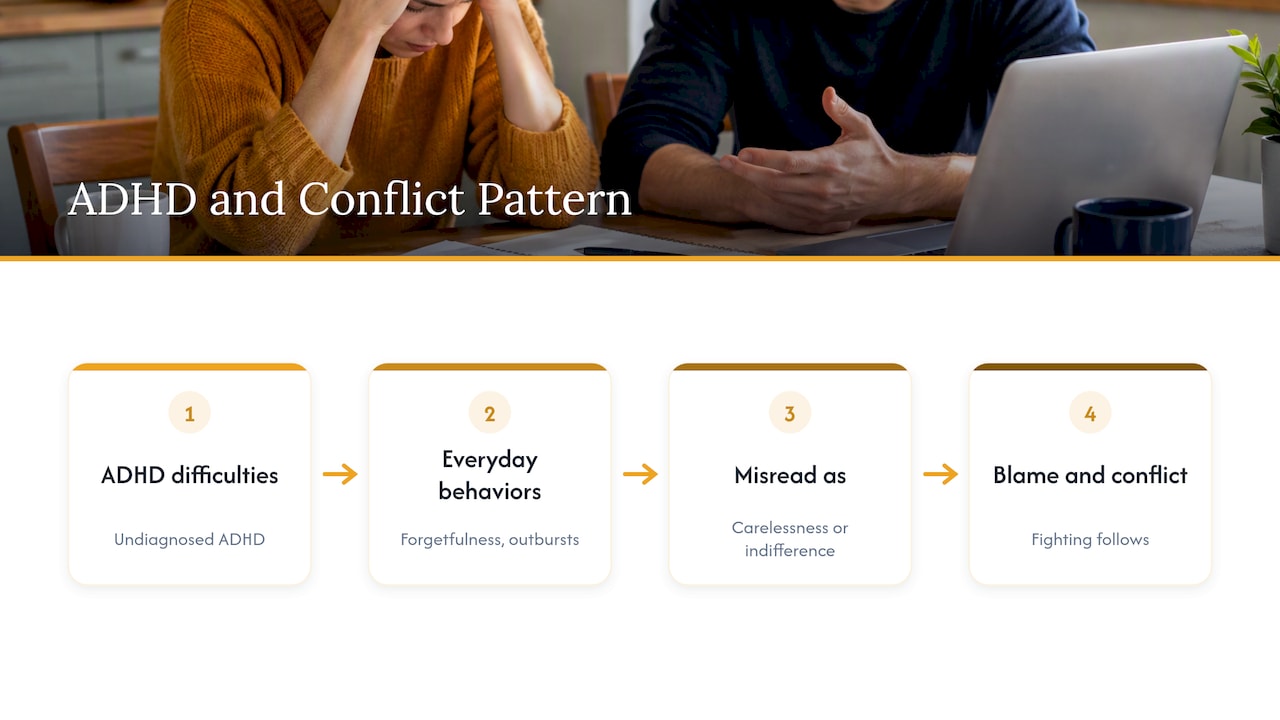
CHADD, the national nonprofit for people with ADHD, explains that attention, executive-function and impulse-control difficulties can lead to forgetfulness, disorganization, poor communication and emotional overreaction. When ADHD has never been diagnosed, a spouse tends to interpret those behaviors as carelessness or indifference. Blame follows, and so does the fighting.
The research backs up what many couples feel. A study of marital adjustment found that couples with ADHD showed more conflict and less marital intimacy than comparison couples, and that spouses often took unkept commitments and emotional outbursts as signs of not being loved.
That last point matters most. If your partner forgets the appointment you mentioned twice, it feels personal. If you are the partner with ADHD and you hear a list of failures every week, it feels like you are being graded. Neither of you is the villain. Both of you are reacting to a pattern.
CHADD says healing begins when the couple learns to separate the disorder from the person. That does not excuse hurtful behavior. It gives you a fair way to talk about what is happening so you can fix it together.
The patterns that make arguments worse
The criticized-and-defensive loop
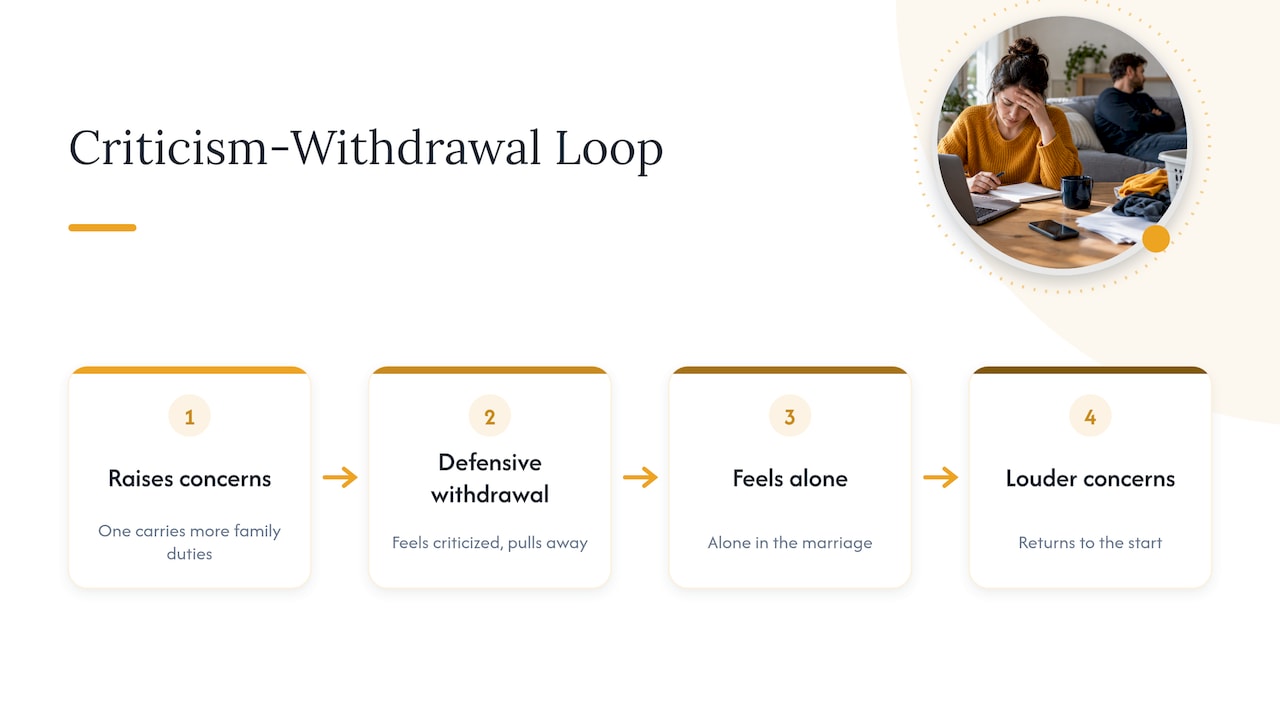
CHADD describes a destructive cycle that many ADHD marriages fall into. One partner takes on more of the family responsibilities and raises concerns. The partner with ADHD feels criticized, becomes defensive and pulls away from the relationship. The withdrawal convinces the first partner they are alone in the marriage, so they raise concerns more loudly. Round and round.
If this sounds familiar, our guide to the pursuer-distancer cycle walks through the same dynamic with scripts for breaking it, and eight conflict escalation patterns couples repeat can help you name which one is yours.
Neutral comments heard as blame
CHADD’s 2024 article on ADHD and relationships lists conflict habits that show up in many ADHD couples: hearing a neutral observation as blame, getting defensive or over-explaining, interrupting, and switching topics quickly. Say “the dishwasher is still full” and one spouse hears a fact while the other hears an accusation.
Attention pulled toward what is urgent or new
The same CHADD source on destructive cycles notes that ADHD can bias attention toward what is immediate, urgent, new or exciting instead of what is important. That is why the laundry loses to a new project, and why a partner can seem fully engaged one week and absent the next. Knowing this will not make the dishes appear, but it changes the question from “why don’t you care?” to “what system will help this get done?”
Fast escalation
CHADD also notes that in couples where one or both partners have ADHD, emotional escalations can happen very quickly because of difficulty regulating emotion. A small comment can become a shouting match in under a minute. That speed is why the skills below focus on slowing the first few seconds.
How to argue differently, starting tonight
These steps draw on CHADD, university extension programs and our own work with couples. Use them together or pick one.
- Wait about three seconds before you answer. CHADD recommends a short pause, repeating back what you heard, asking for clarification and using a sensory tool if it helps, such as a fidget or a cold glass of water.
- Repeat back what you heard. “What I’m hearing is that you felt alone with the kids this week. Is that right?” Utah State University Extension advises couples to reflect back what they heard before judging or responding. Our six reflective listening steps with ready scripts lay this out line by line.
- Raise one issue at a time. The same Utah State guidance says to address one issue at a time and to speak assertively but respectfully. For a spouse who changes topics fast, a rule like “we finish this one, then we can park the next one on a list” is a real help.
- Look for the softer feeling under the anger. Purdue University Extension suggests identifying hurt, sadness or disappointment beneath anger. “I’m disappointed we missed that dinner” lands very differently than “you always forget.”
- Take a break, and say when you will come back. Purdue also advises a short break when emotionally activated, then returning when calmer. Agree on this in advance, for example “I need twenty minutes, and I will come find you.” That way a break is not mistaken for stonewalling.
- Skip the contempt. The University of Florida’s SMART Couples program lists sarcasm, name-calling, eye-rolling and stonewalling as habits to avoid, and recommends I-statements, gentle complaints and listening without defensiveness.
For the moments when you are already flooded, our piece on emotional regulation for couples gives clinician-backed ways to calm down first. If defensiveness is your main sticking point, try how to manage defensiveness.
Talking about follow-through without blame
Most ADHD marriage fights are about the same few things: unfinished tasks, missed plans, lateness and the sense that one person is running the household. The conversation goes better when it is structured.
Purdue’s guidance gives a simple formula: describe your feeling with an I-statement, name the behavior and why it affected you, then make a realistic request. It also stresses repeating these skills over time rather than expecting one talk to repair things.
Here is how that sounds:
- Instead of: “You never help around here.”
- Try: “I feel overwhelmed when the evening routine falls on me, because I end up with no time to rest. Could you take bath time on weeknights?”
The second version names a feeling, a behavior and a request that can be done. Our guide to criticism versus complaint has four more rewrites you can adapt.
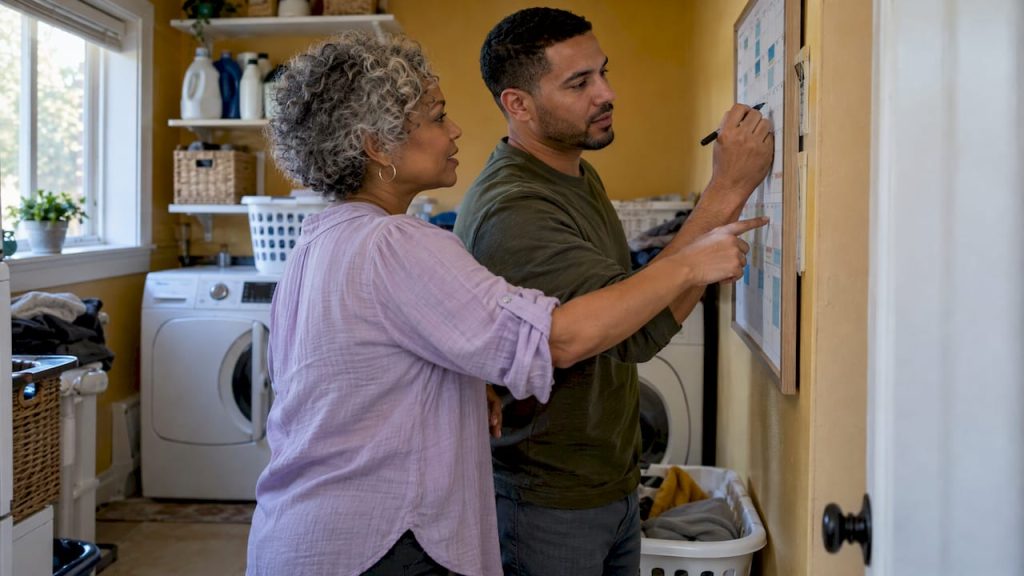
Then build the system around the request. CHADD lists structured routines, planners or reminder apps, and breaking tasks into smaller steps among the helpful strategies. A shared calendar, a visible weekly chore board or a phone alarm set by the partner with ADHD (not by the other partner as a nag) moves the job from a character test to a logistics problem.
If you are the spouse without ADHD, ask whether you want the task done your way or done. If you are the spouse with ADHD, tell your partner what actually helps, and do not promise what you cannot track.
Repairing the distance after the fight
Many couples with ADHD are not stuck on the arguments themselves. They are stuck on the coldness that follows. Utah State University Extension suggests discussing the distance calmly and in general terms, reaffirming commitment and listening without judgment. It also recommends apologizing once both people have cooled down, and taking responsibility for your own contribution rather than only your partner’s.
The same guidance carries an important limit: assuming good intentions does not apply when abuse is involved. If you feel afraid of your partner, or are being controlled, threatened or hurt, this is no longer an ADHD communication problem, and you should contact a professional or the National Domestic Violence Hotline.
SMART Couples also recommends rebuilding closeness with shared rituals such as nightly check-ins or regular dates, plus small acts like notes, check-in texts and favors, and names forgiveness, including self-forgiveness, as part of healing. For ADHD couples, rituals that are short and tied to something already in the day work best, like five minutes over coffee.
If you often feel you are not being heard even when you are talking, read why couples feel unheard during arguments. If the same topic keeps resurfacing, see why couples fight about the same things and how to overcome communication gridlock in marriage.
Our perspective
We are licensed mental health professionals, and we have sat with many couples who were certain the problem was a lack of love. Usually it was a lack of a shared way to talk when things got hot.
That is the idea behind the F.I.G.H.T. Plan®. It is a structured, step-by-step system for communication, emotional regulation and healing, and it works because it gives both partners the same steps to follow. When one partner reacts quickly, a script and a pause give them something to hold. When the other partner feels like a manager, a clear request format lets them stop nagging and start asking.
We do not treat ADHD, and we will never tell you a workbook replaces an evaluation or medical care. What we teach is the part that sits between the two of you: how to hear a concern without hearing an attack, how to repair after a bad night and how to build a routine of connection. Those skills are the same ones the research above points to, and they get stronger with practice.
Start small. One conversation using the three-second pause and reflective listening will tell you more about your own pattern than another round of the old argument.
Carlos
When to get professional help
CHADD says couples therapy may help and that the person with ADHD may seek evaluation or treatment from a mental health professional. Consider it when the same fights repeat despite your best efforts, when one of you suspects undiagnosed ADHD, or when resentment or withdrawal is hardening.
The American Academy of Family Physicians notes that adult ADHD management may combine behavioral interventions, medication, patient education and monitoring, and that family therapy may help adults with relationship difficulties. If you are curious how treatment decisions work, this overview of ADHD medication for adults explains what to ask a prescriber. Decisions about medication belong with a licensed prescriber who knows your history.
Look for a couples therapist who is comfortable with ADHD. The American Psychological Association’s published principles say ADHD-focused couple therapy should cover every issue on the table, from sex and money to communication, by combining couple-therapy basics with ADHD-specific executive-function approaches. There is early evidence, too: a small study of a six-session program blending CBT and couples work found participants reported lower relationship impairment afterward, though it was preliminary.
Autism and couples communication: how it differs
Readers who search for autism couples communication often wonder whether the same advice applies. A 2021 study of romantic relationships in adults notes that ADHD and autism spectrum disorder can each affect social interaction and communication, but in different ways. ADHD involves inattentive and/or hyperactive-impulsive behaviors, while difficulty with social interaction is a core feature of autism.
In practice, that means a few skills overlap, such as clear, concrete requests and planned breaks, but the underlying needs differ. If you suspect autism, ADHD or both, a diagnostic evaluation with a qualified clinician will do more for your marriage than guessing.
Tools to practice together
Skills stick when you practice them outside of a fight. Our offers are communication and conflict tools for couples, not ADHD treatment, and they pair well with whatever clinical care you have.
- The F.I.G.H.T. Plan Couples Conflict Toolkit, $27, for a fast start.
- The F.I.G.H.T. Plan workbook, $14.99 to $25, for guided exercises you can work through together.
- Stop the Fighting: The Couples Communication & Conflict Resolution Course, $149, for a full self-paced program.
- Private coaching, with a 4-session VIP package at $997, if you want someone guiding you through your own patterns.
Browse everything in the Couples Fight School shop.
FAQ
Does ADHD cause divorce?
Not on its own. Research finds more conflict and less intimacy in couples where a spouse has ADHD, but that is a pattern, not a verdict. Couples who understand the condition, separate it from the person and learn new communication skills have a real chance to change the pattern.
Why do we argue so much when my spouse has ADHD?
Often because symptoms like forgetting or interrupting are read as not caring, which leads to criticism and defensiveness. Emotional reactions can also escalate fast. Pausing, reflecting back what you heard and discussing one issue at a time slows the cycle.
How do I bring up ADHD without sounding accusatory?
Use an I-statement, describe what you have noticed and how it affects you, and suggest an evaluation as a shared step. For example: “I feel worn down when plans fall through, and I wonder if an evaluation could help us understand what’s going on.” Avoid diagnosing your spouse yourself.
Is couples therapy worth it if only one of us has ADHD?
Yes, it can be. The ADHD affects the dynamic between you, not just one person. Look for a therapist who knows ADHD-focused couples work, and consider an individual evaluation for the spouse with symptoms.
What if the arguments ever feel unsafe?
If you fear your partner, or there is threatening, controlling or physical behavior, skills practice is not the answer. Talk to a licensed professional or contact the National Domestic Violence Hotline for confidential support.
Sources
- Marriage and Partnerships, CHADD
- Marital Adjustment and Marital Conflict in Individuals with ADHD
- ADHD and Relationships: When Love Gets Lost in Translation, CHADD
- The Destructive Cycles that Tear ADHD Marriages Apart, CHADD
- Couples Living with ADHD: Manage Intense Emotions and Build Deeper Connections, CHADD
- After the Fight: Four Perspectives and Skills for Rebuilding Emotional Intimacy, Utah State University Extension
- When it Hurts So Bad: Healing Your Marriage, SMART Couples, University of Florida IFAS
- Relationships: Handling Conflict with Your Partner, Purdue University Extension
- Adult ADHD Toolkit for Family Physicians, AAFP
- Principles of ADHD-focused couple therapy, APA PsycNET
- Integrative CBT and couples intervention for emerging adults with ADHD symptoms, APA PsycNET
- Common Venues in Romantic Relationships of Adults With ADHD and ASD
Recommended
- Stop Arguing With Your Husband in 10 Minutes Using Therapist Scripts
- How to Choose the Right Partner and Fight Less
- Married Couples: Share the Mental Load With a 3–5 Chore System
- Couples: Identify Fight Triggers in 3–5 Logged Arguments