
Apology Languages: The 5 Types and How to Find Yours
Apology languages are the different ways people need to hear “I’m sorry” before they feel it. The idea comes from Gary Chapman and Jennifer Thomas, who describe five of them: expressing regret, accepting responsibility, making restitution, planning for change, and requesting forgiveness. One partner may need to hear “I was wrong.” The other may only believe the apology when something changes. When you apologize in the wrong language, you can mean every word and still leave your partner feeling unheard.
This guide explains each language and what it sounds like. It shows you how to find yours and your partner’s, and what every good apology needs whatever the language. It also gives you scripts and an outline for an apology letter to a spouse.
TL;DR
- The five apology languages are expressing regret, accepting responsibility, making restitution, planning for change, and requesting forgiveness.
- Most people have one or two that matter most to them. Ask your partner what would mean the most instead of guessing.
- Research and professional guidance agree on a core: name the harm, own it, show remorse, offer a repair, and commit to changing.
- Explanations are fine only when they do not turn into excuses. “I’m sorry you feel that way” is not an apology.
- A letter can show effort, but some partners would rather talk face to face. Match the format to the person.
Table of Contents
- The five apology languages, and what each one sounds like
- How to find your apology language
- When you and your partner speak different languages
- What every apology needs, whatever the language
- Apology scripts for couples
- How to write an apology letter to your wife or spouse
- Is it a real apology? Telling accountable from insincere
- Best books on apologizing and repairing a relationship
- Our perspective: an apology is the start of repair, not the end of it
- Practice apologizing together
- FAQ
- Sources
The five apology languages, and what each one sounds like
The wording below follows the Chapman and Thomas framework. The couple examples are adapted from Women’s Health’s relationship guidance.
| Apology language | The core message | What it sounds like |
|---|---|---|
| Expressing regret | I feel bad that I hurt you | “I’m sorry. I can see how painful that was.” |
| Accepting responsibility | I own what I did | “I was wrong to lie to you. No excuses.” |
| Making restitution | I will make it right | “How can I make this right?” |
| Planning for change | It won’t happen again | “Here is what I’ll do to prevent this next time.” |
| Requesting forgiveness | I hope you can let this go | “Will you forgive me?” |
1. Expressing regret
This person needs to know you feel the hurt. The apology is emotional: you name how your action affected them and show real remorse. Without that, a promise to change feels cold. A good version lists the specific effects: “I know I embarrassed you in front of your family, and I hate that you felt small.”
2. Accepting responsibility
This partner wants a clear admission: “I was wrong.” Hedges are what hurt them most. “I’m sorry, but you also…” or “Mistakes were made” lands as dodging. If your partner is in this camp, give the sentence its own space with no “but” after it.
3. Making restitution
For some people, words are cheap until there is an effort to repair. They want to hear “What can I do to make this right?” and then see you do it. Restitution should fit the harm. Washing dishes does not repair a broken confidence, and it works best when the hurt person helps decide what repair means.
4. Planning for change
This person is thinking about next week. They want a concrete plan: what you will do differently, and how you will notice when you slip. Vague promises (“I’ll try harder”) do not satisfy. “When I feel myself getting loud, I’ll tell you I need ten minutes, and I’ll come back to finish the talk” does.
5. Requesting forgiveness
Here the apology is incomplete until you ask: “Will you forgive me?” Asking hands the choice back to the hurt partner and signals humility. It also carries a risk. Greater Good in Action notes that forgiveness may not be the result, so ask without demanding an answer on the spot.
How to find your apology language
There is no need to wait for a quiz. Three practical approaches work:
- Look back at your last big hurt. Think of a time someone apologized and it still did not feel finished. What was missing: the feeling, the admission, the repair, the plan, or the request? That gap usually points to your language.
- Notice what you do when you apologize. People tend to apologize in the way they want to receive one. If you always rush to fix things, you may be a restitution person. If you always explain how bad you feel, regret may be yours.
- Ask. Greater Good in Action recommends asking the offended person what would mean most to them when making amends, rather than doing something that only relieves your own guilt. A simple question works: “When I hurt you, what do you most need from me afterward?”
Try it when you are both calm, not in the middle of a fight. A conversation about apologizing is much easier than one about a fresh injury.
When you and your partner speak different languages
This is where couples get stuck. Say one of you needs to hear “I was wrong,” and the other, when they apologize, jumps straight to “here’s how I’ll fix it.” The fixer thinks they have apologized thoroughly. The partner hears no admission, and the fight restarts about the apology itself.
A few habits help:
- Lead with your partner’s language, then add yours. Start with what they need, then say the rest in your own words.
- Stack more than one. Research on apologies supports this. In a classic study, Scher and Darley tested five components: an expression of apology, an explanation, an expression of responsibility, an offer of repair, and a promise not to repeat the offense. They found the components generally had independent effects, and apologies became more effective as more were used within the range they studied. You do not have to guess one language perfectly if you cover several.
- Say what you need, too. If you are the one who was hurt, tell your partner which part of the apology would help. “I believe you’re sorry. I need to hear what you’ll do differently” is clear and kind.
- Treat a missed apology as information, not rejection. If your apology did not land, ask what was missing before defending your effort.
Compassionate listening matters as much as the wording. Learning to validate feelings during a painful family conflict applies to couples too: people soften when they feel understood before they are asked to move on.
If your arguments keep ending in the same stalemate, our piece on why couples feel unheard during arguments covers the pattern underneath.
What every apology needs, whatever the language
Apology languages describe what a person emphasizes. Professionals who study apologies describe a shared core, and the lists overlap heavily:
- Harvard Health, summarizing psychiatrist Aaron Lazare: acknowledge the offense, explain what happened without excusing it, express remorse, and offer amends.
- The American Counseling Association (March 2026): name the behavior and its impact, validate the other person’s feelings, offer a remedy, and commit to changed behavior.
- Columbia University’s Ombuds Office: a shared understanding of the offense, accountability, acknowledgment of the other person’s pain, a judgment that the conduct was wrong, regret, and future intentions. It also warns that explanations should not become defensive justifications.
The 5 R’s
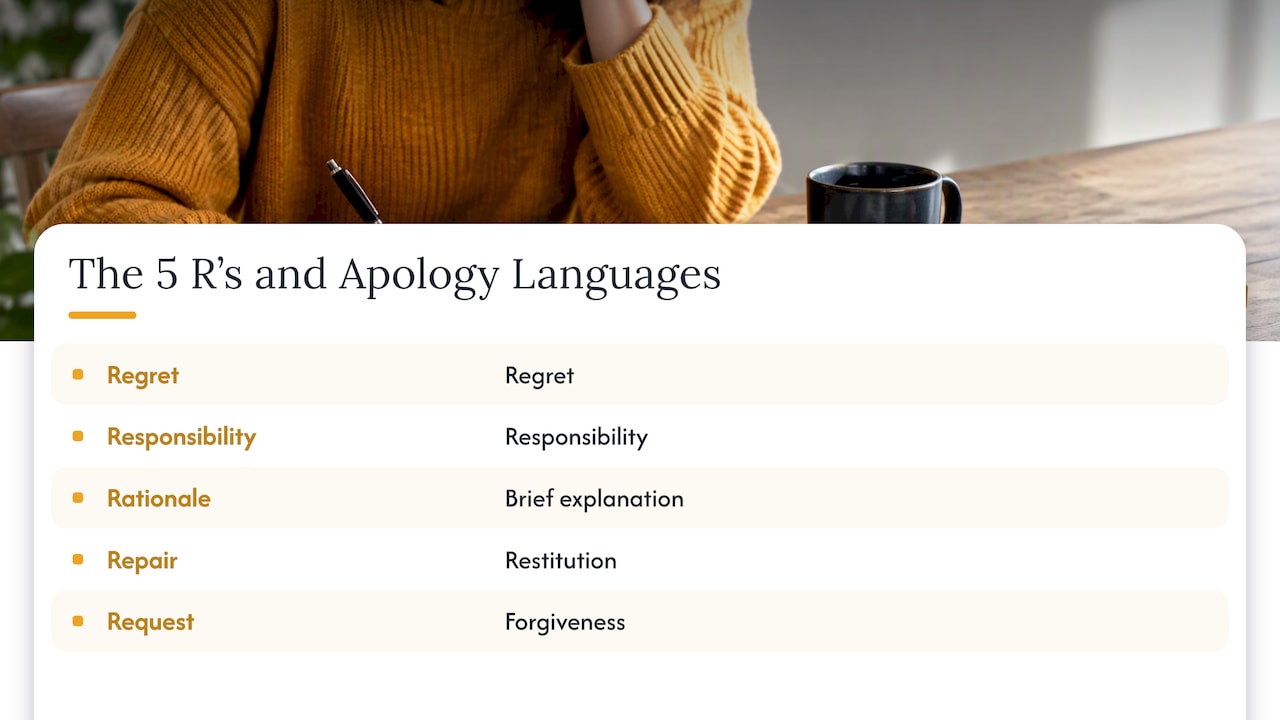
You may have seen the “5 R’s” of an apology. One common version is Regret, Responsibility, Rationale, Repair, and Request: name the harm, own it, briefly say what went wrong without justifying it, offer a concrete fix, and ask to rebuild the relationship. Notice how closely this lines up with the five languages: regret, responsibility, repair (restitution), and request (forgiveness). The extra piece is the short explanation, which the research above handles with care. An explanation helps when it shows you understand what happened. It hurts when it shifts blame.
Apology scripts for couples
Scripts are a starting point. Put them in your own words, or they will sound rehearsed. Each one below pairs a language with a full apology.
A complete apology, modeled on Harvard Health. Harvard Health’s example of an effective apology is: “I’m sorry I lost my temper last night. I’ve been under a lot of pressure at work, but that’s no excuse for my behavior. I love you and will try harder not to take my frustrations out on you.” It names the act, gives context, refuses to use it as an excuse, and states an intention.
For a regret-first partner:
“I’ve been thinking about what I said at dinner. I embarrassed you, and I can see it hurt. I’m sorry I made you feel that way.”
For a responsibility-first partner:
“I was wrong to dismiss your plans. I knew they mattered and I brushed them off. That’s on me.”
For a restitution-first partner:
“I forgot the appointment, and that cost you time and stress. What would help make it right? I can take care of rescheduling and the drive.”
For a change-first partner:
“I’ve been checking my phone while you talk. From now on it goes in the other room during dinner. If I slip, tell me and I’ll put it down.”
For a forgiveness-first partner:
“I’m sorry for how I handled that. Whenever you’re ready, I’d like to ask for your forgiveness. I understand if it takes time.”
After any script, stop talking. Let your partner respond. The pause is part of the apology.
How to write an apology letter to your wife or spouse
A letter can be a good choice when emotions run too high to talk, or when you want to choose words carefully. Columbia’s Ombuds Office notes that a written apology can communicate time and effort, but that some people prefer a face-to-face talk and a chance to describe their pain directly. So ask yourself which your spouse would value, and consider offering both: a letter first, then a conversation when they are ready.
Harvard Health’s summary of a heartfelt apology gives you a workable letter outline:
- Name what you did. Be specific. “I lied about where I was on Friday” beats “I’ve been a bad partner.”
- Explain without excusing. One or two sentences at most. “I was stressed and afraid of your reaction, but that doesn’t justify lying.”
- Express remorse and care. Say how you think it felt for them, in plain words.
- Offer amends. Ask what would help, or offer something concrete.
- Say how you will avoid a repeat. Be realistic and specific.
Sample letter for a spouse:
Dear Maria,
I’m sorry for the way I spoke to you on Saturday in front of your sister. I raised my voice and made a joke at your expense. I know it made you feel small and unsupported, and I hate that I did that to you.
I was frustrated about the trip and took it out on you. That’s an explanation, not an excuse. You deserved better from me.
I’d like to make it right. Is there something you need from me this week? From now on, if I’m frustrated, I’ll tell you privately instead of letting it show in front of others.
I love you, and I’m sorry.
Tom
Avoid ending with a demand (“I hope we can move past this”). Keep it short enough to be read in one sitting, and let your spouse respond in their own time.
Is it a real apology? Telling accountable from insincere
Not every “sorry” is repair. Harvard Health’s guidance says an accountable apology names the offense, accepts responsibility, expresses remorse, and offers amends, while an ineffective one may be vague, passive, grudging, minimize the harm, or blame the other person’s sensitivity.
Warning signs in everyday speech:
- “I’m sorry you feel that way” (puts the problem in your feelings, not their action)
- “Mistakes were made” (no one did anything)
- “I said I’m sorry, what more do you want?” (a grudging demand to drop it)
- “I’m sorry, but you…” (the apology turns into an accusation)
A healthy apology is also followed by action. If the same hurt happens again and again with the same apology, the words are not the problem. In that case, or if there is fear, control or ongoing betrayal in the relationship, talk with a licensed couples or individual therapist rather than trying to fix it with better wording.
If blame keeps taking over your apologies, see our guide on how to stop blaming in marriage. For more on repairing after harm, read apology in marriage.
Best books on apologizing and repairing a relationship
The starting point is The 5 Apology Languages: The Secret to Healthy Relationships by Gary Chapman and Jennifer Thomas. Its description covers the five languages, along with family relationships, conflict resolution, and what to say when apologizing. It is a good fit if you want the framework in the authors’ own words.
A book explains the idea. A workbook lets the two of you practice. If you are choosing something to work through together, pick by situation: conflict skills, preparing for marriage, or recovering from an affair. We cover those below.
Our perspective: an apology is the start of repair, not the end of it
We work with couples who are tired. They have tried saying sorry, and what they get back is “that’s not what I needed.” In our experience, the issue is rarely that one partner does not care. It is that each partner apologizes in the language they would want, and the other does not recognize it as an apology.
That is why we teach apologies as a skill within the F.I.G.H.T. Plan®, not as a magic sentence. The skill has three parts. First, calm yourself enough to listen. Second, ask what your partner needs, instead of assuming. Third, follow words with behavior, because trust is rebuilt by what repeats over time.
We also encourage couples to be honest about the limits. A well-crafted apology does not erase a betrayal, and it does not require instant forgiveness. If you are the hurt partner, you are allowed to say, “I heard you, and I need time.” If you are the one apologizing, you can accept that without pushing.
The best apologies we see are plain, specific and unhurried.
— Carlos
Practice apologizing together
If you want structure for these conversations, our tools are built for it. The F.I.G.H.T. Plan workbook ($14.99 to $25.00) walks you through communication and conflict resolution step by step. The R.E.S.T.O.R.E workbook on healing after an affair ($9.99 to $20.00) is for rebuilding trust after betrayal. For deeper skill-building, the Stop the Fighting course costs $149.00. If you want a guide working with you, see our online couples coaching.
FAQ
What are the five apology languages?
They are expressing regret, accepting responsibility, making restitution, planning for change, and requesting forgiveness. Each answers a different need: to feel the remorse, to hear an admission, to see a repair, to trust the future, or to be asked for forgiveness.
What are the 5 R’s of an apology?
One widely used version is Regret, Responsibility, Rationale, Repair, and Request. You name the harm, own it, briefly explain without excusing, offer a concrete fix, and ask to rebuild trust. The elements overlap with the five apology languages.
Do my partner and I have to share the same apology language?
No. Most couples do not. What matters is that you learn what your partner needs and lead with it. You can also include several elements in one apology, so you are less likely to miss.
Should I apologize in writing or in person?
It depends on your partner. A letter shows time and effort, but some people prefer to talk and describe their pain directly. If you are unsure, ask, or offer a short letter followed by a conversation when they are ready.
Sources
- The 5 Apology Languages (Focus on the Family)
- The 5 Apology Languages: What To Know About Yours (Women’s Health)
- Scher and Darley, How effective are the things people say to apologize?
- Making an Effective Apology (Greater Good in Action)
- Elements of an Effective Apology (Columbia University Ombuds Office)
- Relationship Repair (American Counseling Association, March 2026)
- The art of a heartfelt apology (Harvard Health)
- Apology Letter Format: 15 Templates + Expert Guide
- The 5 Apology Languages (Google Books)
Recommended
- 5 Therapist Backed Couples Conversation Scripts to Use Tonight
- 9 Step Partner Anger Debrief: Ready Scripts and F.I.G.H.T. Plan®
- Memorized Scripts for Four Horsemen Antidotes That Stop Fights Tonight