
Three Breathing Exercises to Calm Anger Fast
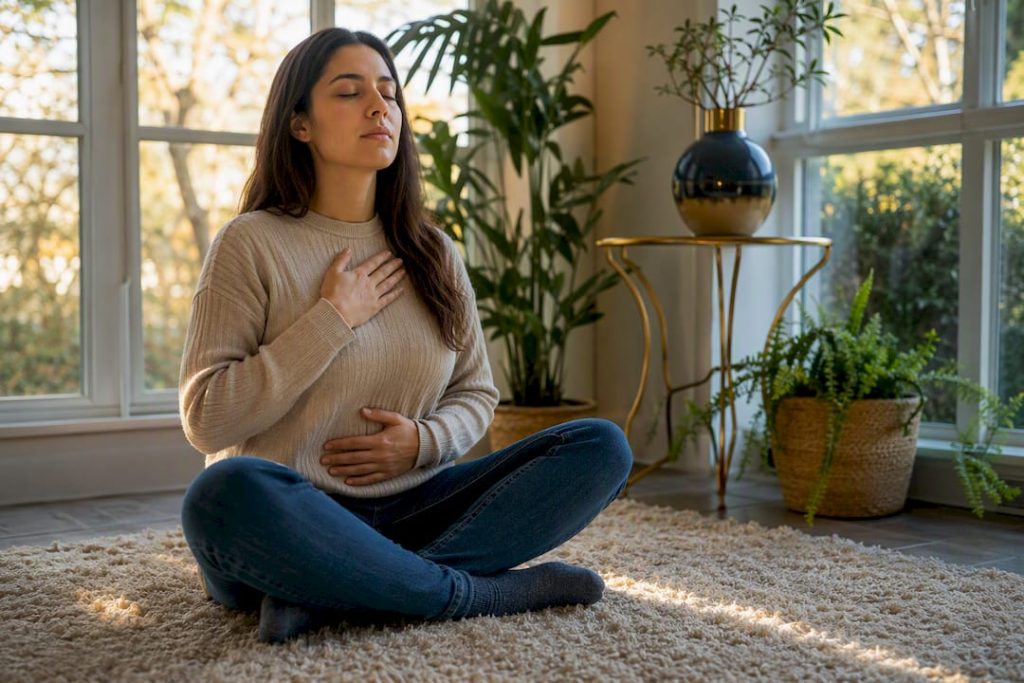
When anger spikes, use one of three quick breath resets, box breathing, 4-7-8, or diaphragmatic breathing, to lower your arousal and buy time to respond calmly instead of reacting, as explained in detail by deep breathing calms anxiety. Each works on the same lever: your breath is one of the few autonomic functions you can consciously override, and slowing it down pulls your nervous system out of fight mode.
- Box breathing: equal counts in, hold, out, hold. Best for a fast reset when you need to stay in the room.
- 4-7-8 breathing: longer exhale than inhale. Best for a strong downshift before bed or after a blowup.
- Diaphragmatic breathing: slow belly breathing. Best as a daily drill that trains your baseline calm.
Fact check: A 2024 meta-analysis of 154 studies and over 10,000 participants found that arousal-decreasing activities, deep breathing chief among them, reliably reduce anger and aggression across ages and settings.
If you feel dizzy at any point, sit down and shorten your counts. There’s no prize for holding your breath longer than your body wants to.
TL;DR:
- Regular practice of simple breathing techniques like box breathing, 4-7-8, or diaphragmatic breathing trains your nervous system to respond calmly during anger triggers.
- Longer exhalations and diaphragmatic work activate the parasympathetic nervous system, which significantly reduces anger and stress hormones.
- Practicing these techniques daily, especially in calm moments, enhances their effectiveness during high-pressure situations like arguments or confrontations.
- Short resets during arguments, such as a slow exhale or a re-entry line, can prevent escalation and help you re-center quickly.
- The most reliable approach involves consistent, straightforward routines rather than complex patterns or holding your breath beyond your comfort.
Table of Contents
- Why Controlled Breathing Lowers Anger
- How Do You Practice Breathing Exercises for Anger?
- How Do You Use Breathing Exercises During a Real Argument?
- Building a Breathing Practice That Actually Sticks
- Key Takeaways
- Sources
Why Controlled Breathing Lowers Anger
Anger is a sympathetic nervous system event. Your heart rate climbs, cortisol rises, and your body prepares to fight or flee, even when the “threat” is your partner leaving dishes in the sink again. Slow, controlled breathing flips a switch on that response by activating the parasympathetic system, the branch that handles rest and recovery. Longer exhales in particular signal to your vagus nerve that the danger has passed, which brings your heart rate back down and quiets the stress hormones flooding your system.
The strongest available evidence backs this up directly: a meta-analysis of over 10,000 participants found that arousal-decreasing activities, including deep breathing, mindfulness, and meditation, produced a meaningful drop in anger and aggression across populations and delivery formats, whether practiced digitally or in person.
That finding matters because it contradicts the old advice to “let it out.” Ohio State’s summary of the research puts it plainly: breathe, don’t vent. Venting tends to rehearse the anger response rather than resolve it. The practical takeaway is simple. You don’t need a complicated ritual. A longer exhale and a diaphragm doing the work beats a fancy pattern you’ll forget under stress.
How Do You Practice Breathing Exercises for Anger?
Pick one technique and get it into your body before you need it in a real fight. Here’s how each works.
1. Box breathing. Inhale for a count of 4, hold for 4, exhale for 4, hold for 4. Repeat for 4 to 6 rounds. Harvard Health describes this as a tactical breather because it’s used by first responders and military personnel to stay level under acute stress. If 4 counts feel like too much at first, start at 3 and build up over a week or two. Use it when you need to stay present in a tense conversation without shutting down or storming off.
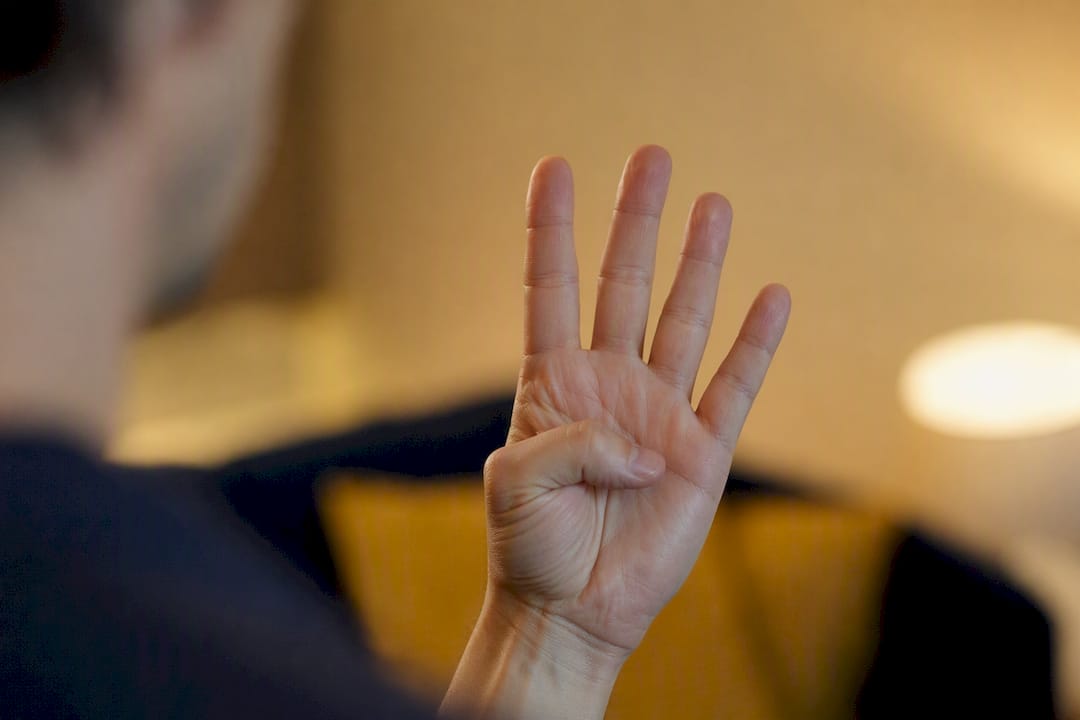
2. 4-7-8 breathing. Inhale through your nose for 4 counts, hold for 7, exhale slowly through your mouth for 8. Do 3 to 4 rounds. This pattern front-loads the exhale, which makes it a stronger downshift than box breathing, but the extended hold can make some people lightheaded. If that happens, drop to a 2-3-4 ratio and keep the exhale longer than the inhale rather than forcing the full count. This one shines at bedtime or right after a blowup, when you need your system to come all the way down, not just steady out.
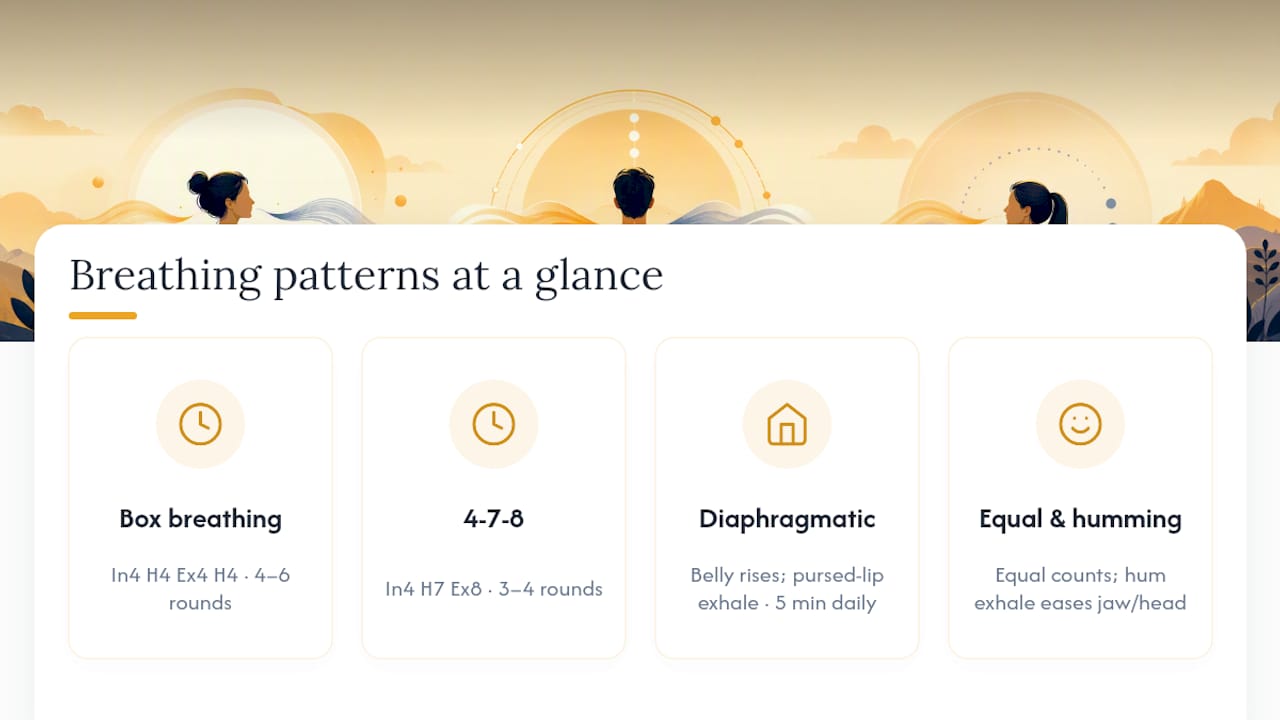
3. Diaphragmatic (belly) breathing. Sit or lie down, one hand on your chest, one on your belly. Breathe in through your nose so the belly hand rises while the chest hand stays still. Exhale slowly through pursed lips, letting the belly fall. Five minutes of this daily trains your diaphragm to do the work instead of your shoulders and neck, which is where most adults breathe when they’re stressed without noticing.
4. Equal breathing and humming (Bhramari). Equal breathing is just inhaling and exhaling for the same count, useful when box breathing’s holds feel like too much. Humming breath, exhaling with a low hum through a closed mouth, targets jaw and head tension specifically and works well if your anger shows up as a clenched jaw or a headache.
Mix and match based on context: seated at a desk, standing in a hallway, nose breathing when you can, mouth breathing when your nose is congested. None of it needs to look formal.
Pro Tip: Under real anger, your working memory tanks. Don’t try to count to 7 precisely, or you’ll get frustrated at the counting instead of calming down. Cleveland Clinic notes that simple, repeatable patterns work better under high emotion than complex ones, so pick one ratio and stick with it until it’s automatic.
How Do You Use Breathing Exercises During a Real Argument?
You won’t always get five quiet minutes. Most anger shows up mid-conversation, at the dinner table, in the car, on a group text. Here’s how to apply these techniques in real time.
The two-minute reset, if you can step away:
- Leave the room or step outside if possible.
- Run 4 to 6 rounds of box breathing or 3 rounds of 4-7-8.
- Name one sentence you want to say when you go back, before you go back.
The micro-reset, if you can’t leave:
- Take one slow exhale, longer than your inhale, before you speak.
- Silently count to four while your partner is talking instead of formulating your rebuttal.
- Drop your shoulders and unclench your jaw. Tension there feeds the loop.
Before a hard conversation you can see coming, spend 3 to 5 minutes on diaphragmatic breathing beforehand. It lowers your baseline arousal so you start the conversation calmer instead of already primed to react, and it tends to improve how you actually respond once things get tense.
A simple re-entry line works better than you’d expect: “I need two minutes, I want to come back and actually hear you.” Our guide on diffusing conflict with your partner has more scripts for exactly this moment.
Building a Breathing Practice That Actually Sticks
Doing box breathing once during a fight won’t rewire much. Practicing it daily will. Aim for two to five minutes in the morning and again in the afternoon, plus one longer ten-minute session weekly where you slow down and really feel the diaphragm move. Research on practicing during calm periods shows this is what actually trains the nervous system to recover faster when a real trigger hits, not the breathing itself in the moment.
If you get lightheaded, impatient, or lose count, that’s not failure, it’s a signal to simplify. Shorten your counts, lie down instead of sitting, and drop any hold that gives you trouble. The goal is a tool you can reach for on autopilot, not a performance you have to get right.
This kind of self-regulation work pairs directly with what we teach couples about responding to anger’s hidden messages inside a relationship. Breathing calms your body. What you do with that calm, how you actually talk to your partner, is a separate skill, and it’s the one Carlos Todd and Natasha Pemberton-Todd built the F.I.G.H.T. Plan® around at Couplesfightschool.
— Carlos
Key Takeaways
Controlled breathing works by shifting your nervous system out of fight mode, and consistent daily practice is what makes it reliable during a real argument, not just in theory.
| Point | Details |
|---|---|
| Pick one go-to technique | Box breathing for quick resets, 4-7-8 for a strong downshift, diaphragmatic for daily training. |
| Long exhales matter most | Exhaling longer than you inhale signals your vagus nerve to calm the stress response. |
| Simplicity beats complexity | Simple, repeatable counts work better under high emotion than elaborate patterns. |
| Practice when calm | Daily micro-sessions train faster recovery so the technique works when you actually need it. |
| Have a re-entry script | A short line like “I need two minutes” lets you pause and return without escalating. |
Sources
- A meta-analytic review of anger management activities that increase or decrease arousal: What fuels or douses rage?
- Try this: Take a tactical breather – Harvard Health
- Box breathing benefits – Cleveland Clinic
This article is general information, not a substitute for advice from a qualified doctor. Consult a qualified healthcare professional about your own circumstances before acting on anything here.
Recommended