
Conflict Avoidant Partner: How to Talk and Be Heard
If your partner goes quiet, changes the subject or says “I’m fine” whenever something hard comes up, the fix is rarely more pressure. It is more safety. Conflict-avoidant partners usually are not indifferent. They are overwhelmed, afraid of making things worse, or raised to believe that disagreement means danger. The approach that works is to lower the stakes, shorten the conversation, agree on a time, and make it clear you are on the same side.
This guide explains what is going on beneath the avoidance, what to say (with scripts), what to stop doing, and what to do if you are the one who avoids.
TL;DR
- Avoidance is usually a stress response, not a lack of caring. Pushing harder tends to deepen the withdrawal.
- Raise one issue at a time, at a scheduled moment, in a soft opening, and keep the first conversation short.
- Agree on a pause with a return time. A break with no return time feels like abandonment to the pursuer and like an escape hatch to the avoider.
- Unspoken grievances do not disappear. They resurface as distance, resentment and recurring arguments.
- If avoidance stems from fear of your partner’s anger or safety, talk to a licensed therapist or a domestic violence advocate before trying any of this.
Table of Contents
- What conflict avoidance actually looks like
- Why your partner avoids: fear, flooding and learned habits
- What not to do
- How to talk to a partner who avoids conflict: a step-by-step plan
- Use a pause with a return time
- Scripts for common situations
- What to do if you are the one who avoids
- A note on safety
- Our perspective
- Learn the skills together
- FAQ
- Sources
What conflict avoidance actually looks like
Avoidance is not always silence. It can look like:
- Agreeing in the moment, then doing nothing afterward.
- Joking or deflecting when a serious topic starts.
- Leaving the room, going to the phone or the garage, or suddenly being very busy.
- Saying “whatever you want” about decisions that matter to them.
- Giving short answers and going flat emotionally.
- Bringing up a problem months later as a long list.
One Psychology Today piece on conflict styles describes avoiding, validating and volatile as three styles that can all exist in a healthy partnership, sitting on a spectrum rather than in boxes. So avoidance is not automatically a defect. It becomes a problem when important issues never get settled and one partner feels permanently alone with them.
Why your partner avoids: fear, flooding and learned habits
Three things usually drive it, and often they stack.
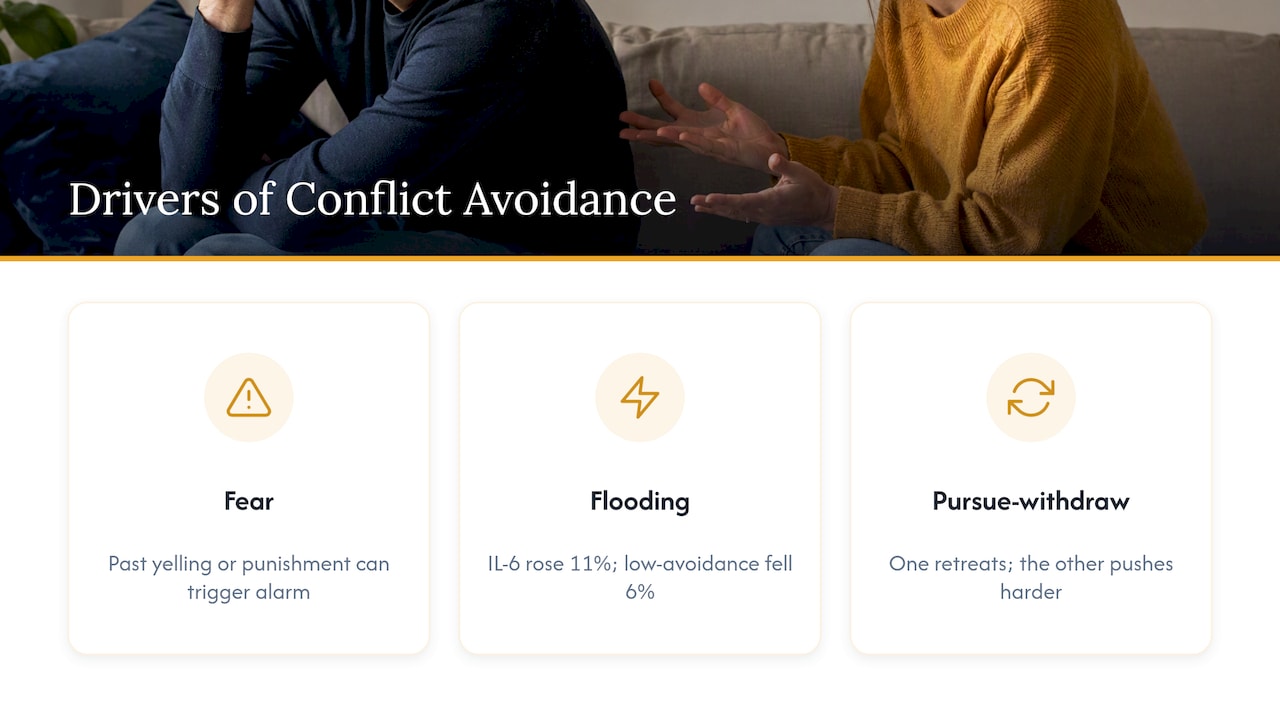
Fear of the outcome. Many avoiders learned early that conflict meant yelling, punishment or a parent leaving emotionally. As adults they feel the same alarm during a mild disagreement. Keeping the peace feels like protecting the relationship.
Physical overwhelm. Research on attachment avoidance found that highly avoidant people showed an average 11% rise in the inflammatory marker IL-6 during marital conflict discussions, while low-avoidance people showed a 6% decrease. That is a small lab study of a stress response, not a diagnosis, but it fits what many couples describe: the avoider’s body treats the conversation as a threat. Another study found that partner attachment pairings predict emotional flooding during conflict, including higher flooding in avoidant men when their partner was anxious.
A pursue-withdraw loop. One partner pushes for a conversation, the other retreats, and the retreat makes the first push harder. Researchers describe this demand-withdraw pattern, tied to lower relationship satisfaction over time, in couples where one partner is avoidantly attached. Neither person is the villain. The loop is the problem.
If you want to understand the loop in more depth, our guide on how to break the emotional withdrawal cycle in couples walks through it step by step.
Avoidant attachment versus a conflict-avoidant habit
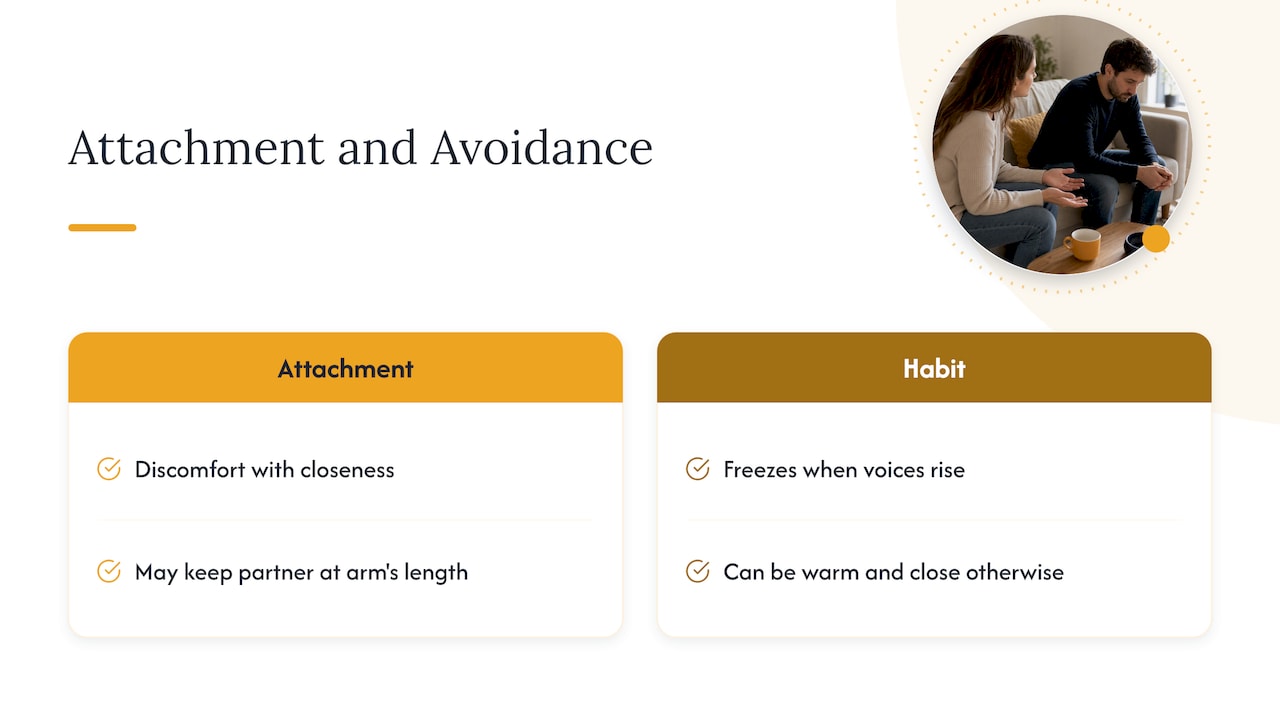
The two overlap but are not identical. Avoidant attachment is a deeper pattern of discomfort with closeness and emotional dependence, and it can show up as aloofness or keeping a partner at arm’s length. A conflict-avoidant habit can belong to someone who is warm and close in every other way but freezes when voices rise. The approach below works for both, though attachment-driven avoidance often takes longer and benefits from professional help.
For a clearer picture of the goal, a general explainer on secure attachment describes how safe, responsive bonds form. It is written for parents, but the core idea carries over to couples: people engage when they trust the other person will respond, not attack.
What not to do
Before the scripts, the common mistakes. Most of them come from desperation, and they are understandable.
- Cornering. Starting a big talk at midnight, in the car, or as they walk in the door.
- Pushing for resolution too fast. Couples therapists who work with avoidant couples say the most frequent error is rushing toward a solution instead of building emotional safety first.
- Stacking complaints. Bringing up five old issues turns a talk into a trial.
- Reading silence as agreement, or as contempt. It is usually neither.
- Following them out of the room. It confirms that conflict means being chased.
- Sarcasm and labels. “You never deal with anything” is a character verdict, and it will end the conversation.
It also helps to know what happens when you swallow your own concerns to keep the peace. Work on post-argument behavior shows that suppressing true grievances can leave a lingering, unresolved negative atmosphere rather than ending the conflict. Staying quiet is not neutral for either of you. We cover the longer-term effect in why conflict avoidance damages relationships over time and what conflict avoidance costs couples.
How to talk to a partner who avoids conflict: a step-by-step plan
1. Pick the topic and shrink it
Choose one issue. Write it in a single sentence that describes a behavior and your need, not their character. “We haven’t talked about how we split the bills” works. “You’re irresponsible” does not.
2. Ask for a time, not a talk
Surprise is the enemy. Try:
“There’s something I’d like to figure out together. It’s not an emergency and nobody’s in trouble. Could we take 20 minutes on Saturday morning?”
Giving an avoider time to prepare changes the experience from ambush to appointment. Name the topic in one line if they ask. Not knowing is often worse than knowing.
3. Open softly and say you’re on the same team
The first thirty seconds set the tone. Lead with what you value, then the issue, then an invitation.
“I love how we handle most things. One thing keeps nagging at me and I’d rather solve it with you than carry it alone. Can I tell you what I’m noticing?”
One advice thread that ranks for this topic puts the principle simply: remind your partner you are on the same team. That is the whole point of a soft opening.
4. Keep it short, and ask for less than you want
For a first conversation, the goal is not a decision. It is for both of you to say one true thing and to leave feeling nothing bad happened. A short, safe conversation builds the evidence your partner’s nervous system needs for the next one.
5. Make it easy to answer
Open questions can feel like an exam. Offer options or lower the bar:
- “On a scale of one to ten, how heavy does this feel to you?”
- “Do you want to talk it through, or would writing me a few lines first be easier?”
- “What’s one thing you’d want me to understand about this?”
Then wait. A 10-second silence is not a failure. Avoiders often need longer to find words.
6. Reflect before you respond
When they speak, repeat what you heard before you add your view: “So you felt shut out when I brought it up in front of your sister. Did I get that right?” Reflecting is the fastest way to teach an avoidant partner that honesty will not be punished. Our active listening exercises give you practice drills.
7. End on purpose
Close with appreciation and a next step: “Thank you for staying with this. Can we pick it up Wednesday evening for another 20 minutes?” Then keep the appointment. Reliability matters more than any single sentence.
Use a pause with a return time
When either of you is flooded, the talk stops being productive. Gottman-based guidance commonly recommends at least 20 minutes apart to let the body settle, though we could not tie that figure to an official Gottman page for this article, so treat it as a rule of thumb and adjust to your own bodies.
What matters most is how you pause:
- Say it out loud: “I’m getting overwhelmed. I want to keep going. Can we pause for 30 minutes and meet back at the kitchen table?”
- Spend the break calming down, not rehearsing your case.
- Return at the agreed time. The person who asked for the pause is responsible for restarting.
This single agreement changes the demand-withdraw loop, because the pursuer knows the topic will return and the avoider knows they won’t be trapped. We lay out ready-to-use wording in therapist scripts for couples’ time outs.
Scripts for common situations
| Situation | Instead of | Try |
|---|---|---|
| They go silent mid-talk | “Say something!” | “I can see this is a lot. Want to take a short break and come back at 7?” |
| They say “I’m fine” | “No you’re not.” | “Okay. If anything changes, I’d like to hear it, even if it’s small.” |
| They agree, then don’t follow through | “You always say yes and do nothing.” | “When we agreed on this, what made it hard to do? I’d rather know the real answer.” |
| Big decision looming | “We need to decide tonight.” | “We have two weeks. Can we each write our top three concerns and swap on Sunday?” |
| You are hurt | “You don’t care about me.” | “When plans change without a word, I feel unimportant. I’d like us to find a way to check in.” |
For more ready-made language, see our post on how to diffuse conflict with your partner and the communication exercises couples can do tonight.
What to do if you are the one who avoids
If you recognize yourself here, you are not broken, and you do not have to become combative. Small changes help:
- Name your body’s signal. Racing heart, tight chest, blank mind. Tell your partner: “I’m flooding, not dodging.”
- Offer a time. “I need an hour. I’ll find you at 8.” Then do it.
- Say one true sentence a day. Practice small disagreements: choosing the restaurant, saying you didn’t love the movie.
- Share the topic list. Keep a shared note where either of you can drop an issue before it grows.
- Separate conflict from rejection. A disagreement is information about a need, not a verdict on the relationship.
If avoidance is tied to past trauma or you notice anxiety, depression or panic, a licensed therapist is the right person to see. Avoidance that is deeply rooted usually changes faster with guided practice than with willpower.
A note on safety
Everything above assumes your partner avoids because of discomfort, not because of fear of you or of being hurt. If you avoid conflict because your partner’s anger feels dangerous, because you have been threatened, controlled or hurt, then communication tips are not the answer. Talk to a licensed therapist on your own or a domestic violence advocate, and make a safety plan before you raise anything difficult.
Our perspective
We have sat with many couples where one person says “we never talk about anything” and the other says “every talk turns into a fight.” Both are right. The pattern is rarely about the topic. It is about whether it feels safe to be honest.
As licensed mental health professionals, we built the F.I.G.H.T. Plan® on a simple belief: conflict is not the enemy of a good relationship, unmanaged conflict is. Avoiding it feels peaceful for a while, but the cost is intimacy. So we do not teach couples to argue harder. We teach structure: how to open a conversation, how to regulate in the middle, how to repair afterward. Once those skills are practiced, the avoider usually discovers that disagreement is survivable, and the pursuer discovers that waiting is not the same as being ignored.
If you take one thing from this article, take this: aim for a conversation that ends well, not one that settles everything.
— Carlos
Learn the skills together
Reading about the pattern is a start. Changing it takes practice with a plan. If you want a structured path, Stop the Fighting: The Couples Communication & Conflict Resolution Course is $149.00 and teaches the openings, pauses and repair steps in this article. For a lower-cost start, our workbooks and toolkit begin at $9.99, including The F.I.G.H.T. Plan – Couples Conflict Toolkit at $27.00. If you would like a therapist-guided process, see online couples coaching or the 6 Hours Couples Intensive at $1,995.
FAQ
How do I get a conflict-avoidant partner to open up?
Ask for a short, scheduled conversation, open with appreciation, and bring one issue only. Reflect what they say before you respond. Over several low-stress talks, most avoiders begin to trust that honesty will not be punished.
Is a conflict-avoidant partner the same as an avoidant attachment style?
Not always. Avoidant attachment concerns discomfort with closeness in general, while conflict avoidance can be a narrower habit around disagreement. They can coexist, and both respond to safety, predictability and patience. A therapist can help you tell which one you are dealing with.
Can a relationship survive if one partner avoids conflict?
Yes, if both people are willing to build a way of talking about hard things. The danger is not the avoidance itself but issues going unspoken for years. Many couples do well with structured tools and, when needed, a counselor.
Should I give my partner space or keep pushing?
Give space with a return time. Silence with no end point feels like abandonment, and pushing feels like attack. “Let’s pause and meet at 7” respects both needs.
What if my partner refuses to talk at all?
Try a written note, a walk instead of a face-to-face sit-down, or a shared topic list. If they still refuse over a long period, consider seeing a couples therapist or working on your own side of the pattern with professional support.
Sources
- Attachment avoidance predicts inflammatory responses to marital conflict (PubMed)
- Perceptions of Conflict at the Transition to Parenthood: Adult Attachment Pairings and Emotional Flooding (PubMed)
- Avoidant Attachment, Withdrawal-Aggression Conflict Pattern, and Relationship Satisfaction (PubMed)
- The Dyadic Construction of Romantic Conflict Recovery Sabotage (PMC)
- Why Couples Fight the Way They Do (Psychology Today)
- How to Cope With a Dismissive-Avoidant Partner (Psychology Today)
- Challenging Communication with your Conflict Avoidant Couples (Couples Institute)
Recommended
- Why Conflict Avoidance Damages Relationships Over Time
- Why Couples Feel Unheard During Arguments
- How to Choose the Right Partner and Fight Less
- What Does Conflict Avoidance Cost Couples