
Two De Escalation Phrases Couples Can Memorize Tonight

Partner-focused de-escalation means using short, non-blaming language to lower emotional intensity and create safety before a disagreement turns into a wound. Two lines to memorize tonight: “I feel overwhelmed, and I need a minute before we keep going,” and “I want to understand you, but I need a pause first.” The rest of this guide covers why these lines work, more scripts by category, exact timing, and when a phrase isn’t enough.
TL;DR:
- Using short, non-blaming repair phrases early in a conflict significantly increases the chances of de-escalation and relationship stability.
- Timing is critical; phrases are most effective within the first sixty seconds of rising tension, especially when both partners are less physiologically flooded.
- Rehearsing a small set of personalized scripts for calm requests, apologies, and reconnections improves their natural delivery during heated moments.
- De-escalation strategies are ineffective in situations involving threats, physical violence, coercion, or ongoing danger, which require immediate safety measures and professional support.
- Consistent practice and patience over weeks help these phrases become natural, making conflict more manageable without feeling scripted or forced.
Table of Contents
- Why do de-escalation phrases actually work?
- What are the best de-escalation phrases to use?
- How do you use these phrases in the heat of the moment?
- How do you build a shared phrase bank with your partner?
- When are de-escalation phrases not enough?
- How Couples Fight School turns these scripts into a habit
- A clinician’s note on practice and patience
- Sources
Why do de-escalation phrases actually work?
Repair attempts are small, well-timed gestures or phrases that interrupt an argument before it spirals, and they’re one of the strongest predictors of whether a relationship holds up over time, according to research summarized by Psychology Today. The mechanism is simple: conflict triggers a threat response, and a repair attempt signals to your partner’s nervous system that the threat is lower than it feels.
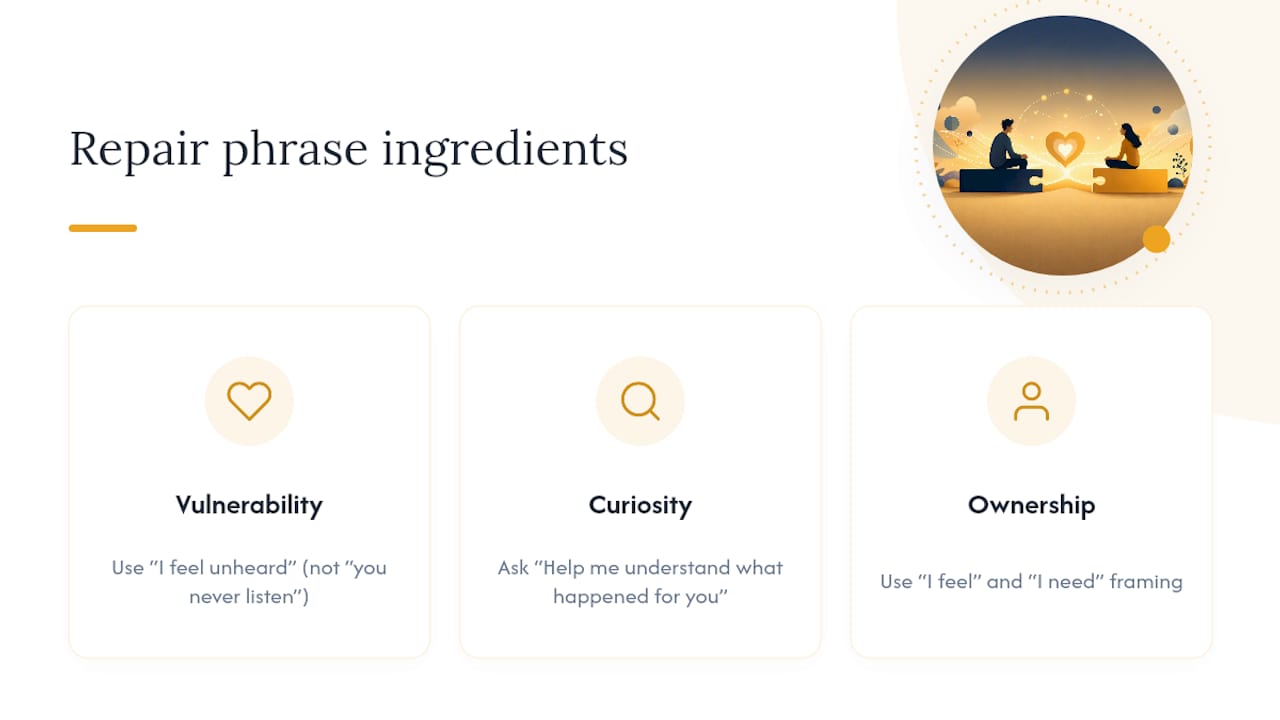
Three things separate a phrase that lands from one that gets ignored. First, vulnerability: “I feel unheard” defuses faster than “you never listen.” Second, curiosity over certainty. Asking “help me understand what happened for you” keeps the door open in a way that stating your own conclusion doesn’t. Third, ownership language, the classic “I feel” and “I need” framing, which keeps the sentence about your internal state instead of your partner’s character.
Timing matters as much as wording. A repair attempt offered in the first sixty seconds of tension works far better than the same words dropped twenty minutes into a shouting match, once both partners are physiologically flooded. Couples who’ve built a friendship foundation outside of conflict tend to have repair attempts land more easily, since CNBC’s coverage of long-running couples research found that a small, consistent set of phrases shows up again and again in the most stable relationships. That’s the trust signal worth building on before you ever need it.
What are the best de-escalation phrases to use?
You don’t need a big vocabulary here. You need six or seven lines you’ve actually rehearsed, sorted by what moment you’re in.
Calm-down requests (for when the temperature is rising):
- “I need a minute to calm down before we keep talking.”
- “Can we pause and come back to this in twenty minutes?”
- “I’m getting flooded. I want to stay in this, but not right now.”
Repair attempts (early interruptions, before things get ugly):
- “I want to understand you, but I need a minute first.”
- “Can we start that sentence over? I don’t think it came out right.”
- “I don’t want to fight about this. Can we slow down?”
Apology lines (own your part without over-explaining):
- “I’m sorry, that came out harsher than I meant.”
- “You’re right, I shouldn’t have said it that way.”
- “I hear that hurt you, and I’m sorry.”
Break requests (stop action before words do damage):
- “I need to step away for a few minutes so I don’t say something I’ll regret.”
- “Let’s press pause. I’ll come back at [set time].”
Getting-to-yes and reconnection:
- “What would it take for both of us to feel okay about this?”
- “I appreciate you staying in this conversation with me.”
- “I love you, and I want us to figure this out together.”
Tone carries as much weight as the words themselves. A soft voice, open hands, and a step toward your partner instead of away signal safety before you’ve finished the sentence, per guidance from Psychotherapy for Young Women on concrete, honest language that lowers the temperature without shutting the conversation down.
Pro Tip: Rewrite three of these in your own voice before you need them. A phrase that sounds like a therapy pamphlet won’t come out naturally at 11 PM. “I need thirty seconds” might work better for you than “I’m getting flooded.”
How do you use these phrases in the heat of the moment?
Saying the right words at the wrong moment, or in the wrong tone, can backfire. Here’s the sequence that actually works.
- Notice the shift. Racing heart, raised voice, or the urge to interrupt are your cues that you’ve crossed from disagreement into escalation.
- Choose one phrase, not a paragraph. Pick a single line from your bank instead of improvising a longer explanation in the moment.
- Soften your body before your words. Drop your shoulders, unclench your jaw, lower your volume. The nonverbal cue often lands before the sentence does.
- Make a concrete next step. “I need a break” without a plan feels like abandonment. “I need a break, back in twenty minutes” feels like structure.
- Set the return plan out loud. Name the time and, if it helps, the place you’ll pick the conversation back up.
Two scripts worth rehearsing on a calm afternoon, long before you need them:
Asking for the break: “I care about this conversation, but I’m too flooded to be helpful right now. Can we take twenty minutes and come back to it?”
Returning and repairing: “Thanks for giving me space. I’ve calmed down. Can you tell me again what felt most important to you?”
Agree on a time limit for breaks before you’re mid-fight, since an open-ended pause tends to trigger the exact abandonment fear you’re trying to avoid. Clinicians often teach couples to script both the pause line and the return line together, because rehearsing both reduces ambiguity in the moment and makes follow-through far more likely.
Pro Tip: A hand on the arm or a held hand while saying “I need a minute” tells your partner the break isn’t rejection. Skip the touch if either of you is already flooded. Forced contact when someone’s in fight-or-flight mode can escalate things instead of calming them.
How do you build a shared phrase bank with your partner?
Repair attempts get easier with repetition, and the Couples Fight School guide to escalation cycles points to weekly practice as the difference between a phrase you fumble and one that comes out naturally.
Start small this week:
- Pick three starter lines together, one calm request, one apology, one reconnection phrase, and write them somewhere you’ll both see them.
- Run a five-minute role-play: pick a minor, low-stakes disagreement, practice the phrases out loud, then swap who initiates.
- Hold a five-minute weekly check-in to ask what worked, what felt fake, and add one new line to the bank.
- Track patterns using structured conflict resolution techniques and worksheets designed for this exact rehearsal process.
Private shorthand, an inside joke, a specific touch, or one word only the two of you understand, often works faster than any scripted sentence because it relies on shared history instead of explanation.
When are de-escalation phrases not enough?
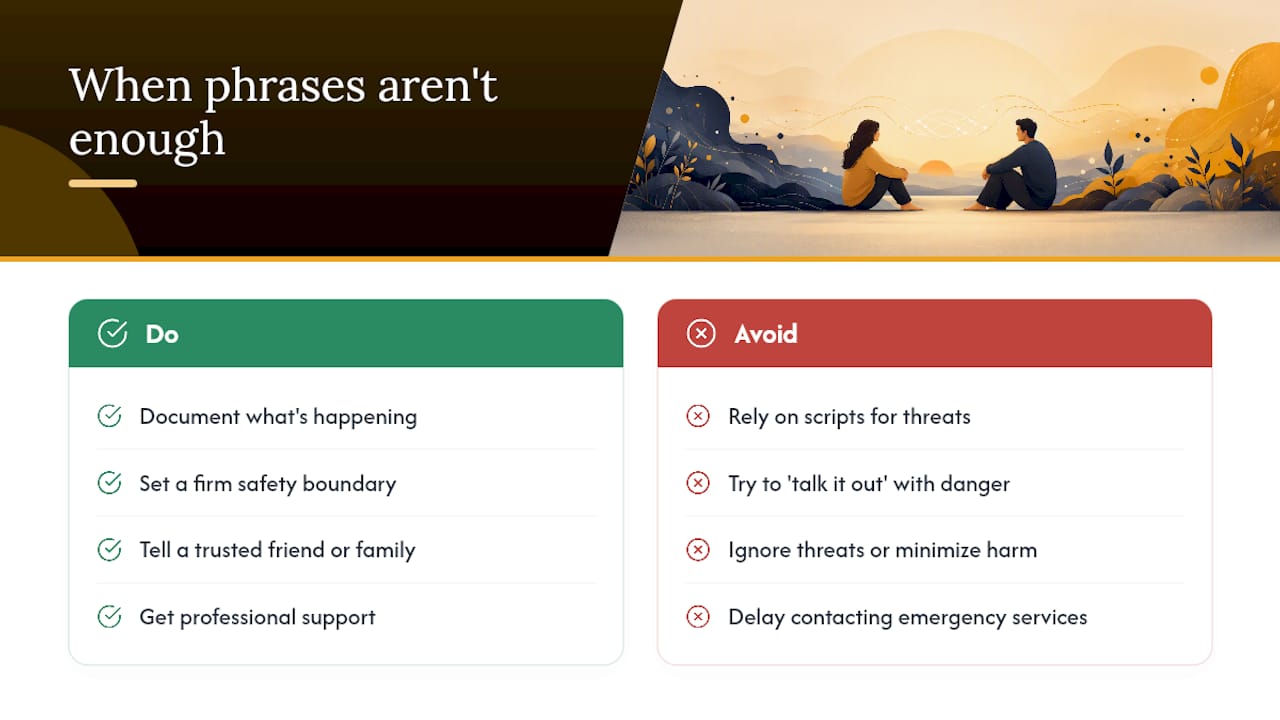
Phrases work on ordinary conflict: frustration, miscommunication, hurt feelings. They are not a fix for danger. If you notice threats, physical intimidation, ongoing coercive control, or stonewalling that repeatedly isolates one partner from friends or family, no script solves that on its own.
Red flags worth naming plainly: your partner threatens to hurt you or themselves, physical contact has happened even once, you’re afraid to disagree, or attempts to leave the room are physically blocked. In any of those situations, document what’s happening, set a firm boundary around your own safety, loop in a trusted friend or family member, and get professional support rather than trying to talk your way through it. If you are in immediate danger, contact emergency services or a domestic violence hotline right away, not a conflict script.
How Couples Fight School turns these scripts into a habit
Reading a list of phrases is one thing. Building the reflex to actually use one mid-argument is another, and that gap is exactly where structured practice matters. Couples Fight School built the F.I.G.H.T. Plan® around that gap, giving couples a repeatable system instead of a one-time list of tips.
If you’re the type who learns best on your own, the self-study conflict resolution course walks through scripts, timing, and drills at your own pace. If your fights have gotten harder to interrupt on your own, or the same argument keeps resurfacing despite good intentions, online coaching for couples puts a licensed professional in the room with you to practice these exact phrases in real conflict, not hypotheticals. Couples further along who want a full structured program can start with relationship counseling built around the same framework. Pick the option that matches how much support your specific pattern needs, and book a session or start the course this week rather than waiting for the next fight to force the issue.
A clinician’s note on practice and patience
These phrases work, but not on the first try, and not without friction. Couples who stick with a shared phrase bank for a few weeks report the words stop feeling scripted and start feeling like theirs. Patience with the awkward, stilted early attempts matters more than getting the wording perfect. Case studies and clinical outcomes from Couples Fight School’s own practice will continue to expand this picture over time.
— Carlos
Sources
- How to Stop Arguments From Spiraling | Psychology Today
- We’ve studied over 30,000 couples—here are 6 phrases you’ll hear in the most successful relationships | CNBC
- How To De-Escalate an Argument Without Losing Each Other | Psychotherapy for Young Women
Recommended
- Conflict Escalation Patterns Couples Repeat: 8 Cycles
- 4-Hour Couples Intensive
- 6-Hour Couples Intensive
- Why Engaged Couples Need Conflict Skills Before Marriage