
Emotional Intimacy vs. Physical Intimacy: Why You Need Both

Emotional intimacy builds trust and safety; physical intimacy expresses closeness and desire. Most couples struggle not because they lack one or the other, but because they never learned how the two actually depend on each other.
Here’s what you’ll walk away with:
- Why emotional closeness without touch tends to feel more like friendship than partnership.
- One immediate action to try tonight: a brief check-in before bed, no phones, just eye contact and one honest sentence each about your day.
The sections ahead break down the signs of each, where they clash, and what to actually do about it.
Key Takeaways
Lasting relationship satisfaction depends on maintaining emotional safety through vulnerability and physical closeness through consistent, pressure-free affection.
| Point | Details |
|---|---|
| Emotional intimacy builds trust | Regular honest disclosure, not grand conversations, creates lasting emotional safety. |
| Physical intimacy spans a spectrum | Holding hands and cuddling matter as much as sex for sustaining connection. |
| The two reinforce each other | Emotional safety often enables desire, and affectionate touch reinforces trust. |
| Avoid the avoidance trap | Using sex or talk to dodge the other issue delays repair instead of solving it. |
| Couplesfightschool offers structured support | Coaching and guided activities help couples rebuild both forms of intimacy without guesswork. |
Table of Contents
- Emotional Intimacy vs. Physical Intimacy: What Emotional Closeness Looks Like
- What Counts as Physical Intimacy, and Where It Starts
- How Emotional and Physical Intimacy Actually Differ
- The Case for Balancing Both, Backed by Research
- How to Build Emotional and Physical Intimacy Without Overhauling Your Life
- The Traps That Quietly Erode Both Kinds of Closeness
- Exercises That Rebuild Emotional Safety Fast
- Reviving Physical Intimacy Without Turning It Into Pressure
- When Self-Help Isn’t Enough: Recognizing the Need for Professional Support
- Sources
Emotional Intimacy vs. Physical Intimacy: What Emotional Closeness Looks Like
Emotional intimacy is the sense that your partner knows the real you and stays anyway. It runs on trust, vulnerability, and mutual understanding, the kind that lets you admit you’re scared about money or resentful about your in-laws without bracing for judgment. Psychology Today frames it as foundational to lasting relationships, not a bonus feature you add once the practical stuff is handled.
You can spot it in small moments. A couple with strong emotional intimacy repairs quickly after an argument instead of stewing for days. They ask follow-up questions instead of nodding along. They notice when their partner’s tone shifts and check in rather than ignore it.
Here’s what tends to show up when it’s missing:
- Isolation inside the relationship. You live together but process hard days alone.
- Secrecy about feelings, not facts. You hide that you’re overwhelmed, not that you had lunch with a coworker.
- Emotional distance disguised as busyness. Conversations stay logistical (calendars, chores, bills) and never go deeper.
- Loneliness despite proximity. Verywell Mind notes this is one of the clearest markers that emotional intimacy has eroded, even in couples who rarely fight.
Quick fact: Research referenced by Psychology Today links emotional closeness directly to relationship resilience and better outcomes when conflict happens, not just fewer arguments overall.
Emotional intimacy isn’t a personality trait some couples have and others don’t. It’s a habit built through repeated small disclosures, the kind that feel almost too minor to mention until you realize you’ve stopped mentioning anything at all.
What Counts as Physical Intimacy, and Where It Starts
Physical intimacy covers more ground than sex. It spans holding hands, a hand on the back while passing in the kitchen, cuddling on the couch, and sexual activity, all sitting on one spectrum rather than existing as separate categories. Practitioner resources describe physical affection as a bonding mechanism in its own right, not just a precursor to something else.
Healthy physical intimacy has a few reliable markers:
- Both partners initiate touch sometimes, not just one.
- Desire feels mutual rather than one person managing the other’s expectations.
- Consent stays ongoing and comfortable to voice, including saying no without a fight following it.
- Affection shows up outside the bedroom, not only when sex is the goal.
Declining physical intimacy tends to look different depending on the couple, but a few patterns repeat: one partner starts avoiding casual touch because it feels like an obligation, requests get met with excuses instead of honest no’s, and simple affection (a hug at the door, a hand on the knee during a drive) quietly disappears first, long before sex does.
Worth saying plainly: physical intimacy problems sometimes have a medical root, not just a relational one. Pain, hormonal shifts, medication side effects, and past trauma can all suppress desire in ways no amount of communication will fix on its own. If avoidance persists despite genuine effort and goodwill, that’s a signal to loop in a doctor, not just try harder.

How Emotional and Physical Intimacy Actually Differ
The two forms of closeness work on different clocks and different fuel. Emotional intimacy builds slowly through repeated vulnerability; physical intimacy can spike fast (a good vacation, a spontaneous night) but fades just as quickly without upkeep.
- Function: Emotional intimacy creates safety; physical intimacy expresses desire and affection.
- Time to build: Emotional trust often takes months of consistent honesty; physical connection can reignite in a single evening.
- Maintenance: Emotional intimacy needs ongoing disclosure; physical intimacy needs ongoing initiation and responsiveness from both sides.
- Failure mode: Emotional intimacy erodes through silence; physical intimacy erodes through avoidance or pressure.
The overlap matters more than the contrast, though. Emotional safety is often what makes desire possible in the first place, and affectionate touch reinforces the bond that makes vulnerability feel safe. A common mismatch: a couple has satisfying sex but no real conversations, and mistakes physical chemistry for closeness. The reverse happens too. Two people talk for hours, feel deeply understood, and still find touch has quietly gone stale.
The Case for Balancing Both, Backed by Research
Emotional closeness predicts long-term satisfaction more reliably than almost any other relationship factor researchers have studied, according to commentary in Psychology Today referencing work on emotional intimacy and satisfaction outcomes. Couples who report high emotional closeness also tend to recover faster after conflict, which matters more over a decade together than any single argument.
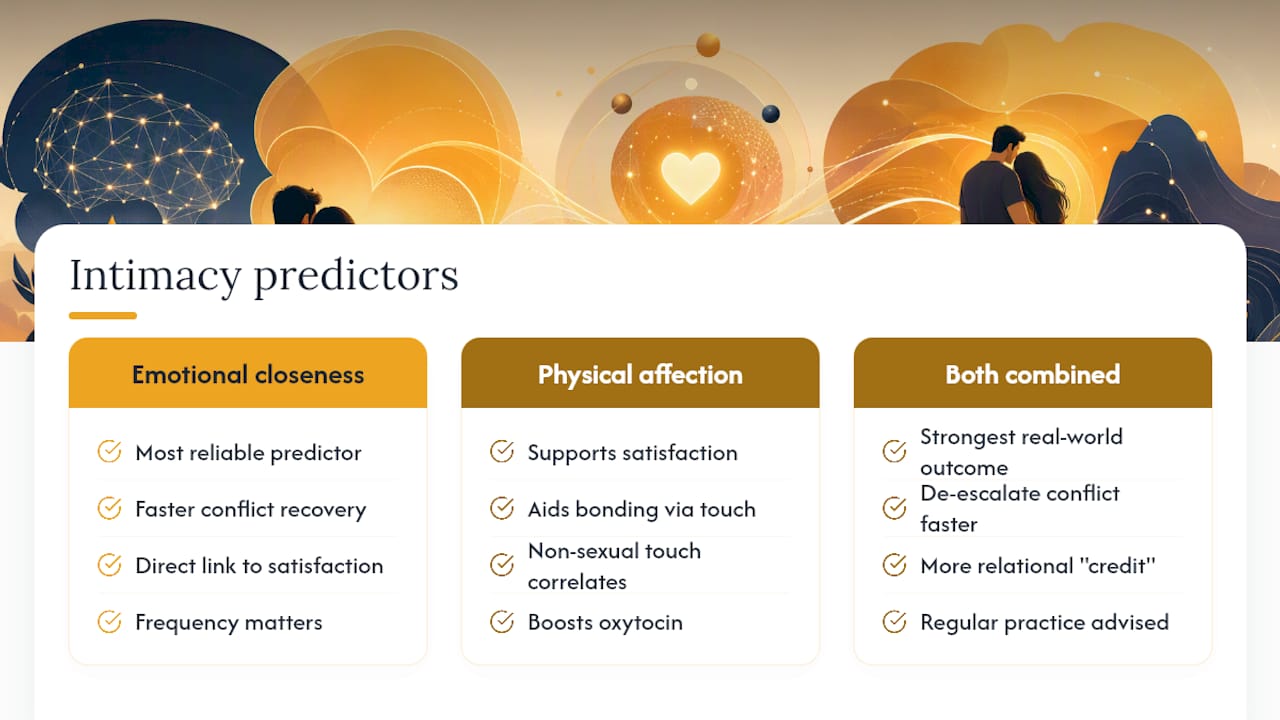
Physical affection carries its own separate weight. Regular non-sexual touch, hugs, hand holding, cuddling, correlates with stronger emotional bonds and greater satisfaction, likely tied to oxytocin release during casual contact.
Put those together and the practical implication is straightforward: couples who maintain both forms of intimacy tend to de-escalate conflict faster because there’s more relational credit in the account. A fight lands differently when you’ve spent the week feeling emotionally seen and physically connected than when you haven’t.
How to Build Emotional and Physical Intimacy Without Overhauling Your Life
You don’t need a retreat weekend to move the needle. Small, repeated habits outperform occasional grand gestures because they train both partners to expect connection as normal, not exceptional.
- Run a daily three-minute check-in. No phones, no agenda. Each partner shares one high and one low from the day.
- Add a five-minute touch ritual. A hug that lasts longer than the automatic two seconds, or ten minutes of quiet cuddling before sleep.
- Turn one chore into shared time. Cooking together or folding laundry side by side counts as connection when you’re actually present for it.
- Ask one curiosity question a week that isn’t logistical: “What’s something you’ve been thinking about that you haven’t said out loud?”
- Use a simple repair script after conflict: name what happened, own your part, ask what your partner needs next.
Mix routine with a little unpredictability. A standing Sunday walk works because it’s reliable; an unplanned Tuesday date works because it’s a surprise. Both matter, and leaning only on one makes connection feel either mechanical or unreliable.
When partners want different things (one craves conversation, the other craves touch), the fix isn’t a scoreboard where you each track who “gave” more. It’s a direct trade: “I’ll initiate physical affection more if you’ll carve out fifteen minutes for real conversation.” Therapists generally agree that mismatched preferences are normal, and negotiated trade-offs work better than moralizing about who’s “wrong.”
Pro Tip: Pick one micro-habit and run it for two weeks before adding another. Stacking five new rituals at once is how most well-intentioned plans quietly die by week three.
The Traps That Quietly Erode Both Kinds of Closeness
A few patterns show up again and again in couples who feel stuck. Performance pressure around sex, where one partner feels evaluated rather than desired, tends to trigger avoidance, which then reads as rejection and spirals further. Emotional withdrawal works similarly: one partner stops sharing, the other stops asking, and silence becomes the default setting.
- Using sex to sidestep an unresolved emotional issue papers over problems instead of solving them.
- Using long emotional talks to avoid addressing a stalled physical relationship does the same thing in reverse.
- Waiting for the “right moment” to raise either issue usually means it never gets raised.
The correction is almost always smaller than people expect: a time-limited check-in (ten minutes, not an open-ended relationship audit) and an explicit agreement about how you’ll repair after the next slip. Naming the cycle out loud, even imperfectly, breaks its grip faster than trying to out-think it. Couplesfightschool’s breakdown of the withdrawal cycle walks through how these loops start and how to interrupt them earlier.
Exercises That Rebuild Emotional Safety Fast
Real exercises beat vague advice to “communicate more.” Try these in order of increasing vulnerability:
- The three-minute check-in, described above, run daily for a week before anything else.
- The emotional honesty scene, a technique from The Physics of Connection that pairs a mundane shared task, folding laundry, washing dishes, with a constraint to say only true things. Removing the pressure to perform emotion tends to produce more honest exchanges than a sit-down “we need to talk” conversation ever does.
- Curiosity prompts, one open question a week that has no right answer, just genuine interest.
Set a safety cue before you start, a word either partner can say to pause without it meaning failure. When repair is needed, keep it to three steps: acknowledge what happened, apologize specifically, and ask what your partner needs from you next. Couplesfightschool’s emotional safety guide covers how to build this foundation before attempting harder conversations.
Pro Tip: If an exercise starts to feel like a performance, stop and name it. “I think I’m just reciting facts instead of actually feeling this” is itself a more honest moment than pushing through the script.
Reviving Physical Intimacy Without Turning It Into Pressure
Desire rarely returns on command, especially if avoidance has built up over months. A sensate-focus approach, starting with non-sexual touch and slowly building comfort, works better than jumping straight back to where things left off.
- Reintroduce touch in low-stakes settings: a hand on the shoulder while cooking, a longer hug at the door.
- Build a weekly date-night ritual that has zero expectation attached to it. Removing pressure is often what makes desire reappear.
- Invite rather than demand: “I’d love to just hold you tonight, no pressure for more” lands differently than silence followed by disappointment.
- Track comfort milestones together rather than rushing back to a previous baseline.
If avoidance persists despite consistent, pressure-free effort, that’s the point to consider a sex therapist or a medical evaluation, since persistent low desire sometimes has roots that patience alone won’t resolve.
When Self-Help Isn’t Enough: Recognizing the Need for Professional Support
Some patterns need more than a daily ritual. Coercion, persistent stonewalling despite real effort, or avoidance tied to past trauma are signals that self-directed exercises have reached their limit.
- Couples therapy helps with communication patterns and recurring conflict cycles.
- Sex therapy addresses desire discrepancies, performance anxiety, or trauma-linked avoidance specifically.
- Medical evaluation rules out hormonal, medication-related, or physical causes behind low desire or pain.
A first session usually starts with history-taking, not immediate advice, so expect questions before solutions. Couplesfightschool’s guidance on rebuilding trust after infidelity outlines what structured support looks like when trust itself is the obstacle.
Who’s Behind This Guidance
Carlos Todd is a licensed mental health professional and co-founder of Couples Fight School®, built alongside Natasha Pemberton-Todd around the F.I.G.H.T. Plan®, a structured framework for communication, emotional regulation, and repair. The exercises above draw on that same approach: small, low-pressure practices over dramatic overhauls.
The couples who make the fastest progress aren’t the ones with the fewest problems. They’re the ones willing to run a three-minute exercise badly, every day, instead of waiting for a perfect two-hour conversation that never happens.
A Quick Note on What Actually Shifts Things
Most couples assume they need a bigger conversation or a dramatic gesture. What actually works is smaller: curiosity instead of assumption, tried repeatedly. Instead of guessing why your partner pulled away, ask. Instead of demanding more affection, invite it once and watch what happens. Small experiments beat grand fixes, mostly because grand fixes rarely survive a normal Tuesday.
Where Couples Fight School® Fits Into This Work
If the exercises here felt useful but you want more structure than a blog post can offer, that’s exactly the gap Couplesfightschool’s programs are built to close. The Intimacy Building Activities guide expands the daily rituals above into a fuller system, and online coaching gives couples a licensed professional to walk through the harder conversations with, rather than guessing alone. Expect clearer communication patterns, safer repair after conflict, and daily habits that don’t require a crisis to justify them. If you’re ready for guided support instead of trial and error, book a session and start there.
Sources
- Why emotional intimacy and sexual intimacy go together | Psychology Today
- 8 Ways to Grow Emotional Intimacy in Your Marriage | Verywell Mind
- Emotional Honesty Scene | The Physics of Connection
Recommended