
Empathy vs. Validation: What Each Does in a Couple’s Fight
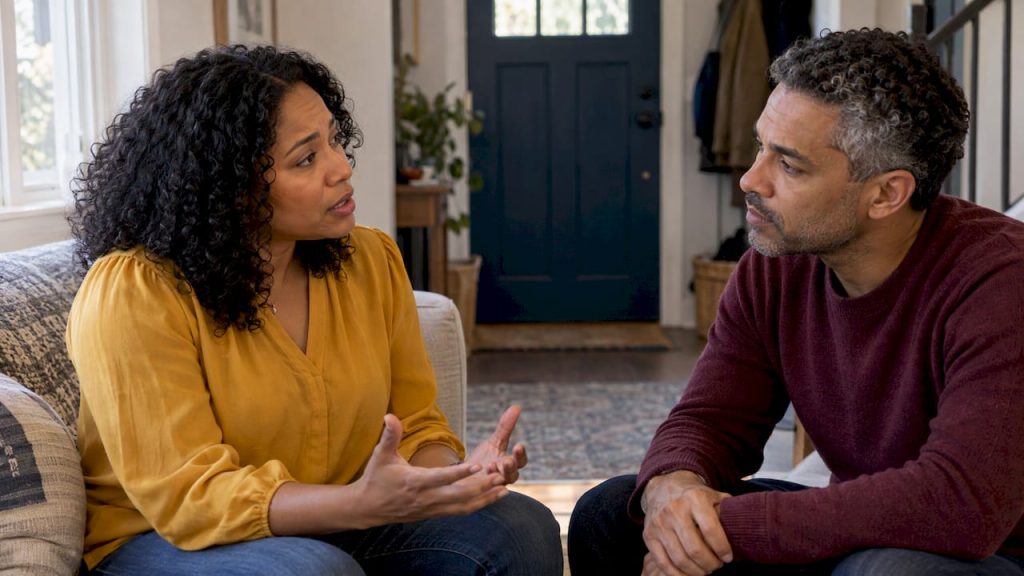
Empathy is understanding what your partner feels and seeing the situation through their eyes. Validation is telling them, in words, that their feelings make sense. Empathy happens inside you. Validation is what your partner actually hears. Most couples who say “you never listen” are missing the second half: one partner may well understand, but the other never hears it. At Couples Fight School, our Stop the Fighting course teaches both skills as one routine, and this article gives you the core of it.
TL;DR
- Empathy is understanding and identifying with your partner’s feelings. Validation is acknowledging those feelings without judgment, out loud.
- Validating does not mean agreeing or approving of what your partner did.
- Empathy without validation stays invisible. Validation without real empathy sounds scripted.
- Skip the fix-it advice at first. Listen, reflect, name the feeling, then say why it makes sense.
- If you cannot honestly relate, say so and offer sympathy instead of faking it.
Table of Contents
- What empathy and validation each mean
- How they work together in an argument
- Validation is not agreement
- A five-part sequence you can use tonight
- What it sounds like: phrases that work and phrases that wound
- How to tell real empathy from the fake kind
- When one of you shuts down
- Our perspective
- Put it into practice with us
- FAQ
- Sources
What empathy and validation each mean
A New York City employee-assistance guide describes empathy as understanding and identifying with another person’s feelings and trying to see the situation from their perspective. It is an internal act: you take in what your partner is going through.
The same guide defines validation as acknowledging another person’s thoughts, feelings and experiences without judgment, even when you disagree. That is an outward act. Your partner can only know you understand if you show it.
A simple way to hold the difference:
| Empathy | Validation | |
|---|---|---|
| Where it happens | Inside you | Between you |
| What it is | Understanding and sharing the feeling | Acknowledging the feeling makes sense |
| What your partner sees | Nothing, unless you say it | Your words and tone |
| Typical failure | Feeling it but staying silent | Using a phrase you do not mean |
For a deeper look at the first skill, see our guide to empathy in marriage.
How they work together in an argument
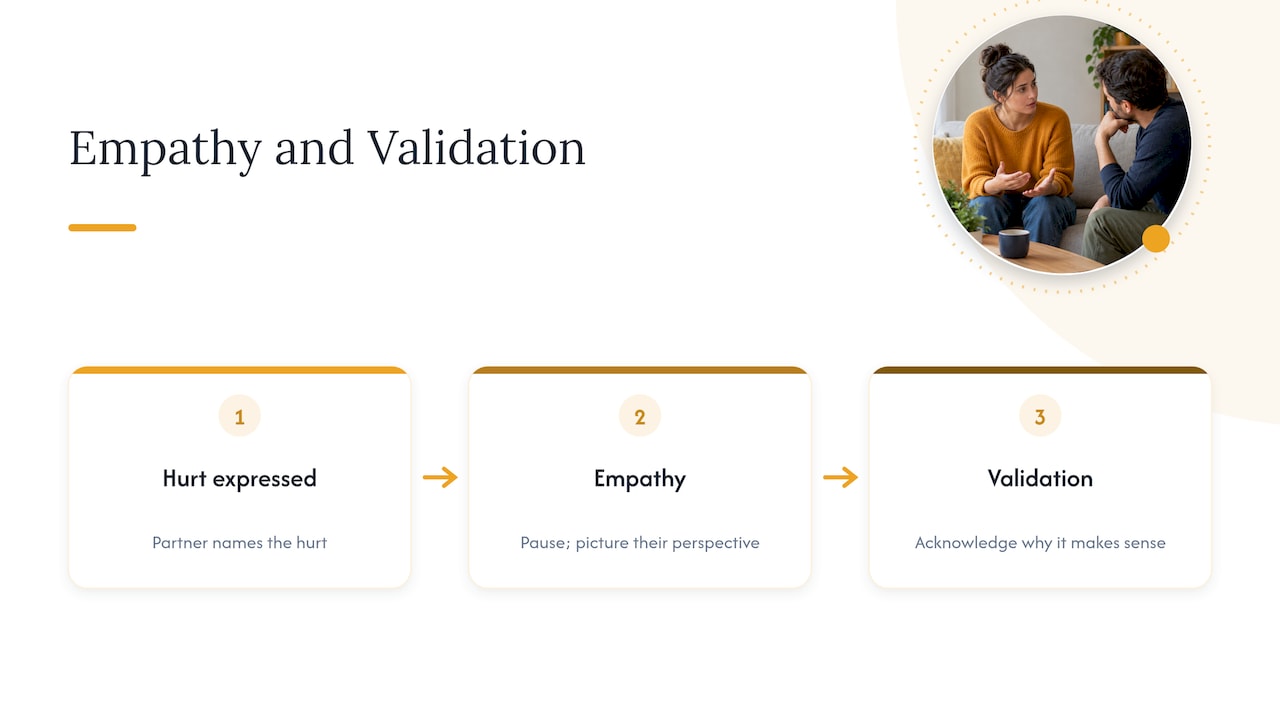
Think of empathy as the source and validation as the delivery. When your partner says, “You forgot again, and it made me feel like I don’t matter,” empathy is the moment you stop defending and picture what that was like for her or him. Validation is what comes next: “That would hurt. I can see why you felt like you didn’t matter.”
Penn State researchers found that highly person-centered supportive messages were more helpful than critical or emotion-minimizing messages for people coping with marital disagreement. The point for couples: how you respond to a feeling often matters more than whether you solve the problem.
When both skills are missing, the pattern is familiar. One partner raises a hurt, the other explains, corrects or defends, and the first partner escalates to be heard. When both are present, the volume drops because the need underneath the argument, to be understood, has been met.
Validation is not agreement
This is the fear that stops most people. If I say your feelings make sense, I am admitting I was wrong. You are not. A Colorado state-government handout says validation is not necessarily agreement and suggests finding the understandable or factual part of the other person’s perspective.
So you can say, “I don’t think I was being dismissive, and I can see why it felt that way to you.” You have not conceded the facts. You have acknowledged the experience. Couples who fight over exactly this knot can use our six-step method for validation vs. agreement fights, and when you truly see it differently, agreeing to disagree respectfully is the next skill.
A five-part sequence you can use tonight
The Colorado handout lays out a validation sequence: pay attention, reflect what you heard, tentatively infer feelings, explain why the reaction makes sense in context, and acknowledge what is valid. Here it is in a couple’s conversation.
- Give full attention. Phone down, face your partner. Utah State University Extension’s marriage guide advises facing the speaker, noticing nonverbal cues and listening without judgment or interruption. Where it goes wrong: you are rehearsing your reply while they talk.
- Reflect what you heard. “So you waited an hour and didn’t hear from me.” Keep it short and factual. Our reflective listening steps and scripts walk through this move in detail.
- Guess the feeling, tentatively. “Were you worried? Or more hurt?” A question invites correction. A pronouncement feels like mind reading.
- Say why it makes sense. “After last month, I understand why that felt familiar.” This is the step that carries the most weight, because it ties the feeling to a reason.
- Acknowledge what is valid. “You’re right that I should have texted.” Name the part you can honestly stand behind.
The same Utah State guide emphasizes focusing on understanding rather than solutions, and the NYC guide advises being present and emotionally attuned rather than immediately offering solutions or advice. Fixes can come later, once your partner says some version of “yes, that’s it.”
What it sounds like: phrases that work and phrases that wound
The NYC guide suggests validating lines such as “I can see why you feel that way” and “It’s understandable that you would be upset about this.” A Penn State example runs in the same spirit: “Disagreeing with someone you care about is always hard. It makes sense that you would be upset about this.” The same summary contrasts this with dismissive advice such as telling someone to stop being depressed.
Here are everyday pairs for couples:
| Instead of | Try |
|---|---|
| “You’re overreacting.” | “This is really getting to you. Tell me more.” |
| “I said I was sorry.” | “I can see my apology didn’t land. What would help?” |
| “Just calm down.” | “I can see why you’re upset. I’m here.” |
| “Here’s what you should do.” | “Do you want me to listen, or help think it through?” |
| “That’s not what happened.” | “I remember it differently, and I want to understand how it felt for you.” |
We collect more lines, with the reasoning behind each, in validation phrases for couples.
How to tell real empathy from the fake kind
Your partner can usually tell. A few signs your response is landing as genuine:
- It is specific. “That would hurt after the week you’ve had” beats “I understand.”
- It does not end with “but.” “I get it, but…” cancels everything before it.
- Your body agrees with your words. Eye contact, a slower pace and a softer voice matter as much as the phrase.
- You stay on their experience. The moment you pivot to your own defense, validation turns into a setup.
If you honestly cannot relate, Utah State University Extension advises against pretending to empathize, since faking it can invalidate the other person’s experience. Express sympathy instead: “I can’t fully imagine that, and I’m sorry you’re carrying it.” The guide also describes invalidation as rejecting or ignoring another person’s thoughts, feelings or emotions, which is why honesty beats a polished line.
When one of you shuts down
Validation is hardest when your partner goes quiet or avoids conflict. Reflecting back a few words and a gentle guess about the feeling, without pressing, gives a withdrawn partner a safe way back in. Our guide to the conflict avoidant partner covers how to talk so you are heard. If an argument is already heated, how to diffuse conflict with your partner gives you steps for lowering the temperature first, because nobody validates well while flooded.
Couples who want this to stick often agree on ground rules in advance. Communication agreements, such as “we pause before we problem-solve,” make validation a habit instead of an act of willpower.
Our perspective
We have sat with thousands of couples, and the pattern is rarely a lack of love. It is that one partner feels understood in their own head and the other has no idea. Empathy without validation is a gift left in the car.
That is why the F.I.G.H.T. Plan® is built as a structured, skills-based system rather than a list of good intentions. A couple who learns to slow down, reflect, name the feeling and say why it makes sense can have the same disagreement and finish it connected instead of wounded.
We built it as licensed mental health professionals who wanted couples to have practical tools, with scripts and guided exercises, available in the middle of real life, including for blended families, Christian couples and high-conflict relationships.
Start with one conversation this week. Validate first, solve second.
Carlos
Put it into practice with us
If you want a guided path instead of piecing it together mid-argument, Stop the Fighting: The Couples Communication & Conflict Resolution Course is $149.00. For a lighter start, The F.I.G.H.T. Plan – Couples Conflict Toolkit is $27.00 and the Fight Less Love Again Video Course is $47.00, both in our shop. If you would like someone working through it with you, see our online couples coaching.
FAQ
Is validation the same as empathy?
No. Empathy is understanding and identifying with your partner’s feelings. Validation is acknowledging, out loud and without judgment, that those feelings make sense. Empathy is what you feel, and validation is what your partner receives.
Can I validate my partner and still disagree?
Yes. Validation is not necessarily agreement. You can acknowledge the understandable part of your partner’s view, such as why they felt hurt, while still holding your own account of what happened.
What if I don’t feel empathy in the moment?
Don’t fake it. Offer honest sympathy, such as “I’m sorry this is so hard,” and keep listening. Understanding often follows once you ask a few curious questions and stop defending.
What should I say when my partner is upset?
Start with a short reflection of what you heard, then a line like “I can see why you feel that way.” Hold off on advice until your partner indicates they feel understood.
Sources
- NYC EAP: Enhancing Your Relationships guide (2025)
- Colorado DPA: Interpersonal Effectiveness Handout, Validation
- Penn State SSRI: Validation may be best way to support stressed out friends and family
- Utah State University Extension: Communicating With Empathy
Recommended
- Validation Phrases for Couples: What to Say and Why It Works
- Empathy in Marriage: What It Is and How to Practice It
- Six Step Method Couples Can Use to Stop Validation vs Agreement Fights
- How to Agree to Disagree Respectfully as a Couple