
Ex Drama in Marriage: How to Set Boundaries and Protect Your Bond

Ex drama in a marriage usually comes down to one question: who gets access to your time, attention and emotional energy? The fix is rarely cutting someone off in a heated moment. It is a calm conversation, a few clear and specific boundaries, and a plan you both agree to and revisit. This guide shows how to do that, whether the ex is yours, your spouse’s, a co-parent or a past partner who keeps showing up.
TL;DR
- Ex drama gets worse when the couple argues about the ex instead of working on the problem together. Treat it as a team issue.
- Raise it at a calm time. Name one specific behavior, say how it affects you with an I-statement, and ask for your spouse’s view.
- Agree on boundaries about when, how and about what you communicate with an ex. Put them in writing if children are involved.
- Rebuild trust with transparency, regular check-ins and changes you both agree on, not with demands or surveillance.
- Get professional help if the conflict keeps repeating. If you feel unsafe, call the National Domestic Violence Hotline at 1-800-799-7233.
Table of Contents
- What ex drama looks like inside a marriage
- Why the ex becomes a fight between you
- How to talk to your spouse about an ex without a blowup
- Setting boundaries with an ex: what actually works
- When children are involved
- Jealousy, secrecy and rebuilding trust
- Warning signs worth taking seriously
- When safety is the issue
- Our perspective
- Get tools that fit your situation
- FAQ
- Sources
What ex drama looks like inside a marriage
Ex drama is not one problem. It shows up in a few common forms, and naming yours makes it easier to solve.
Utah State University Extension lists several ways ex-partners disrupt remarriages: an intrusive ex, unfavorable comparisons with a former partner, and jealousy when exes spend a lot of time together or are overly friendly. In real life those patterns look like this:
- The ex who keeps reaching in. Late texts, last-minute schedule changes, or “emergencies” that always seem to need your spouse.
- The friendly ex. A friendship that predates your marriage and now feels like it has no edges.
- The co-parenting ex. Contact that is necessary but turns every pickup, call or holiday into a negotiation.
- The ghost of the ex. No one is calling or texting, but one of you keeps comparing, checking or wondering.
- The ex who is an unsafe person. Harassment, stalking or threats. This is a safety issue, not a communication issue, and it has its own section below.
The drama is rarely about the ex alone. It is about what the ex contact means to the person who feels uneasy: Am I a priority? Is something being hidden? Do I have a say here? Those are marriage questions, and they deserve marriage-level answers.
Why the ex becomes a fight between you
Most couples do not fight about the ex. They fight about how the topic is raised. One spouse says, “Why are you still texting her?” The other hears an accusation and defends. Within a minute the topic has changed to “you don’t trust me” versus “you’re hiding something,” and the original concern is lost.
This is the same loop we see in most recurring arguments: criticism, defensiveness, then distance. Our article on why couples need a conflict resolution framework explains why a structure beats good intentions when emotions run high. Ex drama is a perfect test of that, because it touches loyalty, history and fear of being replaced or compared.
Verywell Mind (2026), quoting licensed clinical social worker Tatiana Rivera Cruz, notes that continued contact with an ex can reflect emotional bonds, familiarity or unresolved issues, and that it can increase stress and confusion in a current relationship. That does not mean every ex friendship is a threat. It means the reason for the contact matters, and so does how it is handled.
How to talk to your spouse about an ex without a blowup
The conversation is where most couples win or lose. Business Insider (2023), quoting therapist Ani Jambazian, recommends raising ex contact during a calm moment, using I-statements that name the behavior you saw and how it affects you, and aiming for mutual understanding instead of proving who is right.
Here is a simple sequence that follows that guidance.
- Pick the time. Not at midnight, not right after a text arrives, not in front of the kids. Choose a quiet window and say, “Can we talk about something that’s been on my mind? It’s not an attack.”
- Describe one observable behavior. “I noticed the texts with Jordan are often late at night.” Skip words like “always,” “obsessed” or “inappropriate.”
- Say the effect on you. “When that happens, I feel pushed out and I start to worry.” One feeling, one sentence.
- Ask for their view. “How does it look from your side?” Then listen without preparing your rebuttal.
- Agree on one change. Not a total cutoff. Something specific, such as moving logistics to daytime or a shared group thread.
- Pause if you flood. If either of you is too heated to think, stop and name a time to return. A break is not avoidance if you actually come back.
What to say, and what to skip
| Instead of | Try |
|---|---|
| “You’re still obsessed with your ex.” | “When your ex’s name comes up and the conversation shifts, I feel unsure where I stand.” |
| “Block her or I’m done.” | “I’d like us to figure out what contact feels okay to both of us.” |
| “You never put me first.” | “I need to feel like a priority. What would help you show that?” |
| “Why are you so jealous?” | “Help me understand what worries you so I can respond to it.” |
If you are the spouse being asked about your ex, the same rules apply in reverse. Try, “Thanks for telling me. I want you to feel secure,” before you explain anything. Defensiveness is the fastest way to turn a small worry into a big one.
For more tools on lowering the temperature mid-conversation, see our guide on how to defuse conflict with your partner.
Setting boundaries with an ex: what actually works
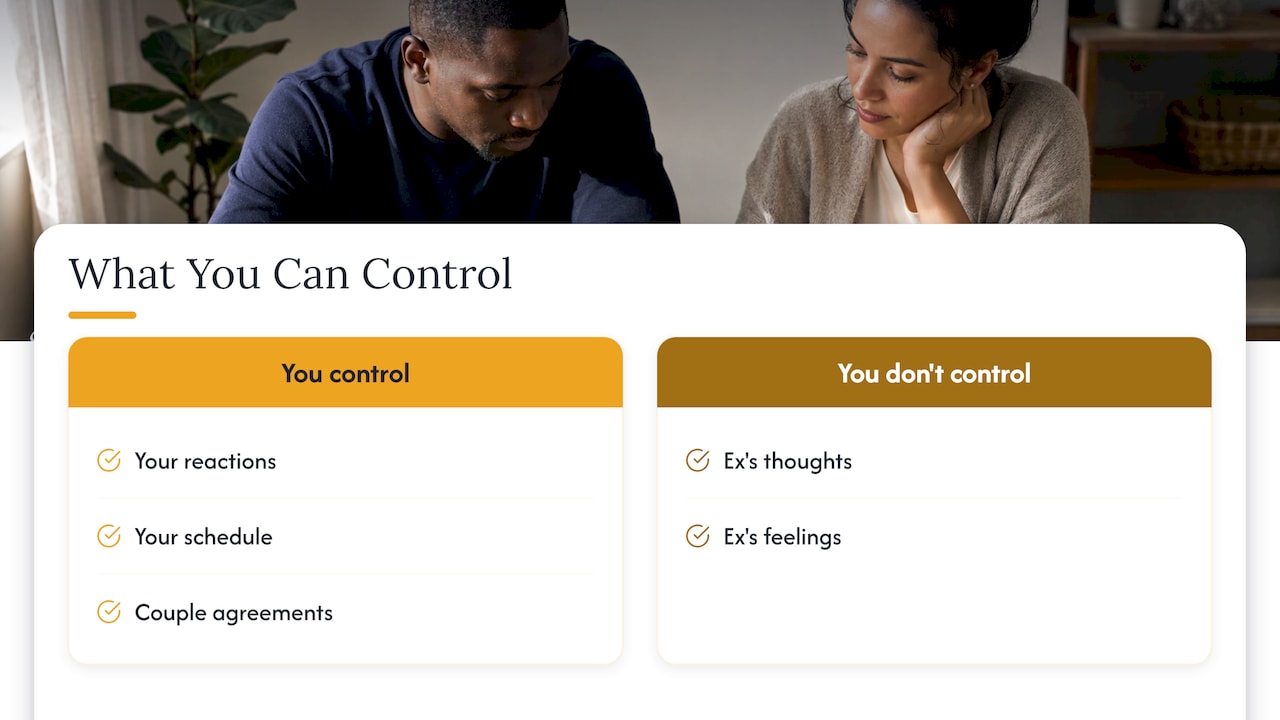
A boundary is not a rule you impose on another person. It is a statement of what you will do. That distinction matters, because you cannot control an ex, but you can control your response, your schedule and your agreements as a couple.
The University of Georgia Cooperative Extension (2022) frames healthy post-divorce interaction as behaviorally manageable: focus on your own reactions, keep your agreements, stay respectful, and do not try to control the former spouse’s thoughts or feelings. That is good advice whether the ex is yours or your spouse’s.
Boundaries between spouses
These are agreements you make with each other about how ex contact fits into the marriage. Good ones are specific and mutual:
- Transparency, not surveillance. “If your ex texts me, I’ll mention it” works. Demanding passwords does not build trust, it replaces it.
- Context. One-on-one dinners, late-night messages and sharing relationship problems with an ex are the usual flashpoints. Decide together where your lines are.
- Topics. If your spouse’s ex is also a parent of their children, contact about the kids is one thing. Venting about the marriage to that ex is another.
- Presence. Decide how you handle events where both of you and the ex will be, such as graduations or weddings.
Verywell Mind’s guidance is to discuss comfort levels and the context of the friendship, communicate concerns with empathy, and agree on boundaries and transparency. It also notes that defensiveness, secrecy, inappropriate communication or boundary violations may signal a real problem. Those are the signs worth taking seriously.
Boundaries with the ex
Once you and your spouse are aligned, the boundary with the ex becomes much easier to hold, because it is no longer one person against the world. Utah State University Extension advises setting formal, clearly established ways to interact with an ex, putting agreements in writing so everyone shares the same understanding, and reviewing interactions regularly with the new spouse.
That can sound like:
- “I’m happy to talk about pickup times by text. I won’t discuss anything else.”
- “I’ll reply within 24 hours unless it’s urgent.”
- “Please send changes to the schedule through the shared calendar.”
Short, calm, repeatable. If the ex pushes back, repeat the same sentence instead of adding a new argument. Nobody wins a debate at 11 p.m. over text.
When children are involved
When a spouse shares children with an ex, you cannot simply go no contact, and you should not expect your spouse to. The goal shifts from avoiding to structuring.
The American Bar Association’s Family Advocate (2024) recommends not interfering with the other parent’s parenting time, setting rules for calls and child communication, and not scheduling activities during that parent’s time without discussion. It also advises keeping exchanges short, because transitions are a particularly likely time for arguments, while staying open to reasonable flexibility.

The University of Georgia Cooperative Extension suggests clear rules, respectful communication, keeping discussions focused on the children, honoring agreements and appointments, and avoiding name-calling or bad language about a former spouse. Utah State adds one more piece: keep children out of the conflict.
Here is how that translates into a step-parent’s day-to-day:
- Let the biological parents handle the logistics when possible. A step-parent relaying messages usually raises the temperature.
- Keep pickups brief and neutral. Greet, hand off, leave. Save conversation for a different time.
- Never criticize the ex in front of the kids. Even a small sigh teaches a child they are caught in the middle.
- Make the plan visible. A written schedule and a communication agreement reduce “I thought you said” arguments. Our co-parenting communication plan can help you shape one.
If the real friction is that you and your spouse parent differently, that is a separate problem from the ex, and worth solving on its own. See our research-backed scripts for parenting differences in marriage. For the step-family side, our blended family boundaries guide includes therapist scripts and a 30 to 90 day plan.
Separation and divorce also take a toll on the people living through them, and that stress can leak into the new marriage. Some readers find practical ways of coping with divorce stress helpful when an ex’s drama keeps pulling an old chapter back open.
Jealousy, secrecy and rebuilding trust
Sometimes the ex is barely involved, yet the feelings are huge. Jealousy, comparing, checking social media and replaying a spouse’s past are common, and they hurt both partners.
If the worry is about something real
If your spouse hid contact, lied about it, or crossed a line you had both agreed on, that is a trust injury, not just jealousy. Business Insider (2023) reports that repairing distrust takes both partners stating what they need, listening without defensiveness, applying agreed changes and revisiting the issue through regular check-ins. Notice what is missing: a single dramatic demand. Trust returns through repeated, observable follow-through.
A practical routine:
- The hurt partner says what they need to feel secure, in one or two concrete requests.
- The other partner repeats it back, then says what they can commit to.
- You both write it down.
- Once a week, spend ten minutes on one question: “How is this working for us?”
If the hurt involves infidelity, the work is deeper and usually benefits from structure and guidance. Our page on online marriage counseling after infidelity explains how that process can go, and our R.E.S.T.O.R.E Workbook on healing after an affair is built for it.
If the worry is about the past
Some people become consumed by thoughts about a partner’s previous relationships, even when nothing is happening now. NOCD (2026) explains that when retroactive jealousy is part of OCD, exposure and response prevention is the evidence-based treatment, which involves facing reminders without checking, comparing, researching or repeatedly seeking reassurance. Compulsive checking and reassurance-seeking can keep the anxiety going, so the target is how you respond to uncertainty, not getting perfect certainty about your spouse’s past.
If you recognize yourself in that description, a licensed mental health professional who treats anxiety or OCD is the right person to see. Your spouse can support you, but they cannot be your treatment.
Warning signs worth taking seriously
Not every ex situation is a crisis. These are the signs that a conversation alone may not be enough:
- Your spouse hides or deletes messages, or becomes defensive at simple questions.
- Boundaries you agreed on are repeatedly ignored.
- The ex consistently undermines your marriage, your parenting or your place in the family.
- The same argument returns every few weeks with no change.
- Either of you starts to feel anxious, tense or afraid around the topic.
One or two of these calls for a clearer conversation and more structure. A pattern of several is the point at which a counselor or coach can save you months of going in circles.
When safety is the issue
Everything above assumes a difficult ex, not a dangerous one. If an ex or anyone else is stalking, threatening, harassing or physically harming you or a family member, communication tips are not the answer.
The VA (2026) describes intimate partner violence as including emotional or psychological aggression, physical or sexual violence, and stalking, and says safety planning is a personalized, practical process that can reduce risk whether someone is staying in a relationship, preparing to leave, or has left. The National Domestic Violence Hotline is free, confidential and available 24/7 at 1-800-799-7233, and you can also text START to 88788, according to the Maryland Health Care Coalition Against Domestic Violence. The same resource lists 988 as the 24/7 Suicide and Crisis Lifeline for suicidal thoughts or emotional distress.
If you are in immediate danger, call 911.
Our perspective
We have sat with thousands of couples, and ex drama almost never starts as an “ex problem.” It starts as a “we” problem that nobody knows how to say out loud. One partner feels unsure, the other feels accused, and the ex becomes the place where both of those feelings land.
That is why we built the F.I.G.H.T. Plan® as a step-by-step, skills-based system. You learn to slow the moment down, name what you feel without attacking, and agree on changes you can both keep. Those same skills handle an ex who texts too much, a co-parenting schedule that keeps blowing up, and the quiet comparison that sits under a good marriage like a stone in a shoe.
Our approach is practical on purpose. You do not need to wait for a crisis, and you do not need a perfect spouse. You need a shared language and a process you trust. When couples have that, the ex stops being a threat and becomes just one more topic they can handle together.
Carlos
Get tools that fit your situation
If the same ex-related argument keeps returning, a structure can help more than another round of willpower. Our most relevant options:
- The F.I.G.H.T. Plan workbook, a therapist-created workbook for communication and conflict resolution, priced between $14.99 and $25.00.
- Stop the Fighting course, our full communication and conflict resolution course, at $149.
- The F.I.G.H.T. Plan Conflict Toolkit at $27, for quick scripts and tools you can use in the middle of a hard conversation.
- VIP Private Coaching, 4 sessions at $997, if you want tailored guidance on your own boundaries and agreements.

If you are still deciding, our free 10-minute conflict resolution worksheets are a low-pressure way to practice the first conversation. Engaged and newly married couples may also like our piece on why newlywed conflict is normal.
FAQ
How do I set boundaries with my spouse’s ex?
Start with your spouse, not the ex. Agree together on what contact is acceptable, then let your spouse communicate it. Where you must deal with the ex directly, keep messages brief, respectful and limited to logistics. You control your own responses and agreements, not the ex’s feelings.
Is it a red flag if my spouse stays friends with an ex?
Not automatically. The context matters: how open the friendship is, how it affects you, and how your spouse responds when you raise it. Secrecy, defensiveness, inappropriate communication or repeated boundary violations are the signs that suggest a real problem, according to Verywell Mind.
How do I bring up my spouse’s ex without starting a fight?
Choose a calm moment, describe one specific behavior, say how it affects you using an I-statement, and ask for your spouse’s perspective. Aim for understanding and one agreed change, not a win or an instant cutoff. If either of you gets flooded, pause and return later.
What if the ex is the other parent of our children?
Structure the contact instead of trying to eliminate it. Keep communication focused on the children, put agreements in writing, keep exchanges short and keep kids out of adult conflict. Review the arrangement with your spouse regularly so it still works for everyone.
When should we get professional help?
Consider help if the same argument keeps repeating, trust is not recovering, or the ex situation is damaging your marriage or family life. A licensed counselor can help with communication and conflict. If you feel unsafe, contact the National Domestic Violence Hotline at 1-800-799-7233.
Sources
- Helpful Strategies to Deal with Ex-partners in Remarriages, Utah State University Extension
- Dealing Positively with Your Former Spouse, University of Georgia Cooperative Extension
- Creating and Maintaining a Healthy Shared Parenting Arrangement, American Bar Association Family Advocate
- What to Do If Your Boyfriend Keeps Messaging His Ex, Business Insider
- My Partner Is Still Friends With Their Ex, Verywell Mind
- What is retroactive jealousy, and how can I handle it?, NOCD
- Relationship Health and Safety, VA Cheyenne Health Care
- Crisis & Safety Resources, Maryland Health Care Coalition Against Domestic Violence
- Divorce Stress: Coping Strategies for the Remainder of Winter
Recommended
- Argument Boundaries in Marriage: 6 Steps to Practice Before a Fight
- Boundaries After Betrayal: Therapist Tools and a 30–90 Day Plan
- Pick One Boundary to Hold: Therapist Scripts Couples Can Use With In Laws
- Relationship Boundary Examples: 30 Scripts to Set Healthy Limits