
Faith and Marriage Conflict Resolution: A Practical Guide

Faith is defined as the shared moral framework that gives married couples a reason to forgive, a posture of humility, and a common purpose when conflict threatens to divide them. The role of faith in marriage conflict resolution goes beyond religious ritual. It shapes how spouses interpret disagreement, respond to hurt, and choose repair over retaliation. Research shows that active Christians who pray together report over 90% relationship satisfaction, and couples with daily faith practice show 27%–50% lower divorce rates than non-churchgoers. Faith does not eliminate conflict. It changes what couples do with it.
How does faith foster forgiveness and humility in marriage conflicts?
Forgiveness is the single most powerful tool in faith-based conflict resolution, and it is also the most underused. Forgiveness rooted in faith draws directly from the belief that each spouse has already been forgiven by a higher power, which creates a moral obligation and emotional motivation to extend that same grace to a partner. Ephesians 4 frames this plainly: forgive one another as God has forgiven you. That is not a suggestion. It is a relational standard.
Humility works alongside forgiveness by changing the lens through which spouses see each other during conflict. Theologian Thomas J. Neal describes the spouse as a mystery to be loved, not a problem to be solved. That single reframe shifts the entire posture of a disagreement. Instead of building a case against your partner, you approach them with curiosity.

Faith also challenges pride directly. Pride escalates conflict. It tells you that you are right and your partner is wrong, and it keeps you there. Spiritual practice, whether prayer, scripture, or community accountability, invites spouses to self-examine rather than judge. That internal shift is where de-escalation begins.
Key ways faith builds forgiveness and humility in conflict:
- Theological grounding: Believing you are forgiven makes forgiving others feel less optional and more like a natural response.
- Perspective shift: Viewing your spouse as a person God loves, not an opponent, reduces contempt during arguments.
- Self-reflection over blame: Faith traditions consistently call individuals to examine their own faults before pointing to a partner’s.
- Grace under pressure: Spiritual practice builds the emotional capacity to pause before reacting, which is the foundation of healthy conflict behavior.
Pro Tip: Before your next difficult conversation, spend two minutes in prayer or quiet reflection asking what role your own pride or fear is playing in the conflict. That single habit interrupts the blame cycle before it starts.
What is the role of prayer and spiritual practices in resolving conflicts?
Prayer does something no communication technique alone can replicate. It shifts the couple’s posture from adversarial to collaborative by reorienting both partners toward a shared source of meaning. Couples who pray together daily report over 90% relationship satisfaction. That number reflects more than religious habit. It reflects the emotional safety that shared vulnerability creates.
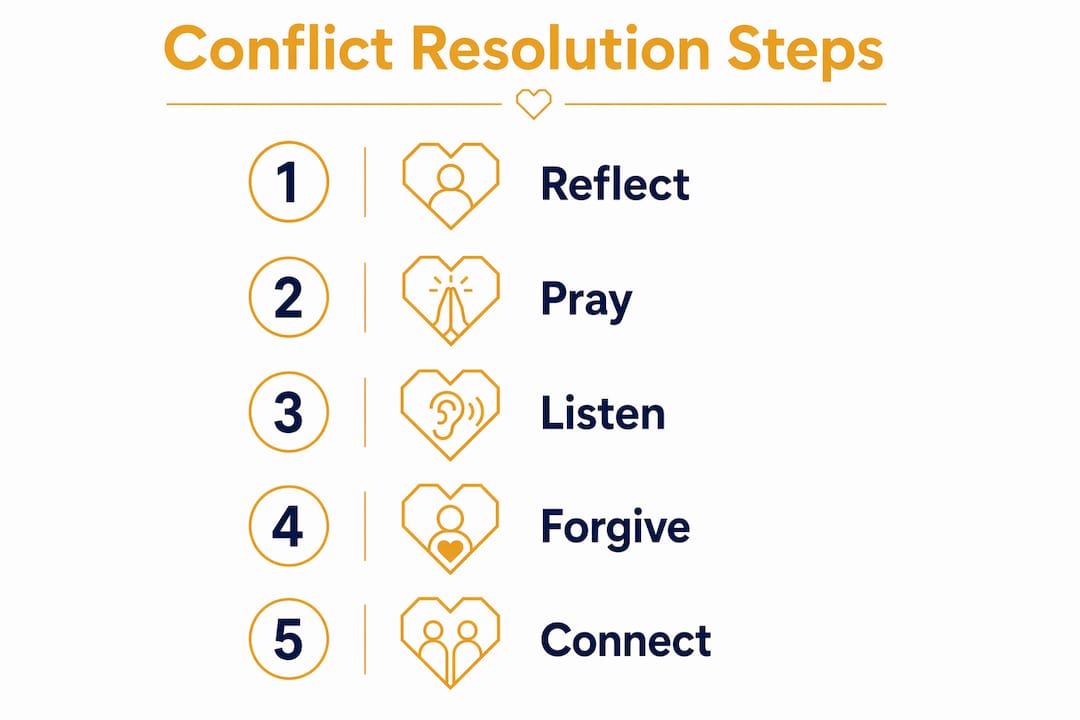
When two people stop arguing long enough to pray together, something changes in the room. Matthew 18:19–20 captures this: where two or three gather in God’s name, He is present. For couples in conflict, praying during disagreements reduces contempt and reorients both partners toward a purpose larger than the immediate argument. Contempt is the single strongest predictor of relationship breakdown, so anything that reliably reduces it matters.
Spiritual practices that support conflict resolution include:
- Joint prayer: Praying together during or after a conflict builds vulnerability and trust simultaneously.
- Scripture reading: Using passages focused on love, patience, and forgiveness gives couples shared language for repair.
- Sabbath rhythms: Regular rest and worship together create emotional reserves that make conflict less destabilizing.
- Accountability to a faith community: Being known by others who share your values creates external motivation to repair relationships rather than abandon them.
Prayer is not a magic fix. It works because it requires both spouses to stop performing and start being honest before God and each other. That honesty is the raw material of real reconciliation.
Why faith alone does not eliminate marital conflict
Faith provides the “why” for commitment. Relational skills provide the “how” for daily connection. Both are necessary for a marriage that does not just survive but actually thrives. This is the part many faith-centered couples miss.
A couple can be deeply devoted and still fight destructively. Faith softens the heart and inspires forgiveness, but it does not automatically teach a person how to listen without interrupting, regulate their emotions under pressure, or repair after a rupture. Those are learned skills. Without them, even the most spiritually motivated couple can fall into patterns of resentment, withdrawal, and recurring arguments.
Consider the difference between endurance and joy. Many faith-committed couples stay married. Fewer stay genuinely connected. Faith without relational skill produces endurance. Faith combined with communication competency produces intimacy. The goal is not just to stay together. The goal is to actually like each other through the hard seasons.
Pro Tip: If you and your spouse keep having the same argument, faith is not the missing ingredient. A specific skill, such as learning to identify your emotional trigger before it controls your words, is what you need. Couplesfightschool’s F.I.G.H.T. Plan® workbook was built exactly for this.
Research on family therapy effectiveness confirms that skill-based interventions, when paired with a couple’s existing values and beliefs, produce significantly better outcomes than either approach alone. Faith and skill are not competing priorities. They are complementary ones.
How can couples navigate faith differences in marriage?
Mixed-faith marriages face a specific conflict risk: the temptation to use faith as a weapon. Trying to fix a spouse’s faith through theological arguments or spiritual pressure deepens conflict rather than resolving it. Spiritual maturity requires humility and curiosity, not persuasion campaigns.
Practical steps for couples navigating faith differences:
- Adopt a curiosity mindset. Ask your spouse about their faith journey with genuine interest, not an agenda to correct them. “What does this belief mean to you?” opens more doors than “You should believe what I believe.”
- Listen to understand, not to respond. Your spouse’s faith evolution often carries fears, wounds, and questions that deserve to be heard before you offer any perspective.
- Anchor to shared values. Mixed-faith couples consistently find that forgiveness, respect, and humility provide common ground even when doctrine differs. Start there.
- Model, do not mandate. Spiritual leadership in a mixed-faith home looks like living your values with integrity, not enforcing them on your partner.
- Redefine spiritual intimacy. Intimacy does not require theological agreement. It requires mutual respect, shared vulnerability, and a willingness to honor each other’s inner life.
The stronger-feeling spouse is spiritually responsible for their own growth, not their partner’s faith progress. That distinction frees both people. It removes the pressure to convert and replaces it with the invitation to connect.
Practical ways to integrate faith and conflict resolution skills
Spiritual principles and relational skills work best when they are practiced together, not kept in separate compartments. Using scripture during conflict is not about winning an argument with a Bible verse. It is about using shared language to regulate emotion and reframe the moment.
Practical integration looks like this:
- Pause to pray before escalating. When a conversation heats up, calling a brief timeout to pray together interrupts the physiological arousal that makes productive dialogue impossible.
- Admit your part first. Practicing humility by naming your own contribution to the conflict before listing your partner’s is both a spiritual discipline and a proven de-escalation technique.
- Approach conflict as a team. Frame every disagreement as “us against the problem” rather than “me against you.” Faith traditions reinforce this through the covenant language of marriage.
- Engage your faith community. Church community support strengthens marital resilience. Couples who are known and supported by a community navigate disputes with greater confidence and accountability.
- Build skills that honor your values. Faith-informed conflict resolution techniques give couples a structured way to fight without destroying trust.
Family therapy that incorporates a couple’s faith framework produces stronger results than approaches that ignore spiritual identity. A counselor or program that respects your beliefs while building your skills is not a luxury. For many couples, it is the difference between a marriage that recovers and one that does not.
Key Takeaways
Faith gives couples the motivation to forgive and the humility to listen, but relational skills are what turn those intentions into lasting change.
| Point | Details |
|---|---|
| Faith shapes conflict posture | Shared spiritual beliefs give couples a framework for forgiveness, humility, and repair during disagreements. |
| Prayer reduces contempt | Couples who pray together daily report over 90% relationship satisfaction, and prayer reliably lowers adversarial tension. |
| Faith alone is not enough | Spiritual commitment without communication skills produces endurance, not intimacy. Both are required. |
| Curiosity beats persuasion | In mixed-faith marriages, listening to understand your spouse’s faith journey creates more harmony than trying to change their beliefs. |
| Skills must match values | Conflict resolution programs that respect a couple’s faith framework produce stronger, more lasting outcomes. |
What I’ve learned after years of working with faith-centered couples
The couples who struggle most are not the ones with the least faith. They are the ones who believe faith alone should be enough. I have sat with deeply devoted couples who love God and genuinely love each other, and they are still tearing each other apart in conflict. Faith brought them to the table. It did not hand them the skills to stay there productively.
What I have observed consistently is this: faith works best in marriage when it produces humility, not certainty. Certainty in conflict makes you rigid. Humility makes you curious. The couples who thrive are the ones who let their faith push them toward growth rather than use it as a shield against accountability.
The most dangerous thing I see is faith weaponized. One spouse quoting scripture to shame the other. One partner claiming spiritual authority to avoid being questioned. That is not faith at work. That is control dressed in religious language, and it causes real damage. Spiritual maturity in marriage looks like why Christian couples still struggle even with strong faith, and being honest about that gap is the first step toward closing it.
My honest advice: let your faith give you the “why” for staying committed and growing. Then invest in the skills that teach you “how” to do it well. Neither alone is sufficient. Together, they build something worth having.
— Carlos
How Couplesfightschool supports faith-centered conflict skills
Couplesfightschool was built by licensed mental health professionals who understand that faith and relational skill are not competing priorities. They are partners.
The F.I.G.H.T. Plan® framework at the core of Couplesfightschool’s programs gives couples a structured, faith-respecting approach to communication, emotional regulation, and conflict repair. Whether you are a Christian couple looking to apply biblical principles or a mixed-faith couple seeking common ground, the relationship skills program gives you practical tools that honor both your spiritual values and your emotional needs. For couples who want personalized support, online coaching pairs you with a professional who integrates faith and skill in every session.
FAQ
What is the role of faith in marriage conflict resolution?
Faith provides a shared moral framework that motivates forgiveness, encourages humility, and gives couples a common purpose during conflict. It shapes how spouses interpret disagreement and choose repair over retaliation.
Does faith eliminate conflict in marriage?
Faith does not eliminate marital conflict. It changes how couples respond to it by softening hearts and inspiring forgiveness, but practical communication skills are still required to resolve disagreements constructively.
How does prayer help couples during conflict?
Prayer shifts a couple’s posture from adversarial to collaborative by creating shared vulnerability and reducing contempt. Couples who pray together daily report over 90% relationship satisfaction.
How should couples handle faith differences in marriage?
Mixed-faith couples build harmony by anchoring to shared values like forgiveness and respect, listening with curiosity rather than trying to change each other’s beliefs, and modeling spiritual integrity rather than mandating agreement.
When should faith-centered couples seek professional help?
Couples should seek faith-based marriage counseling or coaching when recurring conflicts do not resolve despite spiritual commitment, when communication patterns become destructive, or when emotional distance grows despite shared faith practice.
Recommended
- How to Use Scripture for Conflict Resolution in Couples
- StripeM-Inner
- Manage Conflict Before Marriage Habits That Actually Work