
Gaslighting vs. Disagreement: How to Tell the Difference

A disagreement is two people seeing something differently and both still being allowed to say so. Gaslighting is a pattern in which one partner keeps denying, twisting or dismissing your reality until you stop trusting your own memory and judgment. The difference is not how loud or painful the fight is. It is whether your perspective is allowed to exist at all. If you are stuck in recurring fights and can’t tell which one you are in, our Stop the Fighting course walks couples through how to argue without escalation, and the rest of this article gives you the tests to use first.
TL;DR
- A disagreement is about the issue: you each have a view, and both views get heard. Gaslighting is about your reality: your memory, feelings and sanity are what get attacked.
- Gaslighting is a pattern over time, not a single bad night. Federal health guidance notes it may not be noticed at first.
- Lying is a false statement. Gaslighting uses falsehood, denial and blame to make you doubt yourself so the other person keeps control.
- Defensiveness, faulty memory, and harsh words in a fight are common and harmful, but they are not automatically gaslighting.
- If you feel afraid, or increasingly unsure of your own mind, treat it as a safety question and reach out for support.
Table of Contents
- What a normal disagreement looks like
- What gaslighting actually is
- Gaslighting vs. disagreement, side by side
- Signs of gaslighting in a marriage
- Gaslighting vs. lying
- What people often mistake for gaslighting
- Five questions to ask yourself
- If you’re unsure, what you can do next
- Why couples keep fighting about “what really happened”
- Tools for couples who want to fight less
- FAQ
- Sources
What a normal disagreement looks like
The American Psychological Association defines interpersonal conflict as disagreement, discord and friction that arise when one person’s actions or beliefs are unacceptable to and resisted by another. Notice what that definition assumes: two people, two positions, real friction. Conflict is built into close relationships. Having it does not mean something is broken.
In an ordinary disagreement, even a nasty one:
- You can say “that’s not how I remember it” and the conversation continues, however awkwardly.
- The argument stays about a topic: money, in-laws, chores, parenting, the thing someone said at dinner.
- You may both get defensive, interrupt, or say something you regret. Afterward, at least sometimes, one of you repairs.
- You leave frustrated, but you still trust your own account of what happened.
That last point is the most useful single test. After a disagreement you feel angry, sad or misunderstood. After gaslighting you feel confused about what is real.
Ordinary conflict can still be unhealthy. Contempt, stonewalling and name-calling wear a marriage down even when nobody is manipulating anyone. Our guide to what a healthy argument looks like and our breakdown of destructive conflict cover that ground. The point here is narrower: a bad fight is a skills problem you can work on together, while gaslighting is a power problem.
What gaslighting actually is
The U.S. Department of Health and Human Services’ Office on Women’s Health describes gaslighting as a form of emotional abuse. The abuser denies that an event happened, calls the other person crazy or too sensitive, or describes the event as completely different from the person’s memory, in order to keep power and control. The National Domestic Violence Hotline similarly describes it as a form of emotional abuse that makes a victim question themselves, which gives the abusive partner even more power.
Two things in that definition matter for telling it apart from an argument.
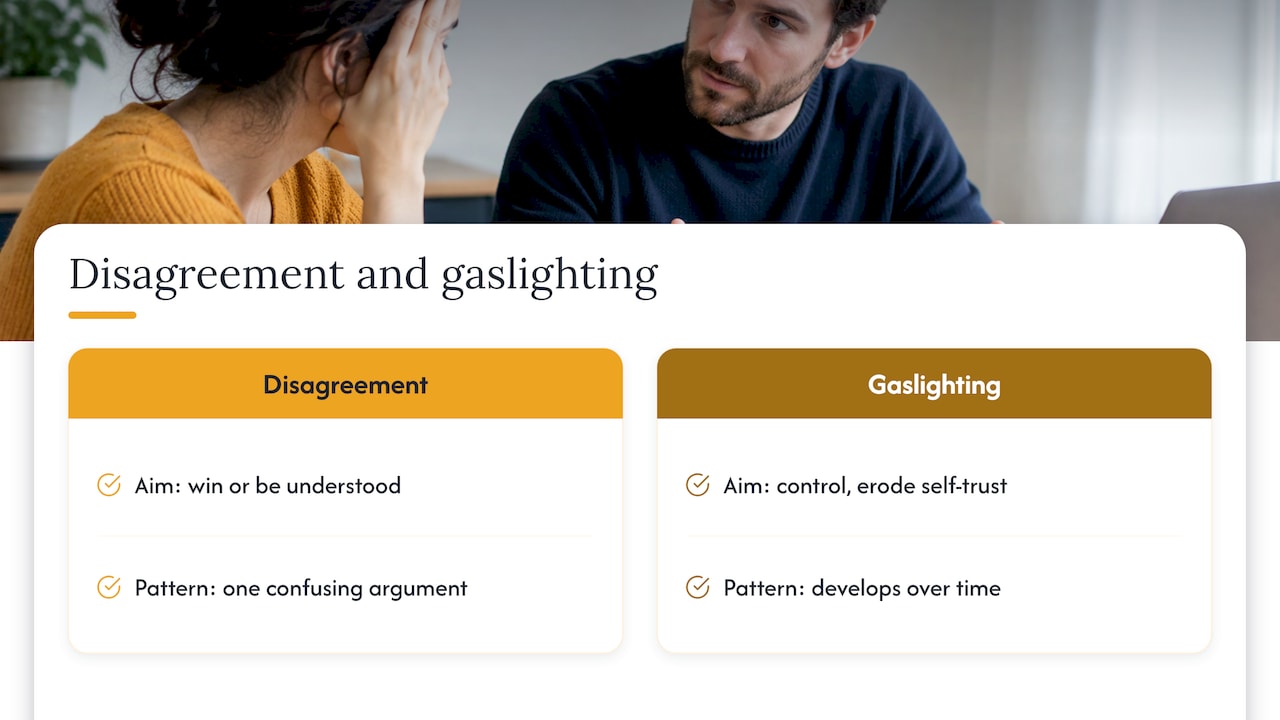
It is about control, not about being right. In a disagreement, each person wants to win a point or be understood. In gaslighting, the goal is that you stop trusting your own view so the other person never has to be held accountable.
It happens over time. The same federal page says gaslighting may not be noticed at first. A Utah State University Extension guide describes it as moving in stages: first disbelief, then defensive attempts to prove your partner wrong, and eventually, for some people, depression or a loss of their sense of self. That is why one confusing argument rarely tells you much, while a year of them does.
For a plain-language walkthrough of how this manipulation works, this explanation of recognizing and stopping manipulation is a helpful companion read.
Gaslighting vs. disagreement, side by side
| Ordinary disagreement | Gaslighting | |
|---|---|---|
| What it is about | The issue: money, plans, a comment | Your reality: what you saw, said, felt |
| Your perspective | Heard, even if rejected | Dismissed, denied or rewritten |
| Typical lines | “I see it differently.” “I don’t remember it that way.” | “That never happened.” “You’re imagining things.” “You’re too sensitive.” |
| Pattern | Varies; repair happens at least sometimes | Repeats; the same moves show up across topics |
| Who ends up wrong | Either of you, depending on the facts | Always you |
| How you feel afterward | Frustrated, hurt, but grounded | Confused, doubting yourself, “maybe I am crazy” |
| Accountability | Possible, even if slow | Avoided; blame is turned around |
No single row proves anything. Look at the whole column over weeks and months.
Signs of gaslighting in a marriage
Marriage makes this harder to spot. You share a home, money, friends and history, so a partner’s version of events can quietly become the household’s version. These are the signs worth watching for, especially when several appear together and keep recurring:
- Denial of things you clearly remember. Not “I don’t think I said that,” but flat insistence that a conversation, promise or incident never happened, repeated even when you have proof.
- Calling you crazy, dramatic or too sensitive whenever you raise a concern, so the complaint becomes about your character instead of the behavior.
- Rewriting what happened. The event is described so differently that you start to wonder whether you misunderstood your own experience.
- Turning it around. You bring up a problem and end up apologizing for how you brought it up.
- Eroding your self-trust. You rehearse conversations, keep notes to prove what was said, or stop bringing things up because you expect to lose.
- Isolating you from outside views. Friends and family are described as unreliable, so there is no one to check reality with.
- Growing dependence on their judgment. You ask your partner what you must have meant, felt or remembered.
The National Domestic Violence Hotline lists tactics such as blocking and diverting, where the abuser changes the subject or questions your thinking. If you keep ending conversations feeling that the topic you started has disappeared, that is worth noting.
If these signs sound familiar, our page on stopping gaslighting in marriage covers what to say and do in the moment.
Gaslighting vs. lying
People search “what’s the difference between lying and gaslighting” because the two overlap. Here is the clean version.
Lying is a false statement. Someone says they were at work when they weren’t. It hurts trust, and in a marriage it can be devastating, but the lie is about a fact. You can catch it, confront it, and the facts stay the facts.
Gaslighting targets your ability to know the facts. It may include lies, but its purpose is different: to make you question your memory, perception or sanity so you stop challenging the person. A psychologist interviewed by Parade puts the key difference in intent and impact: gaslighting is a deliberate way to make someone doubt reality.
A simple example:
- Lie: “I didn’t spend that money.” You show the bank statement. They say, “Fine, I did.”
- Gaslighting: “I never said we’d save that money. You’re always making things up. This is why I can’t talk to you about finances.” You show the text message. They say you twisted it, that you’re obsessed, that something is wrong with you.
In the first case, the lie collapses when the evidence appears. In the second, the evidence changes nothing, because the aim was never to be believed. It was to make you the problem.
A lie also isn’t gaslighting just because it hurts. People lie out of fear, shame or avoidance. That is still serious, and couples recovering from betrayal need a structured way back to trust. But it is a different problem from a partner who systematically unravels your sense of reality.
What people often mistake for gaslighting
The word has spread so far that it now gets used for almost any conversation where someone feels dismissed. Psychologists quoted in Parade point out that disagreements, different perspectives and miscommunication are often mistaken for it. Common look-alikes include:
- Different memories. Two people can remember the same evening differently. Memory is unreliable. The healthy response is curiosity (“Help me understand what you recall”). The gaslighting response is certainty plus contempt (“You always get things wrong”).
- Defensiveness. Saying “that’s not true!” or “I didn’t mean it like that” in the heat of an argument can feel like denial. It is a poor way to handle criticism, and a common one, but on its own it is not an attempt to rewrite your reality.
- Hurtful honesty or bluntness. Hearing something you don’t want to hear is not manipulation.
- Avoidance or stonewalling. Shutting down is painful, and conflict avoidance damages relationships over time, but going silent is not the same as insisting you are wrong about what you saw.
- A one-off dismissive comment. “You’re overreacting” said once, in a bad moment, is a communication mistake. Said constantly, about everything, it joins a pattern.
- Setting a boundary. “I won’t discuss this tonight” is a limit, not a denial of your experience.
Why does the distinction matter? Because mislabeling hurts both ways. If everything is gaslighting, a couple that could learn better skills may jump straight to “abuser,” and real survivors find the word less believed. And if real gaslighting gets treated as just a communication problem, the person on the receiving end is told to try harder with someone who isn’t playing fair.
Five questions to ask yourself
Use these as a reflection tool, not a diagnosis.
- When I disagree, can I say so without being told I’m crazy, too sensitive or lying?
- Does this happen across many topics, or only around one hot-button issue? Gaslighting tends to follow you from subject to subject.
- Has my confidence in my own memory dropped since this relationship began?
- When I show evidence, does anything change?
- Do I feel afraid, or do I plan my words to avoid blowups?
If your answers are mostly “yes, we can disagree, and sometimes we repair,” you are probably dealing with conflict and communication, which is very workable. If your answers suggest a one-sided pattern, take it seriously.
If you’re unsure, what you can do next
Write things down for yourself. Keep a private note of dates and what was said. This is not about building a case. It is about having something that does not shift when someone tells you your memory is wrong.
Talk to someone outside the relationship. The Utah State University guidance recommends building a support network, setting firm boundaries and limiting interaction with the person gaslighting you. A trusted friend, relative or pastor can offer a reality check you are not getting at home.
Name the behavior, not the person. Try: “I’m telling you what I experienced. You can see it differently, but you can’t tell me I didn’t experience it.” A partner who is simply defensive will often soften when the request is specific and calm. A partner who is gaslighting will often escalate.
Set argument boundaries before the next fight. Agree on ground rules such as no name-calling, taking breaks, and returning to the topic later. Our six-step guide to argument boundaries in marriage shows how. How your partner responds to a boundary tells you a lot.
Rebuild emotional safety. Whether the problem is gaslighting-like behavior driven by defensiveness or ordinary conflict, safety is the foundation. See the nine behaviors to practice tonight and the 90-day psychological safety plan.
If you feel unsafe or controlled, call for confidential help. The National Domestic Violence Hotline offers free, confidential support for people in abusive relationships, including emotional abuse, and its resources on gaslighting and emotional abuse can help you put words to what is happening. If you are in immediate danger, call 911. Do not try to confront a partner who has been abusive in a way that could put you at risk, and do not wait for a couples program to fix a safety problem.
Why couples keep fighting about “what really happened”
Many couples who are not in abusive dynamics still get stuck in a loop: one says “you never listen,” the other says “that’s not what happened,” and an hour later they are arguing about the argument. When this happens, each person feels unheard, and each may feel gaslit. Usually what is happening is mutual defensiveness, not manipulation.
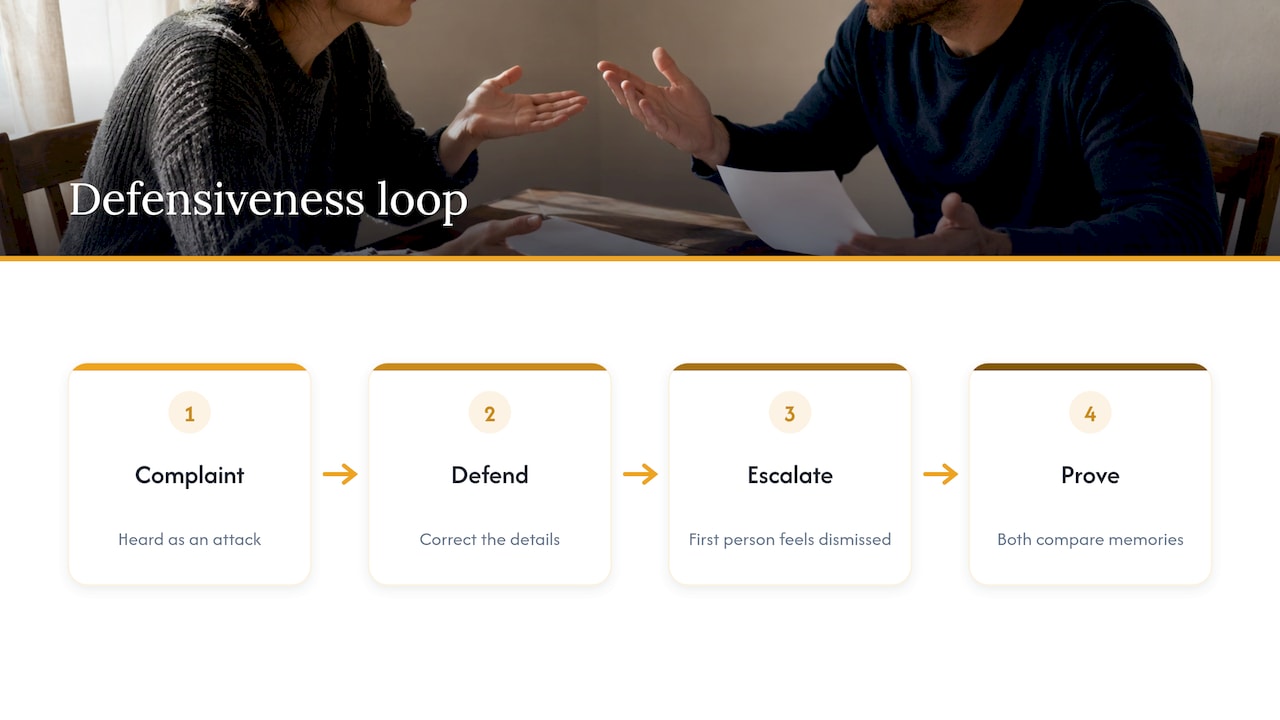
The cycle often looks like this: a complaint is heard as an attack, the listener defends and corrects the details, the first person feels dismissed and escalates, and both end up proving who remembers it better. Neither person is trying to destroy the other’s sense of reality, but both are protecting themselves. Our article on why couples repeat the same arguments explains what drives it.
The repair skills are learnable: validate before you correct, say “I can see why you felt that way” without conceding every fact, and agree to separate how an event felt from what exactly happened. That is where a structured framework helps more than good intentions.
Our perspective
After years of working with couples, we have come to see that the question “is this gaslighting or just a fight?” is really two questions. First: is my partner willing to hear my reality? Second: do we have the skills to disagree safely? Couples often assume the answer to the first is no because they are failing at the second.
That is why we built the F.I.G.H.T. Plan®. It is a step-by-step, skills-based system created by licensed mental health professionals to help couples handle conflict without escalation: communication, emotional regulation, healing and rebuilding. When both partners are willing, the tools give you a way to disagree without making each other feel crazy.
We also want to be clear about the limit of any workbook or course. Where one partner is deliberately controlling the other’s reality, and especially where there is fear, safety comes first. If you recognize that, reach out for confidential support before you work on communication skills.
For the many couples who recognize themselves in the loop of defensiveness and “that’s not what happened,” there is a practical way out, and it starts with learning to hear each other.
Carlos
Tools for couples who want to fight less
If your honest read is that you two are caught in a painful, recurring pattern but both of you want it to change, we have built resources for exactly that. Stop the Fighting: The Couples Communication & Conflict Resolution Course is $149.00 and takes you through the full F.I.G.H.T. Plan®. If you prefer to start smaller, The F.I.G.H.T. Plan Couples Conflict Toolkit is $27.00, and the F.I.G.H.T. Plan workbook ranges from $14.99 to $25.00. Faith-centered couples can choose the Christian F.I.G.H.T. Plan Workbook. You can see everything in the shop.

If you would rather work through it with a guide, online couples coaching is available, including a four-session VIP private coaching package at $997.00.
FAQ
Is disagreeing with my partner the same as gaslighting?
No. Disagreeing means you see something differently and both views are allowed to exist. Gaslighting means your partner repeatedly denies or rewrites your reality so you doubt your own mind. One fight, even a bad one, rarely tells you which you are in. The pattern over time does.
Does gaslighting mean lying?
Not exactly. Gaslighting can include lies, but a lie is a false statement about a fact, and it ends when the facts surface. Gaslighting aims to make you doubt your memory, feelings or sanity so you stop questioning the person, and it continues even when you show evidence.
Can someone gaslight without meaning to?
People can say dismissive things, like “you’re overreacting,” out of defensiveness or habit. The impact can still hurt. A single instance usually reflects poor communication, not abuse. Repeated denial and blame that leave you steadily more confused and less confident is a pattern that deserves serious attention.
What should I do if I think I’m being gaslit in my marriage?
Keep private notes, talk to someone you trust outside the relationship, and set clear boundaries about how you will be spoken to. If you feel afraid or controlled, contact the National Domestic Violence Hotline for confidential support, and call 911 in an emergency.
Sources
- Emotional and verbal abuse, womenshealth.gov (U.S. Department of Health and Human Services)
- Conflict, APA Dictionary of Psychology
- How to Identify and Navigate around Gaslighting, Utah State University Extension
- What is gaslighting?, National Domestic Violence Hotline
- What is emotional abuse?, National Domestic Violence Hotline
- Gaslighting vs. Lying: A Psychologist Explains the Difference, Parade
- 7 Things People Think Are Gaslighting but Aren’t, Parade
- Gaslighting: how to recognize and stop manipulation
Recommended
- Stop Gaslighting in Marriage: What to Do and Say
- How to Agree to Disagree Respectfully as a Couple
- What Does a Healthy Argument Look Like in Relationships?
- Criticism vs Complaint: 4 Rewrite Scripts Couples Can Use Tonight