
How to Agree to Disagree Respectfully as a Couple

Agreeing to disagree respectfully is a defined relationship skill, not a personality trait, and couples who practice it consistently report stronger trust and deeper emotional safety. In relationship science, this skill falls under the broader category of constructive disagreement, a set of techniques that allow partners to hold different views without damaging the connection between them. The goal is never forced consensus. The goal is mutual respect, even when the conversation ends without resolution. Couplesfightschool, founded by licensed mental health professionals Carlos Todd and Natasha Pemberton-Todd, teaches couples exactly this through the F.I.G.H.T. Plan® framework, which combines emotional regulation, communication tools, and repair strategies into a practical system any couple can use.
How to agree to disagree respectfully as a couple
Respectful disagreement starts before the first word of a difficult conversation. The first three minutes of a tough talk predict its outcome in 96% of cases. That statistic means how you open a conversation matters far more than how long you argue.
The technique behind this is called a “softened startup.” A softened startup expresses a feeling and a need without placing blame. It sounds like “I feel unheard when we skip these conversations” rather than “You never listen to me.” The difference is not just tone. It is the difference between a conversation that stays open and one that shuts down immediately.

Absolutist words like “always” and “never” are the fastest way to derail a respectful exchange. When a partner hears “You always do this,” the brain registers a threat, not a concern. The conversation shifts from problem-solving to self-defense, and no one wins that fight.
Using “I” statements without turning them into accusations
“I” statements reduce defensiveness and promote openness when used correctly. The key word is “correctly.” A genuine “I” statement focuses entirely on the speaker’s internal experience. “I feel anxious when plans change last minute” is an “I” statement. “I feel like you don’t care about my time” is an accusation wearing a disguise.
Misusing “I” statements with veiled blame undercuts their effectiveness and triggers the same defensiveness they were meant to prevent. Genuine vulnerability, not clever phrasing, is what makes this technique work.
Pro Tip: Practice your “I” statement out loud before a hard conversation. If the sentence could be rewritten as “You did X,” it is still an accusation. Rewrite it until it describes only your feeling and your need.
| Communication Starter | Effect on Conversation |
|---|---|
| “You always ignore me.” | Triggers defensiveness, shuts dialogue down |
| “I feel dismissed when I’m interrupted.” | Opens dialogue, invites empathy |
| “You never help around the house.” | Creates blame cycle, escalates conflict |
| “I feel overwhelmed and could use more support.” | Signals need clearly, reduces tension |
| “Why do you always do this?” | Puts partner on trial, blocks resolution |
| “I get frustrated when this keeps happening.” | Stays personal, keeps conversation safe |
What is physiological flooding and how does it stop respectful disagreement?
Physiological flooding is the state where emotional arousal becomes so intense that rational thinking and empathy shut down. The body treats the argument like a physical threat. Heart rate spikes, breathing shortens, and the part of the brain responsible for problem-solving goes offline.
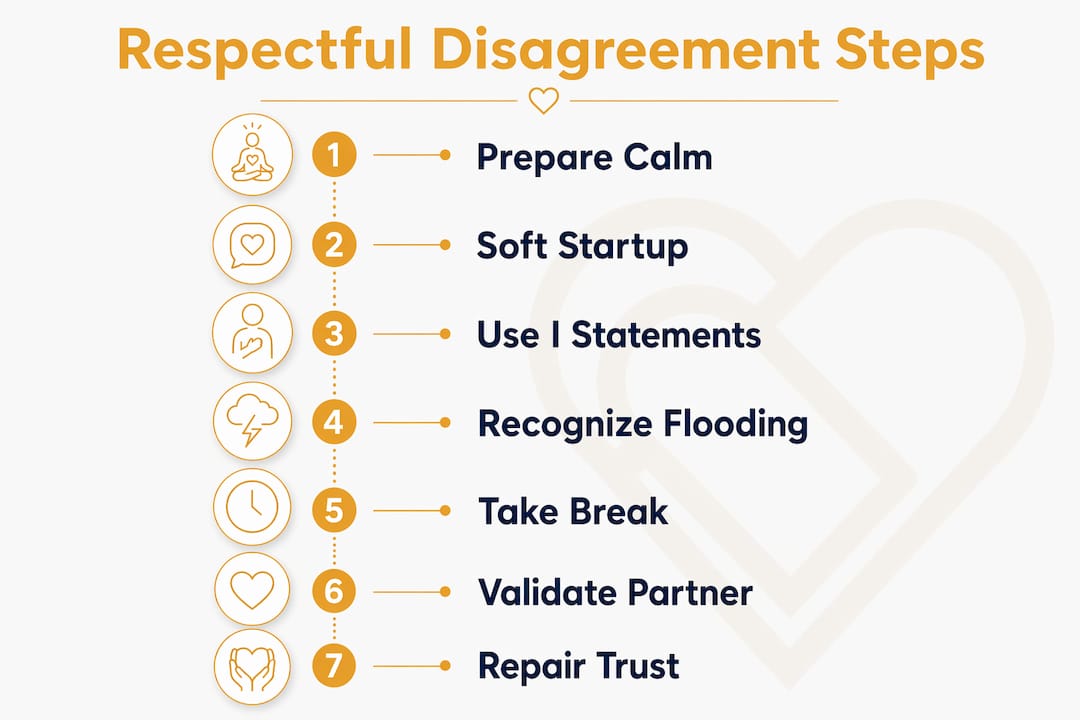
When a partner’s heart rate exceeds about 100 beats per minute, productive conversation becomes impossible. Continuing to talk at that point does not resolve anything. It deepens the wound. Recognizing flooding in yourself or your partner is one of the most underrated skills in healthy conflict resolution.
Signs of flooding include a racing heart, shallow breathing, a clenched jaw, a rising voice, or a sudden urge to say something you will regret. These are not signs of weakness. They are biology. Understanding this is the first step toward doing something about it.
How to take an effective break during a conflict
A break only works when both partners agree to it in advance and treat it as a pause, not a punishment. Effective time-outs must last at least 20–30 minutes to allow the nervous system to fully calm down. Anything shorter and the body is still flooded when the conversation resumes.
- Agree on a signal before conflict arises. A hand gesture or a code word works better than announcing “I need a break” mid-argument, which can feel like rejection.
- Set a return time. Say “Let’s come back to this in 30 minutes” so neither partner feels abandoned.
- Use the break for self-soothing, not rehearsing. Go for a walk, breathe slowly, or listen to music. Do not mentally replay the argument or plan your rebuttal.
- Return as agreed. Honoring the return time builds trust and signals that the break was about regulation, not avoidance.
- Check in before restarting. Ask “Are you ready to continue?” rather than diving back in.
Pro Tip: Agree on your break signal during a calm moment, not during a fight. Write it down if needed. When flooding hits, you will not have the mental bandwidth to negotiate a new system.
Couples who repeat the same arguments often do so because they never fully regulated before returning to the conversation. The break is not a detour. It is the work.
How do you validate your partner without giving up your position?
Validation is not agreement. Acknowledging a partner’s feelings does not mean surrendering your own perspective. This distinction is the foundation of respectful disagreement and one of the most misunderstood tools in couples communication.
When you validate, you are saying “Your feelings make sense given your experience.” You are not saying “You are right and I am wrong.” A partner who feels heard is far more likely to stay calm and open. A partner who feels dismissed will escalate, regardless of how logical your argument is.
Validation acknowledges the legitimacy of emotions without requiring agreement, and that distinction preserves respect even when the disagreement stays unresolved. This is what emotional authenticity in relationships actually looks like in practice: staying present with your partner’s experience without losing your own footing.
Validation phrases couples can adapt:
- “I can see why you feel that way, even though I see it differently.”
- “That makes sense from your perspective.”
- “I hear that this really matters to you.”
- “I understand this is frustrating for you.”
- “Your feelings are valid, and I want to understand them better.”
Pro Tip: Before stating your own view, reflect back what your partner said in your own words. This is active listening in practice. It slows the conversation down and signals that you were actually paying attention, not just waiting for your turn to talk.
Active listening involves reflecting both content and emotion, validating the logic behind a partner’s feelings, and suppressing the urge to counter-argue. That last part is the hardest. It is also the most important.
How do repair attempts rebuild trust after a disagreement?
Repair attempts are the behaviors couples use to stop a conversation from spiraling into lasting damage. An apology, a moment of humor, a request to reset, or simply saying “I don’t want to fight with you” are all repair attempts. Healthy couples use repair attempts consistently during conflicts, and that consistency is what separates productive arguments from destructive ones.
The timing and sincerity of a repair attempt matter as much as the words. Sincere, well-timed repairs prevent negative spirals. A repair attempt that feels manipulative or dismissive, like “Fine, I’m sorry, can we move on?” does the opposite. It signals that the goal is to end the discomfort, not to genuinely reconnect.
Ending a tough conversation with reassurance rather than silence is a small habit with a large return. Saying “I love you even when we disagree” costs nothing and communicates everything.
| Repair Technique | What It Communicates |
|---|---|
| Sincere apology | “I value you more than being right.” |
| Acknowledging your role | “I contributed to this problem.” |
| Requesting a reset | “I want us to try this conversation again.” |
| Expressing appreciation | “I’m grateful we can talk about hard things.” |
| Physical reassurance | “We are still connected despite this conflict.” |
Building everyday trust through small behaviors reduces how often conflicts escalate in the first place. Saying thank you, following through on commitments, and checking in regularly create a relational bank account. When a hard conversation comes, both partners draw on that account instead of starting at zero. A conflict resolution framework gives couples a structure to practice these behaviors consistently, not just when things get hard.
Key Takeaways
Couples who agree to disagree respectfully use specific, learnable techniques, including softened startups, validated emotions, regulated breaks, and sincere repair attempts, to protect their connection during conflict.
| Point | Details |
|---|---|
| Softened startup matters most | The first three minutes of a conflict conversation predict its outcome, so open gently. |
| Flooding stops productive talk | When heart rate exceeds 100 BPM, take a break of at least 20–30 minutes before continuing. |
| Validation is not concession | Acknowledging your partner’s feelings does not mean agreeing with their position. |
| “I” statements need genuine vulnerability | Effective “I” statements describe your internal experience, never a disguised accusation. |
| Repair attempts protect the relationship | Sincere, timely repairs prevent negative spirals and rebuild trust after hard conversations. |
What I’ve learned from watching couples fight well
After years of working with couples in conflict, the pattern I see most clearly is this: the couples who fight well are not the ones who avoid hard topics. They are the ones who have stopped treating disagreement as a verdict on the relationship.
No single conflict style is universally right. Harvard’s Program on Negotiation research confirms that strategic flexibility, the ability to shift your approach based on what the moment needs, predicts success far better than any fixed style. The couples I have seen transform their communication are not the ones who learned one technique. They are the ones who became curious about their partner instead of committed to winning.
Conflict is a tool for intimacy when navigated skillfully. I have watched couples who came in barely speaking leave with a shared language for hard conversations. That shift does not happen because they stopped disagreeing. It happens because they learned to disagree in a way that kept both people in the room, emotionally and physically.
The couples who struggle most are the ones who believe that a good relationship means agreeing on everything. That belief sets them up for failure every time a real difference surfaces. The couples who thrive are the ones who know how to diffuse conflict without erasing the disagreement. They hold their own view and their partner’s view at the same time. That is not weakness. That is the most sophisticated communication skill I know.
If you are still in the early stages of building these skills, get help before the patterns calcify. The longer a destructive conflict cycle runs, the harder it is to interrupt. Seek a structured framework, a course, or a coach who can give you real-time feedback. Reading about these skills is a start. Practicing them with guidance is where the change actually happens.
— Carlos
Couplesfightschool can help you practice these skills
Knowing what respectful disagreement looks like and being able to do it under pressure are two very different things. Couplesfightschool was built for exactly that gap.
The Stop the Fighting course walks couples through the same communication tools covered here, including softened startups, validation, and repair attempts, with structured practice built in at every step. For couples who want personalized guidance, online coaching with Carlos and Natasha gives you real-time feedback on your specific conflict patterns. Both options are grounded in the F.I.G.H.T. Plan® framework and designed for couples who are serious about changing how they fight, not just how they feel about fighting.
FAQ
What does it mean to agree to disagree respectfully?
Agreeing to disagree respectfully means accepting that a difference of opinion can remain unresolved without damaging the relationship. Both partners acknowledge each other’s views as valid while choosing connection over consensus.
How do “I” statements help couples during disagreements?
“I” statements reduce defensiveness by focusing on the speaker’s feelings rather than the partner’s behavior. They open dialogue instead of triggering a defensive response.
What is physiological flooding in a relationship argument?
Physiological flooding occurs when emotional arousal spikes so high that rational thinking shuts down, typically when heart rate exceeds 100 beats per minute. A break of at least 20–30 minutes is needed before productive conversation can resume.
Can you validate your partner’s feelings without agreeing with them?
Yes. Validation means acknowledging that your partner’s feelings make sense given their experience, not that their position is correct. You can say “I understand why you feel that way” while still holding a different view.
What are repair attempts and why do they matter?
Repair attempts are words or actions that interrupt a conflict before it causes lasting damage, such as an apology, a request to reset, or an expression of appreciation. Healthy couples use them consistently to prevent negative spirals and protect the relationship.
Recommended