
How to Compromise Without Resentment: Mutual Respect in Relationships
|
Getting your Trinity Audio player ready...
|
Learning how to compromise without resentment is one of the most important and challenging skills a couple can master.
Many people think of compromise as simply “meeting in the middle,” but in reality, poorly handled agreements often leave one partner feeling short-changed, silent, and quietly bitter.
True, healthy compromise is not about one person winning and the other losing. It’s a balanced, respectful process built on mutual respect couples need to thrive; a dialogue where both partners feel heard, valued, and emotionally safe.
Without the right tools, what starts as a simple negotiation can spiral into scorekeeping, frustration, and anger. You might agree to something just to keep the peace, only to find that unspoken resentment grows over weeks or months, damaging your connection.
This guide is designed to help you break that cycle. We will move beyond the basic idea of “giving and taking” to explore the emotional and communicative foundations of effective compromise.
You’ll learn practical communication techniques, emotional validation skills, and boundary-setting strategies to ensure that finding common ground actually strengthens your bond instead of creating hidden hurt.
By understanding the difference between a collaborative solution and a one-sided sacrifice, you can transform compromise from a source of tension into a powerful tool for intimacy and teamwork.
Why Compromise Often Leads to Resentment
On paper, compromise sounds good. In practice, it often leaves one partner feeling short-changed, which builds quiet resentment over time.
Why does this happen?
The root cause is often a feeling of unfairness. When you feel you’re always the one adjusting your schedule, sacrificing your hobby, or doing more chores, it’s natural to start keeping score.
This avoid scorekeeping in relationships is a trap many fall into, but it’s a symptom of a deeper issue: a lack of flexible fairness in relationship dynamics.
The resentment grows from emotional imbalance. Maybe you agreed to something to avoid a fight, not because you genuinely felt okay with it. Perhaps the compromise was unclear, leaving room for different interpretations later. Without feeling appreciated for your flexibility, your goodwill can quickly turn into bitterness.
A study published in Family Issues found that individuals who feel unfairly treated (such as those who keep score or feel their contributions are unequal) experience increased negative emotions and decreased relationship satisfaction, leading to resentment and conflict. This statistic highlights the direct link between perceived unfairness and emotional damage.
When compromise feels one-sided, it ceases to be a tool for connection and becomes a source of division.
CTA: Want to understand the basis of an effective compromise? Enroll in our Fight Less Love More course to deal with all the relationship issues!
What Healthy Compromise Really Looks Like
So, what does good compromise actually involve? First, it’s important to define what it is not.
A healthy compromise relationship is not about one person winning and the other losing. It is not suppressing your true needs to keep the peace, which is actually a form of self-sacrifice that leads to resentment.
True relationship compromise without resentment has distinct characteristics:
- It is collaborative, meaning both people work together to find a solution.
- It is flexible, understanding that solutions might need to change as life does.
- It is rooted in respect for each other’s core values and needs.
- It leaves both partners feeling that their perspective mattered and that the outcome, while perhaps not perfect, is something they can both support without feeling overlooked.
The Role of Healthy Communication in Fair Compromise

You can’t have a fair compromise without clear, respectful communication. It’s the vehicle that gets you from a problem to a mutually agreeable solution.
Open honest dialogue partners engage in is the foundation. This means speaking your truth kindly and listening without immediately planning your rebuttal.
Destructive communication (like criticism, contempt, or stonewalling) shuts down the compromise process before it begins. Conversely, constructive strategies focus on understanding and problem-solving.
Research in the Journal of Social and Personal Relationships showed that couples who use constructive conflict resolution strategies (such as dialogue and avoiding escalation) report higher relationship quality and are less likely to experience resentment compared to those who use destructive tactics.
This proves that how you talk about a disagreement is often more important than the disagreement itself.
Effective communication compromise techniques include using “I feel” statements (“I feel overwhelmed when the dishes pile up” vs. “You never do the dishes”), asking clarifying questions, and taking responsibility for your own feelings. The goal is to de-escalate tension so you can both think clearly and work as a team.
CTA: Get out “Stop the Fighting: The Couples Communication & Conflict Resolution Course” to improve your communication!
Core Skills for Compromising Without Feeling Overlooked
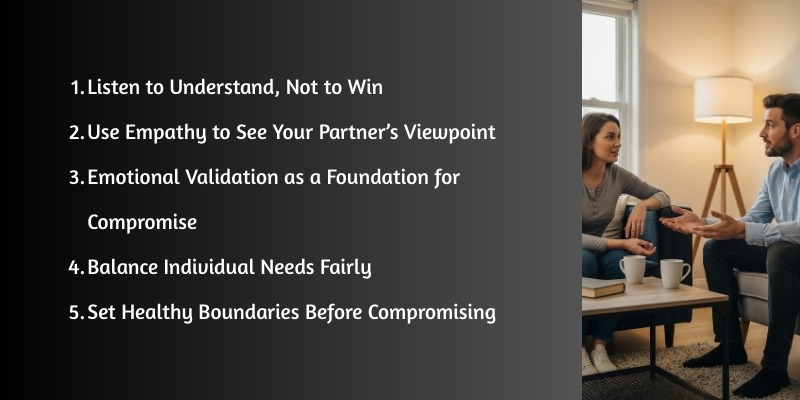
Knowing you need to communicate well is one thing; having the skills to do it is another. Here are the essential abilities to develop for compromises that work.
Listen to Understand, Not to Win
This skill is the foundation. To listen to understand your partner, you must pause your own inner monologue and truly focus on their words and emotions.
Practice reflective listening: “So, what I’m hearing is that you feel stressed when we’re late because it makes your whole day feel rushed. Is that right?” This simple act of paraphrasing shows you care about their experience, not just your own argument.
Use Empathy to See Your Partner’s Viewpoint
Empathy in compromise means trying to feel what the situation is like from your partner’s side.
It’s asking yourself, “Why is this so important to them?” Even if you don’t agree, validating their feelings (“I can understand why that would make you feel anxious”) creates emotional safety. This safety makes it much easier for both of you to bend and find middle ground.
Emotional Validation as a Foundation for Compromise
Validation is empathy in action. Emotional validation that relationship experts often talk about means acknowledging your partner’s feelings as real and understandable. You don’t have to agree with their conclusion to say, “Your frustration makes complete sense.”
When people feel validated, their defenses drop. They become more open to hearing your side and working on a solution, because they don’t feel they have to fight to be heard.
Balance Individual Needs Fairly
A compromise collapses when one person’s needs are consistently sidelined. The art of balancing individual needs and relationship health requires conscious trade-offs.
It means asking, “Is this solution fair to both of us over time?” Sometimes you take turns getting your preference; other times, you find a creative third option. The key is ensuring neither partner feels they are always the one sacrificing.
Set Healthy Boundaries Before Compromising
You cannot compromise effectively if you don’t know your own limits. Setting healthy boundaries and compromise discussions is crucial.
A boundary is not an ultimatum; it’s a clear statement of what you need to feel okay.
For example, “I am willing to host your family for the weekend, but I need us to agree on an end time for visits each night so I can recharge.” Boundaries prevent resentment by ensuring you don’t agree to things that violate your core well-being.
Collaborative Problem-Solving: The Secret to Win-Win Compromise
Shift your mindset from “me vs. you” to “us vs. the problem.” This is the heart of collaborative problem solving couples who avoid resentment practice. Instead of each person lobbying for their own solution, you work together to brainstorm options.
Here’s how it works: First, clearly define the shared problem. (“We both want to feel close, but we have different needs for weekend activity.”) Then, brainstorm all possible solutions without judging them.
Finally, evaluate the ideas together. Which option meets the most important needs for both people? This process turns compromise into a creative, team-based activity, reducing the feeling of personal loss.
How to Ensure Compromises Stay Fair Over Time
Life isn’t static, and neither should your compromises be. What felt fair six months ago might feel draining today. The practice of revisiting compromises when needed is what keeps resentment at bay.
Build in a simple “check-in.” When you agree on a compromise, you can say, “Let’s try this new chore schedule for a month and then see how we both feel about it.”
This frames the agreement as an experiment, not a life sentence. It acknowledges that feelings change, and it gives you both permission to speak up if the balance starts to feel off without it being a breach of contract.
Common Examples of Healthy Compromises in Relationships
Let’s look at what healthy compromise relationship strategies look like in everyday situations:
- Social Time: An introvert and an extrovert agree to attend two social events per month, but they also schedule two quiet “stay-at-home” dates. The extrovert gets connection, the introvert gets recharge, and both are honored.
- Chores: One partner hates dishes but doesn’t mind laundry. They agree to trade these tasks, or one does the dishes while the other handles after-dinner cleanup and tidying.
- Parenting: One parent prefers strict bedtimes; the other values flexibility. They compromise with a consistent weekday routine but more relaxed times on weekends.
- Career & Location: A job offer in a new city is a big decision. A healthy compromise might involve moving, but with a firm agreement to revisit the location in 3-5 years, or with a plan for the other partner to receive dedicated support for their career transition.
Compromise Tips for Couples (Practical Checklist)
Here are actionable compromise tips for couples to use immediately:
- Lead with “I feel…” to express your need without blame.
- Take a timeout if emotions run high. Agree to revisit in 30 minutes.
- Validate first. Start your response with, “I understand why you see it that way.”
- Identify non-negotiables. Each person shares 1-2 absolute needs before brainstorming.
- Aim for the 80/20 rule. If you’re both about 80% happy with the solution, it’s a great compromise.
- Schedule a review. Put a reminder in your calendar to check in on how the compromise is feeling.
FAQs
Is compromise always necessary?
Not on every tiny issue. Save compromise for decisions that impact both of you or touch on core values. Let the small stuff go.
How do I compromise without losing myself?
You can compromise without losing yourself by knowing and communicating your healthy boundaries. A good compromise should never violate your core values or well-being.
What if only one partner is compromising?
This is a sign of imbalance, not compromise. It requires an open conversation about fairness, possibly with the help of a counselor.
What’s the difference between compromise and sacrifice?
Compromise seeks a middle ground where both gain. Sacrifice is one person giving up something entirely, which can build resentment if not mutual and occasional.
Conclusion
Mastering the art of how to compromise without resentment transforms conflict from a threat into an opportunity to build a deeper, more respectful partnership. It moves you away from tallying wins and losses and toward a shared mission of understanding and teamwork.
By prioritizing empathy, clear communication, and collaborative problem-solving, you create a relationship where both people feel valued, heard, and secure.
Remember, the goal isn’t a perfect agreement but a fair process that protects your connection. Start practicing these tools today, and turn compromise into one of your relationship’s greatest strengths.