
How to Identify Communication Patterns Hurting Your Relationship

Harmful communication patterns in relationships are defined as recurring behaviors that erode emotional safety, block genuine connection, and predict long-term relationship failure. Recognizing these patterns is the first step toward changing them. Research on the Four Horsemen — criticism, defensiveness, contempt, and stonewalling — identifies these as the strongest predictors of relationship dissolution. Contempt alone damages not just emotional bonds but the immune function of the partner on the receiving end. The good news is that once you can identify communication patterns hurting your relationship, you have real leverage to change them.
What are the primary harmful communication patterns that damage relationships?
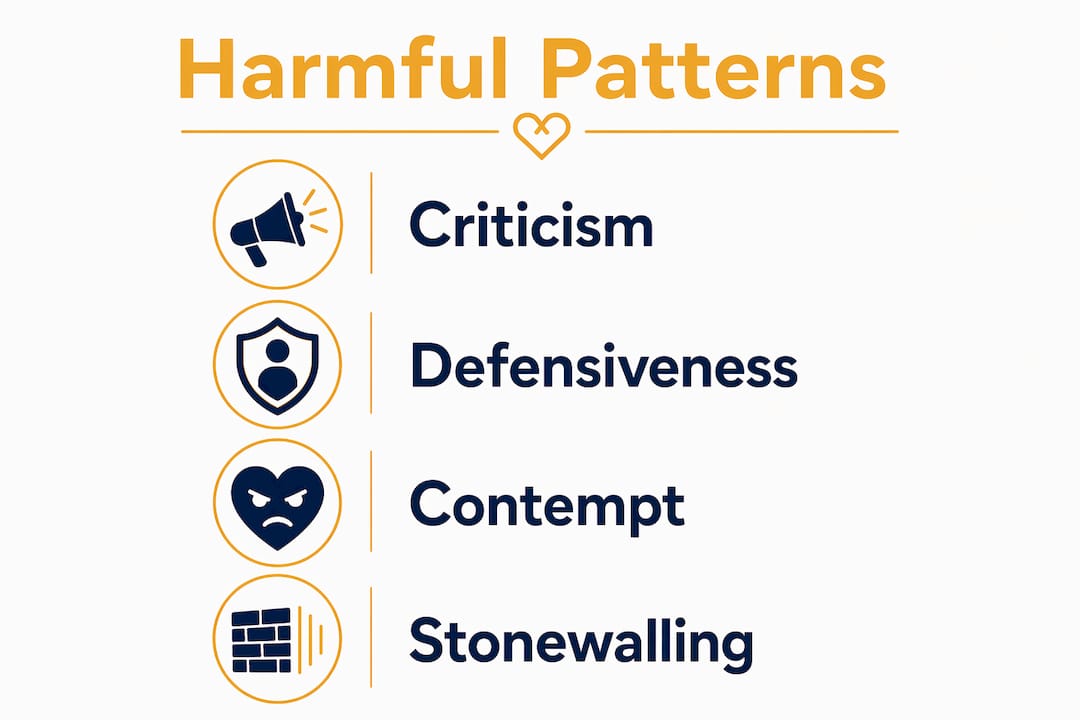
The Four Horsemen framework, developed through decades of relationship research, names the four behaviors most likely to end a relationship. Each one is destructive on its own. Together, they form a cycle that compounds over time.
Criticism attacks a partner’s character rather than addressing a specific behavior. “You never think about anyone but yourself” is criticism. “I felt hurt when you forgot our plans” is not. Defensiveness responds to perceived attack with counter-attack or victimhood, which signals to your partner that their concern will never be heard. Stonewalling is emotional shutdown, the silent treatment, or physical withdrawal during conflict. It tells your partner the conversation is over before it starts. Contempt is the most destructive of the four. Eye-rolling, mockery, sarcasm, and name-calling all signal that you see your partner as beneath you. Contempt predicts relationship failure more reliably than any other single behavior.

The cycle tends to follow a predictable path. Criticism triggers defensiveness, which escalates tension, which leads to stonewalling, which eventually hardens into contempt. Intervening early, at the criticism stage, is far easier than trying to repair a relationship already saturated with contempt.
Beyond the Four Horsemen, two other patterns cause serious damage. The demand-withdraw cycle occurs when one partner pushes for resolution and the other pulls away. This dynamic is often driven by attachment styles, where anxious partners escalate and avoidant partners withdraw, creating a loop that blocks resolution entirely. The second pattern involves verbal abuse tactics like gaslighting and DARVO (Deny, Attack, Reverse Victim and Offender). These are not communication failures. They are strategic patterns designed to control and avoid accountability, and they require a different response than ordinary conflict.
Pro Tip: If you notice contempt showing up regularly, whether in your own behavior or your partner’s, treat it as a five-alarm warning. It does not fix itself without deliberate intervention.
- Criticism: Attacks character, not behavior
- Defensiveness: Deflects instead of listening
- Contempt: Mocks, belittles, or dismisses
- Stonewalling: Shuts down or withdraws entirely
- Demand-withdraw: One pursues, one retreats
- Gaslighting/DARVO: Distorts reality to avoid accountability
How can you recognize if these harmful patterns are present in your relationship?
Recognizing unhealthy communication styles requires honest observation of three things: your own behavior, your partner’s behavior, and the overall dynamic between you. Most people are quicker to spot their partner’s patterns than their own. That bias is itself a warning sign.
Common relationship symptoms include arguments that repeat the same script without resolution, a growing sense of emotional distance, feeling criticized or dismissed even during calm conversations, and a reluctance to bring up certain topics because you already know how it will go. These are not random frustrations. They are signals that a pattern is running the show.
One underrated cause of communication breakdown is rigid mental models. Partners often react to internal predictions about what the other person means rather than what was actually said. You hear a tone and assume hostility. You see a look and assume contempt. This mind-reading replaces real communication with a conversation happening entirely inside your own head. The result is conflict driven by assumption, not reality.
Pro Tip: After your next disagreement, write down what you assumed your partner meant versus what they actually said. The gap between those two things is often where the real problem lives.
The table below summarizes common symptoms and the patterns they typically signal.
| Symptom | Pattern it signals |
|---|---|
| Arguments repeat without resolution | Stonewalling or demand-withdraw cycle |
| Feeling constantly criticized | Criticism or contempt from partner |
| Shutting down during conflict | Stonewalling or emotional flooding |
| Avoiding certain topics entirely | Fear of contempt or escalation |
| Feeling confused about what actually happened | Gaslighting or DARVO |
| Partner dismisses your feelings consistently | Contempt or defensiveness |
You can also use conflict style patterns as a diagnostic lens. If you recognize your relationship in two or more rows of that table, the pattern is established enough to address directly.
What practical tools can interrupt and transform harmful communication patterns?
Changing how you communicate requires more than good intentions. The brain under emotional stress does not have access to its best thinking. That is why the Connection First Protocol prioritizes biological regulation before any attempt at conflict resolution. You cannot reason your way through a conversation when your nervous system is in threat mode.
The first tool is the mindful pause. When emotional flooding begins, a mandatory 20-minute break allows the nervous system to return to baseline. This is not avoidance. It is physiology. Twenty minutes is the minimum time needed for stress hormones to clear enough for productive conversation. Leaving without a plan to return makes it avoidance. Leaving with a specific return time makes it regulation. Couplesfightschool teaches this distinction as a core skill in its conflict resolution programs.
- Pause with intention. When you feel flooded, say “I need 20 minutes to calm down, and I will come back to this.” Then actually return.
- Use daily unplugged check-ins. Set aside 10 minutes each day, phones away, to ask your partner one question about their internal experience. Keep it separate from problem-solving entirely.
- Shift your mental model. Before assuming what your partner meant, ask. Replace “You clearly think I’m incompetent” with “What did you mean when you said that?”
- Name the pattern, not the person. Say “We’re doing that thing where I push and you pull away” instead of “You always shut down on me.”
- Refuse DARVO and JADE. If a conversation involves gaslighting or DARVO, naming the pattern and stopping participation is the most effective response. Do not justify, argue, defend, or explain. That is JADE, and it feeds the cycle.
Daily check-ins are particularly powerful because they create communication habits that are decoupled from conflict. When connection is not only happening during arguments, partners build a baseline of emotional safety that makes hard conversations less threatening.
Pro Tip: Structure your daily check-in around one question: “What’s one thing you felt today that you haven’t told me yet?” This pulls for vulnerability without triggering defensiveness.
How to address common mistakes when changing harmful communication patterns
Changing communication habits is slow work. Most couples underestimate how long it takes and overestimate how quickly they will see results. That gap creates frustration, which can trigger the very patterns you are trying to stop.
The most common mistake is attempting conflict resolution before emotional regulation. Jumping straight into “let’s talk about what happened” when one or both partners are still flooded guarantees escalation. The conversation will not be productive. It will just be another entry in the pattern’s history.
Blame is the second major pitfall. Identifying harmful patterns can quickly turn into building a case against your partner. The goal is not to prove who is worse at communicating. The goal is to understand what the pattern is protecting. Communication patterns are often protective responses learned from past experience, not fixed character flaws. Stonewalling often develops as a way to avoid saying something hurtful. Defensiveness often comes from a history of feeling unfairly blamed. Seeing the behavior through that lens does not excuse it, but it does make it workable.
“Emotional safety is essential for honest vulnerability. Repeated contempt or dismissal erodes this safety, trapping couples in surface-level conflicts.” — Relationship Health Collective
Professional support becomes necessary when patterns include emotional abuse, when one partner refuses to engage, or when the same conversations have been happening for years without movement. A couples therapy workbook or structured coaching program can provide the scaffolding that good intentions alone cannot.
- Regulate before you resolve. Never attempt a hard conversation while flooded.
- Avoid building a case. Focus on the pattern, not the person’s character.
- Practice patience. Patterns built over years do not dissolve in weeks.
- Distinguish poor communication from abuse. The tools for each are different.
- Seek professional support when you are stuck or when safety is a concern.
Key takeaways
Identifying and changing harmful communication patterns requires recognizing the Four Horsemen early, regulating your nervous system before conflict conversations, and replacing assumption-driven reactions with direct, curious questions.
| Point | Details |
|---|---|
| Four Horsemen are the core patterns | Criticism, defensiveness, contempt, and stonewalling predict relationship failure more than any other behaviors. |
| Contempt is the most urgent signal | Eye-rolling and mockery damage emotional safety and immune function; address it before other patterns. |
| Regulation comes before resolution | A 20-minute break after flooding is biology, not avoidance; return with a plan. |
| Mental models distort communication | Partners react to assumptions, not reality; ask what your partner meant instead of assuming. |
| Abuse requires a different response | Gaslighting and DARVO are not communication failures; naming the pattern and stopping participation is the correct move. |
What I’ve learned after years of watching couples fight the same fight
After working with hundreds of couples, the pattern I see most often is not contempt or stonewalling. It is the moment a partner realizes they have been fighting a ghost. They have been responding to a version of their partner that exists only in their own mental model, built from old wounds, old relationships, and old fears. The actual person in front of them has been trying to connect, but the signal never got through.
That realization is both painful and freeing. Painful because it means years of conflict may have been partly self-generated. Freeing because it means the problem is not the other person. It is a pattern, and patterns can change.
What I tell every couple I work with is this: the behavior that frustrates you most in your partner is almost always a protection strategy, not a personality defect. Stonewalling protects against saying something that cannot be unsaid. Defensiveness protects against feeling blamed again. Contempt, as ugly as it is, often protects against deep vulnerability. When you can see the protection underneath the behavior, you stop fighting the behavior and start addressing the need.
The couples who make real progress are not the ones who fight less. They are the ones who learn to fight differently, with curiosity instead of accusation, with pauses instead of escalation, and with the understanding that the goal is connection, not victory. That shift does not happen overnight. But it does happen, consistently, when people commit to improving how they communicate rather than just fighting harder to be right.
— Carlos
How Couplesfightschool helps couples build healthier communication habits
Couplesfightschool was built specifically for couples who are tired of repeating the same arguments and ready to learn a different way.
The programs at Couplesfightschool address the Four Horsemen patterns directly, teach emotional regulation techniques like the 20-minute pause, and build daily connection habits through structured check-ins. The relationship skills program gives couples a clear, step-by-step path from recurring conflict to genuine understanding. For couples who want personalized guidance, online coaching pairs you with a licensed professional who can help you identify your specific patterns and build the skills to change them. Whether you are dating, engaged, or married, the tools are practical, research-backed, and built for real relationships.
FAQ
What are the Four Horsemen communication patterns?
The Four Horsemen are criticism, defensiveness, contempt, and stonewalling. Research identifies them as the strongest predictors of relationship dissolution, with contempt being the single most damaging behavior.
How do I know if my communication patterns are harmful?
Repeated arguments without resolution, emotional withdrawal, and a growing reluctance to raise certain topics are reliable signs. If you recognize two or more of these symptoms consistently, a harmful pattern is likely established.
What is the difference between poor communication and emotional abuse?
Poor communication involves patterns like the Four Horsemen that can be learned and changed. Emotional abuse involves strategic tactics like gaslighting and DARVO designed to control a partner and avoid accountability. Relationship education helps with the former but is insufficient and unsafe for the latter.
How long does it take to change harmful communication patterns?
Patterns built over years typically require months of consistent practice to shift. Emotional regulation skills like the 20-minute pause can show results quickly, but deeper pattern change requires sustained effort and often professional support.
Can couples improve communication without therapy?
Yes, structured self-study through programs, workbooks, and daily check-in practices can produce real change. Professional support accelerates progress, especially when patterns are deeply entrenched or when one partner is resistant to change.
Recommended