
Why Women Settle in Relationships: The Real Reasons

Women settle in relationships far more often than most people realize, and the reasons run much deeper than low standards or poor judgment. A 2026 study found that 33% of women feel they have settled in their relationship, slightly higher than men’s 31%. Psychologist Danielle Roeske of Newport Healthcare describes settling as “a situation where someone overrides core values, long-term needs, or a genuine sense of emotional or physical attraction in order to stay in a relationship.” That override rarely happens by accident. It happens because of trauma, fear, socialization, financial reality, and a nervous system trained from childhood to accept less than it deserves.
The core drivers behind why women settle in relationships include:
- Trauma bonding and intermittent reinforcement creating emotional loyalty despite chronic unmet needs
- The sunk cost fallacy making years of investment feel impossible to walk away from
- Childhood attachment patterns calibrating the nervous system to treat emotional unavailability as normal
- Societal pressure to prioritize harmony, avoid being “difficult,” and tie personal worth to partnership
- Fear of loneliness and social judgment outweighing the pain of staying
- Financial and logistical entanglement raising the practical cost of leaving
- Internalized myths about love that reframe suffering as devotion
Understanding these forces is not about assigning blame. It is the first step toward making choices that actually reflect your needs.
Why women settle in relationships: the psychological and emotional roots
1. Trauma bonding keeps you loyal to inconsistency
Trauma bonding is one of the most misunderstood forces in relationship psychology. It develops through cycles of emotional withdrawal followed by warmth, distance followed by affection. The brain does not attach to steady, reliable love in these dynamics. It attaches to the possibility of love returning. That intermittent reinforcement is the same neurological mechanism behind slot machine addiction, and it creates a bond that feels indistinguishable from deep love.
The result is a woman who knows, intellectually, that her relationship is not meeting her needs, yet feels physically unable to leave. Psychotherapist Shannon Thomas explains that trauma bonding is not a sign of weakness but a result of repeated cycles that alter the brain’s response to intimacy and safety. Those rare moments when a partner feels fully present can overshadow months of emotional absence. The memory of how good it once felt becomes the hook that holds everything in place.
Pro Tip: If you find yourself replaying the “good times” to justify staying through the bad ones, that pattern itself is worth examining with a trauma-informed therapist. Recognizing the signs you need trauma counseling is not an admission of failure. It is a practical starting point.
2. The sunk cost fallacy turns investment into a trap

The sunk cost fallacy is a primary psychological driver in long-term relationship retention. After five or ten years, leaving does not feel like choosing freedom. It feels like declaring that everything you built was a mistake. The more time, energy, and identity you have poured into a relationship, the harder it becomes to walk away, even when the relationship stopped working years ago.
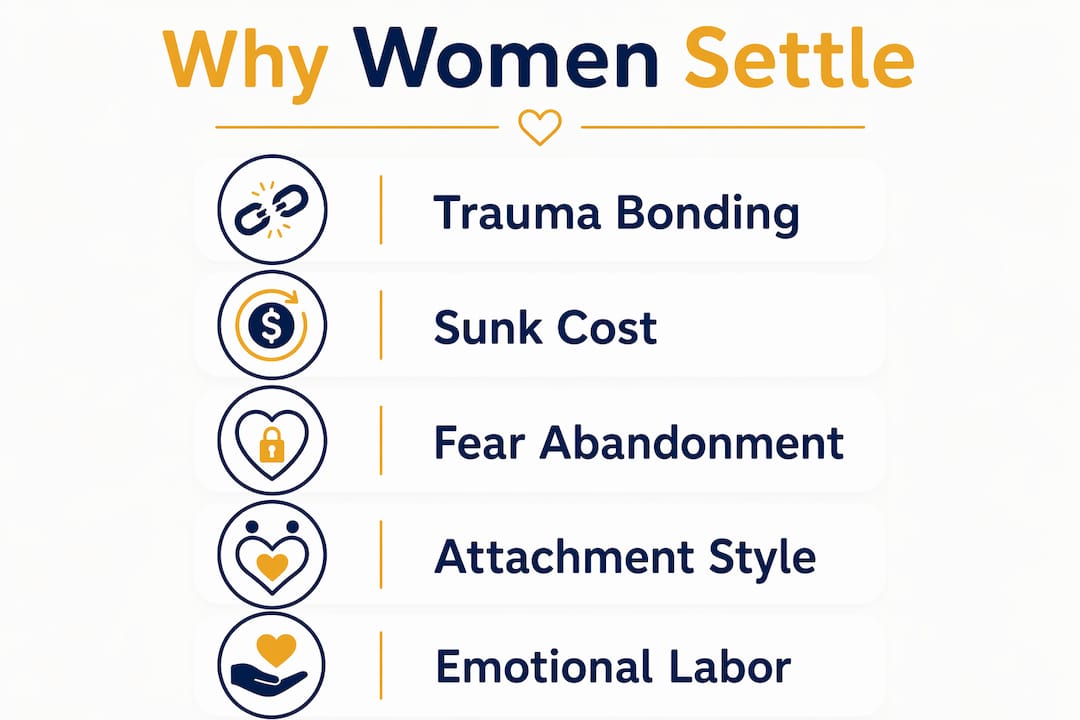
Women tend to invest in relationships holistically. They restructure careers, build shared friendships, manage the household’s emotional architecture, and weave their social life entirely around the partnership. Walking away is not just leaving a person. It is dismantling an entire ecosystem they helped design. That psychological weight is real, and it is one of the clearest reasons women stay long past the point of genuine fulfillment.
3. Fear of abandonment drives chronic self-suppression
Fear of abandonment sits underneath most settling patterns. When fear of being single is high, research shows women are more likely to stay in unsatisfying relationships and even return to ex-partners. The comfort of the familiar, even when it is painful, can feel safer than the unknown.
This fear is not irrational. For many women, it is deeply practical: financial insecurity, loss of a shared social circle, concern about starting over after years of investment. But it also operates at a more primal level. The belief that “asking for more will cost me the relationship entirely” is a core wound that keeps women tolerating emotional unavailability, inconsistency, and disrespect. The emotional triggers that fire when a partner withdraws can feel so threatening that staying, even unhappily, registers as survival.
4. Childhood attachment patterns set the baseline for “normal”
Settling in relationships is frequently a trauma response, not a character flaw. As licensed therapist Annie Wright explains, a nervous system calibrated to low relational supply in childhood trauma treats emotional unavailability as familiar rather than unacceptable. A woman who grew up with emotionally inconsistent caregivers does not necessarily recognize that her adult partner’s behavior is a problem. It just feels like love.
Psychiatrist and developmental psychologist John Bowlby’s Attachment Theory describes this as an insecure internal working model: a deep-seated expectation that one’s needs are too much, or that caregivers will not reliably respond. That template does not reset automatically in adulthood. Consistent, emotionally available partners can actually feel suspicious or suffocating to someone whose nervous system was trained on unpredictability. The mismatch between what a woman deserves and what she accepts is not a reflection of her standards. It reflects what she was conditioned to expect.
5. Emotional labor exhaustion erodes the will to leave
Women carry a disproportionate share of a relationship’s emotional maintenance: managing conflict, tracking the emotional temperature of the household, initiating difficult conversations, and keeping connection alive. Over time, that chronic over-accommodation leads to burnout and a slow erosion of self. As Psychology Today notes, being “good” in relationships often requires self-abandonment, and what women typically get in return is resentment and a gnawing sense that they have disappeared from their own lives.
When a woman has spent years managing everyone else’s emotional needs, she often loses clarity about her own. Leaving requires knowing what you want. Chronic self-editing makes that harder. The cost of leaving starts to feel existential, not just logistical.
How social and cultural pressure push women to compromise
6. Gendered socialization makes harmony the goal
From girlhood, many women receive a consistent message: keep the peace, be accommodating, do not cause problems. That cultural script does not disappear when a woman enters a relationship. It intensifies. Women are praised for making things look easy, for absorbing stress, for not “rocking the boat.” Being assertive or setting a boundary gets labeled as “difficult,” a word that functions as a social penalty designed to keep women compliant.
The social pressures that push women toward settling include:
- Being told that a good partner “works through” problems rather than leaving
- Cultural narratives tying a woman’s worth to her relationship status
- Social stigma around single women, particularly over a certain age
- Family expectations that prioritize keeping the unit together over individual happiness
- Religious or community norms framing divorce or separation as failure or shame
- The quiet judgment women face when they are perceived as “the one who gave up”
7. The cultural equation of worth and partnership
Across many communities in the United States, a woman’s relationship status still carries outsized social weight. Single women face quiet judgment in ways that single men typically do not. The fear of that judgment, of being seen as unwanted or incomplete, can push women to stay in partnerships that stopped serving them long ago.
Psychologist Danielle Roeske points to a culture of comparison in which young adults are constantly exposed to messages about what their lives should look like. When a woman’s relationship does not match that image, the instinct is often to try harder within the relationship rather than question whether the relationship itself is the right fit. The emotional safety that a genuinely good relationship provides gets confused with the social safety of simply being partnered.
8. Women are socialized to manage, not to ask

Women are often more responsible for communication, conflict resolution, and maintaining emotional connection in their partnerships. Roeske notes that carrying that responsibility heightens awareness of imbalance and contributes directly to the feeling of having settled. But the same socialization that makes women attuned to relationship dynamics also trains them to manage those dynamics quietly rather than name them directly.
The result is a woman who senses something is wrong, works harder to fix it, and never directly asks whether her own needs are being met. Conflict avoidance becomes a default strategy, and over time it compounds the dissatisfaction rather than resolving it.
How personal history shapes what women accept in love
9. What you grew up with becomes what feels familiar
The relational patterns established in childhood do not just influence who a woman is attracted to. They shape what she registers as acceptable. A woman who grew up in a home where love was conditional, inconsistent, or emotionally unavailable often gravitates toward partners who replicate that dynamic, not because she wants to be unhappy, but because that dynamic feels like home.
Personal history factors that commonly contribute to settling include:
- Childhood emotional neglect or inconsistent caregiving
- Witnessing unhealthy relationship dynamics between parents or caregivers
- Repeated disappointments in early romantic relationships lowering baseline expectations
- Experiences of abuse or control that normalized boundary violations
- Being praised for self-sacrifice and criticized for self-assertion
10. Life investment raises the exit barrier
Women’s holistic life investments in relationships, including career adjustments, shared finances, social networks, and family infrastructure, create complex psychological barriers to leaving that go beyond the partner themselves. A woman who stepped back from career advancement to support a partner’s goals, or who built her entire social world around a shared couple identity, faces a much steeper exit cost than someone whose life remained more independent.
This is not weakness. It is the predictable result of how women are socialized to invest in relationships. The question “Can I survive what comes next?” is often more paralyzing than “Am I unhappy?” Knowing you are unhappy is one thing. Facing the logistical and emotional reality of rebuilding a life from scratch is another.
11. Self-esteem shapes what you believe you deserve
Low self-esteem does not always look like obvious insecurity. Often it looks like a woman who is highly competent professionally but tolerates emotional unavailability in her personal life. The disconnect is not a contradiction. It reflects what she has been told she is entitled to in love, which is frequently much less than what she deserves.
When verbal criticism or emotional manipulation has been a consistent feature of a relationship, a woman can begin to internalize those messages. She may believe she is at fault for her partner’s behavior, that her needs are too demanding, or that she is lucky to have what she has. That belief system makes leaving feel not just difficult but undeserved.
Common myths about love that make settling feel like the right choice
12. “Real love means sacrifice” distorts the baseline
The myth that love requires suffering is one of the most persistent and damaging beliefs in romantic culture. Women are particularly susceptible to it because it aligns with their socialization toward self-sacrifice. When a relationship is painful, the myth reframes that pain as evidence of depth and commitment rather than as a signal that something is wrong.
Common misconceptions that lead women to accept less than they deserve:
- “Love should fix everything” — effort alone cannot resolve fundamental incompatibility
- “If I love him enough, he will change” — sustained emotional investment rarely transforms a partner’s core patterns
- “Leaving means I failed” — ending a relationship that does not meet your needs is a decision, not a defeat
- “All relationships are hard” — there is a real difference between normal friction and chronic emotional depletion
- “My needs are too much” — emotional safety, reciprocity, and basic respect are not high standards; they are baseline requirements
13. Confusing effort with love keeps women stuck
The belief that how hard you work on a relationship is a measure of how much you love your partner is a trap. It redirects a woman’s energy toward fixing the relationship rather than evaluating whether the relationship is worth fixing. When unhappiness gets reframed as a personal failure, the response is more accommodation, more compromise, more emotional labor. The fundamental dynamic stays unchanged.
As the research on why women stay in unfulfilling partnerships makes clear, there is a meaningful difference between working on a relationship and surviving one. A nourishing relationship is not conflict-free, but it does leave you feeling seen rather than tolerated, supported rather than managed. When that baseline has been absent for years, not weeks, that absence is the signal worth paying attention to.
14. Fear of “rocking the boat” silences real needs
The fear of being labeled “too much” or “difficult” does not just shape how women behave in public. It shapes what they allow themselves to want in private. Women often suppress legitimate needs, concerns, and boundaries because expressing them feels more dangerous than absorbing the discomfort. Over time, that self-editing becomes automatic.
Psychology Today describes this pattern directly: women do not come to therapy because they have been too assertive. They come because they have swallowed too much, for too long. The real risk is not rocking the boat. It is staying silent until you forget what you wanted in the first place.
What Couplesfightschool’s framework reveals about settling
The team at Couplesfightschool, founded by licensed mental health professionals Carlos Todd and Natasha Pemberton-Todd, works directly with couples navigating exactly these dynamics. Their F.I.G.H.T. Plan® framework addresses the communication breakdowns, emotional regulation failures, and unspoken resentments that accumulate when one or both partners have been settling rather than genuinely connecting.
The F.I.G.H.T. Plan® is built around the understanding that choosing the right partner and building a genuinely fulfilling relationship requires structured communication skills, not just good intentions. Emotional safety, reciprocity, and intentional connection are not outcomes that happen automatically. They are built through consistent, practiced behavior on both sides.
For women who recognize settling patterns in their own relationships, the question is not always whether to leave. Sometimes it is whether both partners are willing to do the real work of rebuilding. Couplesfightschool’s approach distinguishes between relationships that have drifted into passive coexistence and those with a fundamental mismatch that no amount of effort will resolve. That distinction matters because the path forward looks completely different depending on which situation you are actually in.
Pro Tip: If you are unsure whether what you are experiencing is normal relationship friction or something deeper, examining your emotional triggers with a structured framework can help you tell the difference before making any major decisions.
Understanding what trauma is and how it shapes your relational patterns is often the prerequisite for any real change, whether that change happens within the relationship or outside of it.
Ready to stop settling and start building something real?
Couplesfightschool offers books, online courses, workshops, and coaching designed specifically for couples who want to move from passive coexistence to genuine connection. Whether you are trying to understand your own patterns or rebuild a relationship that has lost its foundation, the relationship skills taught through the F.I.G.H.T. Plan® give you a concrete, psychology-backed path forward.
You do not have to figure this out alone. Online coaching with licensed professionals is available for couples at any stage, including those who are not sure yet whether their relationship is worth fighting for.
Key Takeaways
Women settle in relationships primarily because of trauma responses, socialization, and psychological investment patterns, not because of low standards or weak character.
| Point | Details |
|---|---|
| Settling is common | 33% of women reported compromising their standards when choosing a partner, compared to 31% of men, according to a 2026 study. |
| Trauma shapes the baseline | Childhood emotional unavailability conditions the nervous system to treat inconsistency as normal, not unacceptable. |
| Sunk cost traps women | Holistic life investments in career, friendships, and family make leaving feel like dismantling an entire identity. |
| Socialization suppresses needs | Women are trained to prioritize harmony and avoid being “difficult,” which silences legitimate needs over time. |
| Change is possible | Structured frameworks like the F.I.G.H.T. Plan® can shift a relationship from passive acceptance to active mutual investment. |
Recommended
- Why Couples Repeat the Same Arguments: Real Reasons
- Trinity Player
- How to Choose the Right Partner and Fight Less