
Why Couples Need a Conflict Resolution Framework

A conflict resolution framework is a structured, agreed-upon system that guides how two people address disagreements without causing lasting emotional damage. Without one, couples default to reactive patterns that erode trust, create chronic stress, and push partners further apart over time. The Gottman Institute’s research and Harvard’s Program on Negotiation both confirm that how couples fight matters far more than how often they fight. Couplesfightschool was built on exactly this principle: conflict is not the enemy of a healthy relationship. The absence of a framework to manage it is.
Why couples need a conflict resolution framework
The single most important reason couples need a structured approach to conflict is that unmanaged disagreements follow a predictable, destructive path. A 16-year study of 373 couples found that early conflict frequency did not predict divorce. What did predict it was the presence of four specific behaviors: criticism, contempt, defensiveness, and stonewalling. This means two couples fighting every week can have completely different outcomes depending on whether they have a framework guiding their behavior during those fights.
Without structure, couples fall into cycles of blame and withdrawal that repeat indefinitely. Each unresolved argument adds a layer of resentment, and over time partners stop seeing each other as teammates and start treating each other as opponents. A conflict resolution framework interrupts that cycle by giving both people a shared language, a set of agreed rules, and a process they trust.
The term used in clinical settings is structured conflict management, and it encompasses everything from how you open a difficult conversation to how you repair the relationship after one. Couplesfightschool’s F.I.G.H.T. Plan® is one example of a structured system built specifically for couples who want to move from recurring arguments toward genuine understanding.
What makes a conflict resolution framework actually work?
Not every structured approach produces results. The frameworks that work share several non-negotiable elements, and understanding each one helps you see why shortcuts fail.
Emotional safety comes first. Dr. Roger K. Allen’s research shows that couples who attempt problem-solving before establishing emotional safety consistently undermine long-term resolution. Safety means both partners feel they can speak honestly without being attacked, dismissed, or punished. Without it, the conversation becomes a performance rather than a real exchange.
Clear communication rules protect the process. Effective frameworks include turn-taking, the use of “I” statements instead of accusations, and a ban on contemptuous language. River North Counseling’s guide identifies repair attempts, focused discussion, and a clear next step as the practical rules that protect a relationship under stress. These are not soft suggestions. They are the structural guardrails that keep a hard conversation from becoming a damaging one.

Repair attempts are the most underrated tool in any framework. Gottman research confirms that humor, apologies, and small gestures of goodwill during a conflict de-escalate tension and signal that the relationship matters more than winning the argument. Couples who recognize and accept these attempts stay engaged rather than shutting down.
Here is what a working framework includes at minimum:
- A shared agreement on how to open difficult conversations
- Rules around interrupting, tone, and language
- A process for calling a break without it feeling like abandonment
- Repair attempts that both partners recognize and accept
- A return agreement so unfinished conversations get completed
Pro Tip: Not every conflict needs a full resolution. Some issues are what the Gottman Institute calls “perpetual problems,” meaning they recur because they reflect core personality differences. The goal with these is not to fix them but to manage them respectfully over time.
How unmanaged conflict affects your health
The stakes of poor conflict management extend well beyond the relationship itself. Persistent stress from unresolved conflict triggers chronic fight-or-flight responses, flooding the body with cortisol and adrenaline. Over time, this contributes to anxiety, insomnia, and depression. That means every argument that ends in stonewalling or contempt is not just a relational event. It is a physiological one.
“When couples learn to regulate their nervous systems during conflict, they shift from a threat state to a connection state. That shift changes everything, including how they hear each other.”
Structured conflict management creates the opposite effect. When both partners feel safe enough to stay in the conversation, the nervous system down-regulates. Defensiveness drops, empathy increases, and the brain can actually process what the other person is saying. This is why emotional safety in relationships is not a soft concept. It is a neurological prerequisite for effective communication.
| Unmanaged conflict | Managed conflict |
|---|---|
| Chronic cortisol elevation | Regulated stress response |
| Increased anxiety and insomnia | Improved emotional stability |
| Emotional withdrawal and distance | Increased empathy and connection |
| Escalating resentment | Repaired trust over time |
| Higher risk of relationship dissolution | Greater long-term resilience |
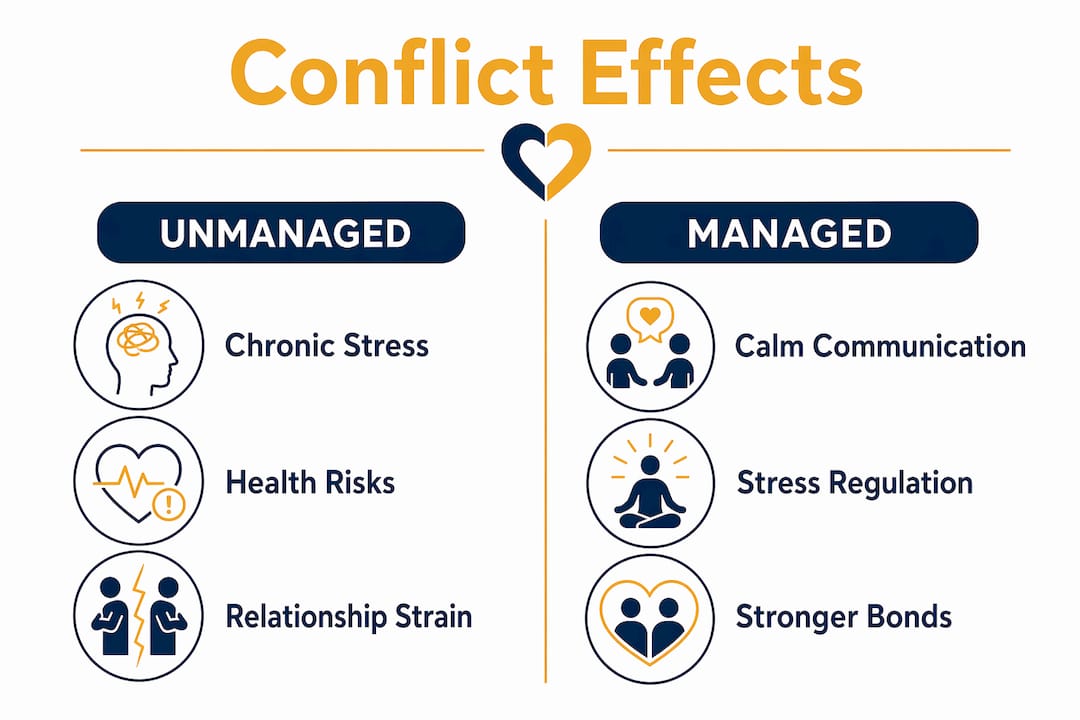
The long-term benefits of conflict resolution in marriage and committed partnerships are measurable. Couples who manage conflict well report higher relationship satisfaction, better individual mental health, and stronger physical health outcomes. The framework is not just good for your relationship. It is good for you.
Effective vs. ineffective conflict approaches
Most couples arrive at conflict using the only tools they were taught, which are usually the ones modeled by their own families. Recognizing the difference between destructive and constructive patterns is the first step toward changing them.
The demand-withdraw cycle is one of the most common destructive patterns in couples conflict management. One partner pursues aggressively, pushing for resolution, while the other withdraws to regulate emotionally. Therapeutic experts distinguish this from a negotiated break, where both partners explicitly agree to pause, set a return time, and commit to resuming the conversation. The difference is not the pause itself. It is the communication around it.
| Ineffective approach | Effective approach |
|---|---|
| Stonewalling without explanation | Structured time-out with a return agreement |
| Accusatory “you always” language | Impact-based “I feel” statements |
| Demand-withdraw cycle | Turn-taking with active listening |
| Jumping to solutions immediately | Establishing emotional safety first |
| Treating conflict as a courtroom | Treating conflict as a shared problem |
Cognitive biases make escalation the default. Harvard’s Program on Negotiation states that egocentrism, the tendency to see your own perspective as the only valid one, increases conflict escalation unless couples follow neutral, structured processes like turn-taking and active listening. This is why externalizing the conflict process matters. When you follow a shared framework, you are no longer fighting each other. You are both working against the problem.
Accusatory language, often called “courtroom” language, is another pattern that destroys productive conflict. Phrases like “you never listen” or “you always do this” put the other person on trial. Impact-based language, such as “I feel unheard when the conversation moves this fast,” keeps the focus on the experience rather than the verdict.
Practical steps to build your own conflict framework
Building a conflict resolution framework does not require a therapist’s office, though professional support accelerates the process significantly. You can start with concrete steps today.
-
Set ground rules together. Agree on no interrupting, no name-calling, and the use of “I” statements before conflict arises. Rules made during calm moments are far easier to follow during heated ones.
-
Learn to recognize emotional flooding. Flooding is the physiological state where your heart rate rises and rational thinking becomes difficult. When you notice it, call a break explicitly. Say: “I need 20 minutes to calm down. I will come back to this conversation.” Conflict and return agreements build trust that the relationship can withstand difficulty without one partner disappearing.
-
Practice active listening and mirroring. After your partner speaks, reflect back what you heard before responding. “What I heard you say is…” This single habit reduces misunderstanding by a significant margin and signals that you are genuinely present.
-
Schedule dialogue for recurring issues. Perpetual problems do not get resolved in the heat of the moment. Set a calm, dedicated time to discuss them without blame. Structured dialogue moves couples from adversarial to collaborative conversations by creating a three-stage sequence: emotional safety, shared understanding, and joint problem-solving.
-
Use repair attempts deliberately. A touch on the arm, a moment of humor, or a simple “I love you even when this is hard” can shift the entire tone of a conflict. Practice offering these and, equally important, practice receiving them.
-
Seek professional support when patterns persist. When the same arguments cycle without resolution, a trained counselor or coach can identify the underlying dynamic faster than most couples can on their own. Couple counseling provides structured intervention that accelerates the process of building healthier conflict habits.
Pro Tip: After every significant conflict, do a brief check-in within 24 hours. Ask each other: “Is there anything left unsaid?” and “Are we okay?” This closes the loop and prevents unresolved tension from becoming the foundation of the next argument.
Key takeaways
Couples who adopt a structured conflict resolution framework protect both their relationship and their individual health by replacing reactive patterns with deliberate, safety-first communication.
| Point | Details |
|---|---|
| Framework over frequency | How couples fight predicts outcomes far more reliably than how often they fight. |
| Emotional safety first | Problem-solving fails without emotional safety established as the foundation. |
| Health is at stake | Chronic unmanaged conflict elevates cortisol and contributes to anxiety, insomnia, and depression. |
| Repair attempts matter | Recognizing and accepting small gestures during conflict keeps both partners engaged. |
| Perpetual problems need management | Some conflicts require ongoing dialogue, not resolution, and frameworks make that sustainable. |
What I’ve learned from working with high-conflict couples
After years of working with couples at Couplesfightschool, the pattern I see most consistently is this: couples do not lack love. They lack a process. They walk into conflict with good intentions and no map, and they end up somewhere neither of them wanted to go.
The most common mistake is believing that conflict resolution means winning the argument or finally getting your partner to understand your point. It does not. It means creating enough safety that both of you can be honest without the conversation becoming a threat. That shift in goal changes everything about how you show up.
I have also seen couples make real, lasting progress without ever becoming conflict-free. The goal is not the absence of disagreement. It is the presence of a framework that keeps disagreement from doing permanent damage. Couples who diffuse conflict effectively are not couples who never fight. They are couples who fight with enough structure that they come out the other side closer, not further apart.
The hardest part of adopting a framework is the early phase, when the old habits are still louder than the new ones. Patience with the process is not optional. It is the work. Every couple I have seen transform their relationship went through a period where the framework felt awkward and forced before it became natural. That discomfort is not a sign that it is not working. It is a sign that something is actually changing.
— Carlos
Ready to stop repeating the same fights?
If this article resonated with you, the next step is not more reading. It is practice with real guidance behind you. Couplesfightschool offers online coaching for couples built around the F.I.G.H.T. Plan® framework, giving you and your partner a structured, psychology-backed system to replace reactive conflict with genuine connection. Whether you are in a high-conflict season or simply want to build better habits before things escalate, the coaching programs are designed to meet you where you are.
You can also explore the Fight Less Love More course for a self-paced option that walks you through the core tools at your own speed. The framework exists. You just need to start using it.
FAQ
Why do couples need a conflict resolution framework?
Couples need a structured framework because unmanaged conflict defaults to destructive patterns like criticism, contempt, and stonewalling, which predict relationship dissolution more reliably than conflict frequency alone. A framework replaces reactive behavior with agreed-upon rules that protect both partners during disagreements.
What are the Four Horsemen in relationship conflict?
The Four Horsemen, identified by the Gottman Institute, are criticism, contempt, defensiveness, and stonewalling. A 16-year study of 373 couples found these behaviors, not how often couples argued, were the reliable predictors of divorce.
How does conflict affect physical health?
Unresolved conflict triggers chronic fight-or-flight responses that elevate cortisol and adrenaline, contributing to anxiety, insomnia, and depression over time. Structured conflict management reduces this stress response by creating emotional safety that down-regulates the nervous system.
What is the difference between stonewalling and a structured time-out?
Stonewalling is withdrawal without communication or commitment to return. A structured time-out involves explicitly telling your partner you need a break, agreeing on a return time, and committing to resume the conversation. That explicit communication prevents feelings of abandonment and keeps trust intact.
When should couples seek professional help for conflict?
Couples should seek professional support when the same arguments cycle without resolution, when one or both partners feel emotionally unsafe, or when destructive patterns like contempt or withdrawal have become the default. A trained counselor or coach can identify the underlying dynamic and provide structured tools faster than most couples can develop on their own.
Recommended