
Why Couples Need Communication Agreements That Work

Communication agreements are defined as mutual understandings between partners that govern how they talk, listen, and resolve conflict. Most relationship breakdowns trace back not to a lack of love but to unmet, unspoken expectations that quietly build into resentment. Understanding why couples need communication agreements is the first step toward replacing guesswork with genuine connection. The industry term for this practice is “relational contracting,” and it sits at the core of evidence-based couples therapy. Couplesfightschool’s F.I.G.H.T. Plan® framework treats these agreements as the foundation of every healthy relationship, not an optional add-on.
Why couples need communication agreements
Communication agreements define the rules of engagement before conflict starts. Without them, partners operate on different assumptions about how disagreements should be handled, when it is okay to walk away, and what “support” actually looks like. Clinical protocols like the RAVE Method use 90-second cycles to create emotional safety before any problem-solving begins. That structure works because it removes the guesswork that fuels most arguments.
The importance of communication in relationships becomes clearest when couples realize they have been working from completely different rulebooks. One partner assumes silence means the conversation is over. The other assumes silence means anger. Neither is wrong by their own logic, but both end up hurt. A communication agreement makes those hidden rulebooks visible and shared.

Couples who stop communicating effectively rarely do so because they stopped caring. They stop because the cost of speaking up feels higher than the cost of staying quiet. Agreements lower that cost by creating a predictable, safe structure for difficult conversations.
What are the core components of effective communication agreements?
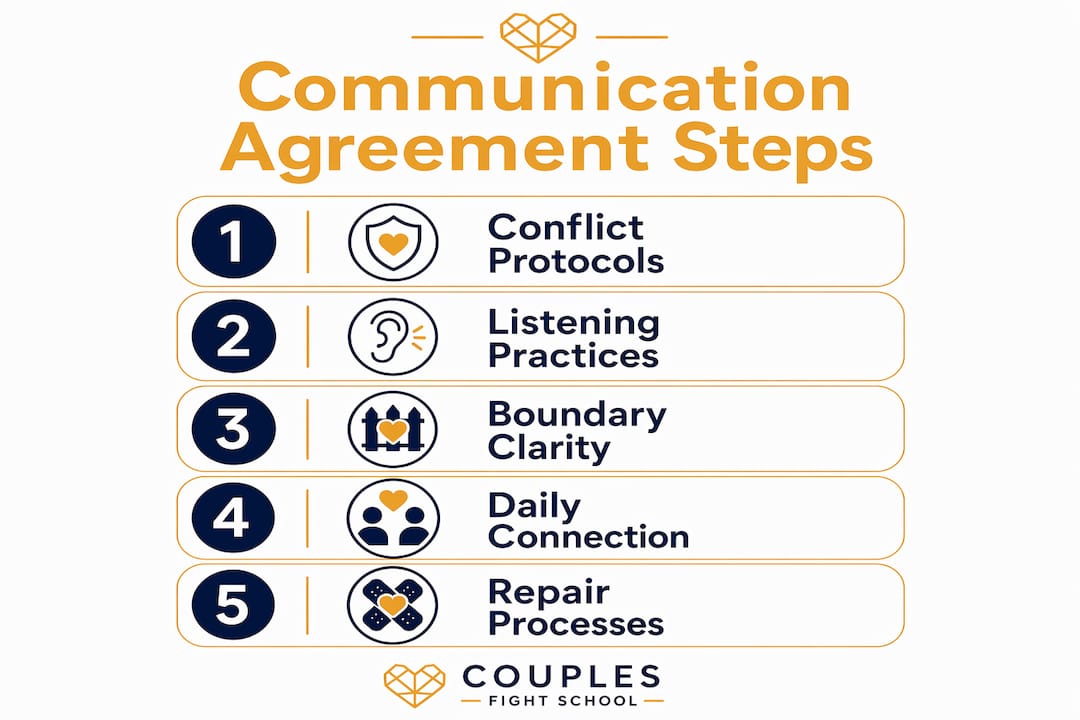
Strong communication agreements cover five areas: conflict protocols, listening practices, boundary clarity, daily connection habits, and repair processes. Each one addresses a different point where couples typically break down.
Conflict protocols are the most urgent. Couples need a shared agreement on what to do when emotions run high. Effective conflict prevention includes mutual agreements on pausing conversations, avoiding personal attacks, and returning to topics when both partners are calm. The key detail most couples miss is the return time. Saying “I need a break” without a specific return time reads as abandonment, not self-regulation.
Listening practices shift the dynamic from debate to dialogue. Soft startups, where a partner opens a difficult topic gently rather than with blame, and reflective listening, where the listener repeats back what they heard before responding, both reduce defensiveness immediately. Daily 10-minute check-ins with uninterrupted speaking build these habits into muscle memory within one week. That is a short investment for a significant shift in emotional contact.
- Agree on a specific pause signal both partners recognize (a word, a gesture, or a phrase).
- Set a return time when pausing: “I need 30 minutes, and I will come back to this.”
- Use soft startups: begin with “I feel” rather than “You always.”
- Practice reflective listening before offering any solution or rebuttal.
- Schedule a daily check-in, even if it is only 10 minutes, with phones put away.
Pro Tip: Controlling technology during partner interactions is one of the most underrated communication strategies. Focused attention during check-ins builds more connection in 10 minutes than an hour of distracted conversation.
Repair processes deserve their own place in every agreement. Practicing agreements about tone, timing, and repair makes conflict feel manageable rather than catastrophic. Knowing that a rupture has a repair path reduces the fear that every argument could end the relationship.
How do communication agreements prevent misunderstandings and reduce conflict?
The core problem in most relationships is not conflict itself. The problem is that relying on guessing a partner’s needs leads to frustration and disappointment even when both partners are trying hard. Effort without clarity produces the same result as no effort at all. Agreements replace assumption with explicit conversation.
“Communication agreements transform guessing games into explicit conversations, improving accountability and connection.”
Consider a common scenario. One partner works late and assumes the other understands. The other partner feels abandoned and says nothing, storing the hurt. Two weeks later, a small disagreement about dishes explodes into a fight about respect and priorities. The dishes were never the issue. The unspoken expectation about time and presence was. A communication agreement about time expectations, discussed in advance, would have made that conversation happen before the resentment built.
Processes like PACER, a structured model for moving from assumption to explicit conversation, give couples a repeatable path for improving accountability and relationship strength. The model works because it separates the need from the narrative. Partners learn to say “I need X” instead of “You never do Y.”
Communication agreements do not eliminate conflict. They make conflict more manageable. Couples who use a conflict resolution framework report that disagreements feel less overwhelming because both partners know the rules of engagement in advance. The fight has a structure. That structure reduces the emotional confusion that turns small disagreements into lasting damage.
Key areas where agreements prevent misunderstandings:
- Time expectations: when to expect a response to messages, how late is too late to bring up a difficult topic.
- Support needs: whether a partner wants advice or just to be heard.
- Responsibilities: who handles what, and what “done” looks like to each person.
- Emotional expression: how much space each partner needs when upset.
What communication strategies support creating and maintaining these agreements?
The timing of when you create agreements matters as much as what you agree to. Agreements made during an argument become ultimatums. Agreements made during calm, connected moments become shared commitments. Effective communication agreements should be established during calm, neutral times when both partners are emotionally regulated.
Here is a practical sequence for creating agreements that stick:
- Choose a low-stakes moment, after a meal, on a weekend morning, or during a walk, when neither partner is stressed or activated.
- Open with curiosity, not correction. Ask “What would help you feel heard when we disagree?” rather than “You never listen to me.”
- Draft the agreement together. Write it down. Verbal agreements fade; written ones create shared accountability.
- Review the agreement monthly. Relationships change, and agreements need to keep pace with those changes.
- Agree on how to handle lapses. When one partner breaks the agreement, the response should be a conversation, not a punishment.
Pro Tip: If a conversation about agreements starts to escalate, pause and reschedule it. Trying to set communication rules while dysregulated defeats the purpose. Regulated states produce better agreements.
Soft startups and reflective listening are not just conflict tools. They are daily practices that make the agreements feel natural rather than forced. When couples use these techniques consistently, the agreements stop feeling like rules and start feeling like their normal way of talking. That shift is where lasting change happens.
Handling lapses requires its own agreement. Partners will forget, revert, or slip under stress. The agreement should include a low-conflict way to name that: “Hey, we agreed to pause before raising our voices. Can we try that now?” That kind of de-escalation language keeps the agreement alive without turning every lapse into a new argument.
What boundaries are important to discuss explicitly in communication agreements?
Boundaries are expressions of personal needs and values, not controlling rules. Explicit communication of boundaries increases intimacy by creating predictability and trust. Most couples avoid naming boundaries because they fear the conversation will feel like rejection. The opposite is true. Naming a boundary is an act of honesty that tells your partner exactly how to care for you well.
Many people grew up in homes where boundaries were never modeled, so they assume their partner should intuitively know their needs. That assumption is where resentment is born. Explicitly naming boundaries helps couples avoid that resentment and move toward mutual understanding.
Partners often mistake boundary setting for rejection. Reframing boundaries as acts of care changes the entire conversation. “I need 20 minutes alone after work before I can connect” is not a rejection. It is a map. It tells your partner exactly when and how to reach you.
| Boundary area | What to discuss explicitly |
|---|---|
| Emotional expression | How each partner prefers to process upset: alone or together |
| Alone time | How much solo time each person needs and when |
| Physical space | Comfort with touch during conflict or stress |
| Responsibilities | Who handles which tasks and what “done” means to each person |
| Communication timing | When is too late or too early to raise a difficult topic |
Healthy boundaries in a relationship create emotional security because both partners know what to expect. Predictability is not boring in a relationship. It is safe. Safety is what allows vulnerability, and vulnerability is what deepens intimacy.
Key Takeaways
Communication agreements are the most direct path from recurring conflict to reliable connection, because they replace unspoken assumptions with shared, explicit expectations.
| Point | Details |
|---|---|
| Agreements prevent resentment | Unspoken expectations cause most relationship breakdowns, not lack of love or effort. |
| Timing of creation matters | Set agreements during calm, regulated moments, not during or after a conflict. |
| Boundaries build intimacy | Explicitly naming limits creates predictability and trust, not distance. |
| Daily habits reinforce agreements | Ten-minute check-ins with focused attention build emotional connection within one week. |
| Repair is part of the agreement | Include a clear, low-conflict process for addressing lapses before they become new arguments. |
What I have learned after years of working with couples
After working with hundreds of couples, the pattern I see most often is this: two people who genuinely love each other, running on completely different operating systems, wondering why nothing connects. They are not failing at love. They are failing at communication structure. That is a solvable problem.
What surprises most couples is how quickly things shift once agreements are in place. Not because the agreements are magic, but because they remove the ambiguity that feeds anxiety. When you know your partner will come back to the conversation in 30 minutes, you can actually regulate. When you know your boundary about alone time is understood, you stop bracing for conflict every time you need space.
The couples I worry about are not the ones who fight. Fighting means they still care enough to engage. The couples I worry about are the ones who have gone silent, who have decided that speaking up is not worth the cost. Communication agreements are what make speaking up feel safe again.
These agreements are not a one-time conversation. They are a living document. Relationships grow, circumstances change, and the agreements need to grow with them. Reviewing them regularly is not a sign that something is wrong. It is a sign that both partners are still invested in getting it right. That investment is what builds the kind of relationship that lasts.
— Carlos
How Couplesfightschool can help you build these agreements
Couplesfightschool was built for exactly this: helping couples move from frustration and silence to real, practiced communication skills. The platform’s courses and coaching programs teach the F.I.G.H.T. Plan® framework, which gives couples a structured system for creating and maintaining the agreements that protect their relationship.
The Stop the Fighting course walks couples through the specific tools covered here, including soft startups, reflective listening, pause protocols, and boundary conversations, in a format designed for real life. For couples who want personalized support, online coaching connects you directly with licensed professionals who can help you build agreements tailored to your relationship. The work is practical, the results are measurable, and the starting point is one honest conversation.
FAQ
What is a communication agreement in a relationship?
A communication agreement is a mutual understanding between partners that defines how they will talk, listen, and handle conflict. It replaces unspoken assumptions with explicit, shared expectations.
When should couples create communication agreements?
Agreements should be created during calm, neutral moments when both partners are emotionally regulated. Agreements made during conflict become ultimatums rather than shared commitments.
How do communication agreements reduce conflict?
They replace assumption with explicit conversation, which removes the guesswork that fuels most arguments. Conflict prevention agreements on pausing, tone, and repair make disagreements feel manageable rather than catastrophic.
Why are boundaries part of a communication agreement?
Boundaries define personal needs and limits that, when named explicitly, create predictability and trust. Partners who understand each other’s boundaries experience greater emotional safety and intimacy.
How often should couples revisit their communication agreements?
A monthly review keeps agreements current as the relationship evolves. Treating agreements as a living document signals ongoing investment in the relationship, not a sign that something has gone wrong.
Recommended
- Benefits of Couples Communication Workshops: 2026 Guide
- StripeM-Inner
- StripeM-Inner
- Why Engaged Couples Need Conflict Skills Before Marriage