
What Does Conflict Avoidance Cost Couples?

Conflict avoidance is a behavioral pattern where couples habitually sidestep disagreements, and the cost is measurable: eroded emotional intimacy, declining trust, and lower relationship satisfaction. The clinical term is “conflict-avoidant behavior,” and researchers distinguish it sharply from healthy de-escalation. A study of over 2,000 adults found that those who avoid conflict experience increased negative emotions and long-term mental health strain, while those who resolve daily conflicts report reduced stress. Couplesfightschool, founded by licensed mental health professionals Carlos Todd and Natasha Pemberton-Todd, works directly with couples caught in this pattern. What does conflict avoidance cost couples? Far more than most realize.
What does conflict avoidance cost couples emotionally?
The emotional price of avoiding conflict shows up fast. Partners who dodge difficult conversations report rising stress, creeping anxiety, and a growing sense of disconnection from each other. These are not abstract risks. They are predictable outcomes backed by research.
Avoiding conflict increases negative emotions and mental health strain over time. That finding comes from a study of more than 2,000 adults aged 33–84, and it means the short-term relief of not arguing carries a long-term psychological debt.
Common emotional symptoms couples experience early in the avoidance cycle include:
- Persistent low-grade anxiety about when the next argument will surface
- Emotional numbness or flatness in daily interactions
- Feeling unseen, unheard, or misunderstood by a partner
- Resentment building beneath a polite surface
- Difficulty feeling genuine joy or closeness together
Pro Tip: If you notice yourself feeling relieved after avoiding a conversation, treat that relief as a warning sign, not a win. Relief without resolution is just postponed pain.
One mechanism driving this is hypervigilance. Conflict avoidance consumes emotional energy by keeping partners hyper-vigilant to maintain peace. That constant monitoring drains the emotional reserves couples need for genuine connection, warmth, and repair.
How does avoiding conflict damage trust and intimacy over time?
Chronic avoidance does not keep the peace. It quietly dismantles the relationship’s foundation. The damage is cumulative, which makes it easy to miss until the gap between partners feels impossible to close.
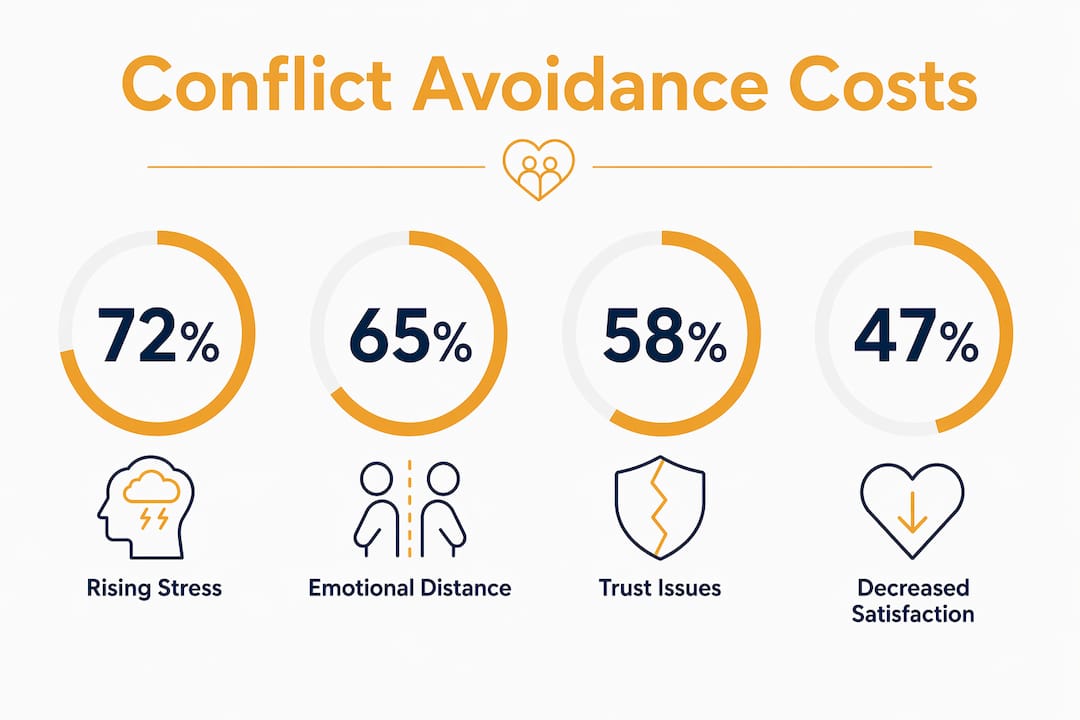
Chronic conflict avoidance leads to emotional loneliness, unresolved accumulation of small hurts that eventually produce explosive arguments, and distorted perceptions where assumptions replace reality. Couples living in this pattern often describe feeling like roommates rather than partners.
The demand-withdraw pattern is one of the most studied dynamics in this space. One partner pushes for conversation; the other retreats. A meta-analysis of 74 studies involving more than 14,000 participants found this pattern correlates with lower relationship satisfaction, reduced intimacy, poorer communication, and increased anxiety. That is not a small sample. That is a consistent finding across thousands of couples.
“Silence and avoidance kill intimacy more than conflict itself. Well-managed conflict actually strengthens relationships.”
— Licensed Professional Counselor LoriAnne Reeves
The long-term relational costs include:
- Emotional loneliness despite sharing a home and a bed
- Loss of physical and emotional intimacy as distance grows
- Explosive arguments triggered by seemingly minor events
- Distorted assumptions filling the space where honest conversation should be
- Gradual erosion of trust in the relationship’s ability to handle honesty
Pro Tip: When small irritations stop being mentioned, they do not disappear. They accumulate interest. Address them early, before they compound into something much harder to manage.
Avoiding difficult conversations leads to emotional distance, misunderstandings, and anxiety that requires longer and more intense intervention over time. The longer a couple waits, the steeper the recovery.
Why do couples fall into conflict avoidance patterns?
Conflict avoidance rarely starts as a conscious choice. It develops from learned responses, often rooted in early life experiences, and then gets reinforced every time it seems to work in the short term.
Conflict avoidance often arises from childhood experiences where disagreement was equated with loss or abandonment. A child who learned that raising concerns caused a parent to withdraw or explode will carry that lesson into adult relationships. Silence becomes protection.
The psychological origins typically follow a recognizable sequence:
- Early learning: Disagreement felt dangerous in childhood, so silence became a survival tool.
- Nervous system conditioning: The body associates conflict with threat, triggering a fight, flight, or freeze response even in low-stakes adult conversations.
- Myth reinforcement: Many couples believe conflict is inherently destructive. Conflict avoidance stems from the misconception that conflict is a win-lose scenario and fear of emotional vulnerability.
- Polite avoidance mistaken for skill: Even couples with strong emotional intelligence can fall into this trap. Mistaking politeness for maturity creates a low-conflict dynamic that starves true intimacy and makes vulnerability feel dangerous.
- Short-term reward: Avoiding a fight feels like success, which reinforces the behavior regardless of the long-term cost.
“The cost of avoiding difficult conversations compounds like unpaid debt. Sooner intervention drastically reduces long-term relational damage.”
— Psychology Today
The compound interest effect is real. Every avoided conversation adds to a growing balance of unresolved tension. Couples who wait years to address patterns often face a much heavier lift than those who learn conflict resolution skills early.
How does conflict avoidance show up in daily relationship life?
Abstract costs become concrete when you look at how avoidance disrupts specific areas of a couple’s shared life. The pattern does not stay contained to arguments. It bleeds into everything.
Avoidance tactics couples use most often include changing the subject, giving one-word answers, agreeing without meaning it, going silent, or staying busy to sidestep tension. Each tactic sends a message to the other partner: “This relationship is not safe enough for honesty.”

| Conflict avoidance behavior | Healthy conflict behavior |
|---|---|
| Changing the subject when tension rises | Naming the tension and asking to talk about it |
| Agreeing to end the conversation | Expressing a genuine disagreement respectfully |
| Going silent or withdrawing | Asking for a short break and returning to the topic |
| Minimizing a partner’s concern | Validating the concern before offering a perspective |
| Avoiding the topic for days or weeks | Scheduling a calm conversation within 24 hours |
The areas most disrupted by relationship issues from avoidance include:
- Parenting: Disagreements about discipline or values go unresolved, creating inconsistency and tension in front of children.
- Finances: Money conflicts avoided early become entrenched resentments that affect spending, saving, and trust.
- Intimacy: Emotional distance created by avoidance directly reduces physical closeness and desire.
- Trust: A partner who cannot raise a concern without being shut down stops trusting the relationship to hold honesty.
Every avoided conversation is also a missed opportunity. Growth, repair, and deeper connection all require the willingness to say something uncomfortable and stay in the room while the other person responds.
How can couples break the cycle and rebuild connection?
Breaking the avoidance cycle requires both a mindset shift and practical skills. Conflict is not the enemy of a good relationship. Unmanaged conflict is. Healthy conflict is a prerequisite for building deeper trust because it proves the relationship can survive honesty.
Couples show significant shifts in communication and conflict management within 6 to 8 therapy sessions when they address avoidance early. That timeline matters because it shows change is achievable, not years away.
Practical steps couples can take right now:
- Name the pattern out loud. Say to your partner, “I think we’ve been avoiding something. Can we talk about it?” Naming it removes its power.
- Set a time limit. Agree to talk for 15 minutes, then check in. Knowing there is an endpoint reduces the fear of being overwhelmed.
- Use “I” statements. “I feel disconnected when we don’t talk about this” lands differently than “You always shut me down.”
- Regulate before you engage. Take three slow breaths before a hard conversation. A regulated nervous system makes honest dialogue possible.
- Treat repair as the goal, not winning. Ask yourself: “Do I want to be right, or do I want to be close?” The answer shapes the entire conversation.
- Practice with low-stakes topics first. Build the muscle of honest dialogue on smaller disagreements before tackling the bigger ones.
Pro Tip: Start your next difficult conversation with curiosity, not conclusions. “Help me understand how you see this” opens a door that “You never listen” slams shut.
Couplesfightschool’s F.I.G.H.T. Plan® framework gives couples a structured path through exactly this process, covering emotional regulation, communication skills, and relationship repair in a sequence that builds confidence with each step. Learning how to diffuse conflict is a skill, not a personality trait. It can be taught.
Key Takeaways
Conflict avoidance costs couples their emotional intimacy, trust, and long-term relationship satisfaction, and the damage compounds the longer the pattern continues.
| Point | Details |
|---|---|
| Avoidance raises emotional costs fast | Partners experience anxiety, resentment, and emotional numbness within the early stages of the avoidance cycle. |
| Long-term damage is cumulative | Unresolved small hurts build into explosive arguments and emotional loneliness over time. |
| Avoidance has psychological roots | Childhood experiences and nervous system conditioning drive the pattern, not weakness or indifference. |
| Daily life suffers across key areas | Parenting, finances, intimacy, and trust all deteriorate when honest conflict is consistently avoided. |
| Change is achievable and measurable | Couples addressing avoidance early show meaningful communication shifts within 6 to 8 sessions. |
What I’ve seen avoidance actually cost couples
Couples come to me describing their relationship as “fine.” No big blowups. No dramatic scenes. Just a quiet, growing distance they cannot explain. That is conflict avoidance at work, and it is one of the most painful patterns I encounter because it hides so well.
The couples who struggle most are often the ones who pride themselves on being calm. They have mistaken the absence of argument for the presence of connection. But silence is not intimacy. It is often the opposite.
What I have found is that one small, honest conversation, handled well, can shift a relationship more than months of careful politeness. The fear of conflict is almost always worse than the conflict itself. When couples learn to stay in the room through discomfort, they discover something they did not expect: the other person is still there, still willing, still invested.
The work is not about fighting more. It is about communicating more honestly and building the trust that makes honesty feel safe. That trust does not appear on its own. It gets built, conversation by conversation, repair by repair.
If you are reading this and recognizing your relationship in these patterns, that recognition is not a reason to panic. It is the starting point. The couples who reach out early have the best outcomes. Do not wait until the distance feels permanent.
— Carlos
Couplesfightschool can help you move forward
Recognizing the cost of conflict avoidance is one thing. Knowing what to do next is another.
Couplesfightschool offers online coaching for couples designed specifically for partners navigating emotional disconnection, recurring conflict, and communication breakdowns. Sessions are led by licensed professionals and built around the F.I.G.H.T. Plan® framework, giving couples concrete tools they can use immediately. The Stop the Fighting course teaches communication and conflict resolution skills in a structured, self-paced format backed by psychology research. Whether you are newly aware of the pattern or years into it, expert support is available and the work is worth starting.
FAQ
What is conflict avoidance in a relationship?
Conflict avoidance is a behavioral pattern where one or both partners consistently sidestep disagreements to prevent tension. Over time, this erodes emotional intimacy and trust rather than protecting the relationship.
Does avoiding conflict actually harm relationships?
Yes. Research from a meta-analysis of 74 studies with more than 14,000 participants shows that the demand-withdraw pattern tied to conflict avoidance correlates with lower satisfaction, reduced intimacy, and increased anxiety.
What are the signs of conflict avoidance in couples?
Common signs include changing the subject when tension rises, giving one-word answers, agreeing without meaning it, prolonged silence, and feeling emotionally distant despite no obvious argument.
How long does it take to change conflict avoidance patterns?
Couples who address avoidance early show significant shifts in communication and conflict management within 6 to 8 sessions with a qualified professional.
Can conflict actually strengthen a relationship?
Yes. Licensed Professional Counselor LoriAnne Reeves states that well-managed conflict strengthens relationships because it demonstrates the partnership can survive honesty, which is the foundation of genuine trust.
Recommended