
Why Healthy Relationships Feel Boring (And Why That’s OK)

A healthy relationship feels boring because emotional stability removes the adrenaline and cortisol spikes that many people mistake for passion. That absence of drama is not a warning sign. It is your nervous system finally at rest. Understanding why healthy relationships feel boring is the first step toward appreciating what you actually have, rather than chasing a chemical high that was never love to begin with.
Why healthy relationships feel boring: the nervous system explanation
The brain does not distinguish well between excitement and anxiety. Stable partners don’t trigger the adrenaline and cortisol surges that volatile relationships produce. Those surges feel electric. They also drain your nervous system over time.
Early-stage romance floods the body with dopamine, norepinephrine, and cortisol. That cocktail creates the racing heart and obsessive thinking most people call “chemistry.” When a partner is consistent and kind, those spikes level off. The result feels flat by comparison, even though your body is actually in a healthier state.
People conditioned by chaotic relationships often misread calm love as suspicious or dull. Their nervous system has learned to equate anxiety with passion. Therapist Susan Schueler describes this as needing to retrain your nervous system expectations entirely. Calm stops feeling like indifference once you recognize it as safety.
Emotionally stable partners produce fewer emotional extremes, but they predict higher relationship satisfaction over time. Stability does not mean depth is missing. It means the emotional variance is lower, and that is a feature, not a flaw.
- Adrenaline spikes feel like attraction but are often stress responses in disguise.
- Cortisol surges from conflict or unpredictability create emotional highs that mimic passion.
- A regulated nervous system signals safety, not boredom, even when it feels that way.
- Conditioning from past relationships shapes what feels “normal” and exciting to you.
Pro Tip: If calm love feels suspicious to you, that reaction is data about your history, not your current relationship. Sit with the discomfort before acting on it.
Does predictability kill passion in long-term relationships?
Predictability does reduce passion, but not for the reasons most couples assume. The issue is not knowing your partner well. The issue is that desire requires psychological tension and mystery to stay alive, and total comfort removes both.
Relationship therapist Esther Perel frames this as the passion paradox. Love thrives on closeness and familiarity. Desire, by contrast, needs distance, uncertainty, and a degree of separateness to survive. When two people merge completely into a shared routine, the erotic charge fades because there is nothing left to reach toward.
“Love enjoys knowing everything about you. Desire needs mystery. One is about having; the other is about wanting. When the distance closes, desire often goes with it.”
This is why complete predictability erodes erotic charge without maintained separateness. The solution is not to create artificial conflict. It is to preserve individuality and keep some mystery alive within the relationship.
Here is how predictability typically unfolds in long-term partnerships:
- Routine replaces novelty. Couples stop planning dates or surprises and default to familiar patterns every week.
- Logistics dominate conversation. Talk shifts from curiosity and connection to schedules, bills, and chores.
- Individuality shrinks. Partners spend all free time together and lose the separate interests that made them attractive.
- Physical intimacy becomes scheduled. Sex happens on the same night, in the same way, with little variation or anticipation.
- Growth stops feeling shared. Each person develops privately without bringing new experiences back into the relationship.
Recognizing these patterns early gives couples a real advantage. The signs of a boring relationship are not a verdict. They are a signal to act before emotional distance sets in.
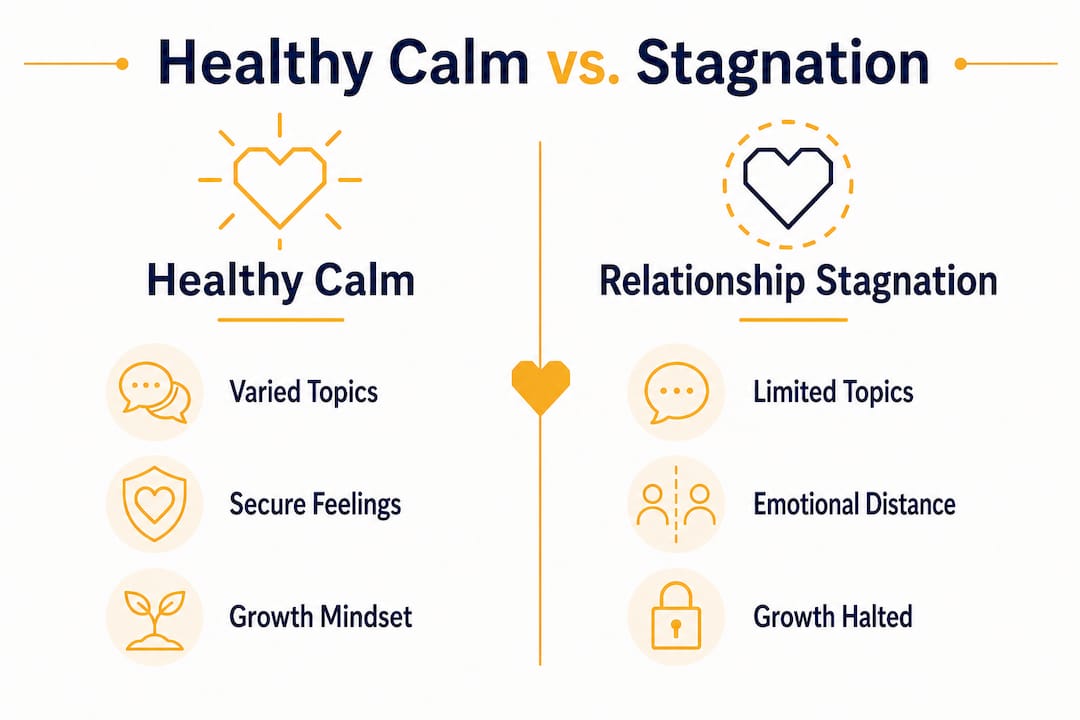
Healthy calm vs. relationship stagnation: what’s the difference?

Not all relationship boredom is the same. Calm after conflict is healthy. Calm from giving up is not. The distinction matters because the response to each is completely different.
Healthy calm looks like two people who feel secure enough to sit in silence, disagree without panic, and trust that the relationship is solid. Stagnation looks like two people who have stopped being curious about each other. They function as roommates, coordinating logistics without genuine emotional contact.
Pro Tip: Ask yourself: “Am I bored because I feel safe, or because we’ve stopped growing?” The answer points you toward the right response.
The table below separates the two states clearly:
| Signal | Healthy calm | Relationship stagnation |
|---|---|---|
| Conversation topics | Varied, includes curiosity and dreams | Mostly logistics and schedules |
| Conflict | Resolved and processed | Avoided or ignored entirely |
| Personal growth | Both partners pursue individual goals | Growth has stalled for one or both |
| Physical affection | Present and intentional | Rare or purely habitual |
| Emotional presence | Partners feel seen and heard | Partners feel invisible or taken for granted |
Relationship boredom often signals a lack of novelty, personal growth stagnation, or autopilot communication focused on logistics. That kind of boredom needs active attention. Couples who recognize they are on autopilot can use tools like a couples therapy workbook to rebuild curiosity and structure intentional connection.
Relationship boredom signals stalled personal and relational growth. Psychologists call the remedy “self-expansion,” which means engaging in new activities together that stretch both partners beyond their comfort zones. Self-expansion stimulates dopamine activity and reintroduces the novelty that long-term relationships naturally lose over time.
How to balance stability with novelty and keep the spark alive
Overcoming relationship boredom does not require drama. It requires intention. The goal is to introduce enough novelty and anticipation to keep desire alive without sacrificing the emotional safety that makes the relationship worth protecting.
Intentional exploration and novelty foster dopamine activity directly linked to desire. That means small, consistent acts of newness matter more than occasional grand gestures. A weekend trip once a year does less for long-term passion than weekly micro-novelty woven into daily life.
Mel Schwartz, LCSW, advocates for replacing predictability with curiosity and playful reengagement rather than fixed routines. That shift in mindset changes everything. You stop asking “What should we do tonight?” and start asking “What don’t I know about you yet?”
Practical strategies that work:
- Protect individual interests. Each partner keeps at least one hobby, friendship, or pursuit that is entirely their own. Separateness creates something to come back to.
- Introduce structured surprises. Alternate planning a date night without telling the other person the details. Anticipation is a powerful driver of desire.
- Ask new questions. Use conversation prompts that go beyond daily logistics. Questions like “What’s something you’ve been afraid to try?” rebuild curiosity fast.
- Change the physical environment. Novelty in setting, even a new restaurant or a walk in an unfamiliar neighborhood, activates the same neural pathways as early-stage romance.
- Invest in shared growth. Take a class together, learn a skill, or tackle a challenge neither of you has faced before. Shared novelty is one of the most reliable ways to sustain long-term passion.
- Name what you appreciate. Gratitude expressed out loud interrupts the invisibility that routine creates. It reminds both partners that they are chosen, not just convenient.
Mental health also shapes how couples experience excitement and stability. For couples where one partner navigates mental illness and dating, the line between healthy calm and emotional withdrawal can feel especially blurry. Recognizing that distinction is part of building a relationship that lasts.
If emotional withdrawal has already set in, Couplesfightschool offers a direct guide on breaking the withdrawal cycle that addresses the disengagement patterns couples often confuse with boredom.
Key Takeaways
Healthy relationships feel boring because emotional safety replaces adrenaline, but that calm is the foundation of lasting love, not evidence that something is missing.
| Point | Details |
|---|---|
| Calm is not emptiness | A regulated nervous system signals safety, not lack of attraction or connection. |
| Predictability reduces desire | Desire needs mystery and separateness; total comfort erodes erotic charge over time. |
| Boredom has two causes | Distinguish healthy calm from stagnation by checking for curiosity, growth, and emotional presence. |
| Novelty must be intentional | Small, consistent acts of newness sustain dopamine activity better than rare grand gestures. |
| Conditioning shapes perception | People from chaotic relationships must retrain their nervous systems to recognize calm as love. |
The paradox I keep seeing in couples who almost walked away
I have worked with couples who were ready to end genuinely good relationships because they felt “nothing.” No fighting, no intensity, no electric tension. They interpreted that absence as proof the love was gone. Almost every time, what they were describing was emotional safety they had never experienced before.
The hardest part of my work is convincing someone that the absence of anxiety is not the absence of love. We are so conditioned by movies, past relationships, and cultural narratives to expect love to feel like turbulence. When it doesn’t, we panic. We go looking for the feeling we recognize, even when that feeling was hurting us.
What I tell couples is this: the goal is not to recreate the chaos. The goal is to build curiosity inside the safety. Those are not opposites. A secure relationship gives you the ground to take real risks with each other, to ask harder questions, to be more vulnerable, not less. That is where the depth lives.
The couples who thrive long-term are not the ones who kept the drama alive. They are the ones who learned to find excitement in knowing someone deeply and still choosing to keep learning about them. That takes skill, not luck. And it is absolutely teachable.
— Carlos
What Couplesfightschool offers couples navigating this paradox
Feeling like your relationship has gone flat is one of the most common reasons couples reach out to Couplesfightschool. The good news is that the skills to balance emotional safety with genuine excitement are learnable at any stage.
The relationship skills course at Couplesfightschool walks couples through the exact communication and connection tools that keep intimacy alive without sacrificing stability. For couples who want personalized support, online coaching pairs you with a professional who can help you identify whether you are experiencing healthy calm or genuine stagnation, and build a plan from there. Both options are grounded in the F.I.G.H.T. Plan® framework, which gives couples a structured path from disconnection to lasting closeness.
FAQ
Why does a healthy relationship feel boring at first?
A healthy relationship feels boring at first because it lacks the cortisol and adrenaline spikes that volatile relationships produce. Those spikes mimic excitement, so their absence registers as flatness until your nervous system adjusts.
Are boring relationships healthy or a warning sign?
A relationship that feels calm and predictable can be healthy, but boredom from stagnation, where curiosity and growth have stopped, is a warning sign worth addressing. The key is identifying which type of boredom you are experiencing.
How do you spice up a relationship without creating conflict?
Introduce structured novelty through surprises, new shared experiences, and individual pursuits that give each partner something to bring back to the relationship. Shared novelty drives dopamine activity and sustains desire without manufactured drama.
Why do relationships lose excitement over time?
Relationships lose excitement because routine reduces psychological tension, which desire depends on. Familiarity is comforting, but without maintained mystery and individuality, erotic charge fades naturally.
When should you seek help for relationship boredom?
Seek professional support when boredom is accompanied by emotional distance, avoided conflict, or a sense that you and your partner have stopped being curious about each other. Couplesfightschool’s guide on when to seek couples therapy outlines the specific signs that indicate it is time to get outside help.
Recommended