
What Is Stonewalling in a Relationship? Signs and Solutions

Stonewalling in a relationship is defined as one partner emotionally shutting down or withdrawing during conflict, typically as an involuntary response to feeling overwhelmed rather than a deliberate choice to avoid. Psychologist John Gottman identified stonewalling as one of the Four Horsemen, a set of communication patterns that predict relationship breakdown. Unlike the silent treatment, stonewalling is rooted in physiological overwhelm, not punishment. Understanding what drives this behavior is the first step toward breaking the cycle and rebuilding real connection with your partner.
What is stonewalling in a relationship, and how does it show up?
Stonewalling is the act of emotionally withdrawing from a conversation, usually during conflict, when one partner becomes too flooded to continue engaging. The person stonewalling may go quiet, leave the room, or respond with flat, one-word answers. From the outside, it looks like indifference. From the inside, it is usually the nervous system hitting its limit.
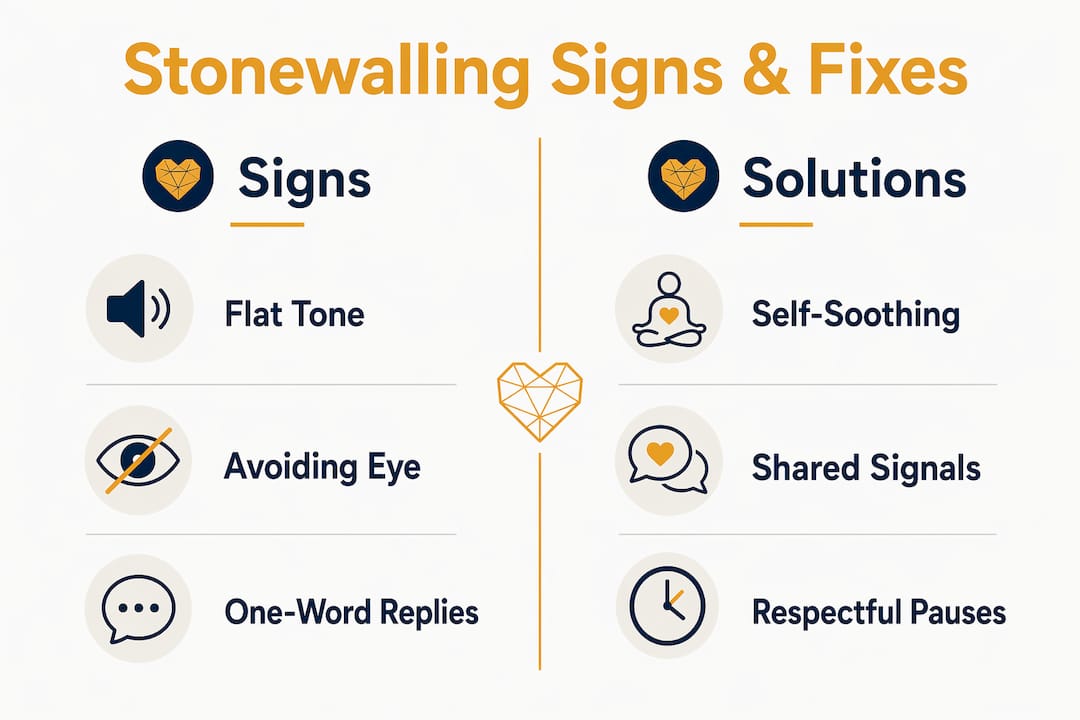
Common behaviors that signal stonewalling include:
- Blank or flat facial expressions with no emotional response
- Avoiding eye contact or turning the body away
- One-word answers or complete silence
- Sudden distractions, like picking up a phone or leaving the room
- A flat, monotone voice that signals emotional shutdown
These behaviors reflect involuntary withdrawal, not calculated avoidance. That distinction matters because it changes how you respond. Pushing harder rarely works. It almost always deepens the shutdown.
The partner on the receiving end often feels dismissed, invisible, or unimportant. That emotional injury compounds over time. When stonewalling becomes a recurring pattern, it erodes the sense of safety that healthy relationships depend on. Couplesfightschool works with couples who describe this exact cycle: one partner shuts down, the other escalates, and both end up further apart than when the argument started.

Pro Tip: If you notice your partner going flat and quiet during conflict, resist the urge to push for a response. Giving a brief, agreed-upon break often produces better results than demanding engagement.
Why do people stonewall their partners?
Stonewalling usually results from emotional flooding, a state where the nervous system enters fight, flight, or freeze mode and temporarily shuts down the brain’s ability to listen, problem-solve, or de-escalate. The person is not choosing to be cold. Their body is responding to perceived threat the same way it would respond to physical danger.
Several factors make emotional flooding more likely:
- A history of trauma or emotionally unsafe environments growing up
- Learned avoidance patterns from watching caregivers handle conflict
- High baseline anxiety or a nervous system that activates quickly
- Feeling chronically criticized or unheard in the relationship
- Accumulated stress from outside the relationship bleeding into arguments
When the nervous system is flooded, the thinking brain goes offline. A person in that state cannot access empathy, logic, or communication skills. They are not being stubborn. They are dysregulated. The most effective response is a pause, not more pressure.
Building emotional resilience is one of the most practical long-term tools for reducing how often flooding occurs. Couples who learn to recognize their own early warning signs, racing heart, clenched jaw, shallow breathing, can call a pause before the shutdown happens rather than after.
The distinction between stonewalling and deliberate punishment is critical. Stonewalling is self-protective. The silent treatment is strategic. Conflating the two leads to the wrong response and makes the problem worse.
How is stonewalling different from the silent treatment?
Stonewalling and the silent treatment look similar from the outside but operate from completely different motivations. Stonewalling is primarily a self-protective stress response, while the silent treatment aims to punish or control the other partner. Choosing the right response depends entirely on understanding which one you are dealing with.
| Behavior | Intent | Awareness | Effect on partner |
|---|---|---|---|
| Stonewalling | Self-protection from overwhelm | Often involuntary | Confusion, feeling dismissed |
| Silent treatment | Punishment or control | Deliberate | Anxiety, fear, resentment |
| Healthy pause | Emotional regulation | Mutual and agreed upon | Relief, space to reset |
| Passive aggression | Indirect expression of anger | Semi-conscious | Frustration, distrust |
A healthy pause differs from both stonewalling and the silent treatment in one key way: mutual agreement. Healthy pauses involve mutual consent and a specific plan to return to the conversation, typically within 24 hours. Unilateral, uncommunicated withdrawal is what makes stonewalling damaging, not the pause itself.
Couples who learn to handle the silent treatment and distinguish it from stonewalling gain a real advantage. They stop responding to the wrong problem. That clarity alone reduces conflict escalation significantly.
What effective strategies can couples use to manage stonewalling?
Breaking the stonewalling cycle requires a structured approach, not just goodwill. The Gottman Institute recommends a three-step method that gives both partners a path forward without forcing engagement when one person is flooded.
- Agree to pause. One partner signals they need a break. Both partners agree to stop the conversation temporarily. The key word is “agree.” A unilateral exit without communication is still stonewalling.
- Self-soothe for at least 20 minutes. Effective break duration is at least 20 minutes for the nervous system to return to baseline. During this time, avoid replaying the argument in your head. Ruminating keeps the body in a stressed state and defeats the purpose of the break.
- Return to the conversation. Come back at the agreed time. Even if the issue is not fully resolved, returning signals commitment and keeps trust intact.
Self-soothing during the break matters as much as the break itself. Effective techniques include slow breathing, a short walk, listening to music, or any activity that genuinely calms the nervous system rather than distracts from it.
Pro Tip: Create a shared signal with your partner before conflict arises, a word, a hand gesture, or a phrase that means “I need 20 minutes.” Agreeing on it in a calm moment makes it far easier to use in a heated one.
Building shared communication agreements is the next layer. Couples who stop communicating effectively often lack these agreements entirely. They enter conflict without a plan, which means stonewalling or escalation becomes the default. Couplesfightschool’s F.I.G.H.T. Plan® framework gives couples a structured system for exactly this kind of preparation, covering emotional regulation, communication, and reconnection after conflict.
Pressuring a partner to engage while they are stonewalling almost always backfires and deepens withdrawal. Respectful pauses with a clear commitment to return are consistently more effective. Learning to diffuse conflict before it reaches the flooding point is the most reliable long-term strategy.
What long-term impact does stonewalling have if left unaddressed?
Chronic stonewalling does not stay contained to individual arguments. It spreads into the emotional fabric of the relationship over time. Gottman’s Four Horsemen research identifies stonewalling as a major predictor of relationship distress and, in persistent cases, divorce. That finding reflects what happens when flooding and withdrawal become the default response to conflict rather than the exception.
The long-term consequences of unaddressed stonewalling include:
- Erosion of emotional intimacy and trust
- Growing feelings of loneliness within the relationship
- Resentment building on both sides, the stonewaller feeling misunderstood, the other partner feeling rejected
- Conflict avoidance becoming the norm, which prevents real issues from ever being resolved
- Power imbalances where one partner learns to manage the other’s emotional state to avoid triggering shutdown
The partner who experiences stonewalling repeatedly often begins to feel that their needs do not matter. That belief, once established, is difficult to reverse. Early recognition and intervention change the trajectory. Couples who address stonewalling patterns before they calcify have a much stronger chance of rebuilding genuine connection.
Key Takeaways
Stonewalling is an involuntary stress response, not a character flaw, and couples who learn to recognize it early and respond with structured pauses can break the cycle before it causes lasting damage.
| Point | Details |
|---|---|
| Stonewalling defined | Emotional shutdown during conflict driven by nervous system flooding, not deliberate avoidance. |
| Key signs | Blank expression, one-word answers, eye contact avoidance, and physical withdrawal. |
| Root cause | Emotional flooding triggers a fight-flight-freeze response that shuts down communication ability. |
| Effective response | Agree to a 20-minute pause, self-soothe without ruminating, then return to the conversation. |
| Long-term risk | Chronic stonewalling predicts emotional detachment, resentment, and relationship breakdown. |
What I have learned after years of working with couples on this
Most people who stonewall do not know they are doing it. They experience the shutdown as relief, a way to stop the pain of an argument that feels like it is going nowhere. What they do not see is what their partner experiences on the other side: a wall going up, silence that feels like rejection, and the slow accumulation of “they don’t care.”
The most important reframe I offer couples is this: stonewalling is not a personality trait. It is a skill gap. The person shutting down has not learned how to stay regulated under emotional pressure. That is teachable. It takes practice, patience, and usually some structured support, but it is absolutely learnable.
What I have also found is that the partner on the receiving end often carries their own piece of the pattern. Pursuing harder when someone shuts down is a natural reaction, but it accelerates flooding rather than reducing it. Both partners need new tools. One learns to signal and pause. The other learns to let the pause happen without interpreting it as abandonment.
Empathy is the starting point. Skill is what makes empathy sustainable. If you recognize this pattern in your relationship, the fact that you are reading this and trying to understand it already puts you ahead of where most couples start.
— Carlos
How Couplesfightschool can help you move forward
If stonewalling shows up regularly in your relationship, you are not alone, and you are not stuck. Couplesfightschool was built specifically for couples who want to move past the patterns that keep them distant and develop real communication skills that hold up under pressure.
The relationship skills training at Couplesfightschool covers emotional regulation, conflict resolution, and the communication agreements that prevent stonewalling from taking over. For couples who want more personalized support, online coaching for couples connects you directly with expert guidance tailored to your specific dynamic. Both options are grounded in the F.I.G.H.T. Plan® framework, which gives you a repeatable system rather than one-time advice.
FAQ
What is stonewalling in a relationship?
Stonewalling is when one partner emotionally withdraws or shuts down during conflict, typically as an involuntary response to emotional flooding rather than a deliberate choice to avoid the conversation.
How is stonewalling different from the silent treatment?
Stonewalling is a self-protective stress response driven by nervous system overwhelm, while the silent treatment is a deliberate act intended to punish or control a partner.
What are the most common signs of stonewalling?
Signs include blank facial expressions, avoiding eye contact, one-word answers, a flat tone, and physical withdrawal such as leaving the room or picking up a phone mid-conversation.
How long should a break last when stonewalling occurs?
The Gottman Institute recommends at least 20 minutes for the nervous system to return to baseline, with both partners agreeing in advance to return to the conversation after the break.
Can stonewalling be fixed without professional help?
Many couples reduce stonewalling significantly by learning to recognize flooding early, using agreed-upon pauses, and building shared communication agreements. Structured programs like those offered by Couplesfightschool provide the framework that makes those skills stick.
Recommended