
Benefits of Couples Therapy After Betrayal: What to Expect
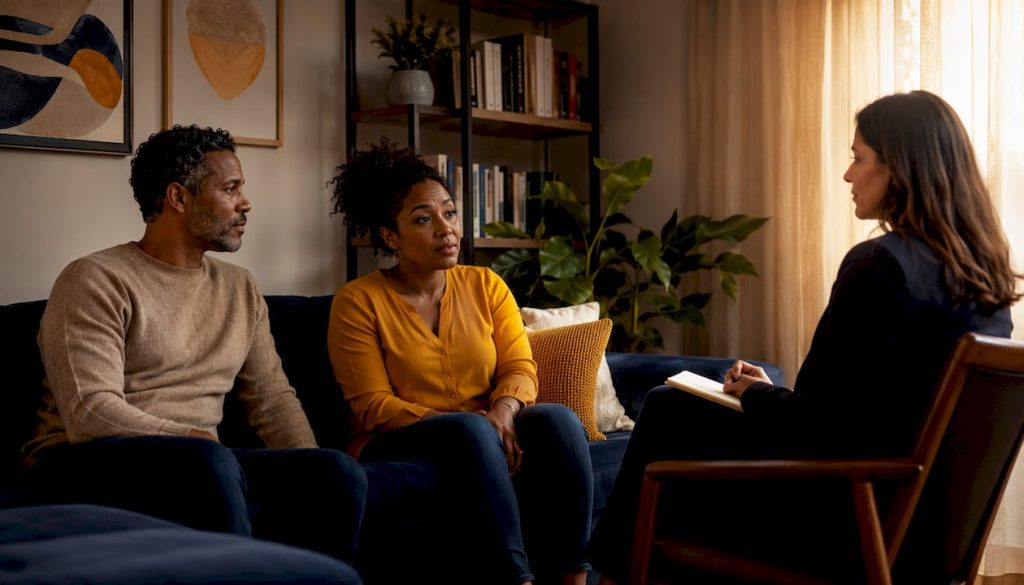
Yes, couples therapy can meaningfully reduce trauma from betrayal and rebuild connection — and the evidence behind that claim is solid. EFT meta-analyses show that 70–75% of couples experience meaningful improvement when both partners engage. The benefits of couples therapy after betrayal aren’t abstract: they include restored emotional safety, clearer communication, structured accountability, and a guided process for processing grief that most couples cannot navigate alone.
The short version:
- Safety and stabilization — therapy stops the crisis from escalating and creates a container for raw emotion
- Structured communication — a trained clinician manages disclosures so they don’t become re-traumatizing
- Accountability — the unfaithful partner is held to observable, consistent behavioral change, not just apologies
- Trauma processing — the betrayed partner’s symptoms (hypervigilance, intrusive thoughts, rage) are treated, not minimized
- Guided decision-making — therapy helps couples decide whether to repair or separate with clarity rather than reactivity
Your next 24–72 hours: If the betrayal just came to light, prioritize safety first. That means stopping contact with the third party, getting individual support if either partner is in crisis, and contacting a licensed therapist (LMFT, LICSW, PhD/PsyD) with explicit infidelity experience. Don’t make permanent decisions in the first week.
Table of Contents
- Why betrayal causes distinct emotional and relational injuries
- What are the real benefits of couples therapy after betrayal?
- Which therapy approaches work best after infidelity?
- What does the research actually say about therapy after betrayal?
- What are the typical stages couples move through in therapy?
- How long does healing usually take?
- Should you choose couples therapy or individual therapy after betrayal?
- What does each partner specifically need from therapy?
- How do you find the right couples therapist after betrayal?
- Key Takeaways
- What experienced therapists say matters most in affair recovery
- Relationship education as a complement to clinical therapy
- Authoritative sources and further reading
Why betrayal causes distinct emotional and relational injuries
Betrayal isn’t just a bad event. It rewires how the betrayed partner experiences the relationship at a neurological level. Attachment theory calls this an “attachment injury” — a moment where a partner needed safety and instead experienced abandonment or deception. The result is a nervous system that stays on high alert long after the affair ends.
Common symptoms to watch for:
- Compulsive phone or location checking
- Intrusive thoughts or flashbacks triggered by ordinary events (a song, a restaurant, a time of day)
- Insomnia or hypersomnia
- Rage that arrives without warning and feels disproportionate
- Emotional numbness or withdrawal from the relationship
- Shame, self-blame, and a shattered sense of identity
These symptoms interfere directly with the couple’s ability to make decisions, have productive conversations, or even be in the same room without escalating. The betrayed partner’s nervous system reads ordinary interactions as threats. The unfaithful partner, often flooded with guilt or defensiveness, either over-explains or shuts down — neither of which helps.
Betrayal extends beyond sexual affairs to include emotional infidelity, financial deception, and broken promises of safety. Whatever the form, the psychological injury follows a similar pattern: loss of the relationship as a secure base.
Severity check: If either partner is experiencing suicidal ideation, active substance use, or symptoms of severe PTSD (dissociation, inability to function at work), individual therapy or crisis support should come before conjoint sessions.
What are the real benefits of couples therapy after betrayal?
The primary mechanisms are stabilization, regulated communication, accountability, meaning-making, and structured repair work. Here is how those play out in practice:
- Safety planning. The therapist helps the couple establish ground rules: no contact with the affair partner, agreed-upon communication windows, and a protocol for when one partner becomes flooded and needs to pause.
- Disclosure management. Rather than the betrayed partner interrogating and the unfaithful partner deflecting, the therapist structures what gets disclosed, when, and how. This prevents re-traumatization through uncontrolled information dumps.
- Emotional processing. The therapist uses emotion coaching to help both partners identify and express primary emotions (fear, grief, shame) rather than secondary ones (rage, contempt, stonewalling). This is where repair after fights actually begins.
- Skill-building. Couples practice new communication patterns in session and take structured homework home — daily transparency logs, check-in scripts, and micro-contracts that rebuild safety through repetition.
- Maintenance planning. Before therapy ends, the couple builds a relapse plan: what to do when trust wobbles, how to handle anniversaries or triggers, and when to return for a tune-up session.
Pro Tip: The most underused tool in affair recovery is the between-session homework. Ask your therapist for one specific micro-behavior each week — something observable and repeatable, like a daily five-minute check-in or a shared location app. Trust rebuilds through accumulated small acts, not grand gestures.

Which therapy approaches work best after infidelity?
Four evidence-based models dominate clinical practice after betrayal. Most skilled therapists draw from more than one, but understanding each helps you ask better questions when choosing a clinician.
Emotionally Focused Therapy (EFT) targets the attachment injury directly. It works by identifying the negative interaction cycle (pursue/withdraw, attack/defend) and tracing it back to underlying attachment fears. The goal is a corrective emotional experience — a moment in session where the betrayed partner feels genuinely seen and the unfaithful partner stays present without defensiveness. EFT has the strongest research base of any couples model.
Gottman Method is more skills-focused. It uses assessments (the “Sound Relationship House” framework), structured exercises, and behavioral interventions to rebuild friendship, manage conflict, and create shared meaning. It’s particularly useful when the couple has strong communication deficits alongside the betrayal.
Imago Relationship Therapy works through structured dialogue (the “Imago Dialogue”) to help partners understand how childhood wounds and relational templates contributed to the relationship’s vulnerabilities. It’s meaning-making focused and tends to suit couples who want to understand why the affair happened, not just manage the aftermath.
Trauma-informed therapy applies when the betrayed partner’s symptoms meet clinical criteria for PTSD or acute stress disorder. The therapist prioritizes stabilization and trauma processing before any relational repair work begins. This approach is often integrated with EFT or Gottman rather than used in isolation.
| Approach | Primary focus | Key benefits | Typical timeframe | Best used when |
|---|---|---|---|---|
| Emotionally Focused Therapy (EFT) | Attachment repair | Trust rebuilding, emotional regulation, secure bonding | 8–20 sessions | Both partners willing; attachment injury is central |
| Gottman Method | Communication skills and friendship | Conflict management, accountability, shared meaning | 10–20 sessions | Communication breakdown is severe; structured approach preferred |
| Imago Relationship Therapy | Meaning-making, relational patterns | Understanding root causes, empathy, dialogue skills | 12–20 sessions | Couple wants to understand underlying dynamics |
| Trauma-informed therapy | Trauma stabilization | Symptom reduction, safety, PTSD processing | Variable; often 12+ sessions | Betrayed partner has significant trauma symptoms |
Therapists rarely stick to a single model. A clinician trained in EFT may use Gottman’s disclosure structure and trauma-informed stabilization techniques in the same case — which is exactly what good clinical judgment looks like.
What does the research actually say about therapy after betrayal?
The evidence is genuinely encouraging, with some important caveats about real-world conditions.
Meta-analyses consistently show that approximately 70–75% of couples experience meaningful improvement with EFT, the most studied model for infidelity recovery. A study published in the Journal of Applied Psychological Research found that EFT-based experiential exercises produced a large effect size in multivariate analysis for marital intimacy among couples who had experienced infidelity, with particularly strong gains in emotional and social-recreational intimacy. A review published in the Journal of Family Therapy reported that many distressed couples benefit from behavioral or emotion-focused approaches, with many maintaining gains at follow-up.
Evidence snapshot: According to Harvard Health, a study published in Family Process found that by the end of treatment, most people who participated in couples therapy felt better than 70–75% of those who did not receive help.
What the research doesn’t promise:
- Effect sizes in controlled research settings are typically higher than in routine community practice
- Sustained improvement usually requires consistent engagement, not just attendance
- Qualitative research shows that therapy provides structure, nonjudgmental support, and a pathway to meaning-making — but those benefits depend on therapist skill and partner investment
- Some couples who complete therapy successfully choose to separate; clinicians view that as a valid outcome, not a failure
What are the typical stages couples move through in therapy?
Recovery isn’t linear, but it does follow a recognizable arc, and knowing how to support your partner through IVF can offer valuable insights for couples managing relationship challenges during stressful times. Here’s what most evidence-based approaches cover, and what progress looks like at each stage.
Stage 1: Stabilization and safety. The first priority is stopping the bleeding. The therapist helps the couple manage the immediate crisis: setting boundaries around contact with the affair partner, assessing mental health needs for both partners, and establishing a basic safety agreement. Progress marker: both partners can be in the same room without the session derailing into an interrogation or a shutdown.

Stage 2: Disclosure and accountability. This is where clinical guidance emphasizes structured disclosure — a managed process where the unfaithful partner provides an honest account of what happened, guided by the therapist to prevent both minimization and information overload. Progress marker: the betrayed partner has enough information to stop obsessing over unknowns.
Stage 3: Emotional processing and meaning-making. The couple processes grief, anger, and loss. The betrayed partner’s attachment injury is addressed directly. Both partners begin to understand what relational patterns or unmet needs contributed to the affair — not to excuse it, but to prevent recurrence. Progress marker: the betrayed partner can express pain without the unfaithful partner becoming defensive or dissociating.
Stage 4: Skill-building and rewiring patterns. New communication habits replace old ones. Transparency routines become automatic. The couple practices conflict diffusion and emotional regulation skills between sessions. Progress marker: the couple can navigate a trigger without it becoming a full crisis.
Stage 5: Consolidation and maintenance. The couple builds a plan for life after active therapy: how to handle anniversaries, what to do when trust wobbles, and how to sustain the gains. Progress marker: both partners feel they have tools they can use independently.
How long does healing usually take?
There is no universal timeline, and any therapist who gives you one in the first session is oversimplifying. That said, clinical practice gives us useful ranges.
Most couples working through infidelity need 12–20 sessions over 3–6 months for moderate betrayal with both partners engaged. Mild cases with strong pre-existing communication skills may resolve in 8–12 sessions. Severe betrayal involving long-term affairs, addiction, or ongoing secrecy often requires 6–12 months or more, sometimes with parallel individual therapy running alongside conjoint work.
Factors that slow recovery:
- Continued contact with the affair partner (even “just to end it cleanly”)
- Ongoing secrecy or minimization by the unfaithful partner
- Untreated substance use or compulsive sexual behavior
- Co-parenting with the affair partner
- Severe pre-existing trauma in either partner
Realistic expectations to hold:
- Setbacks are normal, not signs of failure. A bad week in month four doesn’t erase month three’s progress.
- Trust rebuilds incrementally through consistent behavior, not through a single breakthrough conversation.
- Therapy sometimes leads to a healthier separation. That outcome, when it happens, is still a success — it means both partners made a clear-eyed decision rather than a reactive one.
- Knowing when to seek couples therapy proactively — before patterns become entrenched — shortens the recovery arc considerably.
Should you choose couples therapy or individual therapy after betrayal?
Choose couples therapy when both partners can engage safely and are willing to work toward repair or a clear decision. Choose individual therapy first when there is active danger, severe trauma requiring stabilization, or one partner is unwilling to participate.
Decision checklist:
- Is both partners’ physical safety assured? (If not, individual or crisis support comes first.)
- Is the unfaithful partner willing to stop contact with the affair partner?
- Can both partners tolerate being in the same room without one becoming threatening or the other dissociating?
- Is there active substance use that needs treatment before relational work can begin?
- Is the betrayed partner experiencing suicidal ideation or severe PTSD symptoms?
Red flags that require individual care or specialized referral:
- Any history of intimate partner violence or coercive control
- Active addiction in either partner
- Diagnosed compulsive sexual behavior in the unfaithful partner (requires specialized treatment alongside couples work)
- One partner is using therapy sessions to gather information for legal proceedings
- The unfaithful partner is still in contact with the affair partner and unwilling to stop
When doing both is the right call: Parallel individual therapy is often the most effective structure. The betrayed partner processes shame, grief, and identity disruption in individual sessions; the unfaithful partner works through guilt, underlying patterns, and accountability in their own sessions. Conjoint sessions then focus on repair rather than carrying the full weight of both partners’ individual processing.
What does each partner specifically need from therapy?
The needs are asymmetrical, and pretending otherwise slows recovery.
The betrayed partner needs safety and validation first. Everything else comes later.
- Do: Name your symptoms clearly to the therapist. Ask for structured disclosure rather than an open-ended interrogation. Allow yourself to grieve without rushing toward forgiveness.
- Don’t: Make permanent decisions (divorce, reconciliation) in the first month. Use the affair as a weapon in unrelated arguments. Expect the unfaithful partner to read your mind about what accountability looks like.
The unfaithful partner needs to lead with accountability, not explanation.
- Do: End all contact with the affair partner completely and immediately. Offer full transparency — location, phone, schedule — without being asked repeatedly. Stay present when the betrayed partner expresses pain, even when it’s uncomfortable.
- Don’t: Minimize the affair’s impact (“it didn’t mean anything”). Demand that the betrayed partner move on faster. Use your own guilt as a reason to avoid the conversation.
Between-session homework both partners can use:
- A daily five-minute check-in with a structured script (e.g., “One thing I felt today was ___. One thing I need from you this week is ___.”)
- A couples therapy workbook with guided exercises for processing emotions and rebuilding communication between sessions
- A weekly transparency log where the unfaithful partner shares plans, changes, and follow-through — not as surveillance, but as a trust-building practice
Successful repair requires both partners to be fully invested. The unfaithful partner must stay present with the betrayed partner’s pain without becoming defensive. The betrayed partner must engage in rebuilding trust through consistent interactions, even when it feels risky.
How do you find the right couples therapist after betrayal?
Start with credentials: prioritize licensed clinicians with explicit infidelity and trauma experience. The relevant licenses in the United States are LMFT (Licensed Marriage and Family Therapist), LICSW (Licensed Independent Clinical Social Worker), and PhD/PsyD in clinical or counseling psychology. Certification in EFT (through ICEEFT) or Gottman Method training (Level 2 or 3) signals specialized couples competence.
Questions to ask a prospective therapist:
- How many couples dealing with infidelity have you treated in the past two years?
- Which therapeutic models do you use for affair recovery, and why?
- What is your stance on full disclosure? Do you facilitate structured disclosure sessions?
- Do you recommend parallel individual therapy alongside couples work?
- How do you handle it if one partner discloses ongoing contact with the affair partner?
- What does a typical session arc look like in the first month?
- Do you have safety protocols if one partner becomes threatening or dissociative in session?
- What are your fees, and do you offer telehealth options?
Red flags to avoid:
- A therapist who implies the betrayed partner “drove” the unfaithful partner to the affair
- Quick-fix guarantees (“most couples resolve this in four sessions”)
- A therapist who takes sides visibly or dismisses one partner’s experience
- No clear structure for disclosure or safety planning
For couples who can’t access in-person care, online marriage counseling after infidelity is a legitimate and effective option. Telehealth platforms now include clinicians with specific infidelity training, and the research on telehealth couples therapy shows outcomes comparable to in-person work for most presentations.
Key Takeaways
Couples therapy after betrayal works when both partners engage fully, a skilled clinician manages the process, and recovery is treated as a phased, nonlinear effort rather than a single breakthrough.
| Point | Details |
|---|---|
| Therapy reduces trauma and rebuilds trust | EFT meta-analyses show 70–75% of couples experience meaningful improvement when both partners engage. |
| Recovery follows five stages | Stabilization, disclosure, emotional processing, skill-building, and maintenance each require distinct work. |
| Timelines vary by severity | Most couples need 12–20 sessions over 3–6 months; severe cases often require longer with parallel individual therapy. |
| Each partner has distinct needs | The betrayed partner needs safety and validation; the unfaithful partner must lead with observable accountability. |
| Couplesfightschool offers structured support | The F.I.G.H.T. Plan® framework, workbooks, and courses provide practical tools to use alongside or between therapy sessions. |
What experienced therapists say matters most in affair recovery
The piece of affair recovery that most couples underestimate isn’t the big disclosure conversation or the first session where everything comes out. It’s the six weeks after that, when the initial adrenaline fades and the real work begins. That’s when the unfaithful partner’s accountability either becomes a daily practice or quietly reverts to old patterns. And that’s when the betrayed partner either starts to feel the accumulation of consistent behavior, or starts to feel that nothing has actually changed.
What predicts success isn’t the severity of the betrayal — it’s the consistency of what happens between sessions. A single apology, no matter how heartfelt, does not rebuild safety. What rebuilds safety is a partner who shares their location without being asked, who comes home when they said they would, who initiates the check-in even on a hard day. Those micro-behaviors, accumulated over weeks and months, are what the nervous system eventually learns to trust again.
There’s also a counterintuitive truth worth naming: therapy sometimes leads to a healthier separation, and that is not a failure. Some relationships cannot be safely repaired — because the betrayal was too severe, because the unfaithful partner is unwilling to do the sustained work, or because the betrayed partner’s trauma is too deep to allow genuine reconnection. A therapist who helps a couple reach that conclusion clearly and compassionately has done exactly what good therapy is supposed to do. The goal was never to stay together at any cost. The goal was clarity, safety, and a decision both partners can live with.
Relationship education as a complement to clinical therapy
Clinical couples therapy and relationship education serve different purposes, and knowing the difference helps you use both well. A licensed therapist treats clinical presentations — trauma, attachment injury, severe communication breakdown. Relationship education builds skills: communication frameworks, conflict tools, emotional regulation practices. The two work best together.
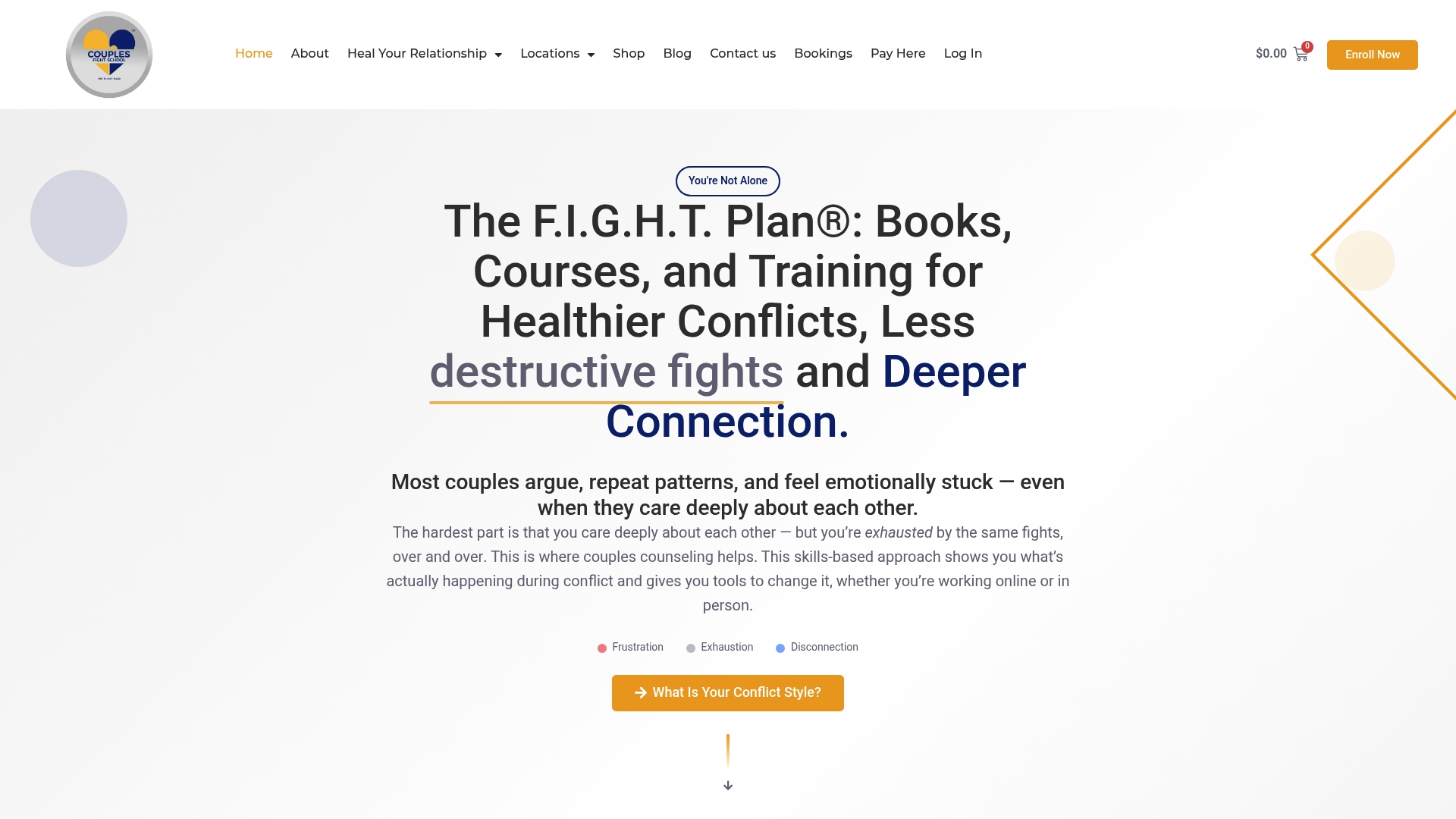
Couplesfightschool was built by licensed mental health professionals Carlos Todd and Natasha Pemberton-Todd specifically to give couples the practical tools that therapy often doesn’t have time to teach. The F.I.G.H.T. Plan® framework translates clinical concepts into daily habits — the kind of micro-behaviors that rebuild trust between sessions. The Stop the Fighting course gives couples structured training in conflict resolution they can practice at home, and the couples therapy workbook provides guided exercises for processing emotions and rebuilding communication on your own timeline. For couples in active repair, these resources work alongside therapy, not instead of it. If you’re not yet in therapy, they’re a solid starting point for building the skills your therapist will ask you to use anyway.
Important: Relationship education and coaching are not replacements for clinical care when there is active danger, severe trauma, or a clinical diagnosis requiring treatment. If either partner is in crisis, start with a licensed clinician.
Ready to build the skills that make therapy stick? Explore the conflict resolution techniques couples can start practicing today.
Authoritative sources and further reading
The claims in this article draw from peer-reviewed research, clinical reviews, and reputable clinical resources. The strongest sources are listed below.
- EFT effectiveness in infidelity recovery: International Centre for Excellence in Emotionally Focused Therapy (ICEEFT) — evidence summary supporting the 70–75% improvement rate in EFT outcome meta-analyses
- EFT experiential exercises and marital intimacy: Journal of Applied Psychological Research, vol. 17, Issue 1, 2026 — quasi-experimental study showing significant EFT effects on marital intimacy in couples affected by infidelity
- General couples therapy effectiveness: Harvard Health — “Could couples therapy be right for you?” — cites Family Process study showing 70–80% improvement rate vs. untreated couples
- Systemic and behavioral couple interventions: Journal of Family Therapy — Carr et al. — review reporting 60–80% of distressed couples benefit from behavioral or emotion-focused approaches
- Resilience factors in infidelity recovery: Contemporary Family Therapy, 2026 — qualitative research identifying therapy as a key resilience factor, including structured disclosure and meaning-making
- Clinical stepwise guidance for affair recovery: HelpGuide.org — Marriage Therapy for Infidelity — practical clinical overview of phased repair work
- Rebuilding trust in couples therapy: Psychology Today — “What Rebuilding Trust Looks Like in Couples Therapy” — clinical guidance on safety, honesty, and phased repair
- General couples therapy guide: Simply Psychology — Couples Therapy Guide — overview identifying EFT as the most research-supported approach for infidelity and conflict
Recommended