
Clinician Scripts for Christian Conflict Resolution Using Matthew 18

Go to the person privately first. If that fails, bring one or two wise witnesses. If it still fails, involve church leadership. That’s the sequence Jesus laid out in Matthew 18, and it works because it forces humility before it forces resolution. The attitude that makes each step actually succeed is repentance on one side and forgiveness on the other, backed by practical listening skills that keep the conversation from turning into a second fight.
TL;DR:
- Conflict resolution should follow a structured sequence involving private confrontation, witness involvement, and church accountability for persistent sin or unrepentance.
- Effective communication skills like reflective listening, pausing before responding, and acknowledging underlying needs help de-escalate fights and foster healing.
- Couples should develop shared agreements for pausing arguments, regular repair check-ins, and naming issues clearly to prevent recurring cycles of conflict.
- Forgiveness is individual and unilateral, but reconciliation requires mutual repentance, time, and trust rebuilding, often taking months to restore fully.
- Outside help from pastors or counselors is necessary only when there is ongoing unrepentance, abuse, or significant power imbalance, not for every disagreement.
Table of Contents
- What Does the Bible Say About Resolving Conflict?
- How Do You Resolve a Conflict the Biblical Way?
- Which Communication Skills Actually De-escalate a Fight?
- How Should Couples Apply These Steps in Marriage?
- When Should You Involve a Pastor, Elder, or Counselor?
- What Tools Do Licensed Christian Counselors Actually Use?
- Forgiveness Isn’t the Same Thing as Reconciliation
- Why Conflict Isn’t a Failure of Faith
- Where Conflict Actually Starts in Christian Communities
- How Prayer Shapes the Whole Resolution Process
- Disagreeing Without Dividing
- What Restoration Looks Like Months Later
- Handling Gossip and Slander Before They Take Over
- A Pastor’s Kid’s View on Getting This Wrong
- How a relationship education platform can help you put this into practice
- Sources
- FAQ
What Does the Bible Say About Resolving Conflict?
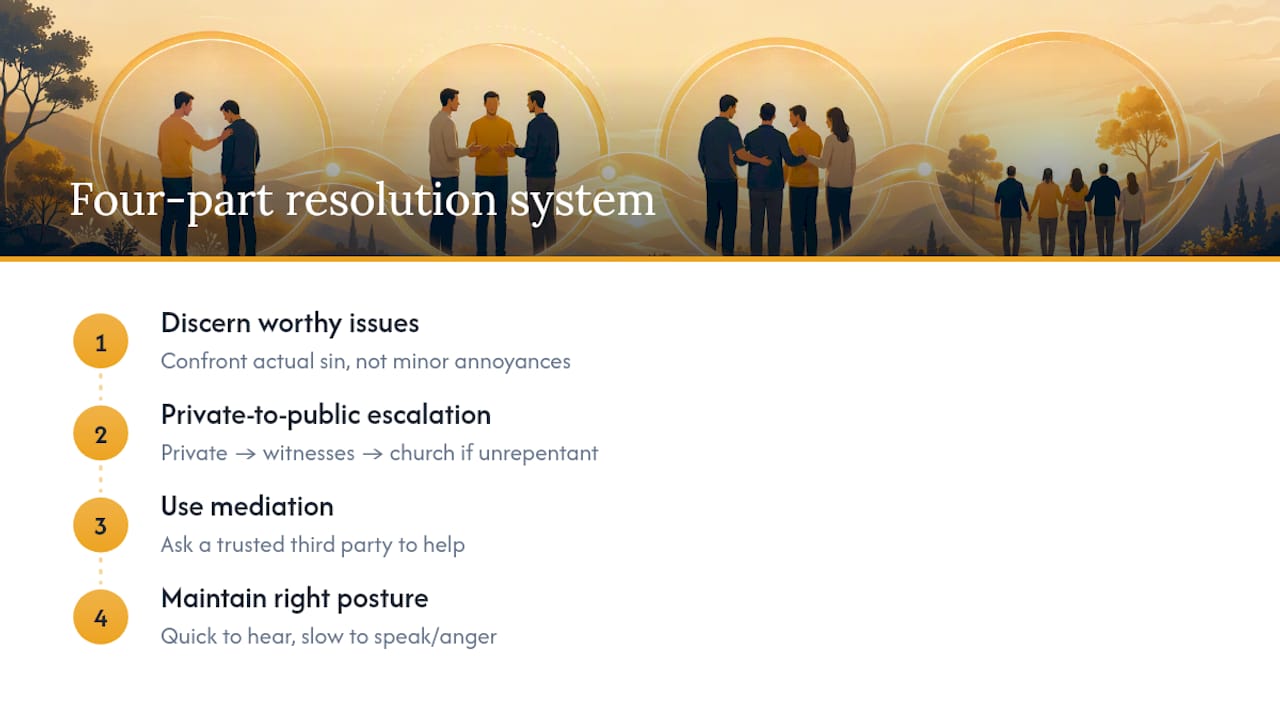
Scripture doesn’t give Christians a vague call to “just get along.” It gives a sequence, and four passages carry most of the weight.
Matthew 18:15-17 is the backbone. Jesus tells his disciples to confront a sinning brother privately first. If he won’t listen, bring one or two witnesses. If he still won’t listen, take the matter to the church (take the matter to the church). This process is designed for situations involving actual sin and unrepentance, not every minor annoyance or personality clash. Scripture elsewhere counsels believers to overlook plenty of everyday friction rather than escalate it, since love “is not easily provoked” and covers a multitude of offenses.
Philippians 4 gives a second, quieter model. Paul doesn’t scold Euodia and Syntyche directly. He asks a trusted companion to help them “be of the same mind,” modeling mediation through a third party rather than forced confrontation.
James 1:19 supplies the posture: “quick to hear, slow to speak, slow to anger.” Most conflicts escalate because someone speaks before they’ve actually listened.
Ephesians 4:26, “be angry and do not sin,” is often read as a 24-hour deadline. It’s better understood as a call to relational maintenance, urging believers to pursue peace before anger hardens into bitterness.
Together, these four passages form a working system: discernment about what deserves confrontation, a private-to-public escalation ladder, mediated help when needed, and an emotional posture that keeps the whole process from becoming another wound.
How Do You Resolve a Conflict the Biblical Way?
Knowing the framework and knowing what to actually say are two different skills. Here’s how the Matthew 18 sequence plays out in real conversations.
-
Pray and check yourself first. Before requesting any conversation, ask what part of this is genuinely yours. Jesus’s warning about removing the log from your own eye before addressing the speck in someone else’s isn’t a throwaway line. It’s the difference between confrontation and self-righteousness.
-
Go privately. Request a specific time to talk, not an ambush in the church parking lot. A simple opener works: “Something’s been bothering me and I want to talk it through with you directly before it affects how I see you.” The goal is restoration, not being right.
-
Bring a witness if the private talk doesn’t land. Choose someone spiritually mature and genuinely neutral, not an ally recruited to strengthen your case. Impartial witnesses who won’t later adjudicate discipline keep the process relational instead of adversarial. Frame the meeting around shared concern for the relationship, not a tribunal.
-
Involve the church only if the pattern continues. This step exists for ongoing, unrepentant sin, not disagreements over preferences or personality friction. Church involvement aims at restoration, not punishment.
-
Repair deliberately. Once there’s movement toward repentance, name it plainly: “I forgive you, and I want to rebuild trust with you.” Follow up in a week or two rather than assuming one conversation fixes months of tension.
Pro Tip: Write your opening line down before the conversation. People who script the first thirty seconds of a hard talk are far less likely to lead with blame, because the hardest part of any confrontation is the first sentence.
Which Communication Skills Actually De-escalate a Fight?
James 1:19’s “quick to hear, slow to speak, slow to anger” sounds simple until you’re mid-argument and your heart rate is climbing. These are the mechanics behind it.
- Reflective listening: repeat back what you heard before responding. “So you’re saying you felt dismissed when I checked my phone during that conversation” slows the exchange down and proves you were actually listening, not just waiting for your turn.
- Timeout language: “I need twenty minutes to calm down so I don’t say something I’ll regret. I’m not leaving the conversation, I’m pausing it.” Ephesians 4:26 isn’t a same-day mandate. It’s permission to pause without letting the issue go cold for days.
- Ownership apologies: “I was wrong to raise my voice, and here’s what I’ll do differently” beats “I’m sorry you felt that way” every time. The second version apologizes for their reaction, not your behavior.
- Boundary statements: “I want to keep talking, but not while either of us is yelling” protects emotional safety without shutting the conversation down entirely.
Anger itself often distorts what you’re actually seeing in the moment. Counselors frequently point out that unexamined anger functions like a fogged lens, making a tired spouse look like a hostile one. Pausing to ask what’s underneath the anger, fear, exhaustion, feeling unheard, usually matters more than winning the immediate exchange.
Pro Tip: Before responding to something that stung, ask yourself one question: “What need is behind their anger right now?” Nine times out of ten it isn’t the surface complaint.
How Should Couples Apply These Steps in Marriage?
Marriage complicates all of this, because you’re not resolving a single incident. You’re interrupting a recurring cycle with someone who has structural power in your daily life, shared finances, shared kids, shared bed. The stakes make the Matthew 18 posture harder to hold and more necessary.
Married couples benefit from turning the biblical framework into standing agreements rather than improvising every time:
- A shared rule for pausing an argument before it turns personal, agreed on in advance rather than negotiated mid-fight.
- A short repair ritual, even a two-minute check-in before bed, that keeps small offenses from compounding into resentment.
- A commitment to name the actual issue instead of the tenth thing that happened that day.
Unity in marriage isn’t the absence of conflict; it’s the practiced habit of pursuing it through humility and truth spoken in love rather than avoidance or contempt.
Faith-based coaching or counseling becomes the better option once a couple notices the same argument recurring for months without resolution, or once one partner consistently shuts down rather than engaging. Pastoral intervention fits better when the conflict involves a clear moral or doctrinal issue. A trained counselor fits better when the pattern looks more psychological than spiritual, chronic defensiveness, contempt, or stonewalling that Scripture names but doesn’t give clinical tools to interrupt. Trust rebuilds in stages, not on a single apology, which is why scripting a short, honest exercise together often works better than a single heart-to-heart.
When Should You Involve a Pastor, Elder, or Counselor?
Not every conflict needs outside help, but some clearly do.
- Persistent, unrepentant sin after private and small-group conversations have genuinely been tried.
- Power imbalances where one party won’t engage honestly or minimizes real harm.
- Safety concerns, including any form of abuse, which requires immediate outside intervention and, where the law requires it, mandatory reporting. This is not a matter for private mediation.
Matthew 18 church involvement, in practice, usually means elders or pastoral leadership stepping in to encourage repentance, sometimes formally through church discipline, always aimed at restoration rather than punishment. It’s worth knowing the difference between the three types of help available: pastoral care addresses spiritual and relational guidance within a church context; biblical counseling blends Scripture with counseling methods, often through trained lay or certified counselors; licensed mental health services address clinical patterns like trauma, addiction, or diagnosable mental health conditions that Scripture-only approaches aren’t equipped to treat alone. Choosing correctly matters more than choosing fast.
What Tools Do Licensed Christian Counselors Actually Use?
Scripture gives the “what” and the “why.” It doesn’t always give the “how to say this out loud without it turning into round two.” That’s the gap licensed clinicians tend to fill.
A relationship education platform developed a structured way to move through a disagreement using regulated emotion, active listening, and concrete repair steps instead of raw reaction. It doesn’t replace Matthew 18 or James 1:19. It operationalizes them, turning “slow to speak” into an actual pause protocol and “forgive one another” into a scripted apology that couples can practice before they need it in a real fight.
A simple exercise to try today: before your next disagreement, each partner writes one sentence naming the need behind their frustration, not the complaint. Compare notes before talking. When that kind of structure isn’t enough on its own, a guided course or coaching usually closes the gap self-help can’t.
Forgiveness Isn’t the Same Thing as Reconciliation
Forgiveness is something you can do alone. Reconciliation requires both people. That distinction trips up more Christians than any other part of conflict resolution, because church culture often treats “I forgive you” as the finish line when it’s really the starting point.
Forgiveness is a unilateral decision to release a debt, choosing not to hold an offense against someone regardless of whether they’ve changed. You can forgive someone who never apologizes, never admits fault, and never speaks to you again. It’s a covenant act between you and God as much as between you and the offender.
Reconciliation is bilateral. It requires the offending party to acknowledge wrongdoing, and it typically requires time, consistency, and rebuilt trust before the relationship returns to its former closeness. Experienced conciliators warn against skipping straight to “we’re fine now” without actually walking through this process, because it buries unresolved issues instead of resolving them.
This matters practically because forgiving someone doesn’t obligate you to immediately restore full access to your life, your trust, or your home. A spouse who was unfaithful can be forgiven the same week and still need months of demonstrated faithfulness before trust returns to where it was. Confusing the two leads to two failure modes: people who withhold forgiveness because they’re waiting for reconciliation to feel complete, and people who rush reconciliation before real repentance has happened, setting up the same conflict to repeat.
Why Conflict Isn’t a Failure of Faith
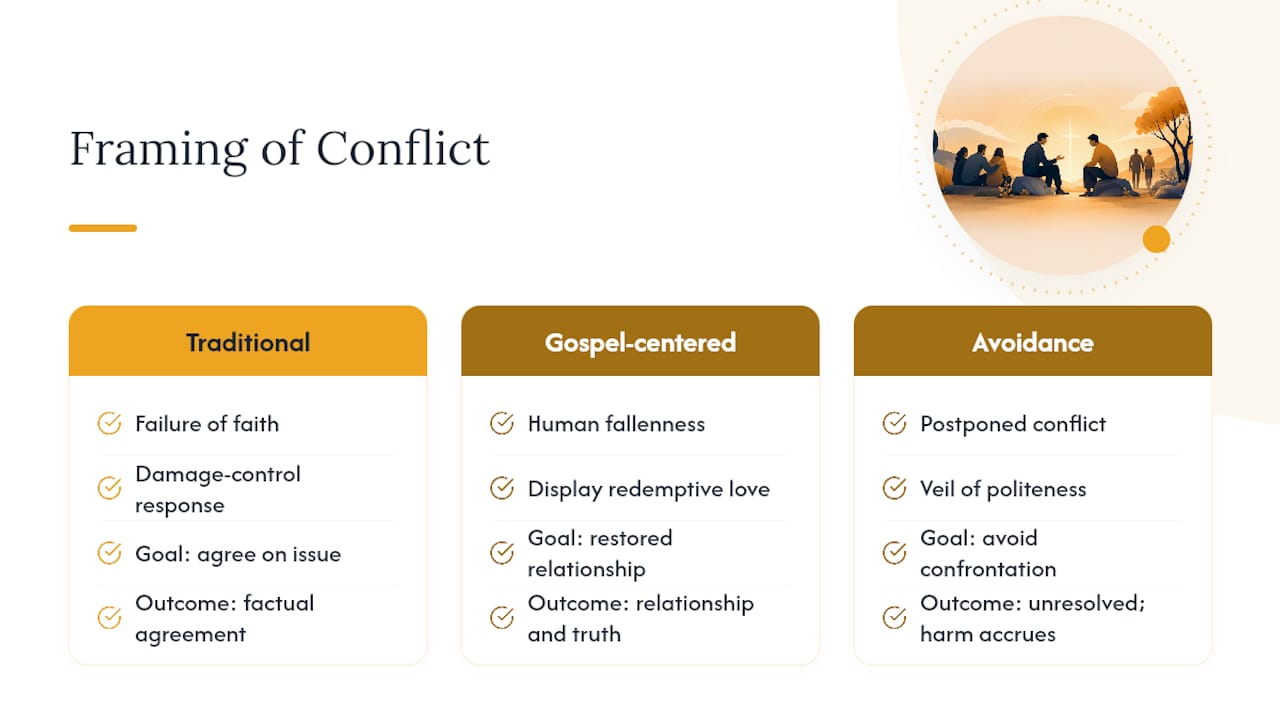
Christian conflict resolution often gets framed as damage control, something you do after faith has already failed to prevent an argument. That framing misses the theological point entirely. Conflict exists because people are fallen and finite, not because someone’s faith broke down. Scripture treats disagreement as an expected feature of community life, not evidence something has gone wrong.
The deeper theological principle is that reconciliation mirrors the gospel itself. Christians believe they were reconciled to God through repentance and grace while still in active rebellion against him, which is the model for how believers are called to treat each other. That’s why Scripture consistently pairs correction with restoration rather than correction with rejection. Gospel-centered advocates for conflict resolution frame disagreement itself as an opportunity to display the same redemptive love shown to them, not merely a problem to manage.
This reframes what “success” looks like. A conflict handled biblically doesn’t necessarily end with both parties agreeing on the original issue. It ends with both parties still committed to the relationship and to truth, even when they see something differently. That’s a significantly lower bar than “we agree now,” and a significantly higher bar than “we stopped talking about it.”
It also explains why avoidance isn’t actually the humble option, even though it often feels like it. Letting an offense fester under a veneer of politeness isn’t peace. It’s postponed conflict with interest accruing.
Where Conflict Actually Starts in Christian Communities
Most church and small-group conflict doesn’t start with theology. It starts with something far more mundane: unmet expectations about roles, unspoken assumptions about how decisions get made, or perceived slights that were never actually intended as slights.
A few patterns show up repeatedly. Leadership transitions create conflict when expectations about vision or process were never made explicit. Volunteer burnout creates conflict when one person feels perpetually overburdened while others feel excluded from serving. Doctrinal disagreements on genuinely secondary issues, worship style, parenting philosophy, political engagement, get treated with the same intensity as core gospel disputes, which turns disagreements into division. And personal offense, someone feeling overlooked, dismissed, or gossiped about, frequently masquerades as a spiritual or theological disagreement when it’s really relational hurt.
Identifying which category you’re actually in changes everything about how to respond. A doctrinal disagreement over a genuinely core issue may need a theological conversation with pastoral input. A hurt feeling dressed up as a doctrinal objection needs an honest, private conversation about the actual wound. Misreading one for the other is why so many church conflicts stall. People argue about the stated issue for months while the real issue, feeling unseen or undervalued, never gets named.
How Prayer Shapes the Whole Resolution Process
Prayer isn’t a formality that opens a hard conversation before the real work starts. It’s part of the discernment process itself, and skipping it usually shows.
Before a confrontation, prayer functions as the self-check step Jesus describes in the “log in your own eye” teaching. It’s genuinely difficult to walk into a hard conversation with humility instead of ammunition unless you’ve first asked God to show you your own part in the conflict. Christians who skip this step tend to walk in already convinced they’re the wronged party, which makes real listening almost impossible.
During the conversation, prayer supports discernment in real time, whether to press an issue further, whether to extend grace, whether the other person’s defensiveness signals guilt or just fear. That kind of read is rarely obvious in the moment, and asking for wisdom mid-conversation is a legitimate practice, not a stalling tactic.
After the conversation, prayer sustains the harder, slower work of reconciliation, particularly when trust rebuilding takes months rather than days. It’s easy to pray fervently before a hard conversation and forget to pray at all during the unglamorous follow-up weeks where trust actually gets rebuilt or quietly abandoned. A short devotional practice built around specific relational needs can keep that follow-up period from losing momentum.
Disagreeing Without Dividing
Not every disagreement in a Christian community is a conflict that needs resolving in the Matthew 18 sense. Plenty of disagreements are simply differences of conviction on matters Scripture leaves open, worship style, parenting choices, views on secondary doctrinal questions, and treating every one of those like a sin issue actually damages unity rather than protecting it.
The key distinction is between core convictions and personal preferences. Core convictions, the nature of Christ, salvation by grace, the authority of Scripture, are worth firm disagreement and even separation when compromised. Preferences, which Bible translation someone reads, whether a church uses hymns or contemporary worship, how a family homeschools versus enrolls kids in school, are not.
Maintaining unity through preference-level disagreement requires a specific discipline: stating your position clearly without implying the other person’s faith is inferior for holding a different one. “I see it differently, and I still respect how you’re walking this out” is a genuinely different sentence than “I see it differently, and I think you’re compromising.” The first preserves the relationship. The second quietly ends it while sounding principled.
Churches that handle this well tend to name the difference explicitly in teaching and conversation, distinguishing “this is core to the faith” from “this is a matter of Christian freedom.” Churches that handle it poorly let every disagreement rise to the level of a test of orthodoxy, which is exhausting and eventually splits communities over things that were never doctrinal battlegrounds to begin with.
What Restoration Looks Like Months Later
Reconciliation isn’t the finish line. It’s the starting point for a slower, less dramatic process: proving over time that the relationship is actually safe again.
The most common mistake after a successful reconciliation conversation is treating it as closed. One honest talk, even a genuinely good one, rarely undoes months of accumulated hurt or distrust on its own. Reconciliation is a bilateral process that typically requires ongoing accountability and gradual trust rebuilding, not a single event that resolves everything permanently.
Practically, this means scheduling a follow-up conversation two or three weeks after the initial repair, not assuming things are fine because no one’s brought it up again. It means watching for whether the changed behavior actually persists, not just whether the apology was sincere in the moment. And it means resisting the urge to bring up the old offense every time a new, unrelated disagreement happens, since re-litigating old wounds during new conflicts is one of the fastest ways to convince someone that reconciliation never actually happened.
Healthy long-term restoration usually has a rhythm: an initial repair, a stated commitment to specific changed behavior, a follow-up check-in, and then a gradual return to normal interaction as trust accumulates evidence rather than promises. Relationships that skip the middle steps and jump straight from conflict to “we’re totally fine” tend to relapse into the same pattern within months, because nothing structural actually changed.
Handling Gossip and Slander Before They Take Over
Gossip is often the thing that turns a manageable disagreement into a church-splitting event, and it usually happens before anyone’s even attempted the Matthew 18 process.
The pattern is predictable: someone feels wronged, doesn’t go to the person directly, and instead processes the hurt by talking to three or four other people first, “just to get perspective.” Each retelling adds interpretation, and by the time the offended party finally does confront the other person, if they ever do, half the church already has an opinion formed on incomplete information.
The corrective is straightforward, even if it’s uncomfortable to practice: if you haven’t spoken to the person directly, you don’t have standing to speak about them to others. That single rule, applied consistently, would eliminate most church gossip before it starts. If you’re on the receiving end of gossip about a conflict you’re in, the direct response is usually best: go to the person spreading it and say plainly that you’d rather they bring concerns to you first.
Slander, spreading claims you know to be false or exaggerated, is a more serious version of the same failure, and it typically requires the same Matthew 18 escalation as any other sin issue: private confrontation first, witnesses if needed, church involvement if the pattern continues. Protecting someone’s reputation while a conflict is being resolved isn’t a nice-to-have add-on to the process. It’s part of what makes reconciliation possible instead of impossible.
A Pastor’s Kid’s View on Getting This Wrong
The mistake I’ve seen most often, in churches and in marriages, is skipping straight to confrontation without the self-check step first. People walk in ready to be heard and never actually get around to listening. The Matthew 18 sequence works precisely because it forces patience most of us don’t want to practice. Repentance and repair aren’t dramatic. They’re slow, specific, and usually unremarkable from the outside. Pursue them anyway.
— Carlos
How a relationship education platform can help you put this into practice
Reading about biblical conflict resolution is one thing. Actually staying calm mid-argument with your spouse is another. There are resources giving Christian couples psychology-informed tools built on the same principles covered here: humility, active listening, and structured repair instead of winging it in the heat of the moment.

If you’re early in recognizing a recurring pattern, the self-paced communication course walks you through the F.I.G.H.T. Plan® at your own speed, with scripts for the exact conversations covered above. If the pattern feels stuck, entrenched defensiveness, repeated blowups, conversations that never actually resolve, private coaching gives you a real person walking through your specific situation rather than a general framework. Couples further along who just need better tools to practice can start with conflict resolution techniques designed for immediate use.
Start with the free assessment to see which option actually fits where you are right now.
Sources
- Gotquestions
- 7 Steps to Conflict Resolution | The Gospel Coalition
- Ephesians 4:26-27 interpretation and guidance | RedeemingGod
- Unity through conflict: a biblical path for Christian marriage | Servants of Grace
FAQ
What Are the “5 C’s” of Conflict Resolution?
Definitions vary across sources, but a common framework includes Communication, Compromise, Collaboration, Calmness, and Commitment. Scripture doesn’t use this exact list, though James 1:19 and Ephesians 4:26 support the calmness and communication elements directly.
What Does Matthew 18 Say About Conflict Resolution?
Matthew 18:15-17 gives a three-step escalation: confront the person privately first, bring one or two witnesses if that fails, and involve the church only if the person still refuses to listen. It applies specifically to situations involving sin, not every minor disagreement.
What Is the Christian Approach to Resolving Conflict?
The Christian approach combines a clear escalation sequence (private, then witnesses, then church) with specific attitudes: humility, quickness to listen, slowness to anger, and a commitment to forgiveness even before reconciliation is complete. Structured tools like the F.I.G.H.T. Plan® from Couples Fight School® translate these principles into practical conversation scripts for couples.
What Does the Bible Say About How to Resolve Conflict?
The Bible calls for private confrontation before public escalation, mediation through trusted third parties when direct resolution fails, and an internal posture of humility and quick listening over quick speaking. Ephesians 4:26 adds a call to pursue peace promptly rather than letting anger calcify into bitterness.
Is Forgiveness the Same as Reconciliation?
No. Forgiveness is a one-sided decision to release an offense, while reconciliation is a two-sided process requiring repentance and rebuilt trust over time. You can forgive someone fully without yet being reconciled to them.
Recommended
- How to Use Scripture for Conflict Resolution in Couples
- 10 Minute Conflict Resolution Worksheets for Couples & Clinicians
- 6 Research Backed Conflict De-escalation Techniques with Ready Scripts