
Unequally Yoked Marriage: What It Means and How to Move Forward
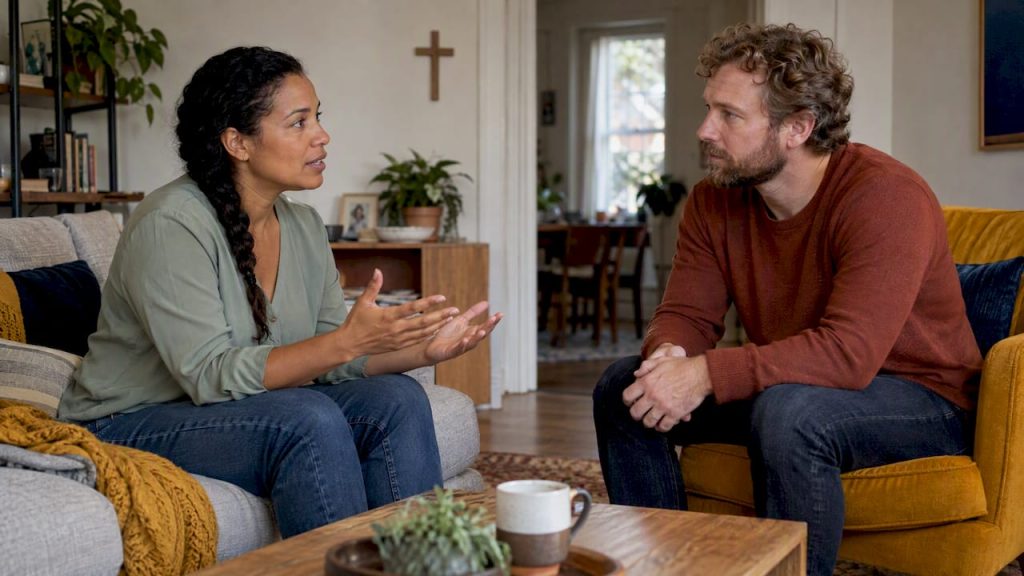
Being unequally yoked in marriage means one spouse’s faith, or lack of it, points in a different direction from the other’s. The phrase comes from 2 Corinthians 6:14 and is usually applied to a believer married to a nonbeliever, but couples also use it for a deeper gap: one spouse prays daily while the other drifts, or two Christians who disagree about church, giving, or how to raise the kids. It is painful, and it is not a verdict on your marriage. Below we cover what the phrase means, what Scripture says about staying, what research finds, and the habits that help couples in a spiritual mismatch stay close.
TL;DR
- “Unequally yoked” describes a marriage where spouses differ sharply in faith or spiritual commitment. The differences often show up in parenting, money, friendships, and church life, not only in worship.
- 1 Corinthians 7 tells a believer not to divorce an unbelieving spouse who is willing to stay. It also says that if the unbeliever leaves, the believer is not bound.
- Research on mixed-belief couples shows varied outcomes. Some believers’ faith deepens, some nonbelievers soften, and some things stay the same.
- What helps most: curiosity over persuasion, soft conversations, respect for each other’s practices, repair after arguments, and outside support when you are stuck.
Table of Contents
- What “unequally yoked” actually means
- How the gap shows up in daily life
- What the Bible says about staying
- What research says about mixed-belief couples
- Practical ways to stay connected
- A worked example
- When to get outside help
- Perspective: what we see in couples
- Tools to work on this together
- FAQ
- Sources
What “unequally yoked” actually means
A yoke is the wooden beam that joins two animals so they pull a load together. If one pulls left and the other right, the work is exhausting and the field never gets plowed. Paul uses that picture in 2 Corinthians 6:14 to warn believers against binding themselves closely to people whose spiritual direction is fundamentally different. Commentary on the verse notes the context is broader than marriage alone, though marriage is the closest partnership most people have.
In everyday use, the phrase covers several situations:
- A believer married to a nonbeliever. This is the classic case, and the one most searches are about. It includes couples where one spouse converted after the wedding.
- Two professing believers at very different levels of commitment. One wants to serve, tithe, and pray together. The other attends at Christmas and Easter.
- Different traditions. A Catholic and an evangelical, or a Christian and a spouse from another religion, may share a belief in God but disagree on almost everything about practice.
- A spouse who has changed. Many people in this situation did not marry a mismatch. Their spouse deconverted, or they themselves became more serious about faith.
That last group matters. Searching “spiritual mismatch in marriage” often means something happened in the middle of the marriage. You did not make a careless choice at the altar. You are working with a situation that developed, and you can work with it honestly.
How the gap shows up in daily life
The disagreement is rarely about theology alone. Utah State University Extension points out that religious differences can affect parenting, finances, and friendships, and that even spouses who attend the same congregation can differ over attendance and participation. Here is what that tends to look like at home.
Sundays and the calendar
One spouse wants the whole family in the pew. The other wants a slow morning. Small scheduling choices begin to feel like referendums on who matters more, God or your spouse. When every Sunday carries that weight, the argument is no longer about church.
Money
Tithing is a common flashpoint. A believer who sees giving as obedience may feel resentful or anxious when the household budget does not reflect it. The other spouse may see the same check as money taken from the family’s goals.
Children
Baptism, dedication, Sunday school, bedtime prayers, what to say when a child asks if God is real: these questions arrive early and keep coming. If parenting is where the tension lives for you, our guide to resolving parenting differences in marriage gives research-backed scripts that work for faith disagreements too.
Friends and community
A believing spouse often builds a social world through church. The other can feel like a guest in their own marriage at those events, or excluded from the friendships that matter most to their partner. Loneliness runs in both directions.
Intimacy
Spiritual intimacy, praying together, talking about meaning, sharing what moves you, is something many believers expect from marriage. Missing it can feel like grief. Meanwhile the nonbelieving spouse may feel judged, or like a project. Neither feeling is a character flaw. Both are signals worth discussing.
What the Bible says about staying
Many Christians in this situation carry a lot of guilt, and some have been told the marriage itself is a sin. Scripture speaks to married people more gently than that.
In 1 Corinthians 7, Paul addresses believers who are already married to unbelievers. According to the USCCB text of 1 Corinthians 7, a Christian should not divorce an unbelieving spouse who is willing to continue living with them. Verse 15 adds that if the unbelieving spouse separates, the believer may let the separation happen and is not bound in such cases, because God has called believers to peace.
Two things follow from that:
- Being unequally yoked is not, by itself, grounds for leaving. A believing spouse who stays is not living in disobedience. Crossway’s reading of the passage takes the same view: do not divorce a spouse who consents to remain, and allow separation if the unbeliever chooses it.
- The warning in 2 Corinthians 6 is mainly about entering a union, not about abandoning one. Thoughtful pastors distinguish between advising a single person who is dating and advising a person already married.
The same chapter of Paul’s letter, in the verse about widows, says a woman may remarry “provided that it be in the Lord.” That line is often cited to encourage believers to marry other believers going forward. It does not say anything harsh about people already in the marriage.
If you are engaged or dating and weighing a relationship with someone of a different faith, take the questions seriously now. Our list of Christian premarital questions walks through faith, money, children, and conflict before the wedding, when conversations are easiest.
A caution: Scripture is not a script for tolerating abuse. If your spouse threatens or harms you, physically, emotionally, or financially, safety comes first. Contact the National Domestic Violence Hotline at 1-800-799-7233 and talk with a pastor or counselor who takes abuse seriously. That is a different problem from a faith gap, and it deserves a different response.
What research says about mixed-belief couples
Popular articles about being unequally yoked tend to predict doom. The data is more mixed. A 2021 qualitative study in Pastoral Psychology interviewed couples in which one partner believed in God and the other did not, including Catholic believers paired with atheist or agnostic partners. Outcomes varied. Some nonbelieving partners became more open to the possibility of God, some did not change, and some believers reported that their faith was strengthened through the relationship.
None of that means a gap is easy or that you should expect your spouse to convert. It does mean there is no single script. Some couples build a good marriage across the divide, and what predicts the outcome is usually how the two of you treat each other, not which box each of you checks.
That fits with a 2014 Christian Century report on interfaith marriages, which describes couples finding common ground by talking about shared values rather than requiring identical beliefs. A couple who both want honesty, generosity, and a home where children feel loved already have a foundation to work from, even when their metaphysics differ.
Practical ways to stay connected
Here is how we would translate the research and our own work with couples into habits. None of these is a technique to change your spouse’s beliefs. That is the first thing to let go of.
1. Name the difference and plan for it
Utah State University Extension recommends acknowledging the difference openly and planning for its effects instead of hoping it will resolve itself. Sit down once, with no deadline pressure, and ask: what are the three or four places this actually touches our week? Holidays, kids, giving, church events. Decide each one on purpose.
2. Explore each other’s faith story
Drawing on John Gottman’s relationship guidance, the same USU page suggests exploring each partner’s faith identity. Try these questions, taking turns, with no rebuttals:
- What was religion like in the home you grew up in?
- When do you feel most at peace?
- What do you hold tightly, and where are you flexible?
- What would you most like me to understand about how you see this?
The goal is to understand, not to win. Many nonbelieving spouses discover they have been quietly hurt by a church or a parent. Many believers discover their spouse respects their faith more than they thought.
3. Start soft
How a conversation begins usually decides how it ends. “You never take this seriously” starts a fight. “I miss praying with you, and I wanted to tell you that without pressure” starts a conversation. Make your request specific, own your feeling, and ask for something small. Our piece on how to defuse conflict with your partner gives wording you can borrow.
4. Participate respectfully without pretending
A nonbelieving spouse can attend a baptism or Christmas Eve service as an act of love, without claiming belief. A believing spouse can skip a Sunday event, or accept a weekend that does not revolve around church. Honest, respectful participation builds more trust than faked enthusiasm. Some Catholic spouses find small rituals meaningful, such as choosing a patron saint for marriage, as something a couple can discuss together even when they see it differently.
5. Set boundaries on persuasion
Trying to change beliefs is the fastest way to turn a difference into a wound. If you are the believer, agree that you will not use guilt, sermons left on the nightstand, or the children as leverage. If you are the nonbeliever, agree that you will not mock or minimize. Those agreements are worth writing down. Our relationship boundary examples include scripts for exactly this kind of limit.
6. Make repair attempts
You will have the argument again. What matters is whether either of you can reach across afterward: a touch, a joke, an apology that names what you did. Repair is a skill, not a personality trait. Gottman-based guidance, as summarized by USU, treats it as one of the main things couples can practice.
7. Build community on both sides
The believer needs fellowship, and that is legitimate. The nonbeliever needs to not be the outsider at every event. Look for a church group that welcomes spouses of any belief, and find activities the two of you share that have nothing to do with faith. Our article on the church community’s role in marriage support covers how congregations can help rather than pressure.
A worked example
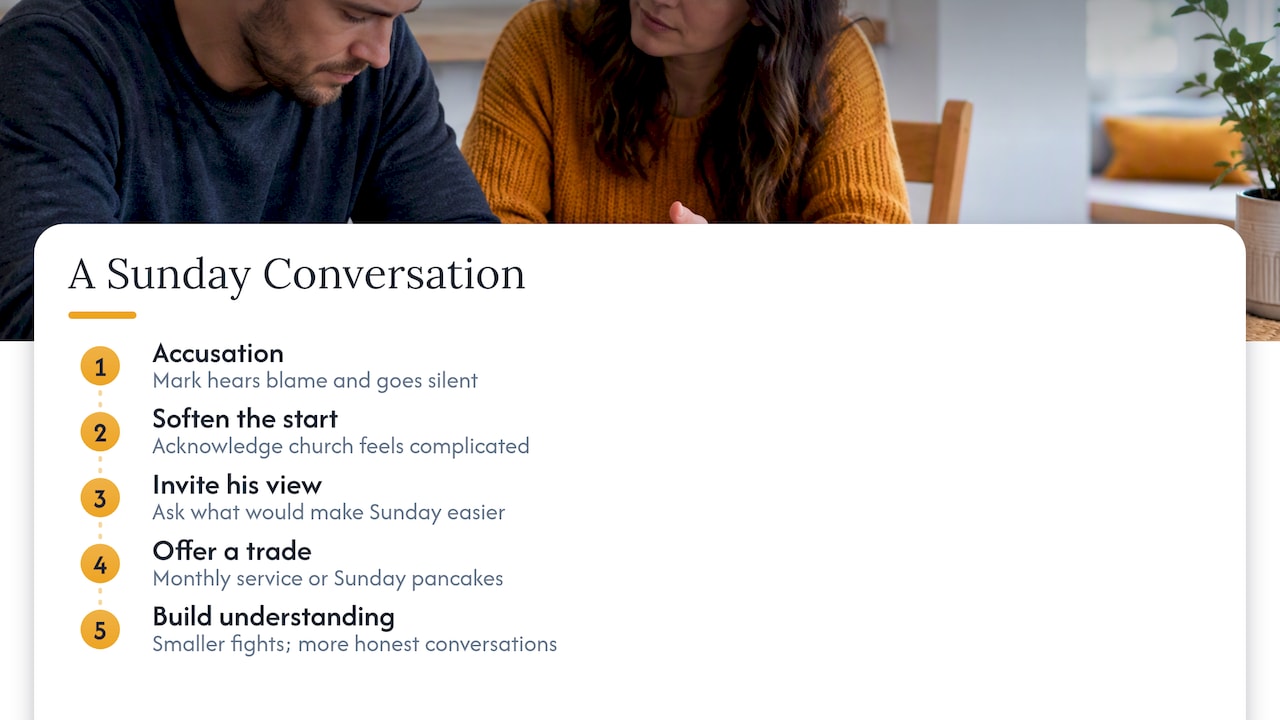
Here is a composite scenario, not a real couple. Dana is a churchgoing believer. Her husband Mark stopped attending after a painful experience with a former pastor. Their fights are always about Sunday morning.
When Dana says, “You could at least come for the kids,” Mark hears an accusation and goes silent. A softer start sounds different: “I know church is complicated for you. I’d love to find one way we can share Sunday that you’d actually enjoy. Can I hear what would make it feel less awful?”
Mark may answer that he would come once a month to a short service, or that he would rather make Sunday pancakes while Dana takes the kids. Either is a trade. The point is that they bargain as partners instead of defending positions. Over weeks, Dana learns about the hurt behind his absence, and Mark sees that her faith is not a rejection of him.
That is the kind of progress you can expect: smaller fights and more honest ones, not necessarily a shared creed.
When to get outside help
Try a counselor when you notice any of these:
- The same argument recurs with no movement for months.
- One of you feels contempt or has started to withdraw emotionally.
- Parenting decisions are stalled because of the faith gap.
- One spouse is considering leaving.
USU Extension suggests seeking a therapist who specializes in working with interfaith couples. If you are a Christian couple, a faith-informed approach can help too; we explain what to expect in the benefits of faith-based marriage counseling. A pastor can also be a strong first stop, and pastoral counseling’s role in a marriage crisis describes when to bring in a licensed clinician as well. If your spouse is not a believer, ask any counselor beforehand whether they will respect both of you, because a spouse who feels ambushed will not return.
Perspective: what we see in couples
We are licensed mental health professionals, and we have worked with thousands of couples. Here is what we notice about faith differences.
First, the faith gap is almost never the real problem. It is usually the container for older problems: feeling unseen, feeling judged, feeling unsafe to be honest. When couples learn to talk about those, the Sunday argument shrinks.
Second, the believing spouse often carries a hidden burden. They are grieving the marriage they pictured, and many have been told, kindly or not, that they should have known better. That shame makes them either push harder or go quiet. Neither helps. Grief needs company, not a campaign.
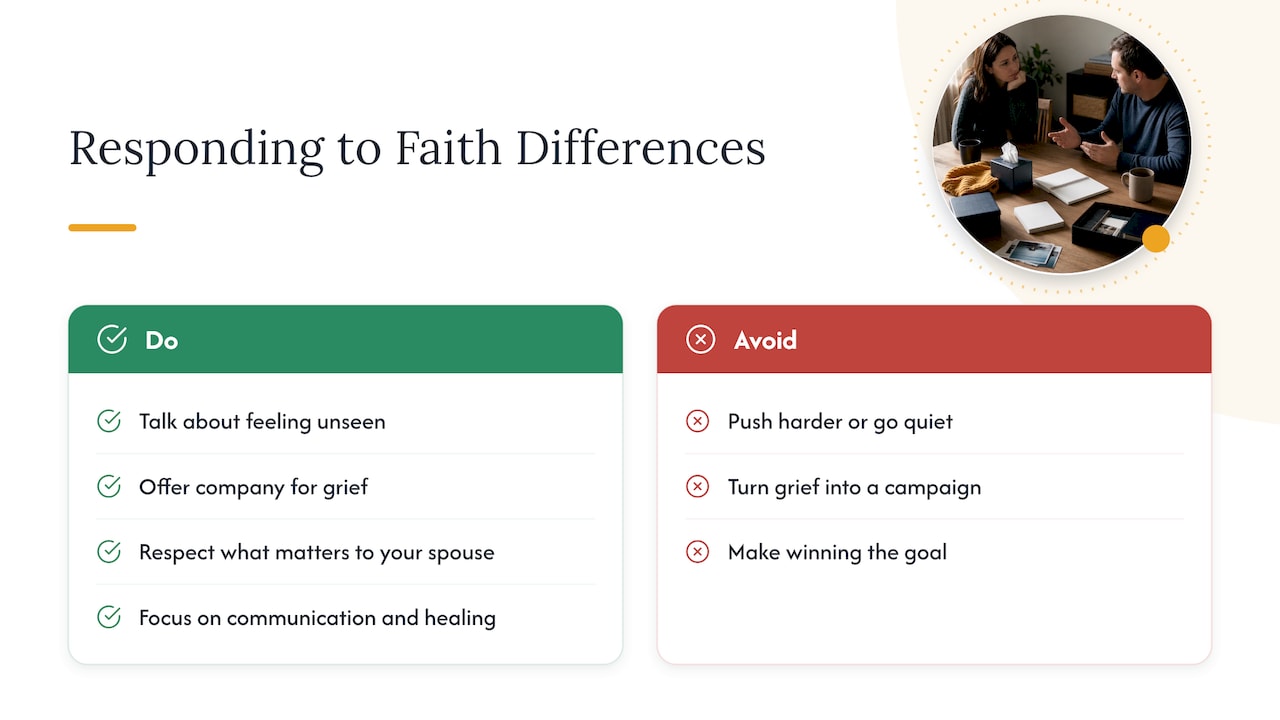
Third, unconditional respect is not weakness. The couples who do best are not those who agree on everything. They are those who can say, “I do not share this, and I love that it matters to you,” and mean it.
This is the reason we built the F.I.G.H.T. Plan® around communication, emotional regulation, and healing rather than around winning. Your yoke is not a problem to be solved in one conversation. It is a way of pulling together that you can learn.
— Carlos
Tools to work on this together
If you want structure instead of improvising, we have materials for different budgets and stages:
- The Christian F.I.G.H.T. Plan Workbook is a faith-centered guide to conflict resolution for couples, priced from $9.99 to $20.00 depending on format.
- Stop the Fighting: The Couples Communication & Conflict Resolution Course is $149.00 and teaches the full skill set at your own pace.
- Online couples coaching gives you a therapist-trained guide for your specific situation; the VIP Private Coaching package of four sessions is $997.00.
- The 6 Hours Couples Intensive is $1,995 for couples who want concentrated work in one stretch.

If you are not sure where to start, begin with the workbook. It is the lowest-cost way to find out whether a structured approach fits the two of you. Browse all options in the Couples Fight School shop.
FAQ
Is it a sin to stay married to an unbeliever?
No. First Corinthians 7 tells a believer not to divorce an unbelieving spouse who is willing to continue the marriage. The warning against being unequally yoked is mainly guidance for people choosing a partner, not a command to leave one.
Can I leave if my spouse doesn’t share my faith?
The faith gap alone is not a biblical reason to divorce. If your spouse chooses to leave, 1 Corinthians 7:15 says you may let the separation happen and are not bound. Safety is a separate matter: if you are being abused, seek help from a domestic violence advocate and a counselor right away.
Can a couple be happy with different beliefs?
Many couples are. A 2021 study of believer and nonbeliever couples found varied outcomes rather than one pattern. Couples who talk openly, avoid pressuring each other, and build on shared values tend to have the sturdiest footing.
How do I talk to my spouse about faith without a fight?
Pick a calm time, start with what you feel instead of what they did, and ask a question you are genuinely curious about. Avoid trying to change their mind. If the conversation heats up, pause and return to it later, then make a repair attempt.
Should we see a counselor?
If the same argument keeps repeating, or if one of you is withdrawing, yes. Look for a therapist experienced with interfaith couples, or a faith-informed counselor both of you agree to. Confirm before the first session that both spouses will be respected.
Sources
- 1 Corinthians, Chapter 7 (USCCB)
- Working Through Religious Differences In Marriage (Utah State University Extension)
- Unequally Yoked? Religion and Spirituality in Couples (Pastoral Psychology, 2021)
- In mixed faith marriages, focus is on values, not beliefs (Christian Century, 2014)
- An Open Letter to the Spouse of an Unbeliever (Crossway)
- What Does Unequally Yoked Mean in the Bible? (Christianity.com)
- Choose Your Patron Saint for Marriage in 4 Steps
Recommended
- 7 Steps to Christian Marriage Boundaries: Therapist Backed, Biblical
- Lonely in Marriage: Why It Happens and How to Reconnect
- Create a Shared Vision for Marriage: A Practical Guide