
Emotional Flooding in Marriage: What to Do When You’re Flooded

Emotional flooding is the moment an argument overwhelms your nervous system so completely that you can no longer think, listen, or respond the way you want to. In a marriage, the fix is rarely to try harder in the moment. It is to recognize the flood early, say out loud that you need a break, step away for at least 20 minutes to calm your body, and then come back to the conversation at a time you both agreed on.
This guide explains what flooding is, how to spot it in yourself and your spouse, why it wrecks problem-solving, and exactly what to do when it hits.
TL;DR
- Flooding is a physical overload during conflict: your body goes into fight-or-flight and your thinking gets disorganized, so productive conversation stops.
- The signs show up before the explosion or the shutdown. Learn your own early warning signals and your personal trigger topics.
- When you notice it, say so, ask for a break, and step away for at least 20 minutes to do something calming. Do not spend the break rehearsing the argument.
- Agree on when you will return, and return. A pause is not an escape from the conversation.
- If flooding is constant, or one partner is abusive, get professional help. Couples counseling is not the right tool when abuse is involved.
Table of Contents
- What emotional flooding means in a marriage
- Signs you are emotionally flooded
- What causes flooding during marital conflict
- What flooding does to communication and your marriage
- What to do when you feel flooded: a step-by-step plan
- How to support a spouse who is flooded
- How and when to return to the conversation
- Our perspective: flooding is a skill problem, not a love problem
- Prevent flooding before the next argument
- When to get professional help
- Practice these skills with us
- FAQ
- Sources
What emotional flooding means in a marriage
Researchers describe emotional flooding as an inability to keep functioning in an effective, organized way in response to a partner’s negative emotions. People who are flooded often feel overstimulated, overwhelmed and mentally scrambled, and the body can shift into a fight-or-flight response, according to a study published in the journal of the National Institutes of Health archive.
The concept comes from the work of psychologist John Gottman, who in 1993 defined flooding as a reaction to a partner’s negative emotions that feel unexpected, unprovoked, intense, overwhelming and disorganizing, to the point that the person will do almost anything to end the interaction (Journal of Family Psychology, 2019). When the idea was first introduced, it was about married couples specifically, as WebMD notes.
That last phrase matters. “Do anything to end the interaction” is why flooded spouses slam doors, say cruel things they do not mean, go silent, or leave the house. It is not a character flaw. It is a body trying to get out of a situation it reads as dangerous, even when the danger is only your partner’s raised voice or a familiar criticism.
Flooding is not the same as being angry
Anger is a feeling. Flooding is what happens when the intensity of the feeling exceeds what your system can process in that moment. You can be angry and still think clearly. Once you are flooded, the part of you that listens, considers your spouse’s point of view, and chooses words carefully is simply not available.
Signs you are emotionally flooded
Everyone floods a little differently, but the pattern is consistent: your body and your thinking change before your words do. Common signals people report include:
- A pounding heart, tight chest, or shallow breathing
- A hot face, clenched jaw, tense shoulders, or a churning stomach
- Mental static: you cannot follow what your spouse is saying, or your mind goes blank
- An urgent need to escape, win, or make it stop at any cost
- Tunnel vision, where everything your spouse says sounds like an attack
- Going quiet, flat, or numb, which can look like calm from the outside but is not
The research describes the urge to escape or withdraw as a core part of flooding (PMC, 2019). That is why one spouse may explode and the other stonewall during the same argument. Both can be flooded. They are just flooded in different directions.
Purdue Extension recommends starting with the body: notice the physical signs of strong emotion first, because they usually arrive before you have the words for what you feel (Purdue Extension, 2022).
Write your own early-warning list
This is the most useful five minutes in this article. Think about your last three bad arguments and finish these sentences:
- Right before I lost it, my body felt like…
- The first thought that went through my head was…
- The thing my spouse did or said just before was…
The answers become your personal early-warning system. The earlier you catch the signal, the easier the next step is.
What causes flooding during marital conflict
Flooding is not caused by one thing. Two ingredients matter most, according to the 2019 research: the interpersonal context, meaning how often and how intensely your partner shows anger, and your own individual threshold for being overwhelmed (PMC, 2019). The same argument can flood one person in thirty seconds and another not at all.
Your trigger topics
Utah State University Extension points out that knowing your personal triggers, such as specific topics like money or parenting that have historically led to high emotional reactivity, helps you enter hard conversations more consciously (USU Extension, 2026). If every conversation about in-laws, spending or housework ends in the same fight, that topic is probably tied to an old sore spot. Our guide to emotional triggers in relationships walks through how to identify yours.
Your history and your spouse’s patterns
A harsh tone from a parent in childhood, a past betrayal, or a partner who tends to criticize can all lower your threshold. If your spouse’s anger is frequent and intense, your system learns to brace for it, and you flood sooner. If you tend to deliver frequent, intense anger yourself, your spouse is the one flooding, and you may never see it because they look like they are tuning out.
What flooding does to communication and your marriage
The cost is practical, not just emotional. In the 2019 study, couples in which at least one partner reported high flooding were less effective at solving problems (Journal of Family Psychology, 2019). A 2024 chapter reviewing the research reached a similar conclusion: couples prone to flooding resolve conflict significantly less effectively (IntechOpen, 2024).
The reason is cognitive. Once flooded, people are prone to distortions such as assuming their partner has bad intentions, which makes constructive resolution close to impossible (IntechOpen, 2024). So the argument you have while flooded is not really about the dishes or the budget. It is two overloaded nervous systems reading each other as enemies.
Over months and years, this builds a predictable cycle:
- A topic comes up and one or both of you floods.
- The fight goes badly, or one person shuts down.
- Nothing is resolved, so the topic returns.
- Each round makes you more braced for the next, which lowers your threshold further.
If that loop sounds familiar, you may also recognize it in our piece on communication gridlock in marriage.
What to do when you feel flooded: a step-by-step plan
The guidance from university extension programs and the American Psychological Association’s discussion of de-escalation lines up well. The core idea is to pause, notice what is happening in your body, stop the hostile pattern, and only then talk about the difference (APA, 2024). Here is how that looks in a real argument.
Step 1: Catch the signal
Use your early-warning list. The moment you notice your heart racing, your jaw tightening or your mind blanking, treat that as the cue. Do not wait to see if it passes.
Step 2: Say it out loud, with an “I” statement
USU Extension, citing Dr. Rachel Diamond, recommends identifying early warning signs, naming your internal state with “I” statements, and asking for an intentional time-out (USU Extension, 2026). Try:
“I’m getting flooded and I can’t think straight. I want to have this conversation well, so I need a break. Can we pick this back up at 8:30?”
Notice what this does: it names your state without blaming, it states that you are not abandoning the topic, and it sets a time to return. Explaining that the break is not abandonment is a key part of making the pause work, according to the same source.
Step 3: Step away for at least 20 minutes
The guidance is to stop the argument, vocalize your need for a break, and step away to regulate yourself for at least 20 minutes (USU Extension, 2026). Purdue Extension suggests deep breaths or a short walk (Purdue Extension, 2022). A slow, deliberate breathing routine is a good place to start, and this breathing exercise for emotional overload is one example of how to calm your body fast.
The key is to choose calming, non-stimulating activities. Do not scroll through angry texts, call a friend to build your case, or replay the fight in your head. That keeps your body in fight-or-flight and the break accomplishes nothing. Our full walkthrough of time-outs for couples includes scripts for the request and the return.
Step 4: Look underneath the anger
Once your body has settled, ask what is under the anger. Purdue Extension recommends identifying the deeper feelings beneath anger or frustration, such as hurt, sadness or disappointment, because sharing those usually communicates your experience more clearly than the anger does (Purdue Extension, 2022).
Step 5: Return at the agreed time
Come back at the time you set. We cover this more fully below, because it is where many couples slip.
How to support a spouse who is flooded
Watching your spouse flood is hard, especially if you are the one they are flooding about. A few principles help you avoid pouring fuel on it.
Do not chase. If your spouse asks for a break, let them take it. Following them from room to room to finish the point is the fastest way to deepen the flood.
Agree on a time, not a vague “later.” The break only works if both of you believe the conversation will resume. Naming a time protects the relationship from the feeling of being abandoned.
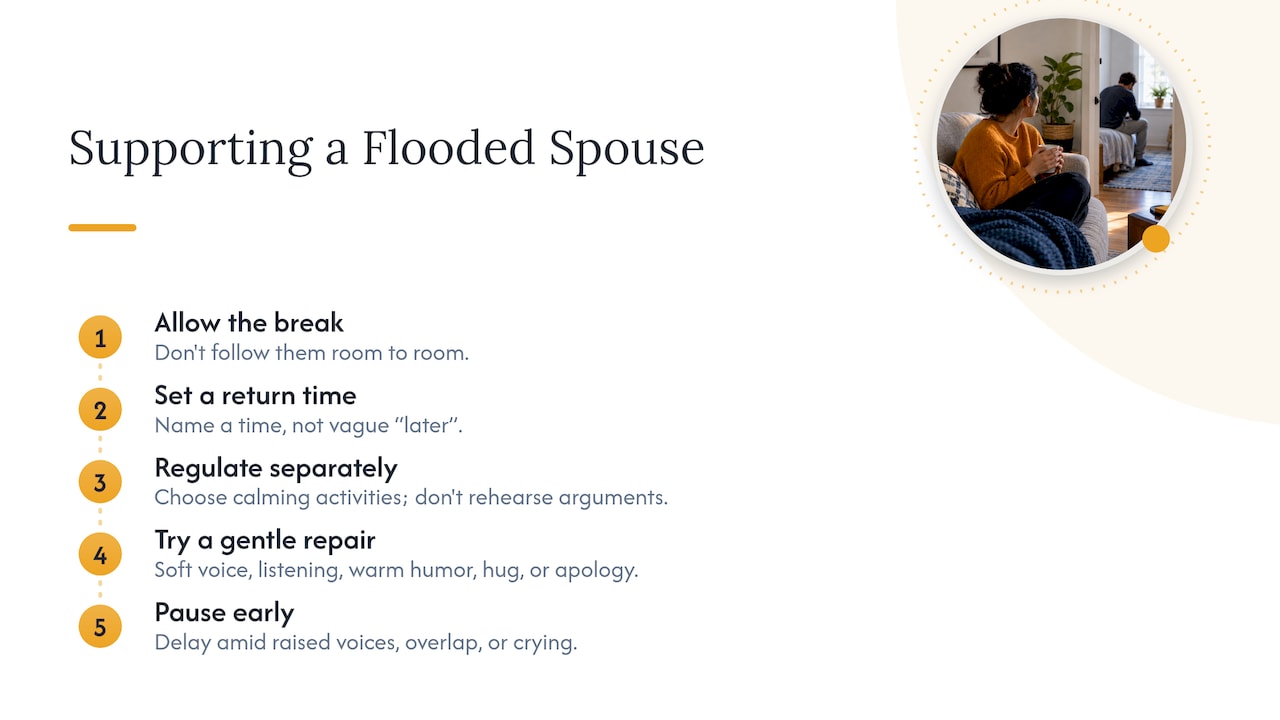
Use your own break well. The pause is for both of you. Use calming activities rather than rehearsing your arguments (USU Extension, 2026).
Try a repair attempt before things boil over. A University of Georgia couples-education guide describes repair attempts as a soft voice, nondefensive listening, appropriate humor, a hug or an apology, all aimed at keeping negativity from escalating and helping a partner calm down (University of Georgia, 2013). Humor only counts if it lands as warmth, so skip anything at your spouse’s expense.
Pause early when you can see it. The University of Southern California advises delaying a hard conversation when both of you are talking over each other, raising your voices or crying, and owning your own feelings rather than assigning them to your partner (USC).
If you are specifically trying to stop arguments with your husband, our therapist scripts for ending an argument give you ready-to-use wording.
How and when to return to the conversation
The return is half of the repair. Without it, a time-out becomes avoidance, and the unresolved issue comes back angrier.
Return at the agreed time, when both of you feel better, with the goal of working through the challenge as a team rather than winning (USU Extension, 2026). Purdue Extension adds that you will do better choosing a calmer time, place, tone and wording, and starting with “I feel” statements instead of blame (Purdue Extension, 2022).
A simple return script:
- Thank each other for coming back.
- Each person shares what they felt, not what the other did wrong.
- Each person repeats back what they heard.
- Then, and only then, talk about the actual problem.
If either of you floods again, pause again. Two pauses in one evening is not failure. It is the process working.
Our perspective: flooding is a skill problem, not a love problem
As licensed mental health professionals who teach couples to fight better, we see the same misunderstanding constantly. Couples assume that if they flood during arguments, their marriage must be fundamentally broken, or that one of them is simply “too emotional” or “too cold.” Neither is true. Flooding is a predictable human response, and responses can be trained.
That is the idea behind the F.I.G.H.T. Plan®, our structured framework for communication, emotional regulation and healing. We build it on the belief that most couples are not short on love. They are short on tools they were never taught. The couples who make the most progress are usually not the ones who never flood. They are the ones who agree on a pause, protect it, and keep returning to each other afterward.
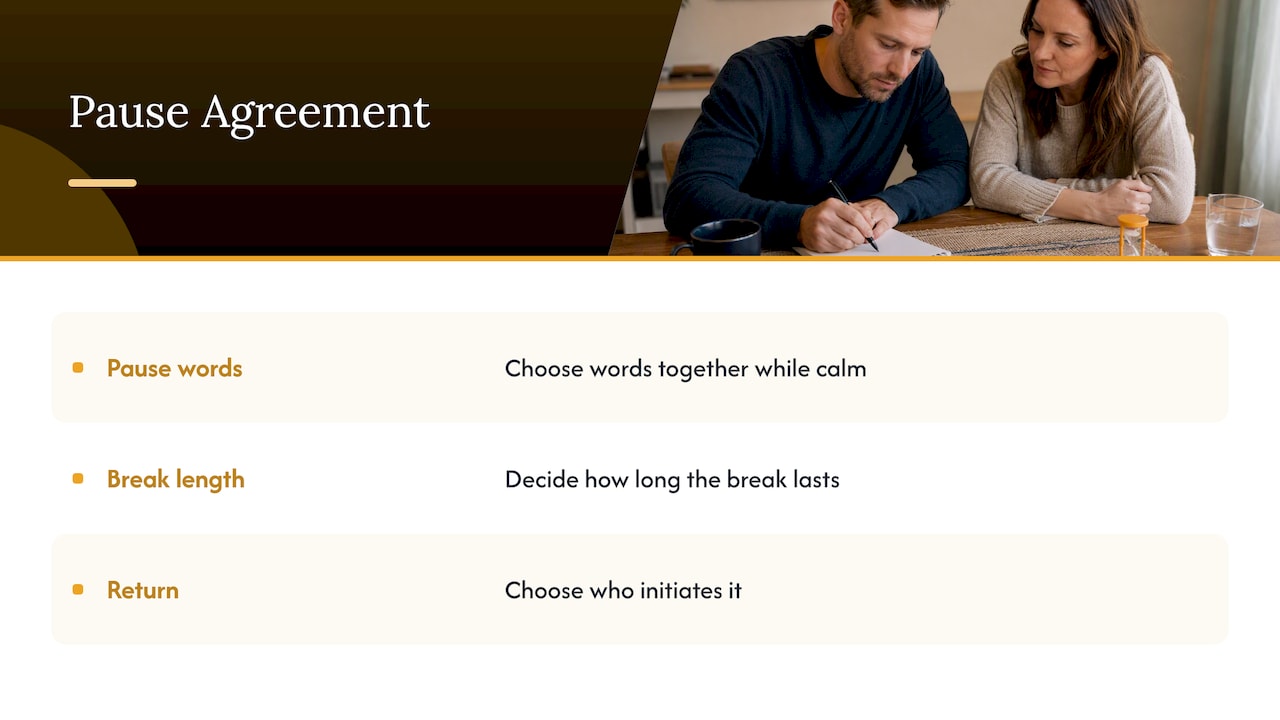
If we could give you one thing to try this week, it is the agreement. Sit down when you are both calm and decide what your pause words are, how long the break lasts, and who initiates the return. Doing this before a fight makes the pause feel like part of your marriage’s rules instead of a tactic one of you is using against the other.
— Carlos
Prevent flooding before the next argument
Managing flooding in the moment is essential. Reducing how often it happens is better.
Set ground rules when you are calm
The University of Georgia guide recommends agreed conflict rules such as no name-calling, no insults, no raised voices, attentive listening, and a mutually agreed time-out when tension escalates (University of Georgia, 2013). Our article on argument boundaries in marriage shows six steps for setting these before the next fight.
Pick your moments
Do not start loaded topics at 11 p.m., when one of you is hungry, or right when someone walks in the door. If you know money is a trigger, schedule the conversation and tell your spouse the topic ahead of time so neither of you is ambushed.
Build a regulation habit
Practice slow breathing and short walks on ordinary days so the tools are familiar when you need them. Our emotional regulation guide for couples and de-escalation tools are good places to build that habit.
When to get professional help
Self-help works for many couples, but not all. Consider a licensed marriage and family therapist if communication is difficult, conflict is more frequent or intense, or you keep repeating unhealthy patterns. USU’s human development department notes that therapy can help interrupt destructive patterns and that there is no wrong time to seek guidance (USU, 2025).
One important exception: if your spouse is abusive, flooding techniques and couples counseling are not the answer. The National Domestic Violence Hotline says couples counseling is not recommended when one partner is abusive, because abuse is not a relationship problem, therapy can expose the abused partner to retaliation, and the abusive partner may use what is disclosed against them (The Hotline). If you are afraid of your partner, contact the hotline or a local domestic violence advocate before attempting any of the steps above.
Practice these skills with us
If you want a structured way to build these habits together, we offer tools at several levels. The Stop the Fighting course is $149 and teaches communication and conflict resolution step by step. The F.I.G.H.T. Plan workbook runs $14.99 to $25 depending on format, and the F.I.G.H.T. Plan Couples Conflict Toolkit is $27. You can see all of them in our shop.
If you would rather work with someone directly, our online couples coaching offers private sessions tailored to your situation, including a four-session VIP package at $997.
FAQ
What does emotional flooding feel like in a marriage?
It usually feels like your body is in alarm: racing heart, tense muscles, a mind that goes blank or races. You may feel an overwhelming urge to escape, to win, or to make your spouse stop talking. Researchers describe it as feeling overstimulated, overwhelmed and mentally disorganized (PMC, 2019).
How long does it take to calm down after being flooded?
Plan on at least 20 minutes away from the conversation, doing something calming like deep breathing or walking (USU Extension, 2026). Some people need longer, especially after a heated or emotionally loaded argument. Agree on a return time, and if you are still flooded when it arrives, ask for a bit more time and name a new one.
Is taking a break the same as stonewalling?
No. Stonewalling is shutting down or leaving without explanation, so your spouse is left wondering whether the conversation will ever resume. A real time-out names what is happening, sets a time to return, and then happens. The difference is the promise to come back.
My spouse floods and I do not. What should I do?
Slow down, lower your volume, and let them take a break when they ask. Avoid following them or pushing for a resolution while they are overwhelmed. Research suggests that how often and how intensely a partner shows anger affects how likely the other person is to flood (PMC, 2019), so your tone matters more than you may realize.
Can couples counseling fix emotional flooding?
Often it helps, because a therapist can teach regulation skills and help you interrupt the patterns that trigger flooding. It is not appropriate when one partner is abusive. In that case, speak with a domestic violence advocate first.
Sources
- Emotional Flooding in Response to Negative Affect in Couple Interactions (PMC)
- Journal of Family Psychology, 2019: emotional flooding study
- WebMD: Emotional Flooding: Types, Symptoms, and More
- Purdue Extension: Handling Conflict with Your Partner (HHS-742-W)
- USU Extension: When Emotions Take Over: Learning to P.A.U.S.E.
- IntechOpen: Emotional Flooding in Couple Relationships
- APA: Treating Challenging Couples Cases
- University of Georgia: Manage conflict guide
- USC: Not all conflict is avoidable
- USU: 10 Signs You Might Benefit from Seeing a Marriage and Family Therapist
- The National Domestic Violence Hotline: couples therapy with an abusive partner
- Breathing exercise for emotional overload
Recommended
- Emotional Neglect in Marriage: Signs and How to Heal
- How to Agree to Disagree Respectfully as a Couple
- Stop Contempt in Marriage: A Therapist’s Plan for the Next Fight
- How to Break the Emotional Withdrawal Cycle in Couples