
Stop Fights in 5 Seconds: Therapist De Escalation Tools for Couples

The fastest way to stop a fight from spiraling is to use a brief regulation move, call a short agreed pause, and follow it with a genuine repair attempt. These are therapist-taught de-escalation techniques, not willpower tricks. Even a five-second pause can lower aggression between partners in the heat of an argument, which is why Carlos Todd and the team at Couples Fight School teach couples to practice these moves before they need them.
TL;DR:
- A five-second pause during a heated argument can significantly reduce aggression by interrupting flooding and giving both partners a chance to regulate.
- Building an agreed pause plan with clear signals, return times, and a focus on regulation rather than rehashing ensures the technique remains effective.
- Calming body movements, such as longer exhalations and softening gaze, help regulate stress hormones and prevent escalation in the moment.
- Using small repair attempts early in a fight, like a shared phrase or gesture, helps reset the tone before emotions become uncontrollable.
- Practicing these de-escalation moves regularly during calm moments builds automatic responses for when real conflicts occur.
Table of Contents
- What are de-escalation techniques for a heated argument?
- How do you build a pause plan that doesn’t turn into avoidance?
- Co-regulation: how to calm your partner without arguing them down
- Repair attempts: the small moves that stop a spiral mid-fight
- How do you make these techniques stick when a real fight hits?
- A clinician’s take on why couples skip the steps that actually work
- Where to learn these techniques with guided practice
- Sources
What are de-escalation techniques for a heated argument?
De-escalation techniques are the specific words, body movements, and timing choices that interrupt a fight before it turns into a spiral neither partner can walk back from. They work because arguments rarely escalate from disagreement alone. They escalate because one or both partners hit a state researchers call flooding, where the nervous system floods with stress hormones and the brain’s higher-level reasoning shuts down. You cannot out-argue flooding. You have to regulate through it.
That is the whole logic behind these techniques: buy your nervous system a few seconds, buy the conversation a longer pause if needed, then repair the moment before resentment sets in. Here is what that looks like in the body, in the room, and in your calendar.
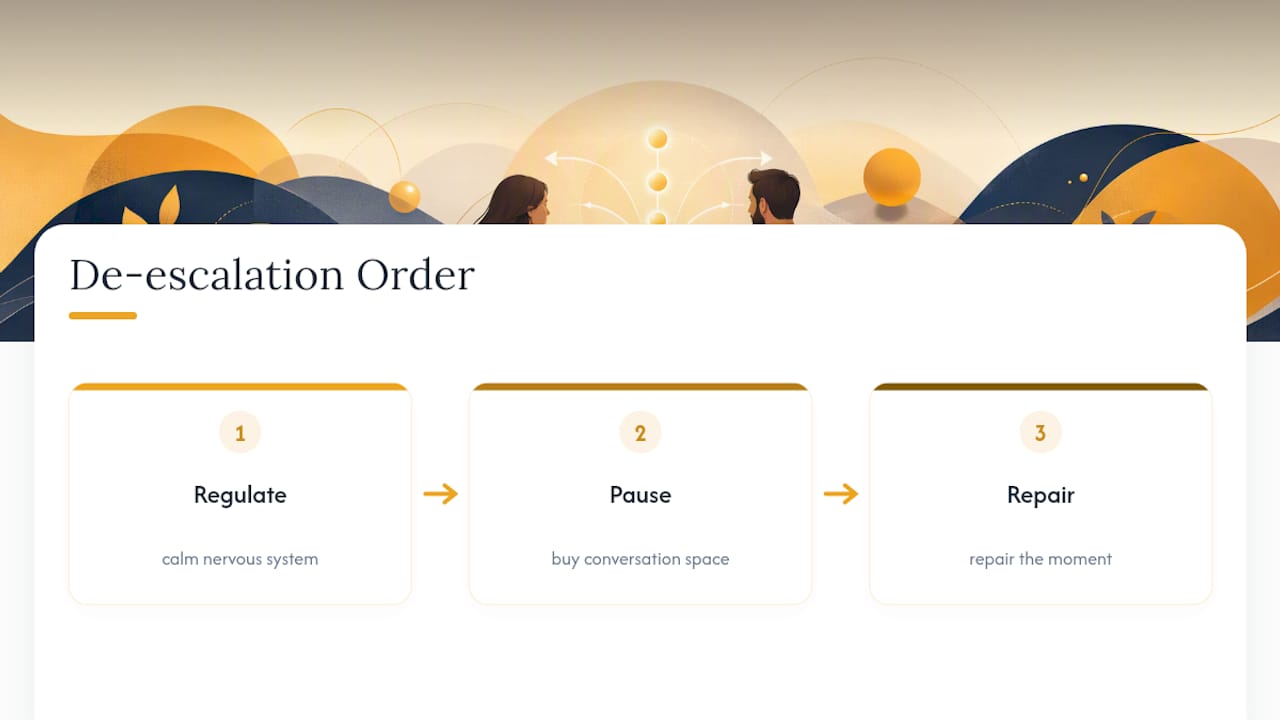
Pro Tip: If you only remember one thing from this article, remember this order: regulate first, pause second, repair third. Skipping straight to “let’s talk about our feelings” while your jaw is clenched and your voice is climbing almost never works.
Quick regulation moves you can use in the moment
Your body tips you off to escalation before your mind catches up. A racing heart, a tight chest, a raised voice, a locked jaw. Once your body crosses into flooding, arguing your point is close to useless because the part of your brain that processes logic and empathy has effectively gone offline.
The good news is that a handful of small physical moves can pull you back from that edge in seconds. Try these mid-argument:
- Breathe with a longer exhale than inhale (inhale for four counts, exhale for six or seven).
- Press your feet flat into the floor to interrupt the fight-or-flight loop.
- Unclench your jaw and drop your shoulders away from your ears.
- Slow your speech down by roughly half; a racing voice keeps both partners flooded.
- Soften your gaze instead of staring your partner down.
A 2024 study covered by Forbes found that a pause as brief as five seconds during a heated exchange measurably reduced aggression between partners. A pause of a few seconds is often enough to interrupt the reactive loop before a word you can’t unsay comes out.
A five-second micro-pause is different from a full timeout. Use the micro-pause the instant you notice your voice rising or your words getting sharper. Save the longer, structured pause for when you notice real signs of flooding: shaking hands, tunnel vision, an urge to walk away or attack verbally, or the sense that you’re no longer hearing your partner at all. Couplesfightschool’s breathing exercises for calming anger are worth practicing outside of a fight, so the moves feel automatic when you actually need them.
How do you build a pause plan that doesn’t turn into avoidance?
A pause only works as a de-escalation technique when both partners have agreed to the rules ahead of time. Without that agreement, one partner’s “I need a break” reads to the other as stonewalling, and the fight escalates worse than before. Build the plan when you’re calm, using a version of the PAUSE framework therapist educators at Utah State University Extension recommend for couples.
- Call the pause out loud, using an agreed signal phrase like “I need a pause” or a hand gesture you’ve both approved in advance.
- State a specific return time. “Give me 20 minutes” works. “I need space” does not, because it leaves your partner guessing.
- Use the break to regulate, not rehearse. Walk, breathe, splash cold water on your face. Do not use the time to build your case for round two.
- Return on time and open with a restart script, something like, “Thanks for waiting. Can we try that again?”
Set a maximum pause length in advance, typically a moderate duration, so neither partner fears the break turning into hours of silence. That single rule does more to reduce abandonment anxiety than almost anything else in the plan.
Pro Tip: Write your pause agreement down somewhere you’ll both see it again, not just in a heated conversation. A plan you only discuss mid-fight rarely survives the fight it was meant to prevent.
Co-regulation: how to calm your partner without arguing them down
Co-regulation means staying steady enough yourself that your partner’s nervous system can borrow your calm instead of matching your escalation. It works precisely because reasoning doesn’t: when a partner is flooded, their capacity for logic and empathy is temporarily offline, so facts and fair points bounce right off.
A soft startup changes the physics of the conversation. “I’m feeling really anxious about this and I want to understand your side” lands completely differently than “You always do this.” Reflective listening backs that up: listen fully, reflect back what you heard in your own words, then ask a genuine question before you respond with your own position.
One underused technique is “naming your parts.” Instead of “I’m furious at you,” try “A part of me is really angry right now, and a part of me is scared we’re drifting apart.” This kind of multi-part language reduces defensiveness because it stops sounding like an accusation and starts sounding like a report from inside your own head, which is much easier for a partner to hear.
- Keep your body open. Uncrossed arms, a relaxed face, feet pointed toward your partner.
- Lower your volume before asking your partner to lower theirs.
- Offer touch only if your partner welcomes it in conflict; for some couples a hand on the arm calms things down. For others, it escalates further.
Repair attempts: the small moves that stop a spiral mid-fight
A repair attempt is any small gesture, word, or ritual that interrupts an argument before it spirals further, and couples who use them consistently report stronger long-term relationship health. Repair attempts don’t need to be profound. A private joke, a silly nickname, or even a specific object one partner holds up as a signal can do more work than a perfectly worded apology.
- “Can we try that again?” resets the tone without relitigating who started it.
- “I’m on your team, even right now” reminds both of you what you’re actually fighting for.
- A short, specific apology: “I raised my voice and that wasn’t fair to you.”
- A shared physical ritual, a squeeze of the hand, a specific phrase only the two of you use.
Pro Tip: Design your repair attempts together while you’re calm, not mid-argument. A repair gesture that feels authentic to your relationship works far better than one borrowed from a book.
Timing matters more than most couples realize. A repair attempt offered early, right as tone starts to sharpen, works far better than one offered after 20 minutes of escalation, when both partners are too flooded to receive it.
How do you make these techniques stick when a real fight hits?
Reading about de-escalation techniques and using them under pressure are two different skills, and the gap between them closes only through rehearsal. Practice the micro-pause and the pause protocol during a calm, low-stakes moment, not during your next real disagreement.
- Build a written conflict agreement: your pause signal, a maximum pause length, a return window, and your go-to repair phrase.
- Run two short drills a week, five to ten minutes each, where you practice calling a pause and returning on time over something minor.
- Add one weekly check-in to review what worked and what didn’t.
- Watch for pauses that quietly become avoidance. If breaks are getting longer or return times keep slipping, shorten the pause window and consider bringing in outside support.
Micro-practice like this entrenches the habit so the moves are already automatic before the next real fight starts. If pauses keep drifting into distance instead of resolution, that pattern is worth naming directly with a look at why couples struggle to repair after fights.
A clinician’s take on why couples skip the steps that actually work
I’ve watched a lot of couples nod along with a pause protocol and then abandon it the first time a real fight hits, because the fight always feels like the exception. It isn’t. The five-second pause, the timeout with a return time, the repair phrase, these work precisely in the moments that feel too urgent for them.
One couple I worked with through the F.I.G.H.T. Plan® kept skipping their agreed pause because “we were already talking, why stop.” Once they added a return time to their pause rule, the same disagreements stopped turning into three-hour standoffs. Try one micro-move and one pause rule this week. Nothing more. See what changes.
— Carlos
Where to learn these techniques with guided practice
Reading about a pause protocol is one thing. Practicing it with real-time feedback from a clinician who can spot what’s actually happening in your specific pattern is another. Couples Fight School exists for that second part: structured coaching and a self-paced course built around the same F.I.G.H.T. Plan® techniques covered here, so you’re not guessing whether you’re doing the pause “right.”

If you want live guidance while you build your pause and repair plan, online coaching for couples walks you through it session by session. If you’d rather work through it at your own pace first, the Stop the Fighting communication and conflict resolution course covers the same de-escalation framework in a structured curriculum you can start this week. Couples looking for a group setting to practice regulation skills alongside other relationships sometimes find a faith-based retreat a useful complement. Pick whichever entry point matches how you learn, and start with the pause plan from this article on your next disagreement.
Sources
- A psychologist explains the 5-second rule of relationships (Forbes summary of 2024 study)
- How to defuse an angry partner | Psychology Today
- When emotions take over: learning to P-A-U-S-E before you react | Stronger Marriage (USU Extension)
Recommended