
Stop Gaslighting in Marriage: What to Do and Say

You can’t stop gaslighting by winning the argument. You stop it by recognizing the pattern, refusing to compete over whose version of reality is right, protecting your own footing, and deciding whether your spouse is willing and able to change. If you are the one being gaslit, your first job is steadiness and safety. If you are the one doing it, your first job is to stop defending yourself and start listening. Both paths are below.
One caution before anything else. If you feel afraid of your spouse, or gaslighting comes with threats, monitoring, isolation or control of money, you are dealing with more than a communication problem. Skip ahead to the safety section.
TL;DR
- Gaslighting is a repeated pattern that makes you doubt your memory, judgment or sanity. A single disagreement about what happened is not the same thing.
- You usually can’t win by proving your version. Disengage from the power struggle, state your experience calmly, and end the conversation if it keeps spinning.
- Document what happens (texts, screenshots, a private dated journal) so you can check reality against your own record.
- Couples work can help when the behavior is unintentional and both partners are willing. If you are afraid, or the behavior escalates when named, safety and individual support come first.
- If you recognize yourself as the gaslighter, the change starts with stopping the denial, not with a better apology.
Table of Contents
- What gaslighting in a marriage actually is
- How to respond when your spouse gaslights you
- What to say after a gaslighting episode
- Can a marriage recover from gaslighting?
- If you recognize yourself as the one gaslighting
- Our perspective: gaslighting thrives where conflict skills are missing
- When couples work is appropriate, and when it isn’t
- Safety: when gaslighting is part of abuse
- Building a marriage where reality is shared
- Tools to practice with, when you are ready
- FAQ
- Sources
What gaslighting in a marriage actually is
Gaslighting is a form of emotional abuse and mental manipulation that can make a person question their sanity, decisions or reality. In a marriage it tends to sound like this:
- “That never happened. You’re making things up.”
- “You’re too sensitive. Nobody else would be upset by this.”
- “I never said that. You always twist my words.”
- “You’re crazy, and everyone agrees.”
Researchers are still refining the definition. A 2025 study in Psychology, Public Policy, and Law described gaslighting through six components: the behavior, its outcomes, intention, repetition, subsidiary tactics, and the role of power and intimacy. That last part matters in marriage. The person who knows you best, shares your home and often your money is the one telling you your perception is wrong, so the words land harder and are harder to shake.
Gaslighting or ordinary conflict?
Every couple remembers things differently. Memory is unreliable, and two people can sit through the same dinner and disagree about what was said. That alone is not gaslighting. The differences are in the pattern.
| Ordinary conflict | Gaslighting | |
|---|---|---|
| Listening | Both people address each other’s concerns, even when emotional | Your concerns are dismissed, mocked or turned around on you |
| Memory disputes | “I remember it differently. Help me understand yours.” | “That never happened,” repeated until you doubt yourself |
| Frequency | Occasional, and tied to specific topics | Repeated across topics and over time |
| Aftermath | You may feel frustrated, but you still trust your own mind | You feel confused, anxious, and less sure of your own judgment |
| Accountability | Apologies and repair are possible | Blame shifts back to you, and your reaction becomes the problem |
HelpGuide makes a useful distinction. In a genuine conversation, both people listen to and address each other’s concerns, even if they get emotional. In a power struggle, one person tries to prove they are right while the other tries to win them over. If you are spending hours trying to get your spouse to admit what happened, you are probably in the second situation.
A good test is how you feel afterward. Frustrated is normal. Disoriented, apologizing for things you didn’t do, and keeping a mental list of “things I’m not allowed to remember” are warning signs.
How to respond when your spouse gaslights you
This is what readers most often ask: what do I actually say in the moment? The research points in a consistent direction, and it is counterintuitive. Arguing harder rarely works.
1. Spot the power struggle and step out of it
Experts recommend disengaging from the argument, not needing to “prove” your version of reality, and focusing on your feelings rather than the right or wrong of the incident. The Cleveland Clinic goes further for intentional gaslighting: reasoning may be impossible, and withdrawing is often the most effective response, because a fire cannot burn without fuel.
In practice, that means swapping the debate for a statement:
- Instead of: “I did NOT overreact, you said you’d be home at six!”
- Try: “I remember it differently, and I felt hurt. I’m not going to argue about who’s right. I’m going to take a break.”
You don’t need agreement to hold your own memory. You are allowed to keep your version without your spouse signing off on it.
2. Know your triggers, and theirs
Utah State University Extension describes a “Gaslight Tango” in which both people may have triggers, and identifying them can help someone step away rather than join the dance. Ask yourself: what does my spouse say that makes me desperate to be believed? What do I do next, such as raising my voice, listing evidence, or following them from room to room? That reaction is your cue to pause.
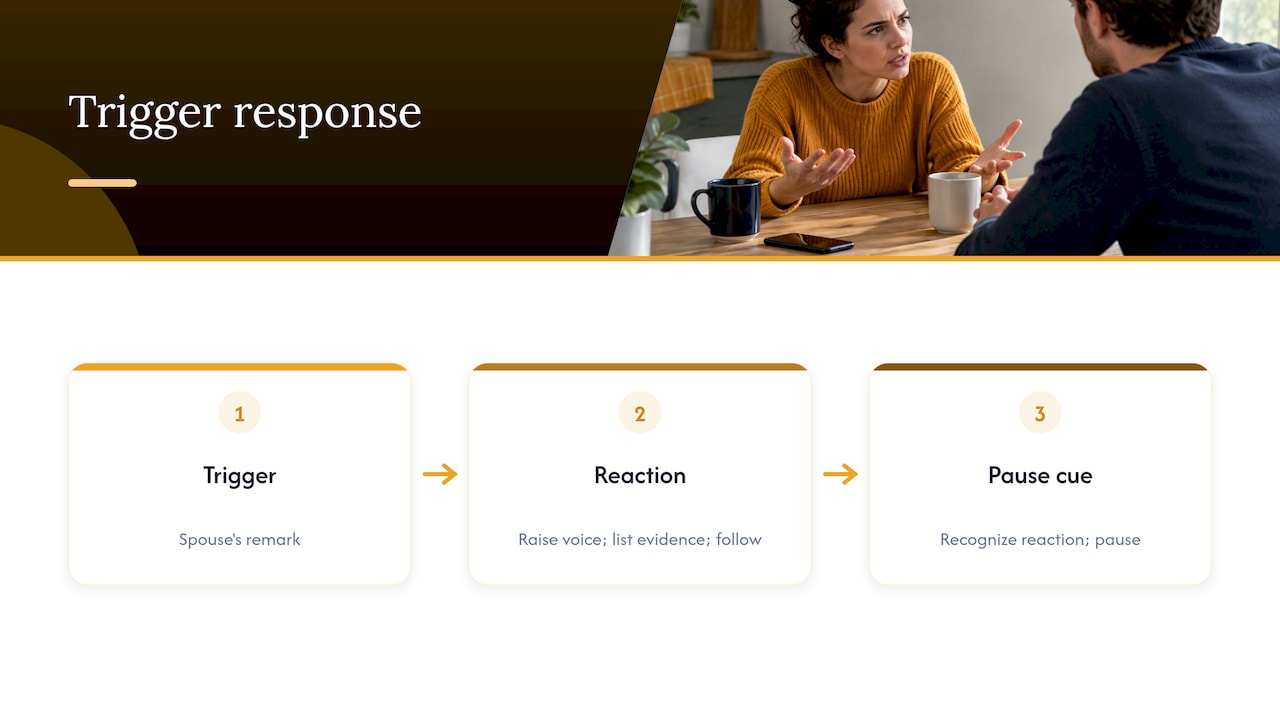
This doesn’t make you responsible for their behavior. It gives you a way to stop feeding the loop.
3. Use short, calm, repeatable statements
Long explanations give a gaslighter more material to twist. Short statements work better:
- “I know what I experienced.”
- “We see this differently.”
- “I’m willing to talk when we can both listen.”
- “I’m going to leave the room now. I’ll come back in 30 minutes.”
Psychology Today’s advice is similar: reaffirm boundaries, calmly assert your perspective, and take physical space or end the conversation when needed. Say it once, then follow through. A boundary you announce and don’t act on teaches your spouse that it is optional. If you need ready-made wording, our relationship boundary examples cover dozens of situations, and the argument boundaries guide walks through setting them before a fight starts, when you are calm.
4. Calm your body first
Gaslighting works partly because it floods you. Your heart pounds, your thoughts scramble, and you start saying things you don’t mean. Deep, slow breaths and stepping away help manage the immediate effects. A structured time-out is the cleanest way to do this without it feeling like abandonment. A negotiated time-out plan helps partners interrupt escalating conversations, and clinical literature treats it as a precursor to couples treatment. Our time-out scripts for couples give you the exact words and the 20 to 45 minute structure.
5. Document, quietly
When someone keeps telling you what happened differently, a record is a lifeline. Cleveland Clinic suggests saving texts, taking screenshots, or keeping a private journal of dates and events so you can distinguish reality from manipulation. Keep it somewhere your spouse can’t access, such as a locked note on a device only you use, or a notebook at a trusted person’s home. The point isn’t to build a case for an argument. It is to be able to say to yourself, “My memory is fine. Here is what I wrote down that night.”

If arguments in your household ever reach police calls or court filings, it also helps to understand how false domestic violence allegations are handled in California courts, because accusations can become a tool in a high-conflict marriage and your rights as a parent are at stake.
6. Rebuild your own footing
Self-care won’t end the gaslighting, and nobody should pretend it will. But Fairfax County Family Services notes that looking after your physical and emotional needs is essential for rebuilding the state of mind you need to face challenges and make decisions. Sleep, regular meals, time with friends who knew you before the marriage got tense, and a therapist of your own are not luxuries. They are how you get your own voice back.
What to say after a gaslighting episode
Once things are calm, you can name the pattern without accusing. The aim is to be specific about behavior and its effect.
- Pick a calm time. Not at bedtime, not in front of the kids, not in the middle of a fight.
- Describe one example. “Last Tuesday, I told you the comment hurt, and you said it never happened and I was imagining it.”
- Say what it did to you. “After that I felt confused and stopped trusting my memory.”
- Make one request. “When I tell you something hurt, I need you to say ‘I hear you’ even if you remember it differently.”
- Watch the response. A partner who is open might say, “I didn’t realize I was doing that. Tell me more.” A partner who intensifies, mocks you, or flips the blame is giving you important information.
How your spouse responds to being named matters more than how they respond to the first request.
Can a marriage recover from gaslighting?
Sometimes. It depends on intent, willingness, and safety.
Cleveland Clinic notes that couples therapy may help when gaslighting in a romantic relationship is unintentional, and that therapy can also help the person gaslighting address the roots of their behavior. Many people repeat what they saw modeled growing up, or use denial to escape shame during conflict. When there is genuine curiosity and remorse, repair is realistic.
With intentional gaslighting, the picture changes. The same source says reasoning may be impossible, and that if the behavior doesn’t stop or escalates after you call it out, leaving may be the only healthy response.
Here is what repair generally requires:
- Acknowledgment without conditions. “I did that, and it was wrong,” not “I’m sorry you felt that way.”
- Consistency over time. One good week isn’t change. Months of reliability are.
- Respect for your reality. Your spouse can disagree about facts without calling you crazy.
- No retaliation for speaking up. If naming the pattern leads to punishment, silence or threats, the pattern is intact.
- Outside help. Both partners may need their own support, and some couples need a structured plan to rebuild communication.
The communication patterns that hurt a relationship are often the soil gaslighting grows in: stonewalling, defensiveness, and criticism. Identifying them is a first practical step for couples who want to stop the cycle.
If you recognize yourself as the one gaslighting
Some readers arrive here because they realized, often after a partner or a therapist named it, that they have been denying their spouse’s reality. That realization is painful, and it is also the starting point for change. Here is what helps:
- Stop correcting their memory. When your spouse says you hurt them, the first sentence is “Tell me more,” not “That’s not what happened.”
- Notice the urge to defend. The impulse to say “you’re overreacting” usually signals shame, not facts.
- Separate intent from impact. You can believe you meant no harm and still accept that it did harm.
- Apologize specifically. “I told you that you were imagining things. That was wrong, and I understand it made you doubt yourself.”
- Get your own support. Therapy can help you address where the habit came from.
- Expect trust to return slowly. Your spouse is allowed to be cautious for a long time.
Our guide to de-escalation techniques with ready scripts gives you replacements for the defensive moves that gaslighting usually hides behind.
Our perspective: gaslighting thrives where conflict skills are missing
After working with thousands of couples, we see a consistent thread. Most of the denial, minimizing and blame-flipping that people describe as gaslighting starts as a way to escape the discomfort of conflict. One partner feels attacked, grabs for defensiveness, and says “that never happened” because admitting fault feels unbearable. Over time, that reflex hardens into a pattern that wears down the other person’s trust in their own mind.
That doesn’t excuse it, and it doesn’t mean every case is innocent. It does mean there are two very different situations, and they need different responses:
- Skill gaps and defensiveness. Both partners are willing to learn. Here, structured tools work well: scripts for naming impact, agreed time-outs, a shared way to repeat back what you heard before responding, and a plan for repair after a fight. That is what our F.I.G.H.T. Plan® framework is designed to teach, step by step, in plain language a couple can practice at the kitchen table.
- Control and intimidation. One partner uses confusion as a weapon. Skills training is not the first answer here. Safety planning and individual support are.
We want you to be able to tell which situation you are in, and to have somewhere practical to go next. If the pattern is defensiveness and recurring arguments, our workbooks and courses give you structure and wording so you aren’t improvising in the heat of a fight. If it is something more serious, we want you to reach out to people trained for that.
— Carlos
When couples work is appropriate, and when it isn’t
Couples therapy and couples coaching assume two people who can speak honestly, without fear of what happens afterward. That assumption is the test.
Consider joint work when:
- You feel safe disagreeing with your spouse.
- Your spouse can acknowledge at least some of the behavior.
- Both of you want the marriage to be healthier.
- Arguments are painful, but not frightening.
Hold off on joint sessions, and start with individual support, when:
- You are afraid of how your spouse will react to what you say.
- Your spouse punishes you after sessions or arguments.
- Gaslighting comes with threats, monitoring, isolation or control of money.
- Your spouse uses what you share against you.
In those cases, start with your own therapist or a domestic violence advocate who can help you plan. Couples sessions can wait.
Safety: when gaslighting is part of abuse
Gaslighting is often one thread in a larger pattern. The National Domestic Violence Hotline explains that relationship abuse often involves multiple types, and that emotional abuse may include gaslighting, isolation, monitoring and threats, while financial abuse is another form. It also notes that gaslighting can break down a person’s trust in their own perspective, making them more vulnerable to abuse and making it harder to leave, and that talking with trusted people can help validate your experience.
If you recognize that picture:
- In immediate danger, call 911. Otherwise, the U.S. Office on Women’s Health advises reaching out to a trusted person, therapist, abuse shelter or domestic violence hotline.
- Talk to someone outside the marriage. A friend, relative, faith leader or counselor who isn’t invested in keeping the peace.
- Plan before you confront. If you are afraid of a reaction, a hotline advocate can help you think through timing and logistics.
- Protect your records. Keep your documentation where your spouse can’t find it.
None of this requires you to decide today whether the marriage ends. It only requires you to stop facing it alone.
Building a marriage where reality is shared
Whether you are repairing or rebuilding, the same habits keep gaslighting from returning.
- Reflect before you respond. Before defending, repeat back what you heard: “You’re saying that when I laughed, it felt like I was dismissing you. Is that right?”
- Accept two truths. “I remember it differently, and I believe you felt hurt” is a complete sentence.
- Name the pattern together. Agree on a phrase such as “let’s pause,” so either of you can interrupt without blame.
- Schedule repair. Revisit hard moments the next day, when you are calm.
- Practice outside of fights. Skills are built in ordinary moments. Our guide to communication in marriage and the practical skills every married couple needs are good places to begin, and why couples stop communicating explains how silence sets in.
- Watch for emotional neglect. Gaslighting often sits beside it. Our piece on emotional neglect in marriage shows the signs and how couples heal.
Tools to practice with, when you are ready
If your situation is recurring arguments, defensiveness and denial, rather than fear, you can work on it with structure. The F.I.G.H.T. Plan® Couples Conflict Toolkit is $27.00, and the F.I.G.H.T. Plan workbook ranges from $14.99 to $25.00. For a full program, Stop the Fighting: The Couples Communication & Conflict Resolution Course is $149.00 and was created by licensed mental health professionals. If you want personal guidance, online couples coaching is available, including a VIP four-session package at $997.00.

If you are the partner being gaslit and feel afraid, begin with an advocate or a therapist of your own, then come back to couples tools when you feel safe.
FAQ
How do you handle someone who is gaslighting you?
Disengage from the power struggle instead of trying to prove your version. State your experience in one calm sentence, such as “I know what I experienced,” and take a break if the conversation keeps looping. Keep a private record of events, and lean on people outside the marriage to help you stay grounded.
What are the signs that someone is gaslighting you in a relationship?
Common signs include being told events never happened, being called too sensitive or crazy, having your words twisted, and feeling steadily less sure of your memory and judgment. The key is repetition: it happens across topics and over time, and you end up apologizing for things you didn’t do.
Can a relationship recover from gaslighting?
It can when the behavior is unintentional and your spouse acknowledges it, takes responsibility, and changes consistently over time. If it continues or escalates after you call it out, or you feel afraid, safety comes first and leaving may be the healthiest option.
Should we do couples therapy if my spouse gaslights me?
Only if you feel safe speaking honestly in the room. Therapy may help when the behavior is unintentional. If you fear your spouse’s reaction, or there are threats, monitoring or control, start with individual support or a domestic violence advocate before any joint sessions.
How do I stop gaslighting my spouse?
Stop correcting their memory, and respond to their hurt first with “Tell me more.” Apologize for specific behavior, notice the urge to defend, and get your own support to address where the habit came from. Expect your spouse’s trust to return slowly.
Sources
- Gaslighting: Definition & How To Spot It, Cleveland Clinic
- Gaslighting in intimate relationships study, APA PsycNet (2025)
- Turning Off the Gas on Your Gaslighter, HelpGuide
- How to Identify and Navigate around Gaslighting, Utah State University Extension
- How to Respond When Being Gaslit, Psychology Today
- Being Gaslit? 5 Ways to Take Back Control, Fairfax County Family Services
- Negotiated time-out plan, APA PsycNET
- Types of Abuse, The Hotline
- A Deeper Look Into Gaslighting, The Hotline
- Emotional and verbal abuse, Office on Women’s Health
- False domestic violence allegations and parental rights in California
Recommended
- Silent Treatment in Marriage: What It Does and How to End It
- Stop Contempt in Marriage: A Therapist’s Plan for the Next Fight
- Stop Arguing With Your Husband in 10 Minutes Using Therapist Scripts
- How to Convince Spouse to Take Marriage Course with You