
Validation Phrases for Couples: What to Say and Why It Works
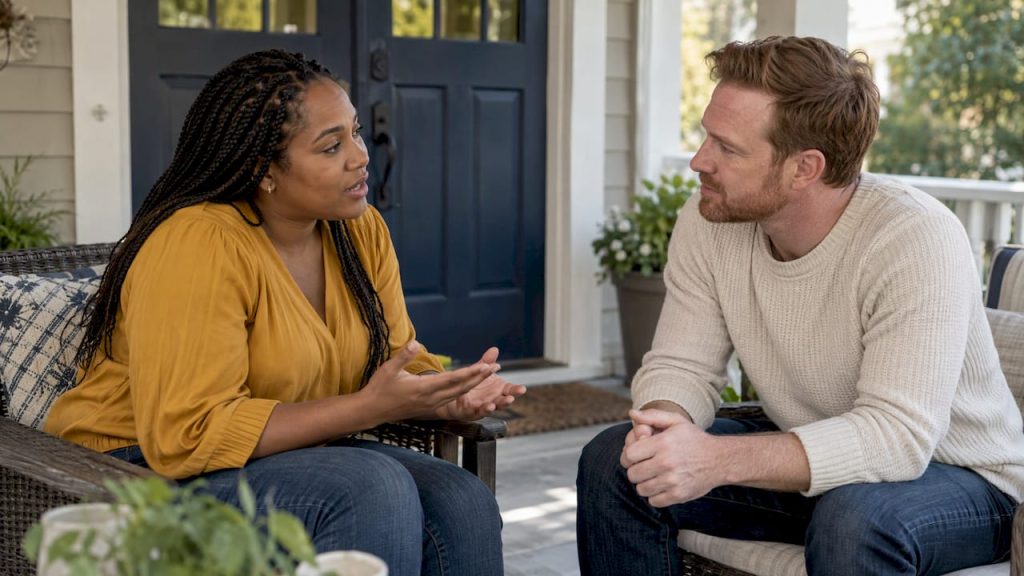
Validation means telling your partner, in plain words, that their feelings make sense to you. You don’t have to agree with them. You don’t have to fix anything. Phrases like “That sounds really painful” or “I can see why that got to you” work because they show you understood before you respond. Below you’ll find phrases for specific situations, a simple formula for building your own, and the swaps that keep a hard talk from turning into a fight.
TL;DR
- Validation says “your feelings make sense.” It does not say “you’re right.”
- A reliable formula: name the feeling, connect it to the cause, then show you’re with them.
- When you disagree, validate the emotion first, then state your own view calmly.
- Skip “calm down,” “you’re overreacting” and instant solutions. They tell your partner they weren’t heard.
- Practice on small irritations, so the words come easily during big conflicts.
Table of Contents
- What emotional validation means in a relationship
- A three-part formula for validating your partner
- Validation phrases for common situations
- How to validate when you disagree
- Phrases that invalidate, and what to say instead
- A worked example: the same argument, two ways
- Our perspective: validation is a skill, not a personality trait
- How to practice so it works in the heat of the moment
- Making validation stick with the right support
- FAQ
- Sources
What emotional validation means in a relationship
Emotional validation is recognizing, understanding and accepting your partner’s emotional experience without judging it. Verywell Mind points out that it doesn’t require you to agree that the reaction or the interpretation behind it is warranted. The same source describes validation as accepting an emotion without judging it or trying to talk the person out of it, which can help with emotional regulation and connection.
That distinction is where most couples get stuck. Many people hear “validate me” and translate it as “admit I’m right.” So they resist, and the conversation becomes a debate about facts. Your partner didn’t ask you to win or lose the debate. They asked to be understood.
Think of two layers in any argument:
- The feeling: hurt, anxious, embarrassed, overlooked, tired.
- The story and the facts: who said what, whether it was fair, what should happen next.
Validation lives on layer one. You can fully honor the feeling and still have a different view of layer two. If you want help with that second layer, our guide on agreeing to disagree respectfully as a couple covers it.
A three-part formula for validating your partner
You don’t need to memorize a script. Most good validating statements have three pieces:
- Name the feeling. “You sound frustrated.” “You seem hurt.”
- Connect it to the reason. “…because you were counting on me to call.” “…since this is the third time this week.”
- Signal you’re with them. “That makes sense.” “I’d feel that way too.” “I’m here.”
Put together: “You sound frustrated that I didn’t call, especially after you’d had such a rough day. That makes sense to me.”
The paraphrasing step has research-based support. Greater Good in Action at UC Berkeley suggests lead-ins like “What I hear you saying is” or “It sounds like”, followed by empathy such as “I can sense that you’re feeling frustrated.” Utah State University Extension likewise recommends rephrasing with “It sounds like you felt…” and keeping your main goal on understanding how your partner feels, not fixing anything.
If you want a fuller step-by-step version, see our reflective listening steps and ready scripts.
Validation phrases for common situations
Use these as starting points and put them in your own words. A phrase that sounds scripted will land worse than a clumsy one you mean.
| Situation | What you can say |
|---|---|
| Your partner is upset and hasn’t explained yet | “I can see something’s weighing on you. I’m listening.” |
| They had a hard day | “That sounds exhausting. No wonder you’re wiped out.” |
| They feel unheard | “I don’t think I was really listening. Tell me again and I’ll give it my full attention.” |
| They’re hurt by something you did | “I can see how that hurt. I didn’t want you to feel that way, and I’m sorry it landed like that.” |
| They’re anxious or worried | “It makes sense that you’re worried, with so much up in the air.” |
| They’re angry | “You have every reason to be upset about this. Help me understand more.” |
| They’re sharing something vulnerable | “Thank you for telling me. I know that wasn’t easy to say.” |
| They’re grieving or disappointed | “I’m so sorry. That’s a real loss, and it’s okay to feel it.” |
Statements that show you’re listening
The U.S. Army’s Human Performance Resources by CHAMP (HPRC) gives a worked example about arriving late to dinner. It includes acknowledging the facts, naming the frustration, and checking your read with a question, such as asking whether your partner feels the lateness was disrespectful of their time. That last step matters: you aren’t guessing out loud and moving on, you’re inviting correction.
You can adapt the pattern to almost anything:
- “So the part that stung was that I didn’t say anything in front of your family. Is that right?”
- “Let me make sure I’ve got this. You felt left out of the decision. Did I miss anything?”
- “It sounds like you’ve been carrying a lot of this on your own.”
Statements for when your partner is stressed
Oklahoma State University Extension suggests a sequence for a stressed partner: notice the stress, invite them to open up, listen, then offer emotional support before any practical problem-solving. The invitation can be as simple as “What’s going on?” The support can be empathy, encouragement and reassurance that you’re there. Advice comes only if they ask.
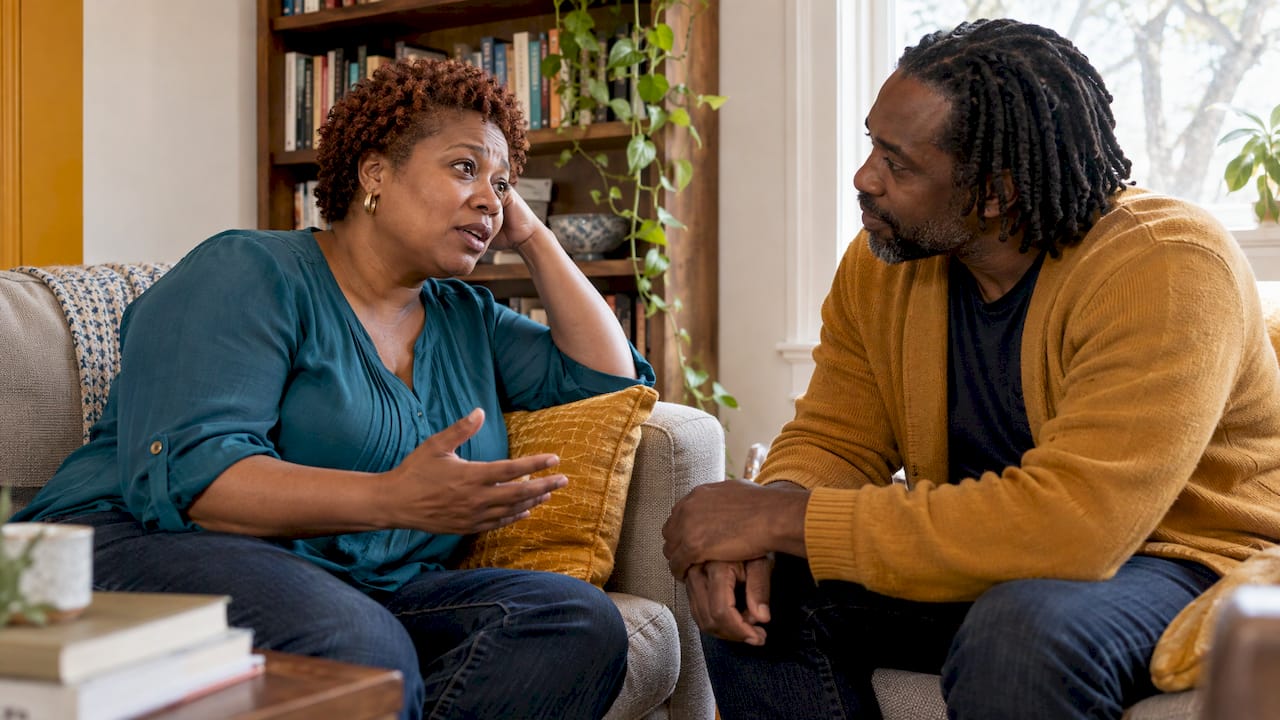
The Well by Northwell notes that an upset person often needs to feel that someone has their back before they can think about options. Its examples include “Wow, that must have been hard for you”. Plain, warm and short.
Helpful phrases when the stress is heavy:
- “You don’t have to figure it out right now. I’m just here.”
- “That’s a lot to handle at once.”
- “Do you want me to just listen, or would ideas help?”
That last one is worth keeping in your back pocket. It lets your partner choose what kind of support they need, and it keeps you out of fix-it mode.
How to validate when you disagree
This is the hardest part, and the reason couples avoid validation altogether. The HPRC guidance says partners can validate each other’s perspectives and find common ground even when they disagree, which makes both people more likely to feel heard and ready to move forward.
A useful order of operations:
- Validate the feeling first. “I can tell this really matters to you.”
- Find what is true from their side. “If I were in your shoes and saw it that way, I’d be upset too.”
- Then state your view with an I-statement. “I see it differently, and I’d like to tell you how it looked from my side when you’re ready.”
Try these:
- “I understand why you feel that way, and I still see it differently. Can we talk about both?”
- “I’m not ready to agree with that, but I do want to understand it.”
- “I hear how important this is. I need some time to think about what I can do.”
On deeper differences in values or politics, relationship writer Rebecca Hendrix recommends language like “I get that. I don’t agree with it, but I love you”, showing that validation isn’t a concession.
Ask permission before you share your view. UC Berkeley’s guidance advises asking whether it’s okay to offer your perspective, then using I-statements such as “I feel overwhelmed when you don’t help out around the house.” Notice that it names a feeling and a situation. It doesn’t hand down a verdict on your partner’s character.
Phrases that invalidate, and what to say instead
Most invalidation isn’t cruel. It’s hurried, defensive or well-meaning. Northwell’s guidance warns that minimizing and rushing to solve can dismiss a partner’s feelings, and that people often appreciate listening and support more than an instant game plan.
| Instead of | Try |
|---|---|
| “You’re overreacting.” | “This is clearly hitting you hard. Tell me more.” |
| “Calm down.” | “I want to understand. Take your time.” |
| “It’s not a big deal.” | “I can see it’s a big deal to you.” |
| “Look on the bright side.” | “That’s really disappointing.” |
| “Here’s what you should do.” | “Do you want ideas, or do you want me to listen?” |
| “I was only joking.” | “I see that stung. I’m sorry.” |
| “You always do this.” (back at them) | “I hear you. Let me take that in before I respond.” |
| “That’s not what happened.” | “I remember it differently, but I can tell how it felt for you.” |
The HPRC page also notes that dismissive, defensive or rejecting responses can leave a partner feeling ignored, and recommends avoiding distractions and judgment. Put the phone face down. Turn toward your partner. Body language is part of the message.
If you notice your arguments keep ending with “you never listen,” our article on why couples feel unheard during arguments digs into the pattern, and why communication styles clash explains why one partner’s way of showing care can feel like dismissal to the other.
A worked example: the same argument, two ways
Imagine one partner comes home and says, “I can’t believe you scheduled your mom’s visit the same weekend as my work event.”
The invalidating version
“I told you about the visit weeks ago. You’re making this a bigger deal than it is.”
The facts may even be right. But the message is that the feeling is wrong, so the next line will be louder.
The validating version
“That sounds stressful. You’ve been working toward this event, and now it feels like it got pushed aside. Did I get that right?”
The first partner answers, “Yes, exactly.” Now both people are on the same side of the table. The second partner can add, “I did mention the visit earlier, and I should have double-checked the dates against your calendar. Let’s figure out what we can adjust.”
Nothing about the facts changed. The order did. Feeling first, then facts, then solutions.
Our perspective: validation is a skill, not a personality trait
After working with thousands of couples, we’ve noticed that almost nobody argues because they don’t love each other. They argue because one person feels unseen and the other feels attacked, and neither knows how to break the loop.
Validation is the loop-breaker. It’s a learnable skill, and it’s the first step in our F.I.G.H.T. Plan® framework for good reason: until your partner feels understood, they can’t take in your side, your apology or your solution.
We also want you to hear this: validating your partner doesn’t make you weak, and it doesn’t mean giving up your needs. It lets you say what you need without it escalating. Couples who learn to validate first tend to find that conflicts get shorter and repair gets faster.
Phrases are only the starting point. The real change comes from practicing them when you’re calm, building a shared agreement about how you’ll talk when you’re not, and repeating the habit until it becomes yours. That’s what our workbooks, courses and coaching are built to help you do.
Carlos
How to practice so it works in the heat of the moment
Reading a list of phrases is easy. Using them when your heart is pounding is not. A few ways to build the habit:
- Start small. Validate in low-stakes moments: a slow commute, a rude coworker, a canceled plan. “Ugh, that would annoy me too.”
- Take turns. Each person talks for two or three minutes about something mildly stressful. The listener only paraphrases and validates. No advice. Then swap. Our active listening exercises give you structure for this.
- Let silence happen. USU Extension advises not interrupting and allowing silence. A pause isn’t a problem to solve; it’s often when the real feeling surfaces.
- Agree on a signal. If either of you feels flooded, agree to pause and come back. Setting communication agreements that work ahead of time takes the guesswork out of those moments.
- Ask what they need. “Do you want comfort, help or just company?” Different feelings call for different support.
- Repair when you miss. You will slip. “I jumped to fixing it. Can I try again?” is itself a validating phrase.
If an argument is already heated, our guide to diffusing conflict with your partner shows how to lower the temperature before you try to talk it through. And when your partner is struggling with something heavier than a bad day, how to help a partner with depression offers guidance for showing up well.
If you want to go deeper on the empathy behind the words, read empathy in marriage and how to practice it.
Making validation stick with the right support
Some couples can take a list of phrases and run with it. Others have years of old patterns, and the words feel awkward or get swallowed by the same old defensiveness. That’s normal, and it’s where structure helps.
Our therapist-created resources are built around practical scripts and guided exercises:
- The F.I.G.H.T. Plan workbook and toolkit: the workbook is priced from $14.99 to $25.00 and the Couples Conflict Toolkit is $27.00, for couples who want to work through conflict skills at their own pace.
- Stop the Fighting course: our full communication and conflict resolution course, $149.00, one-time.
- Online couples coaching: the VIP Private Coaching package of four sessions is $997.00 if you’d like personal guidance on your own patterns.
If you’re ready to move from knowing the right words to using them, start with the resource that fits your situation, or explore everything at Couples Fight School.
FAQ
What is a good validating statement for a partner?
A good one names the feeling and shows you understand why. For example: “You sound really frustrated, and with everything you’ve had on your plate, that makes sense.” Keep it short and sincere, then stay quiet and let your partner respond.
Does validating my partner mean I agree with them?
No. Validation acknowledges that your partner’s emotion is real and understandable from where they stand. You can say “I can see why you feel that way” and still share a different view afterward. Doing it in that order usually helps both of you hear each other.
What should I say when my partner is upset and I don’t know why?
Start with an open invitation: “I can tell something’s wrong. Do you want to talk about it?” Then listen without interrupting, and reflect back what you hear. Hold off on advice until they ask for it or you’ve checked that they want it.
What if my partner never validates me?
Choose a calm moment and describe what you need with an I-statement: “When I’m upset, I feel better if you tell me you understand before we talk solutions.” Offer a specific phrase they can use. Many people simply were never taught how, and a guided workbook or coaching can give you both a shared approach.
Can validation phrases feel fake?
They can at first, especially if they’re copied word for word. Use the formula (feeling, reason, support) in your own voice, and make sure the empathy is real. A simple “That sounds hard” said with full attention beats a perfect line said while checking your phone.
Sources
- The Power of Emotional Validation in Building Stronger Relationships, Verywell Mind
- Validation: Show you’re listening, even if you disagree, HPRC
- Active Listening, Greater Good in Action, UC Berkeley
- How Do I Help My Partner be More Open?, Utah State University Extension
- Communicating During Stressful Times, Oklahoma State University Extension
- What Is Supportive Listening?, The Well by Northwell
- Can a Relationship Survive Ideological Differences?, Hello Gloria
Recommended
- Six Step Method Couples Can Use to Stop Validation vs Agreement Fights
- 5 Therapist Backed Couples Conversation Scripts to Use Tonight
- Couples: Safe NVC, Coach Backed 2 Minute Script to Start Tonight