
What Is Relationship Coaching? A Plain-English Guide for Couples
Relationship coaching is structured, goal-focused support that teaches you and your partner specific skills, such as how to start a hard conversation, calm down mid-argument and repair afterward, then has you practice them between sessions. It is built for couples who are functioning well enough to work on goals together but keep getting stuck in the same fights. At Couples Fight School, our coaching and courses are built on the F.I.G.H.T. Plan® framework, created by licensed mental health professionals Carlos Todd and Natasha Pemberton-Todd.
TL;DR
- Relationship coaching is practical and forward-looking: you name a goal, learn a skill, practice it, get feedback and apply it at home.
- Coaching differs from therapy in focus. Coaching builds skills for couples who want better communication and connection. Therapy treats clinical conditions and deeper mental health concerns.
- Research on relationship education, the skill-building approach coaching draws on, links it to better communication and relationship quality, and programs of 9 to 20 contact hours show stronger effects than shorter ones.
- Before you hire anyone, ask about training, credentials, method and what a typical session looks like. Check credentials rather than assuming them.
- If you want a structured path, our online couples coaching pairs the F.I.G.H.T. Plan® with live guidance from our team.
Table of Contents
- What relationship coaching actually is
- Who relationship coaching is for
- Relationship coach vs. therapist
- What the research says about the benefits
- What happens in a coaching session
- How to choose a couples coach
- Where our programs fit
- Our perspective
- Ready to try coaching with us
- FAQ
- Sources
What relationship coaching actually is
A relationship coach does not diagnose you or dig through your childhood for the cause of every argument. A coach helps you get from where your relationship is to where you want it to be. The usual starting points are things like: “We have the same fight every week,” “We stopped really talking,” “We want to be ready for marriage,” or “We’re blending two families and it’s rough.”
A typical coaching arc looks like this:
- Define the goal. “Fight less” becomes something observable: no more yelling, finishing a hard conversation without shutting down, or feeling heard after a disagreement.
- Learn one skill at a time. A skill is a repeatable behavior, not an insight. Examples are taking a break and self-soothing, a softened start-up to a complaint, or taking turns as speaker and listener.
- Practice together, live. You try the skill on a real issue while the coach watches.
- Get brief corrective feedback. The coach points out what worked and what to adjust.
- Use it at home. The real work happens between sessions.
This is not just our description. A U.S. Administration for Children and Families brief on coaching in healthy relationship programs describes coaching as partners identifying a problem, practicing a communication or conflict skill, receiving short corrective feedback and applying the skill between sessions. Its example program used five 15-minute skill-coaching sessions covering taking a break and self-soothing, softened start-up, speaker-listener practice, compromise and repair.
Those five skills are worth remembering because they show what coaching is: small, specific, learnable behaviors. Most couples do not need a grand theory of their relationship. They need to learn what to do in the first ten seconds of a disagreement.
Who relationship coaching is for
Coaching suits couples who are both willing to work on the relationship and who want practical tools. It fits many situations:
- Couples with recurring arguments. The topic changes (money, in-laws, chores) but the pattern of criticism, defensiveness and withdrawal does not.
- Couples who feel like roommates. There is no big fight, just distance. Coaching helps rebuild daily connection and emotional intimacy.
- Engaged couples. Learning how to disagree well before the wedding is easier than learning it after. Our piece on why engaged couples need conflict skills before marriage explains this.
- Blended families. Parenting differences, loyalty tension and new routines create conflict that benefits from a clear structure.
- Christian couples. Many couples want skills that fit their faith and values. Our Christian F.I.G.H.T. Plan workbook is built for exactly that.
- Women seeking a healthier relationship. If you are working toward a stronger connection or a lasting marriage, coaching gives you language and a plan rather than more guessing.
It can also help couples rebuilding after a rupture such as betrayal, as long as the focus is practical rebuilding of communication and trust habits and both partners are engaged. Healing after an affair is emotionally heavy, and some couples do best combining structured tools with a licensed therapist. That is a good choice, not a failure.
Relationship coach vs. therapist
People search this comparison more than any other, and the honest answer is that the two do different jobs.
| Relationship coaching | Couples therapy | |
|---|---|---|
| Main focus | Skills, goals, action plans | Emotional healing, clinical concerns, deeper patterns |
| Time orientation | Present and future | Present, with more exploration of the past |
| Typical format | Practice, feedback, between-session assignments | Guided discussion and clinical treatment |
| Best for | Couples who function well and want better tools | Couples facing diagnosable conditions, trauma or crisis |
| Who delivers it | Coach (credentials vary) | Licensed clinician |
A useful rule of thumb: if the question is “how do we do this better?”, coaching fits. If the question is “what is wrong, and why does it hurt so much?”, a licensed therapist is the right first call.
Coaching does not replace therapy in those cases, and the two can run side by side. A couple might see a therapist for grief or trauma while using coaching tools to improve daily conversation.
When to see a licensed professional first
Some situations call for a licensed professional, not a skills program:
- Abuse or fear for your safety. If your partner threatens, controls or physically hurts you, contact the National Domestic Violence Hotline or local emergency services. Communication tools are not designed for abusive relationships, and couples exercises can put you at risk.
- Thoughts of self-harm or harming others. Seek immediate help from a doctor, a crisis line or emergency services.
- Active substance dependence or untreated mental health conditions that are driving the conflict. A physician or licensed therapist should lead.
Our founders are licensed mental health professionals, and our materials are written with that clinical awareness. Our coaching is skills-based education for couples working on their relationship.
What the research says about the benefits
Coaching is newer than therapy as a formal field, and most strong studies examine its close cousin: couple and relationship education. That is the skills-based teaching coaches draw on. Here is what that research found.
Communication and relationship quality improve. A meta-analysis of marriage and relationship education reported experimental effect sizes of roughly d = .30 to .36 for relationship quality and .43 to .45 for communication skills. In plain terms, couples who took part showed measurable gains over couples who did not, with the biggest gains in how they talk to each other.
More hours tend to help. A follow-up analysis of programmatic moderators found stronger effects for moderate-dosage programs of 9 to 20 contact hours than for programs of 1 to 8 hours. A single weekend talk can inspire you. A structured series gives you time to practice until the skill becomes automatic.
The effects can last. A PubMed-indexed study of the PREP program, which teaches conflict-resolution and communication skills while emphasizing intimacy, commitment and friendship, reports significant reductions in several indicators of marital distress lasting as long as four years, along with increased marital satisfaction.
Online formats work too. A systematic review of online couple relationship education looked at nine studies of four programs involving more than 2,000 couples. In the six randomized comparisons against wait-list or attention controls, every reported result significantly favored the online program. That matters if your schedules or location make weekly in-person appointments hard.
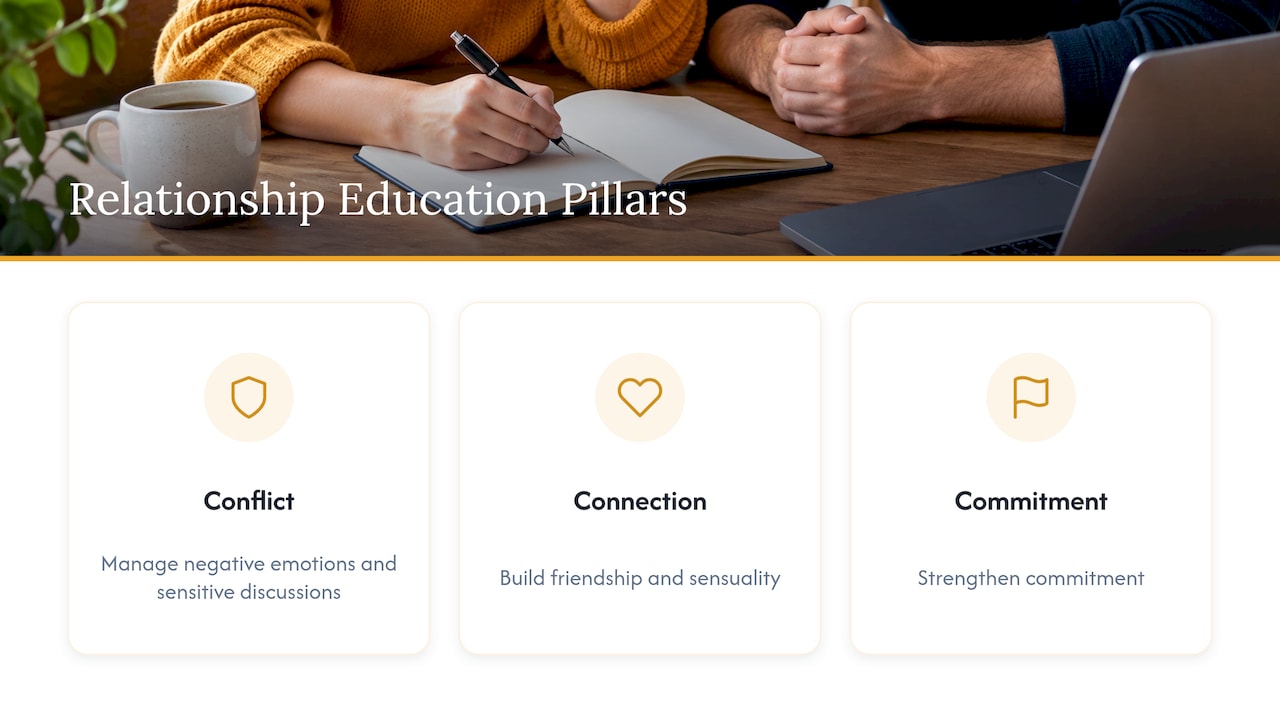
What good programs cover. A review of a decade of couple relationship education research identifies three broad pillars: managing negative emotions and sensitive discussions, enhancing positive connection such as friendship and sensuality, and strengthening commitment. Methods include communication practice, time-outs and speaker-listener techniques. When you evaluate any coach or course, check that it addresses all three: calming conflict, building warmth and deepening commitment.
What happens in a coaching session
Formats vary, but a well-run session usually includes:
- A quick check-in on how last week’s practice went, what worked and where you got stuck.
- One focus topic, such as a recurring argument about money or how to bring up something that bothers you.
- Live practice. You and your partner try the skill while the coach observes.
- Feedback and adjustment. The coach helps you refine your wording, tone and timing.
- A specific assignment, for example using a pause signal three times this week or holding a 20-minute weekly check-in.
If you want to try a taste of this at home first, our six therapist-backed communication exercises are short enough to do tonight.
How to choose a couples coach
The coaching field is not licensed the way therapy is, so credentials and method matter more than a polished website. Here is a practical way to choose.
Check training and credentials
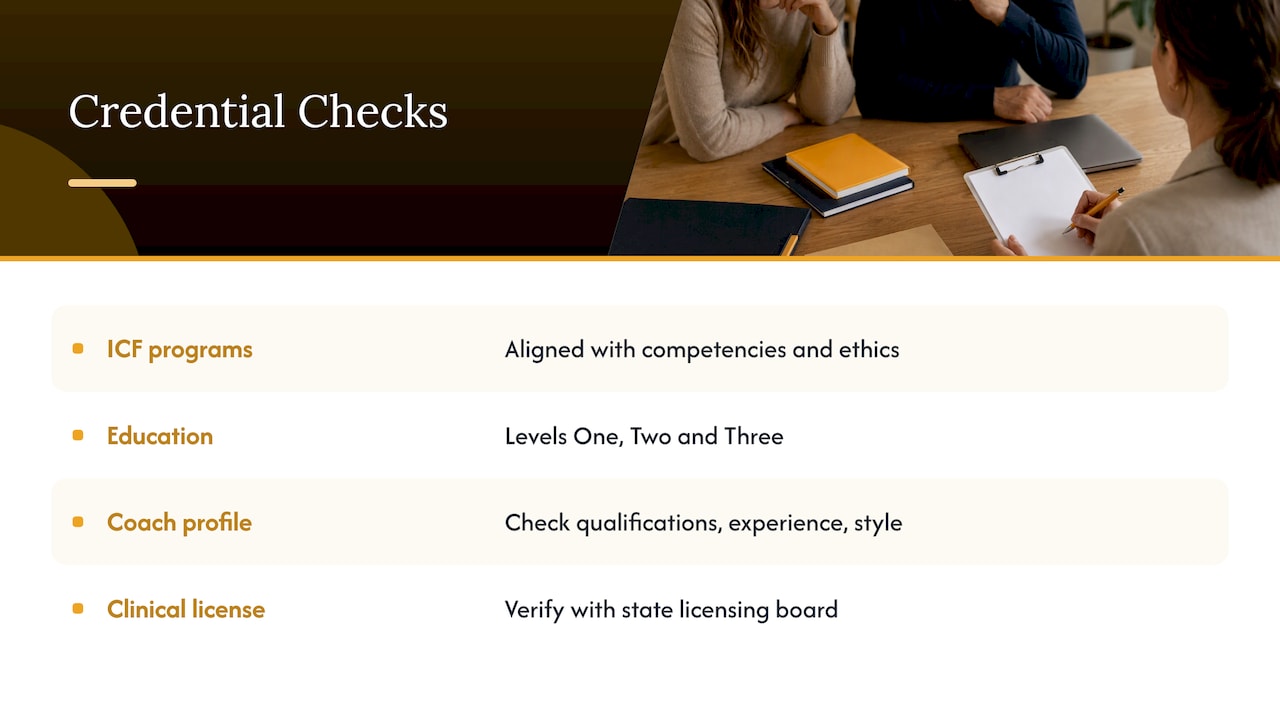
Professional coaching bodies set standards you can look for. The International Coaching Federation reviews coach education programs for alignment with its coaching definition, Core Competencies and Code of Ethics, and it recognizes Level One, Two and Three education. Local ICF chapters advise that you review a coach’s profile for qualifications, experience and coaching style and take reasonable steps to verify credentials. If a coach also holds a clinical license, such as an LMFT, LPC or LCSW, you can look the license up with your state’s licensing board.
Questions to ask a relationship coach
- What training and credentials do you have, and how can I verify them?
- What is your method, and what skills will we actually learn?
- Do you work with couples together, or mostly with individuals?
- What does a typical session look like, and what homework should we expect?
- Have you worked with couples like us (engaged, blended, faith-based, recovering from a betrayal)?
- How do you handle situations that need a licensed therapist, and what do you do if you see signs of abuse or a mental health crisis?
- How long does the work usually take, and what does the full program cost?
- How will we know it is working?
The answers you want are specific. “We’ll work on communication” is vague. “You’ll learn a pause signal, a softened start-up and a repair script, and practice each one in session” is a plan.
Match the format to your situation
Some couples want a self-paced course they can do together at night. Others want a coach in the room for a hard topic. Some want an immersive day to reset. These formats are not rivals; they are steps on a ladder, and many couples start with a workbook or course and add live coaching later.
Where our programs fit
We built our offers to match the way couples actually want to start, with published prices so you can plan:
| Offer | What it is | Price |
|---|---|---|
| The F.I.G.H.T. Plan workbook | Therapist-created guide to couples communication and conflict resolution | $14.99 to $25.00 |
| The F.I.G.H.T. Plan Couples Conflict Toolkit | Practical tools for conflict | $27.00 |
| Fight Less Love Again Video Course | Video course for couples | $47.00 |
| Stop the Fighting: The Couples Communication & Conflict Resolution Course | Full course on communication and conflict resolution | $149.00 |
| VIP Private Coaching, 4 sessions | Private coaching for your relationship | $997.00 |
| 6 Hours Couples Intensive | Extended, focused work for couples | $1995 |
We also offer specialized workbooks: premarital, post-affair, and faith-centered. Our Online Couples Coaching page lists the coaching options. For a first step that suits most couples with recurring conflict, the Stop the Fighting course gives you the full sequence of skills to practice together.
Our perspective
Couples rarely come to us because they lack love. They come because every hard conversation follows the same script, and nobody ever taught them a better one.
We built the F.I.G.H.T. Plan® as a clear, step-by-step system because we have seen how much relief a couple feels when conflict stops being a mystery and becomes a set of steps. Calm yourself. Say what you need without attacking. Listen to understand. Repair. Repeat.
That is what we mean by coaching: not advice from the sidelines, but skills you can use the next time the argument starts. Our materials draw on our work with thousands of couples, and we shape them for dating, engaged, married, blended and faith-based couples because the same skill needs different words in different homes.
Start where you are. A workbook, a course or a private session can all be the right door. What matters is that you and your partner walk through it together.
Carlos
Ready to try coaching with us
If you recognize your relationship in this guide, the simplest next step is to pick the format that fits your week. Our online couples coaching page shows how to book, and our shop has the workbooks and courses if you would rather begin on your own schedule.
The F.I.G.H.T. Plan® was created by licensed mental health professionals and designed for couples who want practical progress together.
FAQ
How much does a relationship coach charge?
Prices vary by coach, format and length of program, so ask for the full cost before you start. Our published prices run from $14.99 for a workbook to $997.00 for four private coaching sessions and $1995 for a six-hour couples intensive. Online Couples Coaching has no published price, so check the coaching page.
Is relationship coaching worth it?
Research on relationship education, the skill-building approach coaching uses, found gains in communication and relationship quality, with stronger results from programs of 9 to 20 contact hours. The ACF brief describes coaching tips as promising and says programs should keep testing and refining them. You get the most from it when both partners practice between sessions.
Can we do relationship coaching online?
Yes. A systematic review of online couple relationship education found that the randomized comparisons with wait-list or attention controls all favored the online programs. Online coaching and courses also let you practice at home, where your real arguments happen.
Do we both have to take part?
Couples coaching works best when both partners join, because the skills are practiced between the two of you. If only one of you is ready, a workbook or course can be a gentle way to begin, and a single partner can still learn to pause, soften a complaint and repair.
Does coaching replace therapy?
No. Coaching builds skills for couples working on goals. Therapy by a licensed professional treats clinical conditions and trauma. If abuse, a mental health crisis or substance dependence is part of the picture, start with a licensed professional, and use coaching tools alongside that care when your clinician agrees.
Sources
- Tips for Coaching in Healthy Relationship Programs, Administration for Children and Families (2023)
- Does marriage and relationship education work? A meta-analytic study (2008)
- Exploring Programmatic Moderators of the Effectiveness of Marriage and Relationship Education
- Equipping couples with the tools to cope with predictable and unpredictable stress (PREP study, 2002)
- How Effective is Online Couple Relationship Education? A systematic review
- Helping couples achieve relationship success: A decade of couple relationship education research
- ICF accredited coach education overview
- Find a Coach, ICF Metro DC
Recommended
- Evidence-Based Couples Therapy: What Works and How to Choose
- What Makes a Love Relationship Actually Work