
The Best Couples Quizzes for Real Connection and Insight

The best couples quizzes right now are the ones built on actual research, not just clever marketing copy. If you want a shortlist you can trust, start here: Couples Fight School’s conflict style quiz for spotting how you fight, the Gottman Institute Relationship Quiz for a research-based health check, the 5 Love Languages quiz for translating affection into terms you both understand, the Attachment Project’s attachment style quiz for uncovering old patterns that shape new arguments, Empathi’s relationship quiz for a deeper compatibility read, and Arthur Aron’s 36 Questions to Fall in Love for couples who want a guided conversation instead of a scored test.
Every one of these was built or endorsed by someone with actual credentials in relationship science, therapy, or psychological research, not a marketing team guessing at what sounds insightful. That distinction matters more than it seems, because a quiz that just feels accurate and a quiz that is actually validated can produce wildly different conversations afterward.
Here’s what you’re getting in this guide: detailed profiles of each quiz (what it measures, how long it takes, what it costs), a decision framework for picking the right one for your relationship stage, an honest look at where science-backed tools outperform fun ones (and vice versa), and a plan for what to actually do once you have your results in hand.
- Couples Fight School’s conflict style quiz — best for couples who fight the same fight on repeat and want to name the pattern.
- Gottman Institute Relationship Quiz — best for a broad, research-grounded snapshot of relationship health.
- 5 Love Languages quiz — best for translating “I don’t feel loved” into something specific and actionable.
- The Attachment Project’s attachment style quiz — best for couples who keep hitting the same wall and suspect it’s rooted in something older than the relationship.
- Empathi relationship quiz — best for a deeper, multi-dimensional compatibility assessment.
- 36 Questions to Fall in Love — best for couples who want connection through conversation, not a scorecard.
Key Takeaways
The best couples quizzes pair a research-backed measurement with a clear next step, since a result without follow-up rarely changes how a couple actually communicates.
| Point | Details |
|---|---|
| Match the quiz to the goal | Pick a science-backed assessment for real patterns, an entertainment quiz for connection and laughs. |
| Check the creator | Favor quizzes built or reviewed by therapists and researchers over anonymous viral content. |
| Protect your data | Confirm a privacy statement exists before entering personal answers into any online quiz. |
| Turn results into action | Use a short conversation and a one-week plan to test one small change instead of just discussing the label. |
| Start with a clinically useful pick | Couples Fight School’s free conflict style quiz identifies fight patterns and links directly to structured follow-up like the F.I.G.H.T. Plan®. |
Table of Contents
- What Are the Best Couples Quizzes to Take Together?
- How Do You Choose the Right Quiz for Your Relationship Goal?
- Are Science-Backed Quizzes Better Than Fun Party Quizzes?
- What Should You Do With Your Quiz Results?
- Which Quiz Should You Take First?
- Why We Prioritize Clinically Useful Quizzes Over Viral Ones
- What Comes After a Quiz? Structured Support That Actually Sticks
- Frequently Asked Questions
- Sources
What Are the Best Couples Quizzes to Take Together?
Six quizzes rise above the noise for different reasons, and none of them claim to do everything. Picking the right one depends on what you’re actually trying to learn.
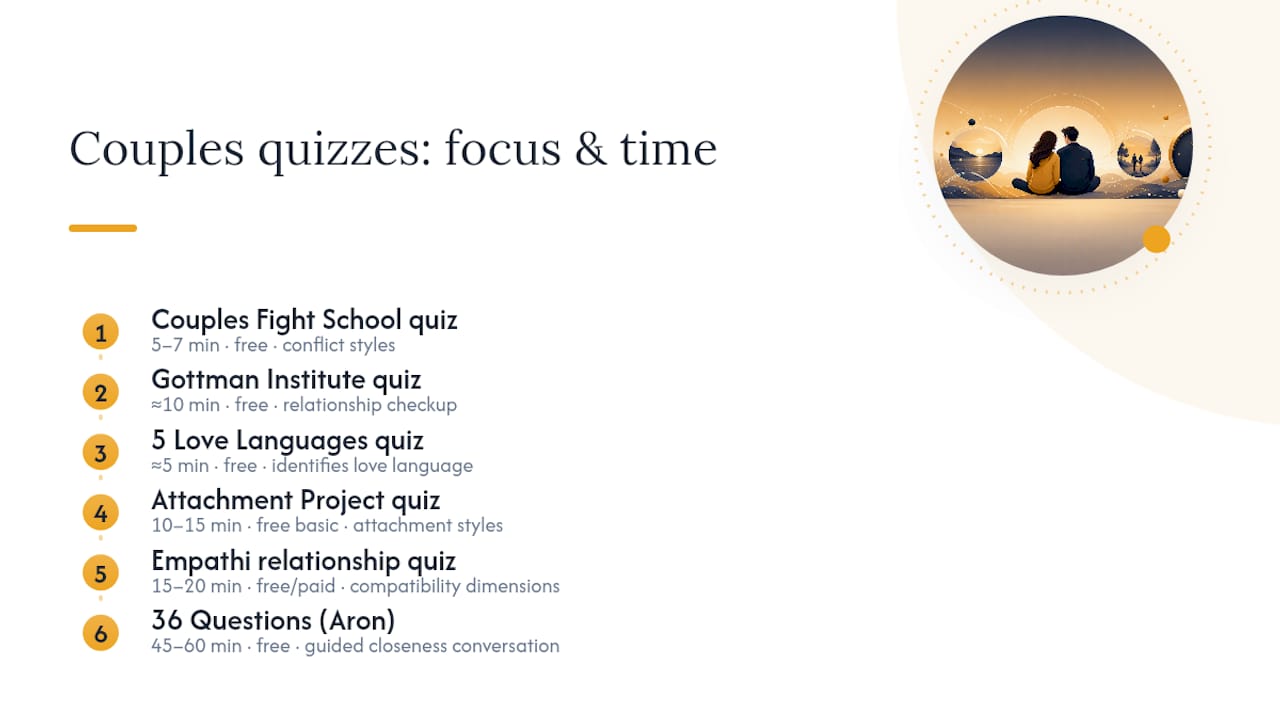
Couples Fight School’s conflict style quiz measures how you and your partner handle disagreement: whether you escalate, withdraw, accommodate, or negotiate. It takes about 5 to 7 minutes, it’s free, and it’s built specifically to feed into structured follow-up work rather than leave you with a label and nothing else. Couples who feel stuck in the same argument on a loop should start here.
The Gottman Institute Relationship Quiz draws on decades of observational research into what separates couples who stay together from couples who don’t. It covers areas like trust, commitment, and conflict management in roughly 10 minutes, and it’s free to take, though some detailed breakdowns sit behind Gottman’s paid materials. This is the closest thing to a general checkup for a relationship.
The 5 Love Languages quiz, based on Gary Chapman’s framework, identifies which of five categories (words of affirmation, acts of service, receiving gifts, quality time, physical touch) makes you feel most loved. It takes about 5 minutes and is free online. It’s less a clinical assessment and more a translation tool, useful when partners keep missing each other’s signals of affection.
The Attachment Project’s attachment style quiz identifies whether you lean secure, anxious, avoidant, or disorganized in close relationships, a framework rooted in attachment theory research going back to Mary Ainsworth. It runs about 10 to 15 minutes and offers a free basic result with paid deeper reports. Couples whose fights seem to trace back to fear of abandonment or fear of engulfment get the most out of this one.
Empathi’s relationship quiz takes a broader compatibility approach, assessing multiple dimensions of a relationship rather than a single trait. It typically takes 15 to 20 minutes and offers both free and paid tiers depending on how detailed a report you want. It suits couples who want more granularity than a single-construct quiz can offer.
36 Questions to Fall in Love, developed by psychologist Arthur Aron for a study on interpersonal closeness, isn’t scored at all. It’s a structured sequence of increasingly personal questions meant to be asked out loud, taking 45 minutes to an hour. It’s completely free and works best as a guided conversation for couples who want closeness over data.
Pro Tip: If you only have ten minutes and want a quick spark, go entertainment-focused. If you’re trying to solve a recurring problem, pick a measurement-focused quiz with a scoring system behind it, then read the interpretation guide before you discuss results, not during.
A few honorable mentions round out the field for couples who want variety in their rotation. SyncWithLove’s real-time quiz format has partners answer simultaneously and reveal at the same time, which adds a layer of unfiltered honesty that turn-taking quizzes lose. Long-form question banks, like Cosmopolitan’s 100 couples quiz questions, work well printed out for a date night when you want volume over precision.
How Do You Choose the Right Quiz for Your Relationship Goal?
Start with your actual goal, not the quiz that showed up first in your search results. A couple trying to survive a rough patch needs something different than a couple three months into dating who just wants a fun Friday night activity.
Run through this checklist before you pick one:
- What’s the goal? Spark conversation, diagnose a pattern, or just have fun. Pick a fun/entertainment quiz for the first and last, a validated assessment for the second.
- What stage is the relationship in? Newly dating couples often do better with something like 36 Questions or a love languages quiz. Married couples navigating a stuck pattern benefit more from an attachment or conflict-style assessment.
- How much time do you actually have? Five minutes calls for a love languages quiz. An evening calls for 36 Questions or a longer trivia set.
- What happens to your data? Interactive online quizzes should tell you clearly whether responses are stored, sold, or used for marketing.
- Do you want a next step, or just a result? Some quizzes hand you a label and stop there. Others, like the conflict style quiz, are designed to connect directly into structured follow-up work.
Before you take any quiz, ask three questions:
- Who created this, and what are their credentials? A quiz built by a licensed therapist or researcher carries different weight than one built by an anonymous content team.
- Is there a research basis behind the categories it uses, or did someone invent the framework for engagement purposes?
- What happens to your answers after you submit them? Look for an actual privacy statement, not a vague “we value your privacy” line buried in fine print.
Watch for a few red flags. A quiz with no visible creator, no privacy policy, and no explanation of its scoring methodology is a guessing game dressed up as science. Be skeptical of anything that claims to “diagnose” a relationship problem. Diagnosis belongs to licensed clinicians, not a ten-question web form. And be wary of any tool that demands payment before showing you even a preview of what you’re buying.
The trust signals worth looking for run the other direction: citations to actual research, a named creator with real credentials, therapist review, and a clear path to follow-up resources once you’ve got your result.
Are Science-Backed Quizzes Better Than Fun Party Quizzes?
Neither type is “better” in isolation. They’re built for different jobs, and confusing the two is where couples get into trouble.
Science-backed assessments, like the Gottman quiz or the Attachment Project’s tool, are built from validated psychological constructs and, in some cases, decades of observational research. They aim for measurement accuracy: identifying a real pattern that predicts something meaningful about how your relationship functions. Their limitation is that a self-report quiz, even a well-designed one, still isn’t a clinical evaluation. It’s a screening tool, not a diagnosis.
Fun and entertainment quizzes, like BuzzFeed’s relationship-type quizzes or long funny question banks, aren’t trying to measure anything real. They’re trying to spark a laugh, a memory, or a conversation you wouldn’t have started otherwise. That’s a legitimate function on its own. A couple stressed about work and parenting doesn’t always need another data point about their relationship health; sometimes they need twenty minutes of laughing about pizza toppings and childhood memories.
Here’s where the two types produce different outcomes in practice: a science-backed quiz might tell you that you and your partner have mismatched attachment styles, which explains a recurring pattern of one person pursuing and the other withdrawing during conflict. A fun quiz asking “what’s your dream vacation” won’t reveal that pattern, but it will get you both talking and laughing in a way that rebuilds goodwill between harder conversations.

The strongest approach combines both. Take an assessment-style quiz once every few months to check in on real patterns, and mix in lighter, entertainment-focused quizzes or long question banks regularly, on date nights or long car rides, for connection without the pressure of a scored result.
What Should You Do With Your Quiz Results?
The single most important rule for what comes next: respond to your results with curiosity, not judgment. A low score on communication isn’t an accusation. It’s information you didn’t have an hour ago.
How you talk about results depends heavily on what the quiz revealed:
- If you scored a mismatch on values or priorities, ask each other: “What does this priority actually look like day to day for you?” rather than debating whose priority is more valid.
- If intimacy came back as a gap area, start with “When do you feel closest to me?” instead of “Why don’t we have more intimacy?” The first invites detail; the second invites defensiveness.
- If your conflict styles clash (one of you escalates, the other withdraws), name the pattern out loud together: “It looks like I chase and you retreat. Let’s figure out what happens right before that starts.”
A simple seven-day plan turns a quiz result into an actual habit shift instead of a one-time conversation that fades by Thursday:
- Day 1: Take the quiz together and read the results out loud to each other, no reacting yet.
- Day 2: Each partner writes down one thing from the result that surprised them.
- Day 3: Have a 15-minute conversation using one of the prompts above, focused on just one finding.
- Day 4: Pick one small, specific behavior change to try (a five-minute check-in before bed, a different way of raising a complaint).
- Day 5: Practice the change once, without discussing it yet.
- Day 6: Check in briefly: did it feel different? Awkward? Better?
- Day 7: Decide together whether to keep the change, adjust it, or drop it and try something else.
Couples Fight School built its F.I.G.H.T. Plan® framework around exactly this kind of translation work, turning insight into practice rather than letting insight sit unused. If your quiz reveals a conflict pattern, the F.I.G.H.T. Plan’s regulation steps give you a script for pausing before escalation. If it reveals a communication gap, the framework’s structured dialogue steps replace vague good intentions with a repeatable process. A quiz result tells you where you are; a framework tells you what to do about it.
Pro Tip: Set a timer for these conversations, five to ten minutes at first. Long, unstructured talks about quiz results tend to drift into old arguments. Short, focused ones tend to actually go somewhere new.
Which Quiz Should You Take First?
If you’re not sure where to start, match the quiz to what’s actually bothering you right now, not to whichever one is trending.
- Want to spark conversation on date night? Start with 36 Questions to Fall in Love or a printable question bank.
- Trying to figure out why the same argument keeps happening? Take the conflict style quiz first.
- Wondering if your attachment history is shaping your current fights? The Attachment Project’s quiz will give you language for it.
- Feel like your partner doesn’t “get” how you show love? The 5 Love Languages quiz solves that specific miscommunication fast.
- Want a general health check with no specific complaint in mind? The Gottman Relationship Quiz covers the most ground in the least time.
Take whichever one matches your situation this week, not the one that sounds most impressive. And on privacy: reputable quizzes state clearly what happens to your answers, so read that line before you start, and treat your result as a conversation starter, never a verdict on the relationship itself.
Why We Prioritize Clinically Useful Quizzes Over Viral Ones
Most quizzes that go viral do it because they’re entertaining, not because they’re accurate, and I think that distinction gets lost constantly in how these tools get marketed to couples. A quiz that produces a shareable, dramatic result will spread faster than one that produces a nuanced, sometimes uncomfortable insight, even when the nuanced one is the more useful of the two.
What actually matters to me, working with couples on conflict and communication, is whether a quiz result can be turned into a concrete next step. A label alone ("You're an anxious attacher" or "Your love language is quality time") does very little on its own. What matters is what a couple does with that information in the next conversation, the next fight, the next attempt to reconnect. That’s why I keep coming back to tools that connect directly to structured follow-up, whether that’s a workbook, a course, or a framework like the F.I.G.H.T. Plan, rather than tools that just hand you a result and move on.
Couples Fight School builds and recommends quizzes with this in mind, and I’ll say plainly that our own conflict style quiz exists because I saw how often couples took a fun assessment, felt briefly validated or briefly alarmed, and then had no idea what to actually do differently. Quizzes are for insight and conversation. They are not diagnostic tools, and no online quiz, ours included, should replace an actual conversation with a licensed therapist when a relationship is dealing with something serious like infidelity, abuse, or untreated mental health conditions.
What Comes After a Quiz? Structured Support That Actually Sticks
A quiz gives you a snapshot. It doesn’t give you the skills to change what the snapshot shows, and that gap is exactly where most couples get stuck after taking an assessment online, nodding at the results, and going right back to old habits by dinner.
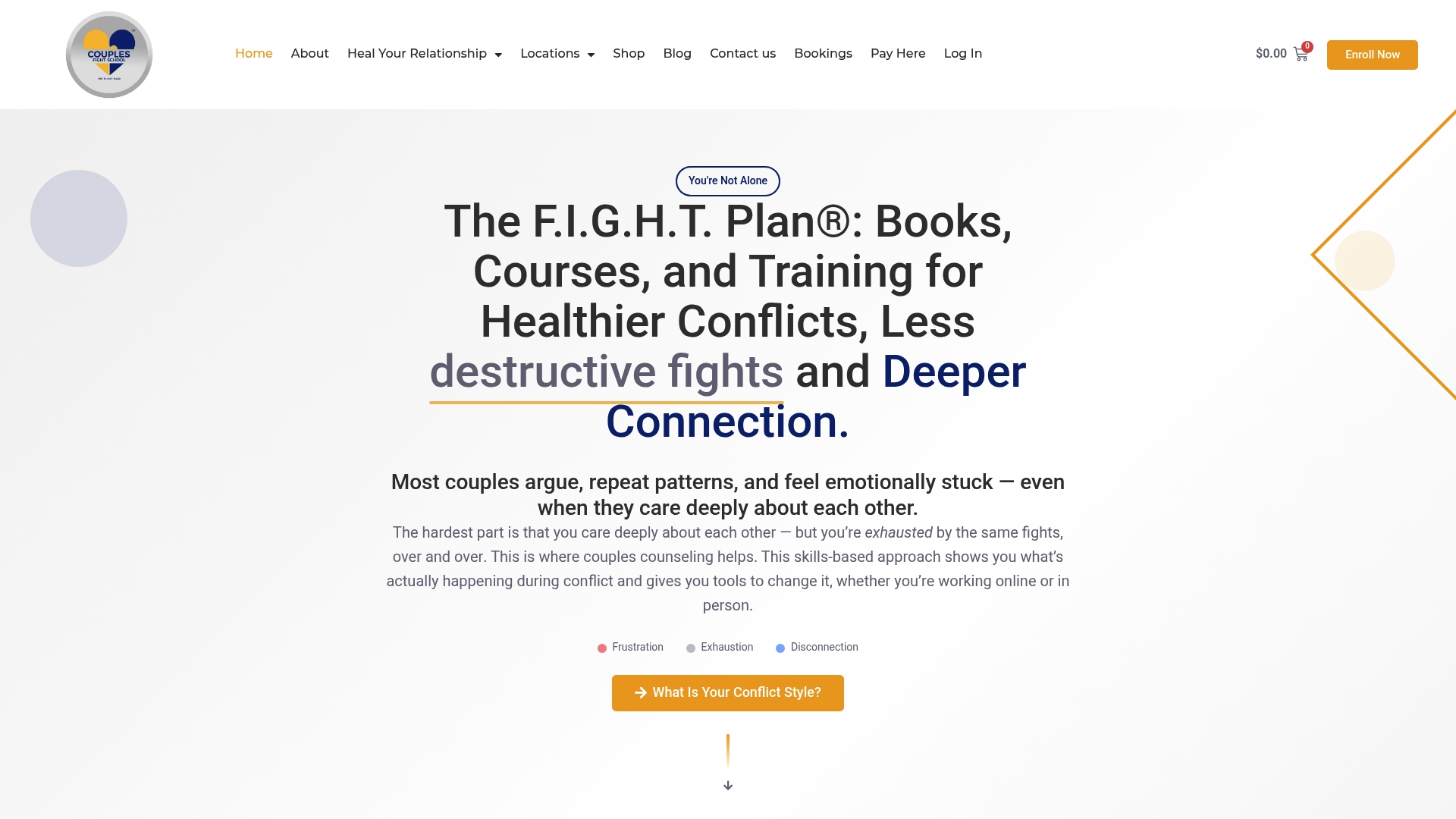
Couples Fight School closes that gap with resources built to turn a quiz result into an actual shift in how you communicate. If your conflict style quiz showed a pursue-withdraw pattern, our Stop the Fighting communication and conflict resolution course walks you through the exact scripts and regulation techniques for interrupting it in real time, not just naming it. If your results pointed to a values mismatch or a repair gap, the couples therapy workbook gives you structured exercises to work through at your own pace, on your own schedule, without waiting for a therapist’s calendar to open up.
For couples who want more direct support, our online coaching program pairs you with guidance built around the F.I.G.H.T. Plan®, the same framework we referenced earlier for turning insight into practice. If you’re not ready for a full course or coaching commitment, start with the free conflict style quiz itself and see which pattern shows up. Take the conflict style quiz now, and use your result as the starting point for your next real conversation.
Frequently Asked Questions
Are online couples quizzes actually accurate?
It depends entirely on who built them. Quizzes based on validated psychological research, like the Gottman Institute Relationship Quiz or an attachment style assessment, reflect real patterns identified through decades of study. Quizzes built purely for entertainment are accurate at sparking conversation, not at measuring anything clinical.
How long does the average couples quiz take?
Most run 5 to 20 minutes. Quick tools like the love languages quiz or Couples Fight School’s conflict style quiz take under 10 minutes. Deeper assessments, like Empathi’s relationship quiz, run closer to 20 minutes. Structured exercises like 36 Questions to Fall in Love take 45 minutes to an hour since they’re a full conversation, not a quick form.
Do we need to take a quiz together, or can we take it separately?
Most assessment-style quizzes, including attachment and conflict-style tools, work best when each partner answers independently first, then compares results together. Entertainment quizzes and conversation-based formats like 36 Questions are designed to be done together in real time.
Is it safe to enter personal information into a relationship quiz?
Check for a visible privacy policy before entering anything personal. Reputable quizzes, including therapist-created and research-based tools, state clearly whether your answers are stored or used for marketing. If a quiz has no privacy statement at all, treat that as a reason to skip it.
Can a quiz replace couples counseling?
No. A quiz can highlight a pattern worth discussing, but it can’t replace the guidance of a licensed therapist, especially for serious issues like infidelity, abuse, or untreated mental health concerns. Use a quiz as a starting point for conversation, and consider therapist-led counseling when the issue runs deeper than a single conversation can resolve.
Sources
Reliable couples quizzes tend to fall into two camps: those created by licensed therapists or researchers, and those built by long-running, widely used interactive platforms with a track record of engagement. Both have a place, as long as you know which one you’re using and why.
- Christian Marriage Counseling in Peoria, Arizona – Prism Counseling & Coaching | Faith-Based Counseling and Spiritually-Integrated Therapy in Peoria and Phoenix AZ
Recommended
- Intimacy Building Activities for Couples That Actually Work
- Alternatives to integrativecouplestherapy.com: Best Picks