
6 Couples Check In Questions for a 15-Minute Weekly Ritual

A 15-minute weekly check-in with the right 6 questions can catch small resentments before they turn into recurring fights. That’s the core promise behind couples check in questions: a short, repeatable conversation that does more for your relationship than an occasional three-hour “let’s talk about us” marathon ever does.
Here’s the starter set. Read these tonight, out loud, to your partner:
- What was the best part of our week together?
- Is there anything I did or said that landed wrong?
- What’s one thing on your plate right now that you need help with?
- On a scale of 1 to 10, how connected have you felt this week?
- Is there anything we’ve been avoiding that we should talk about?
- What’s one thing we can do together before our next check-in?
Time budget: 15 minutes, split roughly into three chunks: gratitude and connection first, logistics next, feelings and one action item last. Short beats perfect. A 10 to 15-minute weekly structure is enough to keep small friction from turning into resentment, and couples who start with a five-minute version tend to stick with the habit longer than those who try to do too much on day one.
Whoever had the harder week speaks first on the gratitude question. End with one shared commitment, something small and specific you’ll both actually remember by next week.

Key Takeaways
A short, structured weekly check-in of 3 to 5 rotating questions, timed to 15 minutes, resolves more small issues than infrequent, unstructured relationship talks.
| Point | Details |
|---|---|
| Start with the 6-question version | Use the starter set tonight; it covers gratitude, logistics, feelings, and one commitment in about 15 minutes. |
| Pick 3 to 5 questions, rotate themes | Avoid long lists; choose questions that are specific and don’t assume the answer. |
| Match frequency to time available | Daily check-ins take 1 to 5 minutes, weekly ones 10 to 20, monthly ones 30 to 60 or more. |
| End every check-in with one commitment | A small, specific action converts talk into actual change by next week. |
| Use the F.I.G.H.T. Plan® when things stall | Couples Fight School’s framework and coaching help resolve issues a check-in surfaces but can’t fully fix on its own. |
Table of Contents
- What Are Couples Check In Questions, Exactly?
- How Does a 15-Minute Weekly Check-In Actually Run?
- How Do You Choose Questions, Frequency, and Ground Rules?
- What Do You Do When a Check-In Goes Sideways?
- Why This Ritual Works Better Than It Sounds
- How Couples Fight School Can Help You Go Further
- Frequently Asked Questions
- Sources
What Are Couples Check In Questions, Exactly?
Couples check in questions are the standard term for what relationship educators call a weekly marriage meeting or relationship check in: a structured, recurring conversation with a fixed agenda instead of an open-ended “how are we doing?” chat. The format matters because it removes the guesswork. You’re not deciding what to talk about in the moment, which is usually where check-ins derail into whichever topic is most emotionally loaded that day.
The rule that separates a useful check-in from a rehash of old arguments is simple: pick 3 to 5 questions per session, not fifteen. A practical rule for weekly check-ins is to choose questions that are open enough to invite an honest answer, specific enough to surface something real, and worded so they don’t assume the answer before your partner speaks.
Below is a themed bank you can pull from. Rotate categories week to week so the ritual doesn’t calcify into the same three questions on autopilot.
Emotional and mental check-in:
- How has your stress level been this week, on average?
- What’s been taking up the most space in your head lately?
- Do you feel like I’ve been present with you this week?
- Is there something you needed from me that you didn’t ask for?
- What’s one thing that made you feel understood recently?
- Have you felt lonely at all, even around me?
Appreciation:
- What’s something I did this week that you noticed and liked?
- What’s a quality of mine you’ve been grateful for lately?
- When did you feel most proud of us this week?
- What’s something small I do that you don’t say enough about?
Logistics, chores, and finances:
- Is our current chore split still working for you?
- Are we on the same page about spending this month?
- Is there a bill, appointment, or deadline I should know about?
- What’s coming up next week that we need to plan around?
- Do you feel like the mental load is split fairly right now?
Intimacy and sex:
- Have you felt desired by me this week?
- Is there anything about our physical connection you’d like more of?
- What’s one thing that would make you feel closer to me physically?
- Is there anything that’s felt off or distant lately?
Conflict and repair:
- Is there something from this week we should circle back to?
- Did I say or do anything that hurt you, even a little?
- Is there a pattern in our arguments you’ve noticed lately?
- What would help you feel safer bringing up hard things with me?
Future, goals, and vision:
- Are we still aligned on where we’re headed this year?
- Is there a goal you’ve been putting off that you want support on?
- What’s something you’re excited about for our future?
Parenting and family:
- How do you think we’re doing as a parenting team this week?
- Is there a family issue that’s been weighing on you?
- Do you feel supported in how we’re handling the kids right now?
Light and playful:
- What made you laugh this week?
- What’s a memory from this week you want to hold onto?
- If we could do anything together this weekend, what would you pick?
| Check-in length | Ideal question count | Best theme mix |
|---|---|---|
| 5 minutes | 2 to 3 | Appreciation, one logistics question |
| 15 minutes | 4 to 6 | Gratitude, logistics, one emotional or repair question |
| 30 to 60 minutes | 6 to 10 | All themes, including goals and intimacy |
Keep the wording concrete. “Are you happy?” invites a shrug. “What’s one thing that made you feel understood this week?” invites an actual answer.
How Does a 15-Minute Weekly Check-In Actually Run?
Here’s a minute-by-minute agenda that mirrors the structure relationship educators recommend for a short weekly meeting.
- 0:00 to 2:00: Gratitude. Each partner shares one thing they appreciated about the other this week. Keeping the opening positive increases the couple’s capacity to handle a harder topic later in the same conversation.
- 2:00 to 6:00: Logistics. Cover the calendar, money, chores, whatever needs a quick decision. This is administrative, not emotional. Keep it moving.
- 6:00 to 12:00: Feelings and concerns. This is where you ask your one or two deeper questions from the bank above. One person answers fully before the other responds.
- 12:00 to 14:00: Support and action. Ask directly: “What do you need from me this week?” Turn the answer into something specific.
- 14:00 to 15:00: Close. State one shared commitment out loud. Something you can both point to next week and say, “did we do that or not?”
Opening script: “Okay, check-in time. Let’s start with something good from this week.”
Inviting honesty script: “I want to hear the real answer, even if it’s not the comfortable one. I’m not going to get defensive.”
Closing script: “So this week, we’re both going to [specific action]. Same time next week?”
Set a timer. Fifteen minutes goes fast, and a visible countdown keeps the logistics section from swallowing the whole meeting.
Pro Tip: If a topic starts heating up during the feelings section, say “let’s flag this for a separate conversation” and move to the close. A check-in is for surfacing issues, not resolving every one of them on the spot.
How Do You Choose Questions, Frequency, and Ground Rules?
Frequency should match the size of the conversation you’re having, not the other way around.
| Frequency | Time budget | Best use |
|---|---|---|
| Daily | 1 to 5 minutes | Quick temperature check, one appreciation, one logistics item |
| Weekly | 10 to 20 minutes | Full agenda: gratitude, logistics, one emotional or repair question |
| Monthly | 30 to 60+ minutes | Goals, intimacy, parenting, bigger-picture alignment |
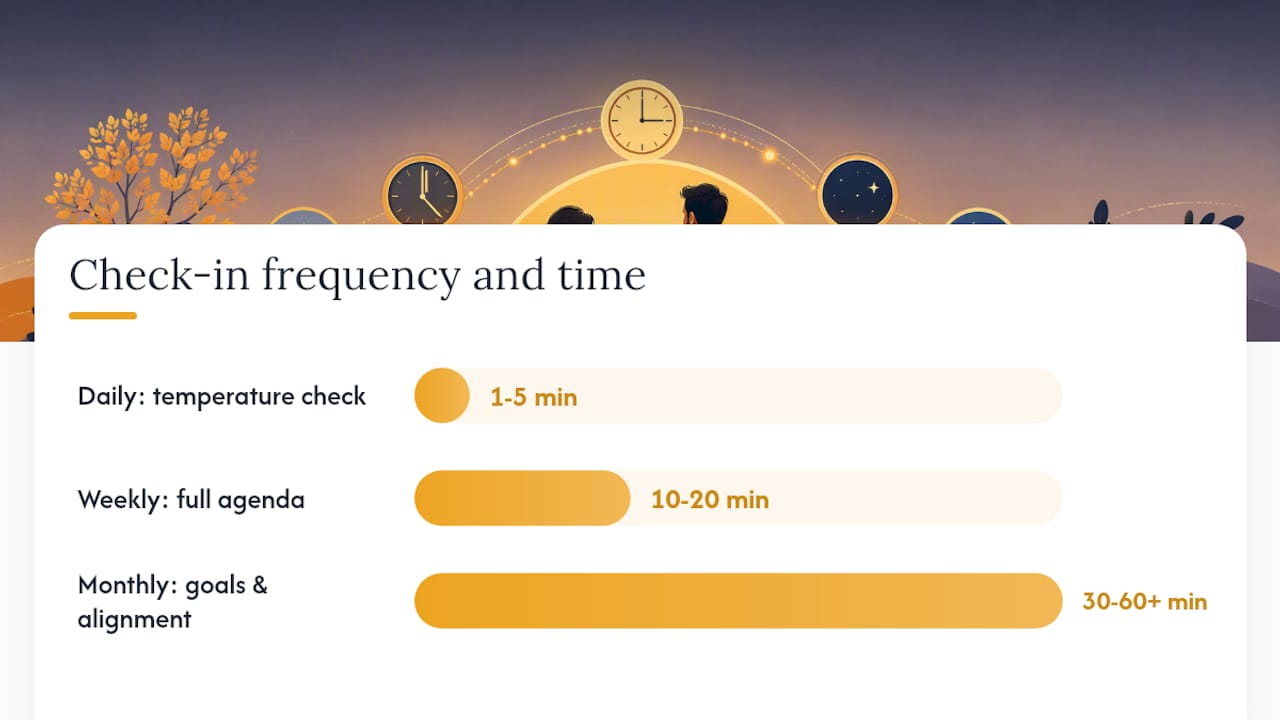
Matching question depth to available time keeps the habit sustainable. A five-minute daily check-in and a fifteen-minute weekly one aren’t competing rituals; they’re different tools for different jobs.
Stick to the pick-3-to-5 rule every time. Keep one or two “anchor” questions the same each week (gratitude is a good one to never drop), and rotate the rest so you’re not just repeating “how was your week” on a loop.
Ground rules that keep this safe:
- Set a timer and honor it. Running long turns a habit into a chore.
- No interrupting during the feelings section. Full answer, then response.
- Use “I” statements instead of “you always” framing.
- Table anything that starts escalating. Big fights don’t belong in a 15-minute slot.
- Always leave with an agreed next step, even a small one.
What Do You Do When a Check-In Goes Sideways?
Someone shuts down, the “logistics” section quietly turns into a complaint session, or the same unresolved issue shows up for the third week running. This is where a structured framework earns its keep. Couples Fight School’s F.I.G.H.T. Plan® gives you a way to name what’s happening and move through it instead of around it: identifying the real issue, checking in on feelings, gaining a shared understanding, working through it together, and landing on a resolution both partners can actually keep.
Common problems and fixes:
- One partner withdraws. Ask a smaller, easier question first: “What’s one word for how this week felt?” Silence often means the question was too big, not that there’s nothing to say.
- The check-in turns into a complaint session. Pause and rename it out loud: “This feels like it’s turning into a list of complaints. Can we pick the one thing that matters most right now?”
- Defensiveness shows up fast. Slow the pace. “I’m not trying to attack you, I want to understand what happened from your side.”
- The same unresolved topic keeps returning. That’s a signal the issue needs its own conversation, not five more minutes at the end of a check-in. Table it, schedule a dedicated time, and treat it as a repair task instead of a check-in item.
A check-in that starts with gratitude before moving into problems keeps the tone constructive and reserves harder topics for when both partners are already feeling connected, rather than starting cold on the thing that’s bothering someone.
If check-ins keep circling the same unresolved resentment, that’s usually a sign the issue is bigger than a 15-minute format can hold. Couples Fight School’s guide on addressing unresolved resentment walks through how to name it and start actually working through it, and the conflict resolution question list is worth pulling from once a check-in surfaces something that needs a dedicated conversation.
Why This Ritual Works Better Than It Sounds
Fifteen minutes doesn’t sound like enough time to matter. In practice, it’s usually the couples who try to fix everything in one long, emotionally loaded conversation who end up avoiding the conversation altogether. Short and frequent beats long and rare, almost every time I’ve seen it play out with clients.
What surprises most couples isn’t the questions, it’s how much a fixed structure lowers the emotional stakes. When you know the meeting ends in fifteen minutes and always closes with one small commitment, you stop treating every check-in like a referendum on the relationship. That alone changes how honestly people answer.
Consistency beats intensity here. A couple who runs a clumsy five-minute check-in every week for two months will be in a noticeably different place than a couple who has one perfect ninety-minute conversation and then doesn’t repeat it. Progress on this compounds quietly. You won’t feel it after one check-in. You’ll feel it after the twelfth.
How Couples Fight School Can Help You Go Further
A weekly check-in handles maintenance. It’s not designed to carry a couple through a recurring, unresolved fight, and it shouldn’t have to. That’s the gap Couples Fight School® fills: structured tools built specifically for the conversations a 15-minute check-in surfaces but can’t fully resolve on its own.

Couples Fight School® offers therapist-designed workbooks, online courses, and private coaching built around the F.I.G.H.T. Plan®, the same framework referenced above for troubleshooting a check-in that’s gone off track. What you get:
- Structured scripts for the exact moments check-ins tend to break down, like defensiveness and withdrawal
- A step-by-step framework for turning a recurring argument into an actual resolution
- Options ranging from self-paced courses to live coaching, depending on how much support you want
If your check-ins keep surfacing the same unresolved issue, online coaching for couples gives you a live guide through that specific conflict rather than another list of questions to try on your own. If you’d rather start with a structured, self-paced option, the communication and conflict resolution course is a practical next step.
Frequently Asked Questions
How long should a couples check-in take?
Fifteen minutes is the sweet spot for a weekly check-in. Daily check-ins can run 1 to 5 minutes, and monthly deeper conversations can run 30 to 60 minutes or longer.
It is recommended to ask a few focused questions per session to allow for meaningful answers, avoiding trying to cover too many topics in limited time.
What if my partner doesn’t want to do check-ins?
Start smaller than you think you need to. A five-minute version with two questions is easier to say yes to than a full fifteen-minute agenda, and adoption tends to stick better when the habit starts small.
Should check-ins include hard topics or just logistics?
Both, but in order. Start with gratitude, handle logistics, then move to one feelings or repair question. Table anything that starts escalating into a bigger fight.
What’s the difference between a check-in and a full marriage meeting?
A check-in is the short, frequent version, usually 5 to 20 minutes. A full marriage meeting can run longer and cover goals, finances, and bigger-picture planning, closer to a monthly cadence.
Sources
The guidance above draws on a handful of sources worth exploring directly if you want to build out your own question bank or agenda further.
- The Power of a Weekly Marriage Meeting | The Art of Manliness
- Relationship Check-In Questions for Couples | The Knot
- 30 weekly check-in questions for couples — Kindred
Building a bigger question bank isn’t about collecting more questions. It’s about knowing which three or four will actually move your specific relationship forward this week.
Recommended
- StripeM-Inner
- 4-Hour Couples Intensive – Couples Fight School
- 9 Ways to Strengthen Marital Friendship That Last
- Premarital Counseling Topics Checklist for Couples