
Blended Family House Rules That Actually Work

The house rules that last in a blended family are the ones the two adults agree on privately first, then present together, with the biological parent leading on discipline while the stepparent builds the relationship. Rules fail less often because the list is wrong than because the couple never settled how to decide, enforce and disagree. This guide gives you the rules to start with, how to roll them out by age and household, and how to connect with stepchildren along the way. We built our work with couples around that skill: fighting less about the rules than you do about everything else.
TL;DR
- Settle the rules as a couple, in private, before you announce anything to the kids.
- Keep the list short and specific, and let the biological parent lead discipline while the stepparent monitors and helps enforce.
- Use regular family meetings so children can be heard, and adjust rules for age without changing the values behind them.
- Never use children as messengers between households, and never criticize the other home in front of them.
- Build the stepparent bond through respect, shared interests and praise, not forced hugs or sudden authority.
Table of Contents
- Why house rules are really a couple’s conversation
- Step 1: Agree privately, in writing
- Step 2: Keep the rule list short and specific
- Step 3: Decide who enforces what
- Step 4: Hold family meetings
- Step 5: Adjust for ages without splitting the family
- Step 6: Handle two households
- Bonding with stepchildren while you enforce rules
- Favoritism: what it looks like and what to do
- What to say when you disagree about a rule
- Our perspective
- Get the structure and the scripts
- FAQ
- Sources
Why house rules are really a couple’s conversation
Most lists of blended family rules say the same things: be consistent, involve everyone, enforce fairly. That is correct and not enough, because the hard part happens between the two adults. One of you has years of habits with your own children. The other is stepping into a home where the rules already exist, and may be asked to enforce them without the history that gives them weight.
University of Georgia extension researchers advise couples to talk before or soon after the marriage about sibling dynamics, family traditions, child-rearing beliefs and the household rules each already has. The same report says to make the marital relationship a priority to avoid jealousy. In practice that means the adults’ alliance comes first, and the rules are what that alliance produces.
If that conversation turns into the same argument every week, the rules are not the problem. Our guide to why blended family conflict happens and how to fix it covers the patterns that sit underneath.
Step 1: Agree privately, in writing
Before you talk to the children, sit down with your partner and go through five questions. Write the answers down.
- What does each of us currently expect in our own home: bedtimes, screens, chores, meals, language, and manners?
- Which of those matter to us, and which are only habit?
- Where do our expectations conflict, and what is the compromise?
- Who responds when a rule is broken, and what happens?
- How will we disagree about a rule when the kids are in the room?
Question five is the one most couples skip. A workable answer is simple: if you disagree, you say “let’s talk about it later” and you do, in private. Child Mind Institute advises expressing disagreement with a partner’s parenting choices in private rather than in front of the child. A child who sees the adults split on a rule learns quickly which adult to ask.
Writing the answers down matters because memory bends under stress. When you are both tired on a Thursday night, a page you agreed on in a calm moment is easier to follow than two conflicting recollections. Our post on communication agreements that work shows how to structure that kind of agreement.
Step 2: Keep the rule list short and specific
The American Psychological Association suggests that stepfamilies develop a list of household rules, with examples such as agreeing to respect each family member and each person cleaning up after themselves. Notice what those examples have in common: they apply to everyone, adults included, and a child can tell whether they were followed.
A good starting list for most blended households covers:
- Respect and language. How we speak to each other, including when we are angry.
- Chores. What each person does, and that it applies equally to resident and visiting children when they are in the home.
- Screens and devices. When, where and for how long.
- Bedtimes and mornings. Set by age, not by whose child it is.
- Meals. Who is expected at the table and what happens if someone misses it.
- Privacy and space. Bedrooms, belongings, and what is shared.
- Guests and visits. Friends, other relatives and the other household’s drop-offs.
Start with four to six rules, not twenty. Frame them as “in this house, we…” rather than a list of prohibitions. Add more only when a real problem shows the need.
The core idea is one set of expectations for the household. Some details can shift with age and maturity, which the UGA report also notes, but a nine-year-old and a fifteen-year-old should be able to see that the same values sit under different details. If you are parenting younger children, the thinking behind consistency in toddler routines carries over well: predictable routines give small children security, and that is just as true when two families merge.
Step 3: Decide who enforces what
This is where many blended families get stuck. The same UGA report notes that about half of stepchildren see their stepparent as having legitimate authority and about half do not. The stepfamilies that fare best are generally those in which the biological parent stays the disciplining authority while the stepparent initially monitors and helps enforce the rules.
The American Psychological Association describes the stepparent’s early role as closer to a friend or “camp counselor” than a disciplinarian. The custodial parent keeps primary responsibility for control and discipline until a solid bond forms, and in the meantime the stepparent monitors behavior and keeps the spouse informed.
In daily life it looks like this:
- The stepparent states the rule calmly: “The rule in our house is phones off the table at dinner.”
- If the child pushes back, the stepparent does not escalate. They say, “I’ll let your dad know, and he’ll talk with you.”
- The biological parent follows through, quickly and consistently, so the stepparent is never left holding a rule with no backing.
That last point carries the whole system. The American Bar Association notes that children between 10 and 14 may struggle with a new adult acting as disciplinarian, especially if a parent undermines the stepparent’s authority. Undermining usually is not malicious. It is a parent softening a consequence out of guilt or loyalty. Naming that pattern in advance helps you catch it.
For word-for-word language, see our stepparent discipline dos and therapist scripts.
Step 4: Hold family meetings
Rules handed down without input tend to get resisted. The ABA recommends that parents initiate regular family meetings where each member can express thoughts and feelings, with active listening and empathy bridging the gap between biological and stepfamily members. The American Academy of Pediatrics also lists regular family meetings as a way to pull together and iron out differences.
A simple format that works:
- Keep it short. Twenty to thirty minutes, at a regular time, not in the middle of a conflict.
- Start with something good. Each person names one thing that went well this week.
- Take one or two issues. A rule that is not working, a schedule change, a request.
- Let children speak first. Adults listen without correcting until everyone has finished.
- Decide and write it down. Even if the decision is “we’ll try this for two weeks.”
Children do not get a vote on everything. Parents set the non-negotiables, such as safety and respect. But children can help shape the details, like chore rotations or screen-time windows, and that gives them ownership. Family meetings are also where you can settle sensitive questions, like what the children will call the stepparent. Child Mind Institute suggests brainstorming names together without rushing, because a shared title builds identity, belonging and safety.
Step 5: Adjust for ages without splitting the family
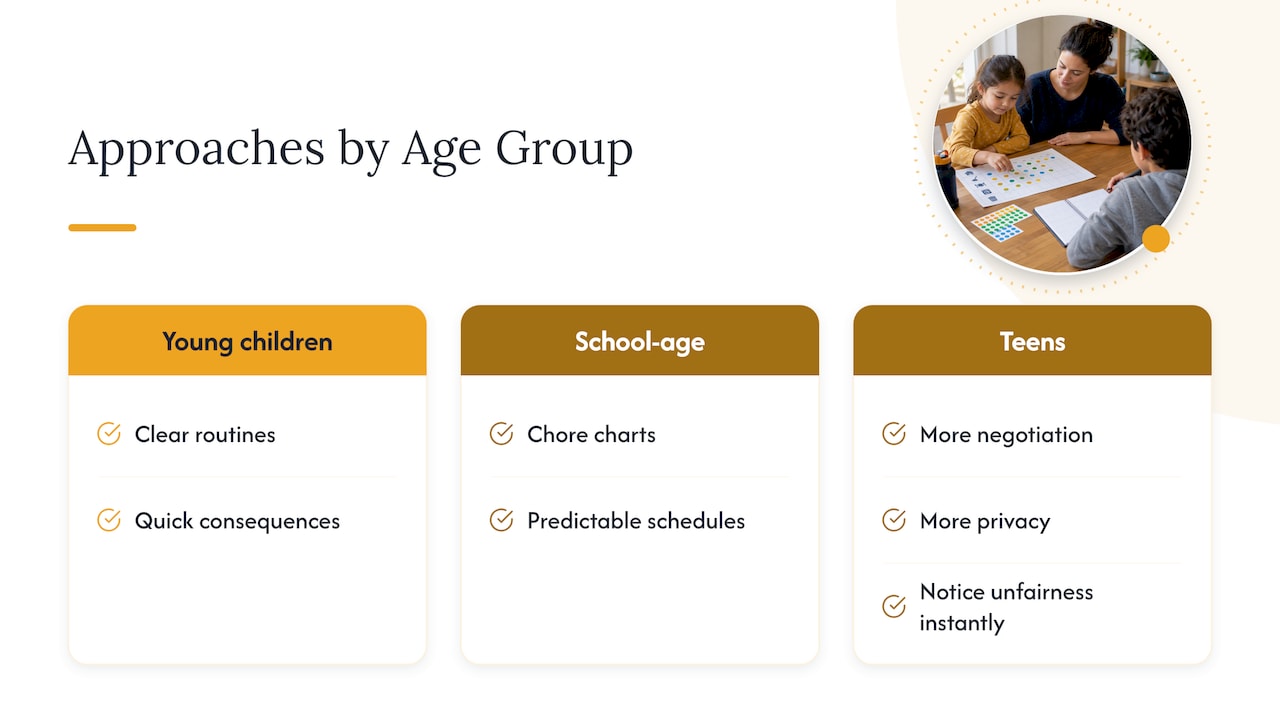
Young children need clear routines and quick, simple consequences. School-age children respond well to chore charts and predictable schedules. Teens need more negotiation and more privacy, and they notice unfairness instantly.
The ABA article points out that children between 10 and 14 may struggle to adjust, often need time to bond with a new stepparent, and benefit from a healthy outlet for honest feelings. For that age group, expect more testing, and keep the stepparent’s role supportive while the relationship develops.
A useful way to keep age differences from reading as favoritism: explain the reason, not just the rule. “Your sister goes to bed at 8:30 because she’s eight. When you were eight, you did too. Your bedtime is 10:00 because you’re fifteen.” Children accept differences more readily when the logic is visible and applies equally to everyone as they age.
Step 6: Handle two households
If any children move between homes, you will not control both sets of rules. You do not need to. Stephen Duncan’s guidance from Brigham Young University says children can manage differences between households as long as the adults are clear about expectations. He suggests letting children enjoy a kind of “dual citizenship,” each home with its own culture and traditions.
The same source offers practical rules for the adults:
- Deal directly with the parenting adults in the other household. Do not make children messengers or spies.
- Keep children out of the middle of disagreements.
- Do not speak negatively about the other household’s parents.
- Do not save special events only for when visiting children are present, because resident children may feel less loved.
Child Mind Institute adds that stepparents should avoid being the “fun house” when children visit, since it creates tension with the biological parent and makes transitions harder. It also recommends talking across households about discipline, privileges and rewards so children cannot play caregivers against each other.
You may not get full alignment, and that is fine. Aim for a few shared basics, like safety, respect and homework, and let the rest differ. A written coparenting communication plan keeps those conversations factual and calm. For a broader look at how families merge expectations, the overview of what makes blended families work is also helpful on children’s feelings and bonding during transitions.
Bonding with stepchildren while you enforce rules
Rules and relationship need to grow together. A stepparent who only enforces becomes the rule police. One who only tries to be liked loses credibility. The balance is slow, and it is meant to be.
What helps, according to the research:
- Require respect, not love. The UGA report advises insisting from day one on courtesy and respect for every family member, without demanding affection.
- Use words before touch. APA reports that boys and girls in stepfamilies prefer verbal affection such as praise or compliments over hugs and kisses, and that girls especially can be uncomfortable with physical affection from a stepfather.
- Find shared interests. The American Academy of Pediatrics suggests stepparents listen to and acknowledge feelings, find shared interests and invite the children to join.
- Protect the original parent-child bond. The American Academy of Child & Adolescent Psychiatry notes that strong blended families nurture original parent-child relationships while building new ones, and that full adjustment may take several years.
Plan one-on-one time between each parent and their own children, separate from family activities. It tells children they have not been replaced, and it takes pressure off the stepparent to fill every gap.
Favoritism: what it looks like and what to do
Favoritism is rarely deliberate. It shows up when your own child gets the benefit of the doubt and a stepchild gets the strict reading, or when discipline gets applied differently depending on whose child broke the rule.
AACAP lists warning signs that, if lasting, should prompt a conversation with a professional: a parent or stepparent openly favoring one of the children, discipline left only to the parent, a child venting anger at one family member or resenting a stepparent, frequent crying or withdrawal, and family members no longer enjoying usual activities.
To keep things even in everyday life:
- Apply the same consequence to the same behavior, whoever the child is.
- Ask your partner once a month: “Where have I been softer on mine than on yours?” Then listen.
- Split treats, outings and attention deliberately, and notice who is left out.
- When a child says “it’s not fair,” hear the feeling first, then explain the reason.
If you find yourselves arguing over whose child is treated worse, that is a sign to work on the couple’s communication, not to add more rules. Our guide to blended family boundaries, with scripts and a 30 to 90 day plan and our piece on parenting differences in marriage are written for that moment.
What to say when you disagree about a rule
When the adults disagree, the conversation matters more than the rule. A few sentences that keep it from becoming a fight:
- To your partner, in private: “I want us to be on the same page with the kids. Can we talk about the bedtime rule tonight after they’re asleep?”
- As the biological parent: “I know I’ve been letting this slide. I’ll handle it, and I want you to feel backed up.”
- As the stepparent: “I’m not trying to take over. I need to know what you want me to do when this happens.”
- To a child, after a conflict: “We’re not mad at you for having feelings. The rule stays, and we can talk about how it feels.”
Persistent trouble is a reason to bring in help. The American Academy of Pediatrics says ongoing negative feelings or bonding problems warrant help from a counselor for the stepparent, ideally the other parent, and the stepchild.
Our perspective
Couples come to us asking for a list of rules. What they need first is a way to talk about rules without it becoming a fight about loyalty.
In blended families, every rule carries a hidden question: whose family does this house belong to? When the adults have not answered it together, children feel the gap and step into it. That is why we teach the same skills to blended couples that we teach to every couple: slowing down, regulating your emotions, saying what you need without blame, and making decisions as a team. The F.I.G.H.T. Plan® was built by licensed mental health professionals to give couples exactly that structure.
Rules written on a page will not hold if the couple cannot disagree safely. Start there, and the rest becomes much easier.
Carlos
Get the structure and the scripts
If you want a guided way to build those agreements with your partner, our workbook The F.I.G.H.T. Plan: A Revolutionary Couples’ Communication and Conflict Resolution Workbook is priced from $14.99 to $25.00, and the F.I.G.H.T. Plan Couples Conflict Toolkit is $27.00. For a full video program on communication and conflict, Stop the Fighting: The Couples Communication & Conflict Resolution Course is $149.00. Couples who want personal guidance can choose online couples coaching, including a VIP private coaching package of four sessions at $997.00.

Faith is part of how many blended families make decisions. The Christian F.I.G.H.T. Plan Workbook offers a faith-centered guide to conflict resolution for couples, at $9.99 to $20.00.
FAQ
What are the basic house rules for a blended family?
Start with a short list that applies to everyone: respectful language, chores, screens, bedtimes, meals and personal space. The American Psychological Association suggests examples like respecting every family member and cleaning up after yourself. Add rules only when a real problem calls for them.
Should a stepparent discipline stepchildren?
Not at first. Research summarized by the University of Georgia finds that families do best when the biological parent remains the disciplining authority while the stepparent monitors and helps enforce agreed rules. Over time, as trust grows, the couple can expand the stepparent’s role together.
How often should we hold blended family meetings?
The ABA recommends regular meetings, and a weekly or biweekly twenty-to-thirty-minute slot is a realistic rhythm for most households. Keep the same time and format so children know what to expect, and open with something positive before taking up any problems.
How do we handle different rules at the other parent’s house?
Be clear about your expectations at home, and let children adapt to differences between households. Talk directly with the other parent, not through the children, and avoid criticizing their home in front of the kids. Aim for a few shared basics rather than identical rules.
How long does it take for a blended family to adjust?
AACAP notes that it may take several years for a blended family to fully adjust. Early progress usually looks like less tension at transitions, more willingness to follow routines and small moments of connection, not instant closeness.
Sources
- Stepparenting Begins with Common Ground, CAES Field Report (University of Georgia)
- Making stepfamilies work, American Psychological Association
- Parenting in Blended Families, American Bar Association
- Tips for Blended Families, Child Mind Institute
- Working Successfully Across Households, BYU ScholarsArchive
- I am getting remarried. What is the best way to blend our families? HealthyChildren.org
- Stepfamily Problems, AACAP
Recommended
- Blended Family Conflict: Why It Happens and How to Fix It
- Therapist Scripts and a 30–90 Day Plan for Blended Family Boundaries
- Stepparents: 7 Dos and Therapist Scripts to Stop Discipline Fights
- Resolve Parenting Differences in Marriage With Research Backed Scripts