
Trust Rebuilding Exercises for Couples: 7 Practices to Start

Trust comes back through repeated, small, observable actions, not through one big gesture or one long talk. The exercises below are built on that idea: a weekly check-in, a listening drill, a structured repair conversation, kept promises, daily rituals, a calm-time rule for hard topics, and shared activities. Each one is simple enough to start this week, and each one works best when you do it on a schedule and not only after a fight. If the damage comes from an affair, a hidden financial decision or a long pattern of broken promises, the same exercises apply, with extra attention to accountability and safety, covered below.
TL;DR
- Trust is rebuilt by consistent actions over time. Pick two or three exercises and repeat them weekly instead of trying all seven at once.
- The core set: a weekly check-in, a speaker-listener drill, a structured repair conversation, and promises you keep and track.
- After betrayal, the partner who broke trust acknowledges the harm first, and both partners follow a set conversation plan with a specific time and place.
- Programs with moderate dosage (9 to 20 contact hours) show stronger effects than short ones, so choose a workbook or course you will finish and revisit.
- Our F.I.G.H.T. Plan® workbooks and courses turn these exercises into a step-by-step routine, starting at $9.99.
Table of Contents
- What trust rebuilding actually looks like
- Exercise 1: The weekly check-in
- Exercise 2: The speaker-listener drill
- Exercise 3: The repair conversation after a breach
- Exercise 4: Promises made small, kept, and tracked
- Exercise 5: Daily rituals of connection
- Exercise 6: A calm-time rule for hard topics
- Exercise 7: Shared activities that rebuild safety and play
- A sample week that puts it together
- What to avoid while rebuilding trust
- How to choose a trust workbook or course
- Where our programs fit
- Start with the tools built for your situation
- Our perspective
- FAQ
- Sources
What trust rebuilding actually looks like
Most couples searching for trust exercises are not looking for a party game. They want to stop feeling on guard. One partner may be checking a phone, replaying an old conversation or bracing for the next disappointment. The other may feel watched, blamed and unable to do anything right.
Trust, in plain terms, is each partner’s expectation that the other will act in the relationship’s best interest. That is how the counseling center at Weber State University describes trust as a core component of a healthy relationship. Read that way, rebuilding trust has a clear job: give both people repeated evidence that the other is acting in the relationship’s interest, and give both people a safe way to say when that evidence is missing.
That is why the exercises below share three features:
- They are specific. “Communicate more” is not an exercise. “Sit down Sunday at 7 p.m. and answer three questions” is.
- They are repeatable. Trust grows from patterns, so a practice you do once feels good and changes little.
- They protect both people. The partner who was hurt gets honesty and room to feel. The partner who caused the hurt gets a clear path to show change, not an endless trial.
Trust trouble also is not limited to affairs. Hidden spending, broken promises about time, a partner who shuts down during conflict and old wounds from past relationships all wear it down. If money is the break, our guide to financial infidelity recovery walks through that specific situation.
Exercise 1: The weekly check-in
The simplest trust practice is also the one most couples skip. Weber State’s counseling center advises couples to check in periodically to clarify goals and expectations. A weekly check-in puts that advice on the calendar.
How to do it (20 to 30 minutes):
- Pick a fixed time when neither of you is hungry, tired or distracted. Phones go in another room.
- Each partner answers the same three questions: What went well between us this week? What was hard or left me feeling unsure? What is one thing I need from you next week?
- Each partner speaks without being interrupted. The other writes down the request and repeats it back.
- End with one thing you appreciated about the other person. Name the specific action, not a general compliment.
Where it goes wrong: the check-in turns into a grievance session, or it gets postponed whenever things feel tense, which is exactly when it matters. If a topic is too heated, write it down and move it to the repair conversation in Exercise 3 instead of fighting through it.
For more structured prompts you can use tonight, see our six therapist-backed communication exercises.
Exercise 2: The speaker-listener drill
Many trust breaks are made worse because neither person feels heard. This drill slows the conversation down so each partner can be sure their words landed.
A 2021 chapter on Mentalization-Based Couple Therapy from University College London recommends a curious, respectful, inquisitive stance and listening without intervening, with the aim of understanding each partner’s perspective. Mentalization simply means paying attention to what is going on in your own mind and your partner’s. The drill turns that stance into steps:
- The speaker shares for two to three minutes using “I” statements: “I felt worried when you didn’t call,” not “You never think about me.”
- The listener says nothing except to reflect back: “What I’m hearing is that you felt worried and alone. Did I get it?”
- The speaker confirms or corrects. The listener tries again until the speaker says, “Yes, that’s it.”
- The listener asks one curious question: “Is there more?” or “What was that like for you?”
- Switch roles.
Where it goes wrong: the listener starts defending, explaining or correcting facts. Understanding is not agreement. Your job as listener is to be able to say what your partner experienced, not to prove it was wrong. You can answer in your own turn.
The same skill underlies how couples calm a conflict before it grows. Our guide on how to defuse conflict with your partner shows how it works in the moment.
Exercise 3: The repair conversation after a breach
When trust has been broken by an affair, a lie or a serious betrayal, a casual talk does not carry enough weight. A structured conversation does. Utah State University Extension’s Stronger Marriage blog (February 2024) says healing from betrayal requires the betraying partner to acknowledge both the betrayal and the harm it caused. It then lays out an eight-step conversation blueprint drawn from Gottman’s work. In plain language, the steps are:
- Set a specific time and place. Choose somewhere private where you will not be interrupted, and agree on a start and an end.
- Name your feelings without blame. Say what you feel (hurt, afraid, ashamed), not what the other person is.
- Listen without comment. While your partner talks, you do not rebut, correct or sigh.
- Each partner describes their perspective. The hurt partner shares the impact. The other shares what was going on for them, without using it as an excuse.
- Discuss deeper feelings triggered from past experiences. Old wounds, such as a parent’s betrayal or an earlier relationship, often explain why this hurt so much.
- Each takes responsibility for their part. The partner who broke trust owns the breach fully. Both can own their contribution to the distance that came before, without shifting blame for the betrayal itself.
- Each apologizes and accepts the apology. A real apology names what was done and its effect on the other person.
- Make a plan to prevent recurrence. Write down the concrete changes: boundaries, transparency, check-in times and what happens if either of you slips.
Expect to repeat this conversation more than once. Early rounds are often mostly steps 2 to 4. That is normal, and rushing to steps 7 and 8 before the hurt partner feels heard tends to produce an apology that does not stick.
Where it goes wrong: the betraying partner asks for forgiveness on a timeline, or the hurt partner uses each session to re-argue every detail. Both patterns stall the repair. If you are working through infidelity specifically, our pages on forgiveness after infidelity and intimacy after infidelity cover what comes next.
Exercise 4: Promises made small, kept, and tracked
Trust is a record. After a breach, the hurt partner is quietly asking one question: when this person says something, does it happen? You answer it with a practice anyone can do:
- Each partner makes one or two small, specific commitments per week. “I will text you when I leave work” counts. “I will be better” does not.
- Write them where both can see them: a shared note or a page in your workbook.
- At the weekly check-in, review each one. Kept, missed or changed? If missed, the person says so first, without being asked, and says what got in the way.
The point is not surveillance. It is building a short, honest history. Early on, a promise kept late is better than a promise broken silently, because the first still shows you will tell the truth about it.
For the partner who caused the hurt: offering information before you are asked is one of the clearest signs of change. Answering questions honestly, again and without irritation, is part of the work, and it gets lighter as the weeks go by.
For the hurt partner: you are allowed to ask for what you need to feel safe, and it helps to ask for specific things, such as a call at a set time, rather than constant proof. Ask yourself weekly whether the commitments are being met and what would make the next week feel a little safer.
Exercise 5: Daily rituals of connection
Trust is not built only in hard conversations. It is built in the five minutes after work, the goodbye in the morning and the way you greet each other. Small rituals give both people reliable moments of warmth, which is especially valuable when the relationship feels fragile.
Try one or two:
- A six-second kiss or a real hug at greeting and goodbye, fully present, with eyes open.
- A daily “high and low” over dinner: one good moment and one hard moment from your day. No fixing, just listening.
- A short message midday that is not about logistics.
- A bedtime check: “Is there anything between us tonight?” If yes, name it in one sentence and schedule the full talk.
Pick rituals you can keep. A ritual you do every day for a month builds more confidence than an elaborate one you drop after a week.
Exercise 6: A calm-time rule for hard topics
One of the fastest ways to damage trust again is to raise the biggest issue at the worst moment: late at night, in front of the kids, or in the middle of an argument about something else. Weber State’s counseling center recommends agreeing on times to discuss conflict only when both partners are calm and fighting fairly by avoiding blaming, name-calling and defensiveness.
Turn that into an agreement:
- Choose a pause word. Either of you can say it when you are flooded. It means “I want to continue, and I need 20 minutes.”
- Take the break and come back. The person who asked for the pause is responsible for restarting the conversation, which keeps a pause from becoming avoidance.
- Use the parking lot. Topics that are not for tonight go on a shared list and are covered at the next check-in.
- Ban three things: name-calling, bringing up unrelated old fights and walking out without saying when you will return.
This agreement is a trust exercise in itself, because it tells both people that hard topics will be handled and not ambushed. If you often end up disagreeing without a resolution, our guide on how to agree to disagree respectfully gives you language for that.
Exercise 7: Shared activities that rebuild safety and play
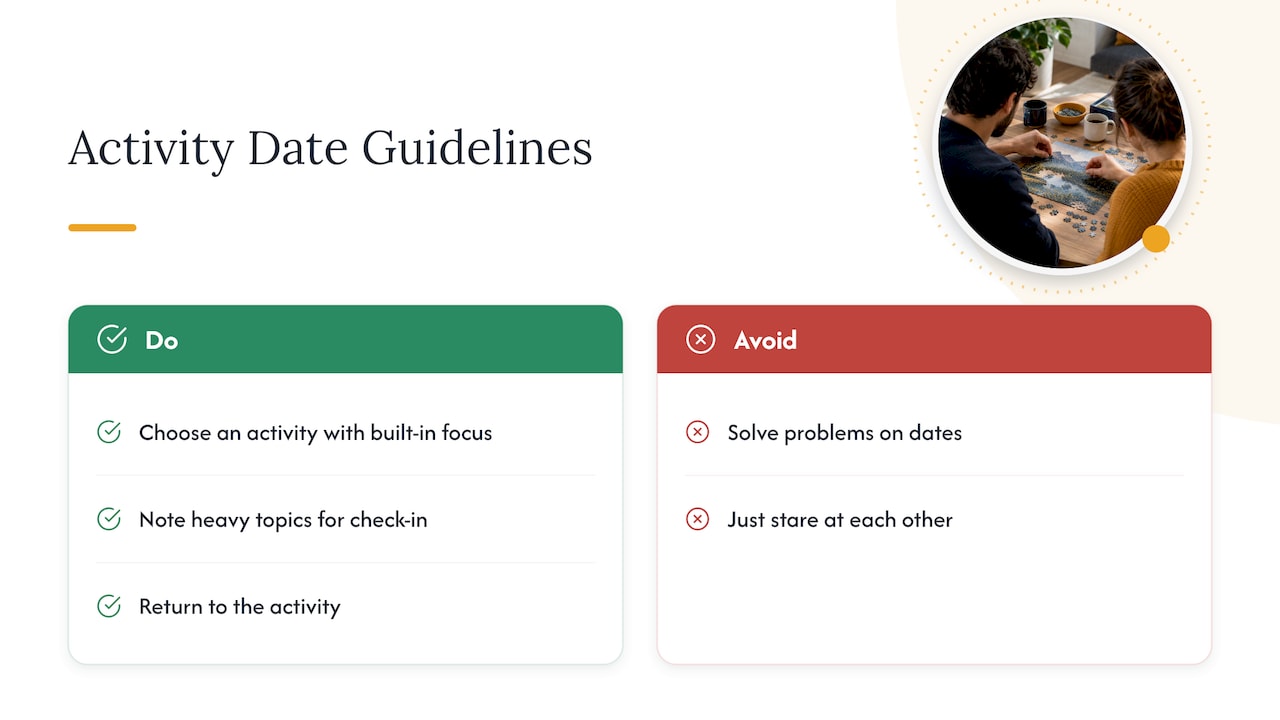
Couples in a trust crisis often stop doing anything fun together because every shared moment feels loaded. Adding back low-pressure activities helps the relationship feel like more than a repair project. Choose something with a built-in focus so you are not just staring at each other: cooking a new recipe, walking the same route each weekend, or a creative project together. Some couples like couples art date activities because the task gives you something to do with your hands while you talk.

The rule is simple: no problem-solving on these dates. If something heavy comes up, note it for the check-in and return to the activity. Over time, these hours give you new, positive memories to stand beside the painful ones.
A sample week that puts it together
You do not need to run every exercise at once. This is a realistic starting rhythm:
| Day | Practice | Time |
|---|---|---|
| Daily | Greeting and goodbye ritual, high and low at dinner | 10 minutes |
| Daily | Keep or report on your small commitments | 5 minutes |
| Sunday | Weekly check-in (Exercise 1) | 30 minutes |
| Midweek | Speaker-listener drill on one small topic (Exercise 2) | 20 minutes |
| As needed | Repair conversation on a bigger issue (Exercise 3) | 45 to 60 minutes |
| Weekend | Shared activity, no problem-solving (Exercise 7) | 1 to 2 hours |
Start with the daily rituals and the weekly check-in for the first two weeks. Add the drill in week three. Bring in the repair conversation when both of you feel steady enough, not before.
What to avoid while rebuilding trust
- Trust falls and games that skip the real issue. A physical trust exercise can be fun, but it does not answer whether your partner will be honest about their day.
- Using exercises as a weapon. The check-in is not the place to read a prosecutor’s list.
- Demanding a deadline. There is no set time by which trust “should” be back. Aim for steady evidence, week after week.
- Doing the work alone. Both partners take part. One person doing all the exercises while the other watches does not rebuild a shared trust.
- Ignoring safety. If you feel afraid of your partner, or there is physical violence, threats or control, a trust exercise is not the right tool. Contact the National Domestic Violence Hotline or local emergency services first.
How to choose a trust workbook or course
Workbooks and courses are useful because they hold the structure for you: the prompts, the order and the scripts. When you compare options, here is what the research suggests matters.
Enough hours to practice. A 2011 meta-analysis by Hawkins, Stanley, Blanchard and Albright, which coded 148 evaluation reports, found that moderate-dosage programs of 9 to 20 contact hours were associated with stronger effects than low-dosage programs of 1 to 8 hours. A single-evening seminar has its place, but a program you work through over several weeks gives you time to repeat the skills.
A focus on communication skills. The same meta-analysis found that a communication-skills emphasis was associated with stronger effects on couple communication outcomes. Look for scripts, practice exercises and guided reflection, not only reading.
The right level of support for your situation. A 2016 review hosted by Utah State University Extension notes that Halford and Bodenmann (2013) recommend a stepped approach: couples with less need might read books or watch videos, while those with more need attend training courses. The same review reports that skills-training courses produced effect sizes of d = .24 to .36 for marital quality and d = .36 to .54 for communication in an earlier meta-analysis of 117 studies. In practice:
| Where you are | A good fit |
|---|---|
| You mainly want better habits and fewer repeated arguments | A workbook you complete together |
| You want guided teaching, examples and a longer program | A video course |
| The break is serious or you feel stuck | Coaching or an intensive with a professional guiding you |
Fit with your values and situation. Premarital couples, couples healing after an affair, blended families and faith-centered couples face different problems. A workbook written for your situation will use examples that sound like your life.
Where our programs fit
We built these exercises into tools you can use at your own pace. Here is how the options match the situations above, with prices as published on our site:
- Healing after an affair: the R.E.S.T.O.R.E Workbook, a guide to rebuilding trust and love after an affair, is $9.99 to $20.
- Conflict that keeps repeating: The F.I.G.H.T. Plan workbook is $14.99 to $25, and the F.I.G.H.T. Plan Couples Conflict Toolkit is $27.
- Faith-centered couples: The Christian F.I.G.H.T. Plan Workbook is $9.99 to $20.
- Engaged couples: the F.O.R.E.V.E.R. Workbook, a premarital guide, is $9.99 to $20.
- Guided teaching: Stop the Fighting, our couples communication and conflict resolution course, is $149. The Love & Trauma Course and the Fight Less Love Again Video Course are each $47.
- One-on-one support: the VIP Private Coaching package of four sessions is $997, and the 6 Hours Couples Intensive is $1995.
If you want to see where you stand first, our quiz on healing and repair after conflict and the one on ground rules for a safe space to communicate point to the skills to start with. For what to expect from professional help after betrayal, read about the benefits of couples therapy after betrayal.
Start with the tools built for your situation
If you are ready to turn these exercises into a routine, our therapist-created workbooks and courses give you the prompts, scripts and sequence, so you spend your energy on each other and not on planning. Browse the workbooks and courses in our shop or look at online couples coaching if you want guidance alongside you.

Our perspective
We founded Couples Fight School as licensed mental health professionals, and the pattern we care about most is this: couples rarely lose trust in one moment, and they never get it back in one moment either. What brings it back is a structure both people can lean on when emotions run high.
That is why the F.I.G.H.T. Plan® is a step-by-step system and not a collection of tips. Our tools are built around communication, emotional regulation and healing, so a couple always knows what to do next: how to start a hard conversation, how to stay in it, and how to repair it afterward. The partner who was hurt gets a process that takes the pain seriously. The partner who hurt them gets a clear way to show change.
We also know that every couple’s starting point differs. A newly engaged couple needs different tools than a couple recovering from an affair, and a faith-centered marriage may want to ground the work in shared beliefs. That is why we offer workbooks, courses, coaching and intensives for each of those situations.
If you take one thing from this article, let it be this: choose two or three exercises, put them on the calendar and keep the appointments. Consistency is the proof that trust can return.
Carlos
FAQ
What are the 7 steps to rebuild trust?
There is no single official list, but a workable sequence is: acknowledge the harm, listen fully, take responsibility, apologize specifically, agree on changes, keep small promises and review progress weekly. The eight-step conversation in Exercise 3 covers the first part of that sequence, and Exercises 1 and 4 cover the rest.
How long does it take to rebuild trust?
It depends on what broke it, how consistently both partners do the work and whether the behavior has stopped. Expect weeks before the first signs of relief and often months or longer for deeper wounds such as an affair. Measure progress by whether your partner’s actions match their words week after week, not by a deadline.
Can we rebuild trust without a therapist?
Many couples start with a structured workbook or course and practice the exercises together, in line with the stepped approach of starting with lighter support and adding more as needed. If the breach is severe, the conversations keep turning into fights, or you feel unsafe, add guided support such as coaching with us. In any case involving abuse or fear, contact a domestic violence hotline or emergency services first.
What is the best exercise to start with?
The weekly check-in. It takes about 30 minutes, needs no preparation and gives you a regular, safe place for everything else on this list. Add the speaker-listener drill once the check-in feels comfortable.
Sources
- Healthy Relationships, Weber State University Counseling Center
- Mentalization-Based Couple Therapy, University College London
- How Can a Couple Recover from Betrayal?, Utah State University Extension
- Exploring Programmatic Moderators of the Effectiveness of Marriage and Relationship Education Programs, PMC
- Relationship Help-Seeking: A Review of the Efficacy and Effectiveness of Interventions, Utah State University Extension
- Couples art activities
Recommended
- Six Therapist Backed Communication Exercises Couples Can Do Tonight
- Grounding Techniques for Couples: 10 Exercises to Reset Together
- Intimacy After Infidelity: How to Rebuild It, Step by Step
- Intimacy Building Activities for Couples That Actually Work