
$200–$10,000: What U.S. Couples Workshop Costs Actually Buy

In the United States, couples workshops and retreats run from community weekend events at low hundreds of dollars to private destination intensives costing several thousand dollars, with many couples choosing options in the mid-price range. A 2026 psychology manuscript found that coach-supported programs widen access at lower cost, and some providers offer structured intensives in that middle range.
TL;DR:
- Midrange couples workshops, costing between $600 and $3,500, include licensed facilitators and some private coaching, making them suitable for addressing recurring conflicts.
- The main cost determinant is the amount of direct contact time with a licensed coach or therapist, not the venue, with private sessions typically costing more per couple.
- Private retreats and week-long destination intensives can exceed $3,500, best suited for high-stakes issues like infidelity or long-standing gridlock, with deposits often nonrefundable.
- Online or hybrid workshops costing $150 to $800 provide accessible, lower-cost options for skill-building or maintenance, especially when in-person options are limited by budget or scheduling.
- Transparent providers that clarify what costs are included and ensure confidential, credentialed facilitation generally offer better value and safety in selecting a program.
Table of Contents
- Typical price ranges for couples workshops and retreats
- What the price actually buys you
- Comparing costs across workshop and retreat formats
- How to choose the right workshop for your budget and needs
- What the research says about cost, access, and outcomes
- When paying more actually makes sense
- Where Couples Fight School fits in your budget
- FAQ
- Sources
Typical price ranges for couples workshops and retreats
Price mostly tracks three things: who leads the session, how long it runs, and whether lodging is included. Community weekend conferences and online workshops sit at the entry level, usually between $200 and $600 per couple. These events often take place in a hotel conference room or over video and focus on a single skill set, like communication or conflict de-escalation, without one-on-one coaching time.
Midrange options, typically $600 to $3,500, include credentialed two-day workshops led by licensed therapists or trained coaches, plus shorter private intensives that run a few hours to a full day. A 2026 psychology manuscript notes that this tier is where therapist involvement starts to show up consistently, which matters for couples working through recurring conflict rather than general skill-building.
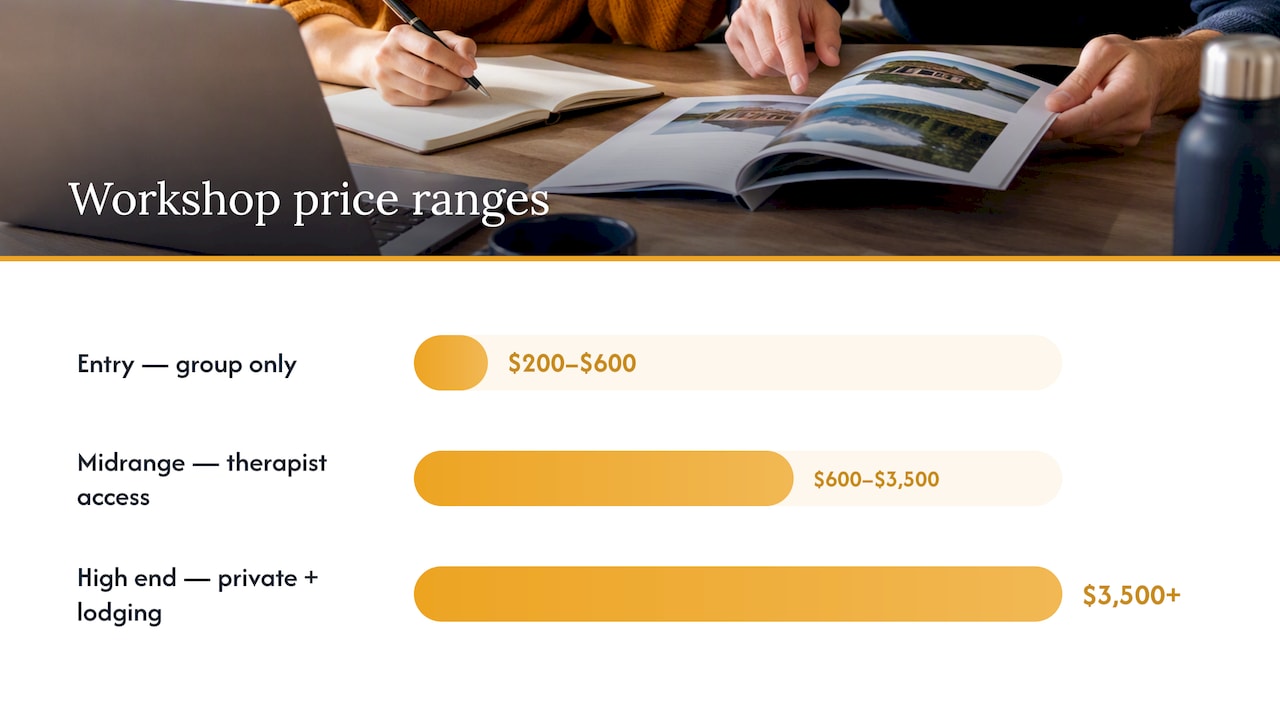
At the high end, private intensives with a dedicated therapist and week-long destination retreats can run from $3,500 into five figures. These programs usually combine extended one-on-one time with lodging, meals, and sometimes follow-up sessions after the couple returns home.
What each band typically includes:
- Entry level: workbook or handout materials, group instruction, little to no individual coaching time.
- Midrange: licensed facilitator access, structured curriculum, some small-group or private coaching blocks.
- High end: private therapist hours, on-site lodging and meals, and post-retreat check-ins built into the price.
What the price actually buys you
The biggest cost driver is not the venue. It is how much direct time a licensed therapist or trained coach spends with your specific couple, and how many other couples share that time.
- Contact hours and staff ratio: a program with one therapist for six couples costs less per couple than one offering private, one-on-one sessions throughout.
- Lodging and meals: multi-day retreats that include a hotel room and catered food carry that expense directly in the sticker price, while day workshops typically do not.
- Materials and assessments: workbooks, relationship assessments, and printed guides are usually bundled into registration rather than billed separately.
- Follow-up coaching: some providers include a check-in call or two after the event; others sell this as an add-on.
- Travel, childcare, and fees: flights, hotel nights beyond the program, childcare at home, and processing fees are rarely in the quoted price and can add several hundred dollars.
Pro Tip: Ask for an itemized breakdown before booking. A provider that can tell you exactly what’s included (and what isn’t) is usually more transparent about quality, too.
Comparing costs across workshop and retreat formats
Format changes the math as much as the headline price does. A weekend conference and a private intensive solve different problems at different price points.
- Weekend conference ($200 to $600): large-group setting, good for couples wanting a refresher or early-stage skill building; low deposit, often bookable a few weeks out.
- Two-day credentialed workshop ($600 to $1,500): smaller groups, licensed facilitator, suited to couples with specific recurring conflict patterns; typically requires a deposit and a few months’ lead time for popular dates.
- Private intensive, half or full day ($1,000 to $3,000): one-on-one therapist time, ideal for couples past general advice who need focused attention on a specific issue.
- Week-long destination retreat ($3,500 to $10,000+): lodging and meals included, best for couples facing significant breaches like infidelity or long-standing gridlock; requires substantial lead time and nonrefundable deposits are common.
- Online hybrid workshop ($150 to $800): coached or self-guided, works well as a lower-cost complement to or substitute for in-person sessions when travel or budget is the barrier.
Workshops and intensives are not always a substitute for weekly therapy. They tend to work best as a concentrated reset, either before starting therapy, between therapy phases, or as maintenance once weekly sessions have ended. Booking flexibility also varies: destination retreats often carry strict cancellation windows and nonrefundable deposits, while online and local workshops usually allow more lenient rescheduling.
How to choose the right workshop for your budget and needs
Price alone is a poor filter. The questions below tell you more about whether a program will actually help.
| What to check | Why it matters |
|---|---|
| Facilitator credentials | Licensed therapists bring clinical training that unlicensed coaches may not have |
| Staff-to-couple ratio | Lower ratios mean more individual attention for your situation |
| Agenda transparency | A published agenda signals a structured program, not improvisation |
| Follow-up support | Check-ins after the event support longer-term maintenance of gains |
| Refund and cancellation policy | Clear terms protect you if plans change |
Before booking, ask the provider directly:
- What exactly does the price include, and what costs extra?
- How many couples will be in the room, and what is the staff ratio?
- Is my information kept confidential, and how?
- What happens if we need to cancel or reschedule?
Red flags include vague agendas, prices quoted without a breakdown, and facilitators who cannot name a license or certification when asked. Providers such as Align Therapy Collective outline sliding-scale options and insurance practices directly on their services page, which is the kind of transparency worth looking for before you commit a deposit.
What the research says about cost, access, and outcomes
A 2026 psychology manuscript on couple interventions found that online and coach-supported brief interventions can be cost-effective and improve access for couples who might otherwise skip help entirely because of price, scheduling, or childcare barriers. The same literature synthesis found that unguided self-help programs show weaker maintenance of gains over time compared with therapist- or coach-supported formats, suggesting the human support built into a workshop’s price is not just overhead.
When cost, childcare, or scheduling are the main obstacles, a coach-supported online program is often a more realistic first step than skipping help altogether.
One approach built around this same principle is structured, skills-based support that does not require a weekly therapy commitment to start making progress.
When paying more actually makes sense
Higher investment is justified when the stakes are high: infidelity, rapidly escalating conflict, or a relationship at a genuine breaking point often benefits from a therapist-led private intensive or retreat with dedicated time and follow-up care. For skill-building, early-stage communication work, or maintenance after therapy, a lower-cost workshop or coach-supported online program tends to deliver comparable value, consistent with research on access and outcomes.
— Carlos
Where Couples Fight School fits in your budget
If a full retreat feels like more than you need right now, start smaller. The Fight Less Love Again Video Course and related programs give you a structured, therapist-created curriculum for a fraction of a weekend workshop’s price.
- Video courses suit couples who want a self-paced, low-cost starting point before committing to anything bigger.
- The 4-Hour Couples Intensive fits couples who want focused, guided time without a multi-day commitment.
- Online Couples Coaching works for couples who want ongoing support between or instead of in-person sessions.
Book a session or browse the full catalog at Couplesfightschool to find the format that matches your budget and your next step.
This article is general information, not a substitute for advice from a qualified doctor. Consult a qualified healthcare professional about your own circumstances before acting on anything here.
FAQ
How much does couples therapy cost in the US?
Traditional weekly couples therapy is billed per session rather than as a flat workshop fee, and rates vary by therapist, location, and whether insurance applies. Providers like Align Therapy Collective list sliding-scale pricing directly on their services page, which is a useful reference point when comparing weekly therapy to a one-time workshop.
What is the 5-5-5 rule for couples therapy?
Definitions of the “5-5-5 rule” vary across relationship resources, and there is no single clinical standard behind the term. If you encounter it, treat it as one informal communication exercise rather than an established therapeutic framework.
How much does a marriage helper workshop cost?
Pricing for named marriage workshop programs is set by each individual provider and published on their own booking pages, so it is best confirmed directly with that provider. In general, two-day credentialed workshops in the United States tend to fall in the $600 to $1,500 range.
How much do couples retreats cost?
Multi-day couples retreats in the United States typically range from $3,500 to $10,000 or more per couple, depending on whether lodging, meals, and private therapist time are included. Shorter formats, like a half-day or full-day private intensive, usually cost less, often between $1,000 and $3,000.
Are there affordable payment options for couples workshops?
Many providers offer payment plans or sliding-scale fees to make workshops more accessible, though insurance rarely covers non-clinical workshops or retreats. Self-paced online courses, such as structured communication courses, are typically the lowest-cost entry point.
Recommended
- Benefits of Couples Communication Workshops: 2026 Guide
- Create a Shared Vision for Marriage: A Practical Guide
- Free Online Marriage Counseling: What to Try First